

Key Takeaways
-
Dark web credential monitoring collects credential data from marketplaces, paste sites, Telegram channels, and infostealer logs, then matches it against an organization’s domains and identities to generate alerts.
-
Most monitoring relies on dataset matching rather than live surveillance, so a clean result only confirms the credential has not appeared in the monitored corpus.
-
A match proves exposure and requires correlation with internal authentication records before action; strong entity resolution reduces false positives.
-
Infostealer-log credentials demand the fastest response because they are current, often paired with session cookies, and can bypass multi-factor authentication (MFA). Session tokens and application programming interface (API) keys also require rapid action.
-
Cyble closes both the exposure-to-awareness gap and the awareness-to-action gap with artificial intelligence (AI)-native collection and native managed takedown, as detailed below.
See what Cyble finds in your environment
How Dark Web Credential Monitoring Works In Practice
Dark web credential monitoring runs in three clear stages. Reputable credential monitoring platforms generally hash monitored identifiers before matching them against collected dark web data, so plaintext credentials stay inside the customer’s environment. Have I Been Pwned (HIBP) Pwned Passwords uses k-anonymity for the same reason, so the server never receives the full password.
-
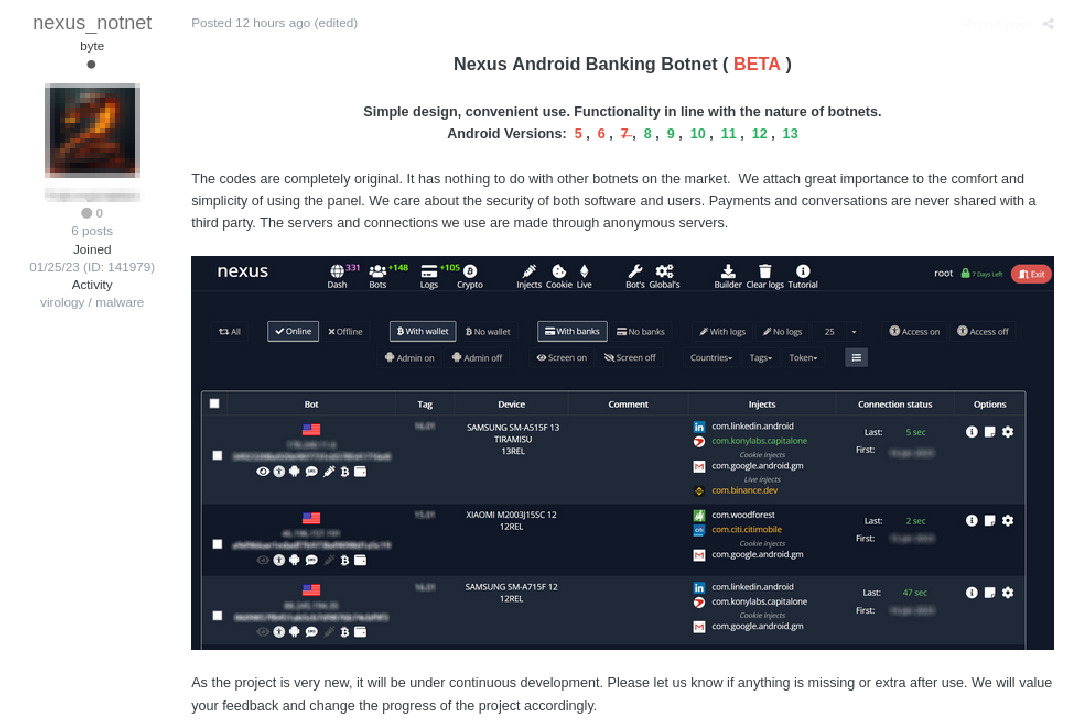
Collection. Data is gathered from dark web marketplaces, paste sites, Telegram channels, and infostealer logs. Providers with AI-native collection layers make source-prioritization decisions at ingestion. Providers without that capability rely on rule-based crawlers that miss gated communities and ephemeral channels.
-
Matching. Collected credentials are resolved against the organization’s domains, subsidiaries, executives, and technology stack. Entity resolution determines whether an obfuscated or cross-language reference, such as a misspelled brand name in a Russian-language post, actually refers to the monitored organization.
-
Alerting. Matched findings are scored for severity and delivered into the tools the team already uses, including security information and event management (SIEM) platforms, security orchestration, automation and response (SOAR) tools, and ticketing systems.
What Dark Web Credential Monitoring Actually Detects
Understanding how monitoring works makes it easier to see where it stops working. The gap between vendor marketing and operational reality is widest here, and four limitations define the category honestly.
Dataset matching instead of continuous surveillance. No provider has live visibility into every closed forum simultaneously. Collection depends on which sources a provider has acquired access to, how frequently those sources are ingested, and whether the provider can reach invite-only communities at all. A clean result means the credential has not appeared in the monitored corpus and says nothing about sources that provider cannot see.
A match signals exposure, not confirmed compromise. A credential appearing in a dump does not confirm the account has been accessed. NHI Mgmt Group’s August 2026 guidance states this directly: dark web monitoring proves exposure, and alerts require correlation with internal authentication records before action.
False positives are structural. Criminal forums carry recycled breach data, repackaged dumps, and misleading datasets. Traditional regular expression (regex) and static keyword scraping generates an 80% to 90% false-positive rate for threat intelligence teams. Entity resolution quality, the ability to distinguish a mention of your organization from a similarly named entity, largely determines whether alerts are trustworthy.
Coverage gaps remain. A provider that relies only on open crawling cannot reach gated underground communities where the highest-value access is negotiated. Gated underground communities sit outside the reach of open automated crawling alone, which is why Cyble uses proprietary gated dark web ingestion and human intelligence (HUMINT) alongside automated collection.
Credential Classes And How They Shape Response
Coverage gaps and false positives affect what you detect, but the urgency of response depends on what kind of credential was exposed. Response urgency differs materially by credential class. MITRE ATT&CK maps credential-access techniques under tactic TA0006, primarily T1555 (Credentials from Password Stores) and sub-technique T1555.003 (Credentials from Web Browsers), with related techniques including T1056 (Input Capture) and T1557 (session or token interception).
The table below shows how response urgency varies by credential class, so teams can prioritize the exposures that matter most.
|
Credential Class |
Source |
Typical Age |
Response Urgency |
|---|---|---|---|
|
Breach-dump credentials |
Compromised server or application |
Often old, may already be rotated |
Lower, still relevant for credential stuffing, which replays stolen username and password pairs against other services at scale |
|
Infostealer-log credentials |
Infected endpoint, harvested from browser |
Typically current, paired with session cookies |
Highest, immediate access that often bypasses MFA |
|
Session tokens |
Infostealer log or adversary-in-the-middle (AiTM) phishing |
Live until expiry or revocation |
Urgent, authentication bypass even after password change |
|
API keys and secrets |
Code repositories, configuration files, infostealer logs |
Often long-lived |
Urgent, programmatic access that is often unmonitored |
The infostealer-log category warrants particular attention. Infostealer logs capture credentials directly from infected endpoints, and the volume of stolen credentials continues to grow. Credentials typically move from theft to underground listing within 48 hours, and ransomware affiliates have been observed weaponizing purchased access within 48 hours of an initial access broker (IAB) listing going live.
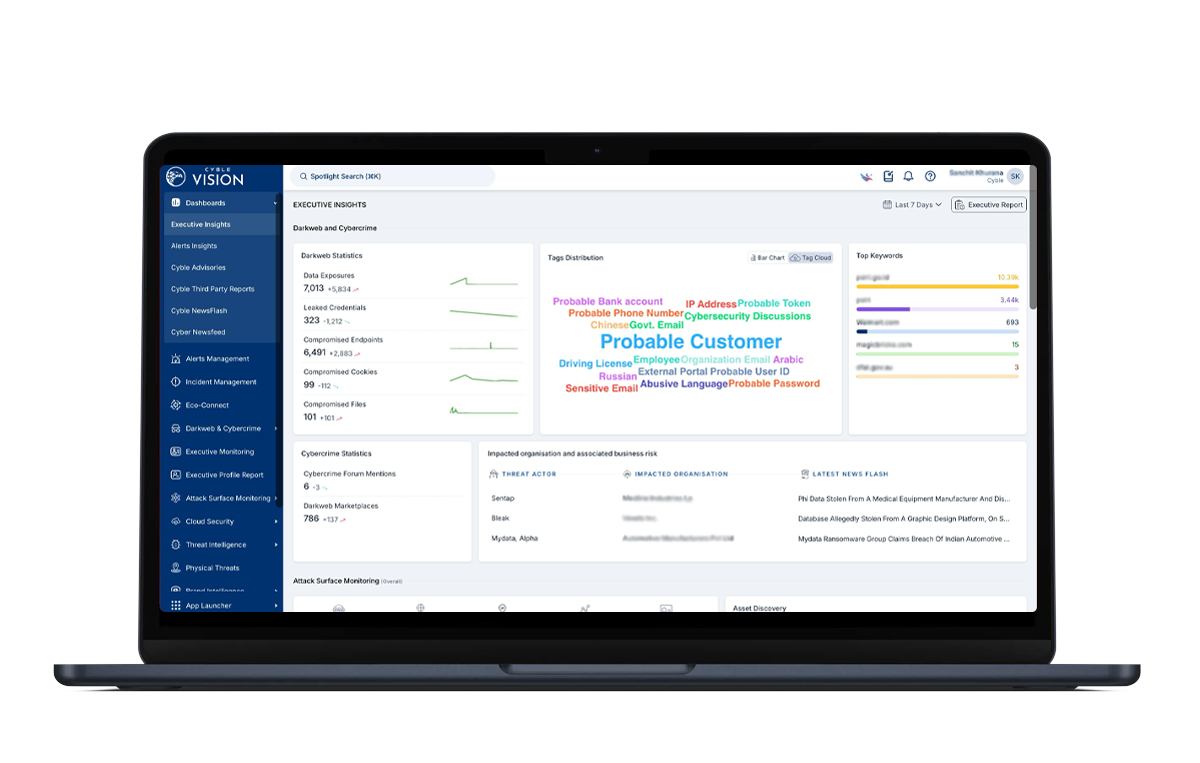
Session tokens form a distinct risk class from passwords. A session token is a bearer token the browser holds after authentication. Whoever presents a stolen one is treated as the authenticated user and lands inside a live session without triggering MFA. Changing a password does not invalidate an already-running session, so security teams must revoke those sessions separately.
API keys and secrets carry a different risk profile. They grant programmatic access, are often long-lived, and are frequently embedded in code repositories or configuration files where rotation is inconsistent. A single leaked infostealer dump can expose multiple still-valid API keys across major artificial intelligence (AI) providers, which makes prompt rotation and revocation essential.
Individual And Enterprise Coverage: Where Free Tools Stop
The value of paid monitoring depends on what the organization needs to catch. Free tools stop being sufficient at a predictable threshold: more than one domain, customer personally identifiable information (PII) or regulated data, executives or public-facing employees at phishing risk, or any need to integrate credential exposure data into SIEM or incident response workflows.
Free tools stop being adequate at that point. The specific gaps are:
-
Coverage is typically limited to breach-dump datasets that have been publicly disclosed and ingested, not infostealer logs, gated community listings, or Telegram channel drops.
-
There is no entity resolution across subsidiaries, executive aliases, or obfuscated brand references.
-
There is no response path, so the alert arrives and the organization must handle everything that follows.
Enterprise dark web credential monitoring fills those gaps. The capabilities that mark the shift to enterprise coverage include:
-
Continuous collection across surface, deep, and dark web sources, including infostealer log feeds and gated underground communities.
-
Entity resolution that maps obfuscated and cross-language references to the correct monitored organization.
-
Relevance scoring against a specific attack surface, including domains, subsidiaries, executives, and technology stack.
-
Enrichment that arrives with the alert rather than requiring an hour of manual pivoting.
-
A takedown path that converts detection into removal.
How To Evaluate A Dark Web Credential Monitoring Provider
Once an organization decides to move beyond free tools, the next question is how to choose a provider. These criteria apply regardless of which providers are under evaluation.
Coverage of infostealer logs and gated underground communities. A provider that monitors only breach dumps and public paste sites focuses on history. The sources where 2026’s fastest-growing threats circulate, such as infostealer log feeds, private Telegram channels, and invite-only forums, require active collection infrastructure. Ask for a named source list instead of accepting a claim of “comprehensive” coverage.
Entity resolution quality across languages and obfuscated spellings. When a threat actor posts about a target using a misspelled brand name or a transliterated reference in a non-Latin script, rule-based keyword matching fails. The quality of entity resolution determines whether alerts describe the monitored organization or unrelated noise.
Alert enrichment. An alert that arrives without context forces the analyst to spend the first hour pivoting before any decision can be made. The strongest providers enrich findings at ingestion, attaching source, harvest date, malware family where applicable, and affected accounts, so the alert is case-ready when it lands. That difference at ingestion, not at the dashboard, is the operational differentiator.
Integration into existing tools. An unintegrated alert is a ticket nobody owns. Providers should push intelligence into the SIEM, SOAR, and ticketing systems the team already uses. Cyble integrates with more than 70 integrations including Splunk, Microsoft Sentinel, IBM QRadar, Cortex XSOAR, and ServiceNow.
Whether takedown is native or referred to a third party. Removing an exposed credential requires action beyond detection. A provider that ends at the alert and hands the hard part back to the customer leaves the awareness-to-action gap open.
The Two Gaps That Define The Category And How Cyble Closes Them
External threat intelligence succeeds when it closes two specific gaps.
Gap one: exposure to awareness. This gap measures the time between a credential appearing in the wild and the team knowing. It is routinely measured in days or weeks. Discovery frequently comes from outside the organization, such as a journalist, a regulator, or a fraud spike.
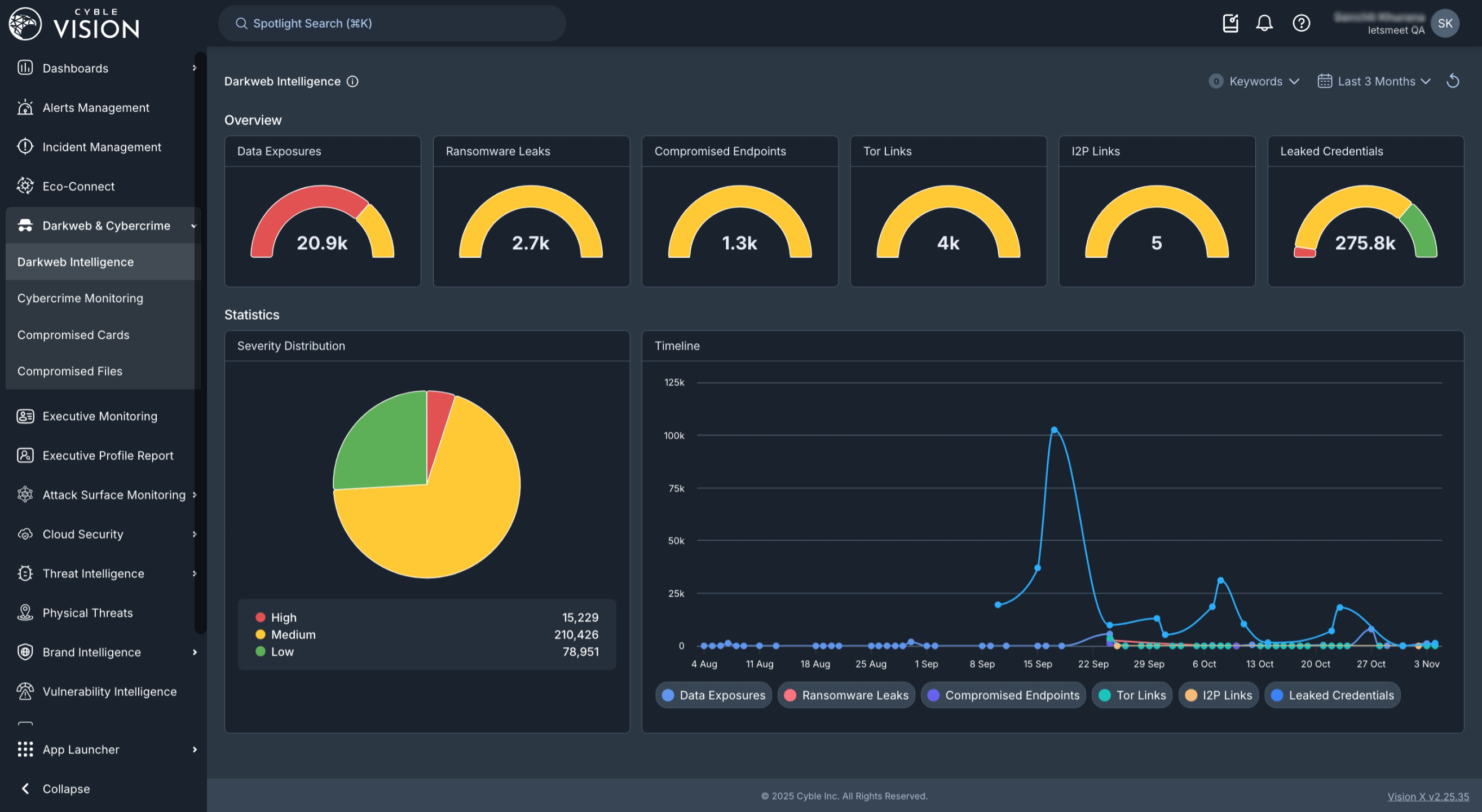
Cyble’s AI-native collection layer addresses this gap structurally. Models operate at the collection layer, deciding which sources to prioritize, resolving entities across languages and obfuscated spellings, scoring relevance against the customer’s domains, subsidiaries, executives, and technology stack, and enriching findings before an analyst opens the case. This approach differs from a summarization layer added to a legacy pipeline. Collection prioritization, entity resolution, and relevance scoring are all model-driven before a human sees anything. Cyble reports visibility into more than 15,000 darknet marketplaces and a 95% signal-to-noise ratio, based on Cyble internal telemetry.
Gap two: awareness to action. Most intelligence products end at the alert and hand the hard part back to the customer. Takedown is slow, jurisdictionally complex, and typically sits with a separate vendor or an internal legal queue.
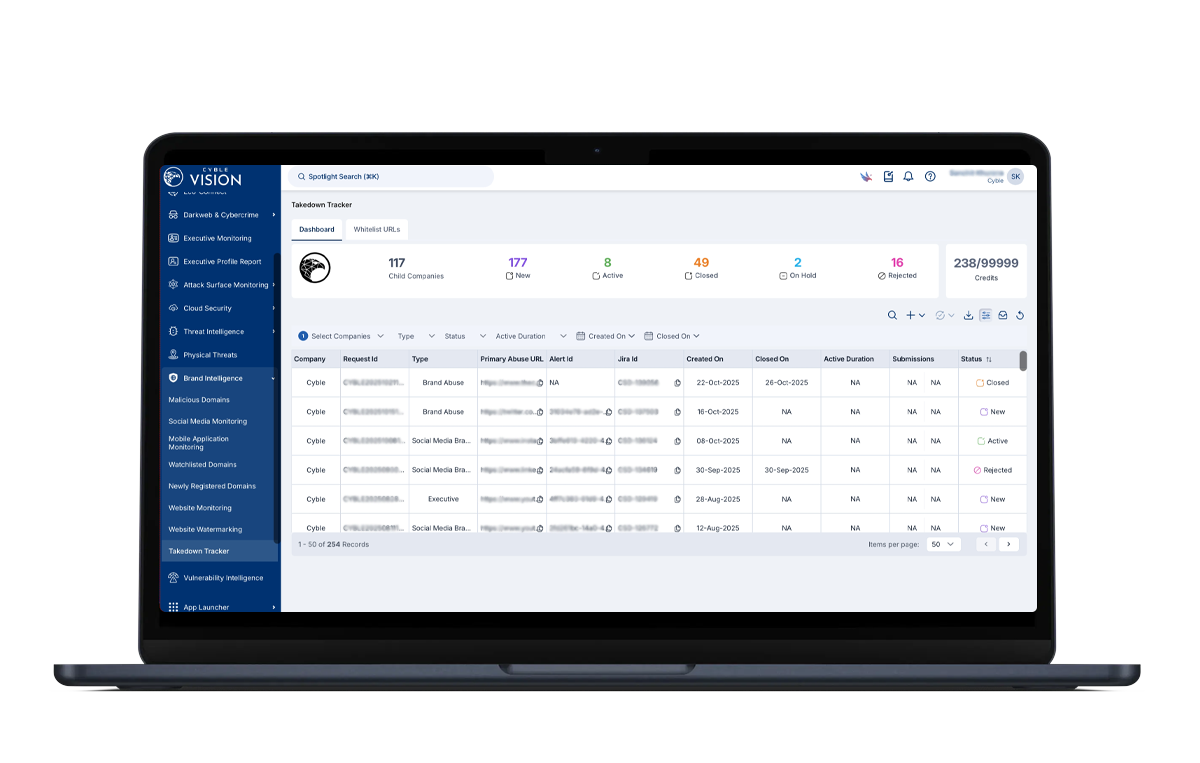
Cyble’s native managed takedown closes this gap by combining detection and removal in one pipeline, delivered against service level agreements (SLAs). Cyble reports a 98% takedown success rate, based on Cyble internal telemetry. Capabilities, coverage, and service levels vary by subscription tier and region.
Disclaimer: Statistics cited above, including visibility into more than 15,000 darknet marketplaces, a 95% signal-to-noise ratio, and a 98% takedown success rate, are drawn from date-stamped Cyble internal telemetry and have not been independently verified. Results depend on the customer’s environment, asset scope, and configuration.
Close both gaps with a Cyble demo
How To Justify Dark Web Credential Monitoring Internally
The strongest internal case usually emerges during a proof of concept (POC) when previously unknown findings are specific to the organization. A monitoring product that produces alerts nobody acts on creates the appearance of coverage without the substance.
For the governance, risk and compliance (GRC) audience, Cyble Saratoga applies the Factor Analysis of Information Risk (FAIR) model to live telemetry and expresses exposure in financial terms that a chief financial officer (CFO) or board can evaluate. This translation turns the abstract risk of credential exposure into the language budget decisions use.
Cybersecurity and Infrastructure Security Agency (CISA) guidance establishes phishing-resistant MFA as the most secure form of MFA and the gold standard organizations should prioritize, alongside hardening credentials and replacing default passwords with unique passwords. Organizations that cannot immediately implement phishing-resistant MFA should employ additional prevention and detection controls, such as number matching and internal mail and messaging monitoring. That guidance matters here because monitoring and MFA address different parts of the same problem. Monitoring is reactive and detects exposure after the fact, while MFA and unique passwords reduce the blast radius of any exposure that monitoring catches.
Build your internal case with a live Cyble POC
Frequently Asked Questions
Is dark web monitoring legit?
Dark web monitoring is legitimate when it is a first-party service from a reputable provider. Dark web credential monitoring detects exposure and does not prevent credential theft. The value comes from shortening the window between exposure and response. Evaluate any removal or takedown claim on the provider’s stated scope, success rate, and service level agreements, and confirm what the provider commits to in writing. Rotation and revocation of exposed credentials remain the effective response, because takedown removes a listing and does not undo the exposure itself.
How much does dark web monitoring cost?
Pricing varies by coverage scope, number of monitored assets, source depth, whether analyst validation is included, and integration requirements. Free tools exist for individuals. Enterprise platforms are typically sold through quote-based engagements that scale with the number of monitored domains, subsidiaries, executive identities, and the breadth of underground sources covered. The largest hidden cost often appears in alert triage, because a platform that generates high alert volume without enrichment consumes analyst time that the subscription price does not show.
Is there a free dark web monitor?
Free options exist for individuals. Have I Been Pwned checks email addresses against known breach corpora and provides a sound baseline for personal breach-notification lookup. Google discontinued its dark web report in early 2026, as noted earlier. Free tools do not monitor infostealer logs, gated underground communities, or private Telegram channels. They do not perform entity resolution across subsidiaries and executives and provide no response path beyond the alert itself.
What is the difference between dark web monitoring and breach monitoring?
Breach monitoring alerts after a vendor publicly discloses an exposure, often months after the data was first stolen and circulating. Dark web credential monitoring watches the sources where credentials surface before disclosure, including infostealer log feeds, underground marketplaces, and private channels. The practical difference is timing. A credential appearing in a stealer log on Russian Market may never generate a public breach disclosure, while dark web monitoring can catch it at the source.
How do I check if my credentials are on the dark web?
Individuals can use Have I Been Pwned for a free breach-notification lookup against known breach corpora. Organizations need enterprise monitoring that resolves entities across domains and subsidiaries, ingests infostealer log feeds, and covers the underground sources where corporate credentials surface. A single domain search against a breach database provides a starting point and not a complete answer.
What should I look for when evaluating a provider?
Five criteria matter most: infostealer log coverage and gated community access, entity resolution quality across languages and obfuscated spellings, alert enrichment that arrives case-ready rather than requiring manual pivoting, integration depth into the SIEM and SOAR tools the team already uses, and whether takedown is native or referred to a third party.
Conclusion
External credential exposure represents a category of risk that internal tools structurally cannot see. A SIEM cannot index a Telegram channel. An endpoint detection and response (EDR) agent cannot see credentials being sold on a dark web marketplace at midnight. The evidence that a breach is coming, or has already started, lives outside the perimeter. Reaching that evidence requires purpose-built collection infrastructure.
Dark web credential monitoring addresses this gap when the provider closes both structural problems the category presents. The exposure-to-awareness gap requires AI-native collection that reaches infostealer logs and gated communities and resolves findings to the right organization before an analyst opens the case. The awareness-to-action gap requires native managed takedown rather than an alert that ends at the dashboard.
When evaluating providers, the criteria that separate genuine capability from marketing are source coverage of infostealer logs and gated communities, entity resolution quality, alert enrichment depth, integration into existing tools, and whether takedown is part of the same pipeline or a separate engagement. A POC against the organization’s own environment, scoped to its actual domains and subsidiaries, remains the most reliable way to validate those criteria before committing budget.
See Cyble in action against your own environment