

Key Takeaways
-
Attack surface management (ASM) for banks means continuous discovery, monitoring, and risk scoring of external, cloud, and third-party digital assets from an attacker’s perspective. It produces the time-stamped evidence regulators expect when the incident notification clock starts.
-
The external attack surface of a bank has expanded faster than most internal security programs. Cloud adoption, open banking application programming interfaces (APIs), fintech integrations, and remote access infrastructure have dissolved the legacy perimeter.
-
Verizon’s 2026 Data Breach Investigations Report (DBIR) found that System Intrusion accounts for 57 percent of breaches in the Financial and Insurance sector. Stolen credentials and vulnerability exploitation are nearly tied as initial access vectors at 39 percent and 38 percent, and third-party involvement in breaches has surged.
-
Without continuous external visibility, the first evidence of exposure often comes from outside the institution. A regulator, a journalist, or a fraud spike may surface the issue before internal monitoring does. ASM creates the visibility that supports a defensible notification timeline.
-
Cyble unifies cyber threat intelligence (CTI), attack surface management, and digital risk protection (DRP) on one shared data layer so banks can connect external exposure directly to regulatory notification decisions.
The Banking Attack Surface: Four Categories That Fail Differently
Banks face four distinct external attack surface categories, and each category introduces different failure modes that examiners care about. The table below shows which assets fall into each category and the specific risk that makes each one examiner-relevant.
|
Surface Category |
Specific Banking Assets |
Common Risk |
|---|---|---|
|
External / Digital |
SWIFT gateways and operator portals, mobile banking APIs, public customer portals, online account opening flows |
The web application layer in front of SWIFT is the attack surface, not the SWIFT network itself; credential stuffing against customer portals; business-logic abuse of account opening flows |
|
Multi-Cloud |
Storage buckets, identity and access management (IAM) configurations, exposed cloud services, infrastructure-as-code templates |
IAM credential abuse bypasses perimeter controls; configuration drift between audit cycles |
|
Supply Chain |
Fintech vendors, core banking plugins, managed file transfer (MFT) systems, third-party API integrations |
According to Wolters Kluwer’s Banking & Financial Law Daily, third-party service providers were responsible for 30% of data breaches across all industries in 2024; supply chain exposure is often invisible because it sits in a vendor’s environment |
|
Identity |
Credential exposure, privileged accounts, executive personally identifiable information (PII), non-human identities such as service accounts and API keys |
Over-permissioned service accounts can be reviewed far less often than human accounts; dark web credential markets enable account takeover before internal teams detect the exposure |
The Regulatory Frame: ASM As A Supervisory Obligation
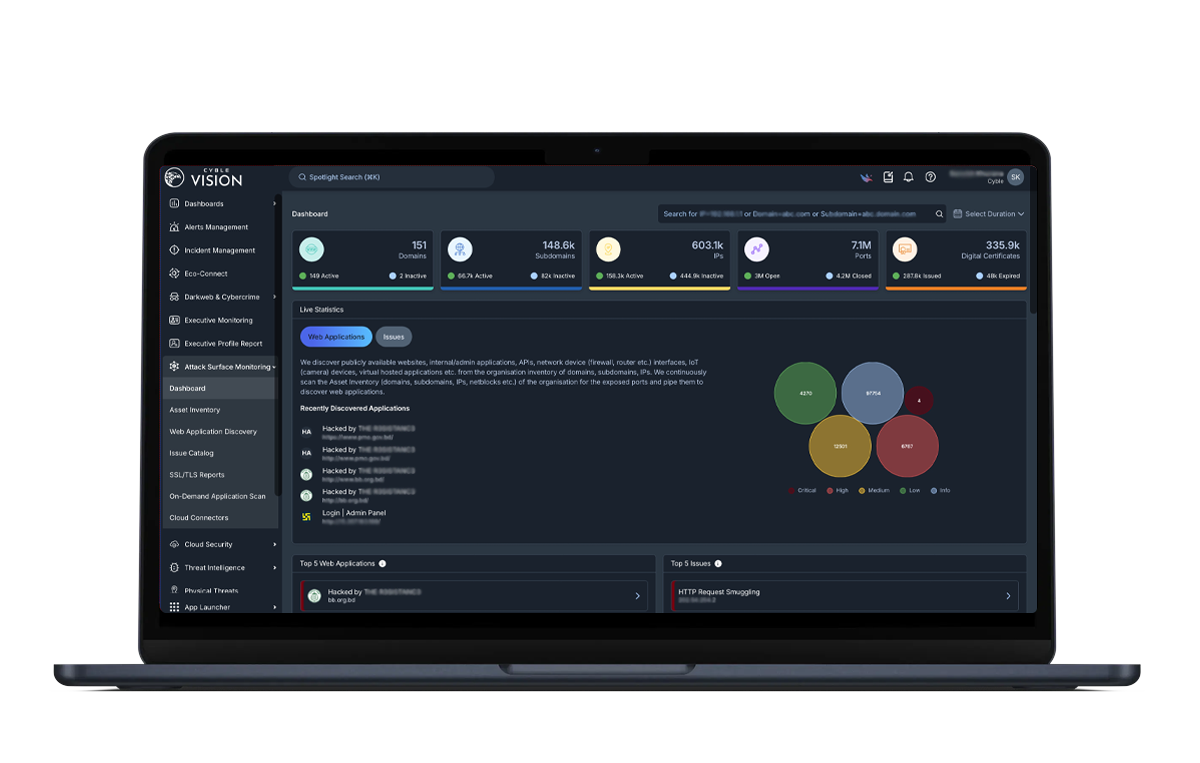
Attack surface management functions as an operational foundation for meeting the notification timelines that federal banking regulators enforce today and that the Cyber Incident Reporting for Critical Infrastructure Act (CIRCIA) will extend once its final rule takes effect. Regulators expect banks to know what is exposed externally and to show how they acted on that knowledge.
The most immediate obligation for banks is the Computer-Security Incident Notification Rule issued jointly by the Federal Reserve, the Office of the Comptroller of the Currency (OCC), and the Federal Deposit Insurance Corporation (FDIC), effective May 1, 2022.
Under this rule, a covered banking organization must notify its primary federal regulator as soon as possible and no later than 36 hours after determining that a computer-security incident rises to the level of a notification incident. A notification incident disrupts or degrades the viability of operations, prevents customers from accessing accounts, or impacts the stability of the financial sector. The 36-hour clock does not run from the first security alert; it begins when the institution determines the event meets the notification-incident threshold. A team that spends 18 hours in ambiguity before reaching that determination has 18 hours remaining to notify.
CIRCIA, enacted in 2022, directs the Cybersecurity and Infrastructure Security Agency (CISA) to establish a federal cyber incident reporting regime. As of August 2026, CISA had not issued a final CIRCIA rule, and mandatory reporting begins only after the final rule goes into effect. The 2024 Notice of Proposed Rulemaking (NPRM) proposes that covered entities report a covered cyber incident within 72 hours after reasonably believing the incident occurred and report a ransom payment within 24 hours. Banks should build a clearly labeled future-state CIRCIA module and treat the NPRM as provisional readiness planning.
The Federal Financial Institutions Examination Council (FFIEC) sets the examination framework that examiners use to assess cybersecurity programs. Institutions now assess cybersecurity using contemporary frameworks while still meeting expectations in the FFIEC Information Technology (IT) Examination Handbook.
The Bank Service Company Act authorizes federal banking regulators to directly examine technology service providers that supply critical services to financial institutions. Even when a vendor can be examined directly, the supervised institution still owns oversight of that relationship and must show how it manages that risk.
ASM makes the notification clock defensible. Because it time-stamps every external exposure as it is discovered, the institution can later show exactly when it had the facts needed to make its determination and therefore that the 36-hour clock was started correctly.
The Prioritization Problem: Turning Scores Into Regulatory Decisions
Knowing that a notification clock exists does not tell a bank which finding to fix first. A Common Vulnerabilities and Exposures (CVE) system score of 9.8 on a core banking API and a 9.8 on a branch marketing microsite do not represent the same risk.
Common Vulnerability Scoring System (CVSS) measures intrinsic severity: exploitability, privileges required, and impact on confidentiality, integrity, and availability. It has no knowledge of asset inventory, internet exposure, or active exploitation.
A defensible prioritization model for banks incorporates four inputs beyond CVSS:
-
Asset criticality. A system that processes account queries, transaction postings, and balance updates carries materially higher business impact than a low-value marketing site. The same CVE carries very different priority depending on whether it hits a core banking system, an internet-facing service, or a lower-value asset.
-
Customer data exposure. Assets that hold or transmit nonpublic personal information (NPI) or payment card data increase the regulatory consequence of exploitation and the notification obligation that follows.
-
Active exploitation signals. CISA’s Known Exploited Vulnerabilities (KEV) catalog documents CVEs confirmed to be actively exploited in the wild.
-
Exploit Prediction Scoring System (EPSS) scores. EPSS, maintained by FIRST.org, outputs a probability between zero and one that a published CVE will be exploited in the next 30 days.
MITRE ATT&CK adds an adversary behavior mapping layer that connects a CVE to the tactics, techniques, and procedures (TTPs) threat groups use against banks. Mapping a finding to a MITRE ATT&CK technique such as T1078.004 (Valid Accounts: Cloud Accounts) for an IAM misconfiguration shows which threat actors are likely to exploit it and what lateral movement may follow. That context informs escalation decisions that CVSS alone cannot support.
Six-Step Attack Surface Management Workflow For Banks
This six-step workflow shows how a bank can operationalize ASM from initial discovery through validated closure. Each step highlights the banking-specific decision that examiners will review.
-
Discover. Enumerate all external, cloud, and third-party digital assets from an attacker’s perspective. Include forgotten staging servers, expired certificates on subsidiary domains, and developer test instances never taken offline. The key scoping decision is which assets are in scope for the examination, and that scope must extend beyond the official inventory.
-
Classify. Assign each discovered asset to a surface category (external or digital, multi-cloud, supply chain, identity) and determine its data classification, regulatory relevance, and line-of-business ownership. The banking-specific decision is ownership assignment. Unowned assets become the highest-priority classification findings.
-
Assess. Score each asset’s exposure using asset criticality, customer data exposure, EPSS, KEV status, and MITRE ATT&CK technique mapping. The banking-specific decision is which findings trigger the notification-incident analysis under the 36-hour rule.
-
Prioritize. Rank findings by the combined inputs from the assessment step. A finding on a core banking system routes to the chief information security officer (CISO) and the incident response team. Lower-impact findings enter the standard vulnerability management queue. The escalation path and its rationale must be documented.
-
Remediate. Execute remediation according to the prioritized queue. Patch, reconfigure, take down, or accept with documented rationale and compensating controls. For third-party findings, remediation requires engaging the vendor and documenting the vendor’s response timeline against the institution’s own recovery time objectives (RTOs).
-
Validate. Confirm closure through rescan, configuration verification, or managed takedown confirmation. Closure evidence must be time-stamped and retained. A finding marked closed without validation evidence does not satisfy examiner expectations. FFIEC examiners expect evidence that controls are operating effectively, not just that policies exist.
Examiner-Ready Evidence: Turning ASM Activity Into Proof
An ASM program succeeds when it can show regulators exactly what happened, when, and who owned each decision. Four categories of documentation consistently appear in examinations and incident notification reviews.
-
Discovery timestamps. Record the date and time an exposure was first detected, by which system, and against which asset. This record anchors the notification clock analysis. Different notification regimes start their clocks from different events such as discovery, determination, reasonable belief, or materiality, so the facts known at each point must be preserved separately.
-
Asset ownership records. Capture which line of business owns the asset, who the named contact is, and when ownership was last confirmed. An unowned asset with an active exposure often becomes an examiner finding on its own.
-
Prioritization rationale. Document why a finding was escalated or queued, which inputs were used (asset criticality, EPSS, KEV status, customer data exposure), and who made the decision. This rationale shows that the program followed a structured model rather than sorting by CVSS alone.
-
Remediation closure evidence. Store the rescan result, configuration verification, or takedown confirmation, with a timestamp. According to Vulert, a defensible audit record should include the scan result, exposure assessment, ticket, owner, target date, remediation action, and closure date.
When an examiner reviews a notification, this evidence shows when the bank first saw the exposure, how it judged the risk, and how quickly it closed the issue. A mature ASM program produces this record continuously so the notification timeline can be reconstructed with confidence.
Third-Party And Supply Chain Exposure: Extending Visibility To Vendors
Third-party and supply chain exposure often sits in someone else’s environment while still creating a path into the bank. A fintech partner’s misconfigured API, a core banking plugin with an unpatched CVE, or a managed file transfer system in a vendor’s data center can all provide an entry point without appearing in the bank’s own asset inventory.
An annual vendor questionnaire does not satisfy the ongoing monitoring expectation common to all five United States financial services third-party regimes; continuous external monitoring is the only practical answer that does not depend on the vendor volunteering bad news. The 2023 interagency guidance issued jointly as OCC Bulletin 2023-17, FDIC FIL-29-2023, and Federal Reserve SR 23-4 requires ongoing monitoring of critical third parties that includes assessment of their business continuity and disaster recovery plans and testing results.
The Bank Service Company Act’s third-party examination authority means that a vendor’s security posture remains examiner-relevant to the bank. The governance, risk, and compliance (GRC) lead must keep vendor inventory, criticality tiering, ongoing monitoring records, and contractual security requirements ready for review at any point in the examination cycle.
Extending ASM to fintech partners and core banking vendors means mapping their internet-facing assets alongside the bank’s own. A vendor’s forgotten staging server or expired certificate becomes a bank risk if that vendor has access to the bank’s systems or customer data. Evidence of that monitoring, including what was found, when, and what action followed, belongs in the same documentation set as the bank’s internal ASM records.
Cyble For Banks: Intelligence-Driven ASM On A Shared Data Layer
Cyble is an artificial intelligence (AI) native cybersecurity company that unifies intelligence-driven security across the entire digital attack surface. For banks and financial institutions, Cyble connects external exposure directly to regulatory notification decisions by combining cyber threat intelligence, attack surface management, and digital risk protection on one shared data layer through its flagship platform, Cyble Vision.
The scanning engine behind Cyble’s attack surface management is ODIN. ODIN maps internet-facing assets across the entire Internet Protocol version 4 (IPv4) and Internet Protocol version 6 (IPv6) space to surface shadow and forgotten infrastructure that remains reachable from the outside. ODIN’s external view of a bank’s perimeter is what an attacker sees. That view includes third-party exposure and misconfigured services that internal tools cannot observe.
When a phishing site, lookalike domain, or fake mobile application targeting a bank’s brand is identified, Cyble’s native managed takedown capability removes it under defined service level agreements (SLAs). Cyble reports a 98 percent takedown success rate based on internal telemetry. Takedown operates as part of the platform so detection and removal happen in a single motion.
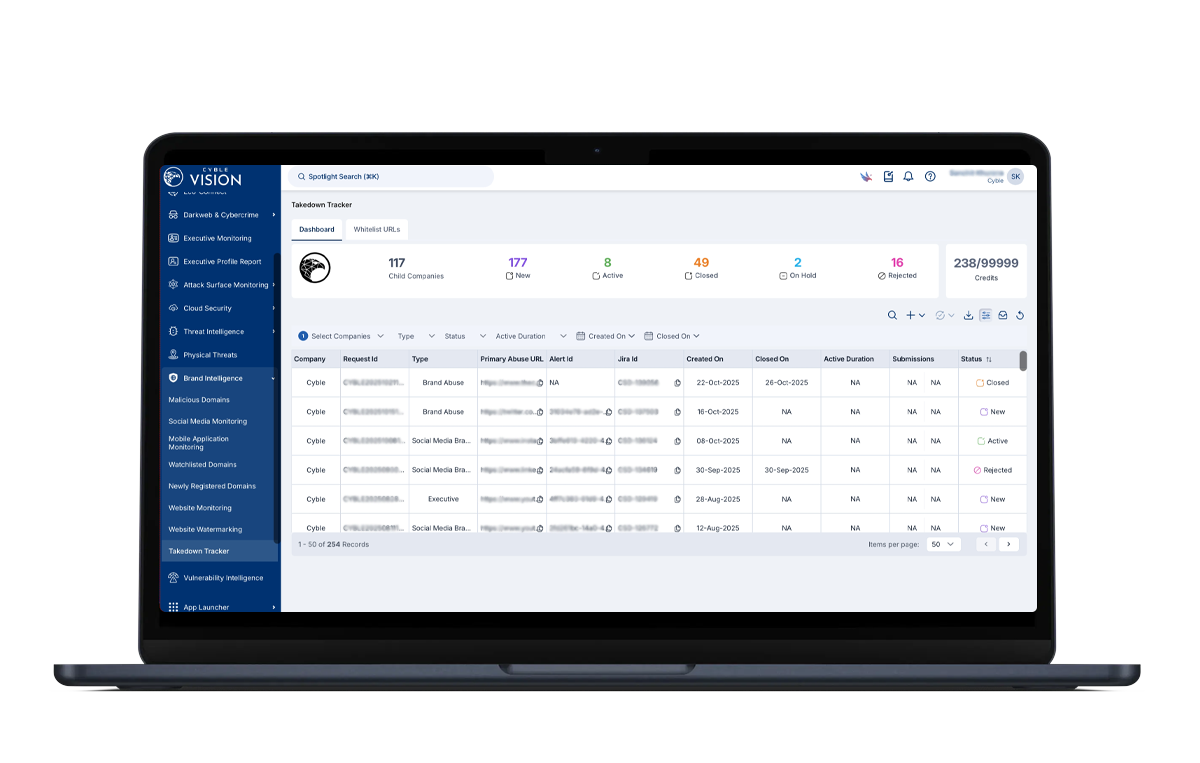
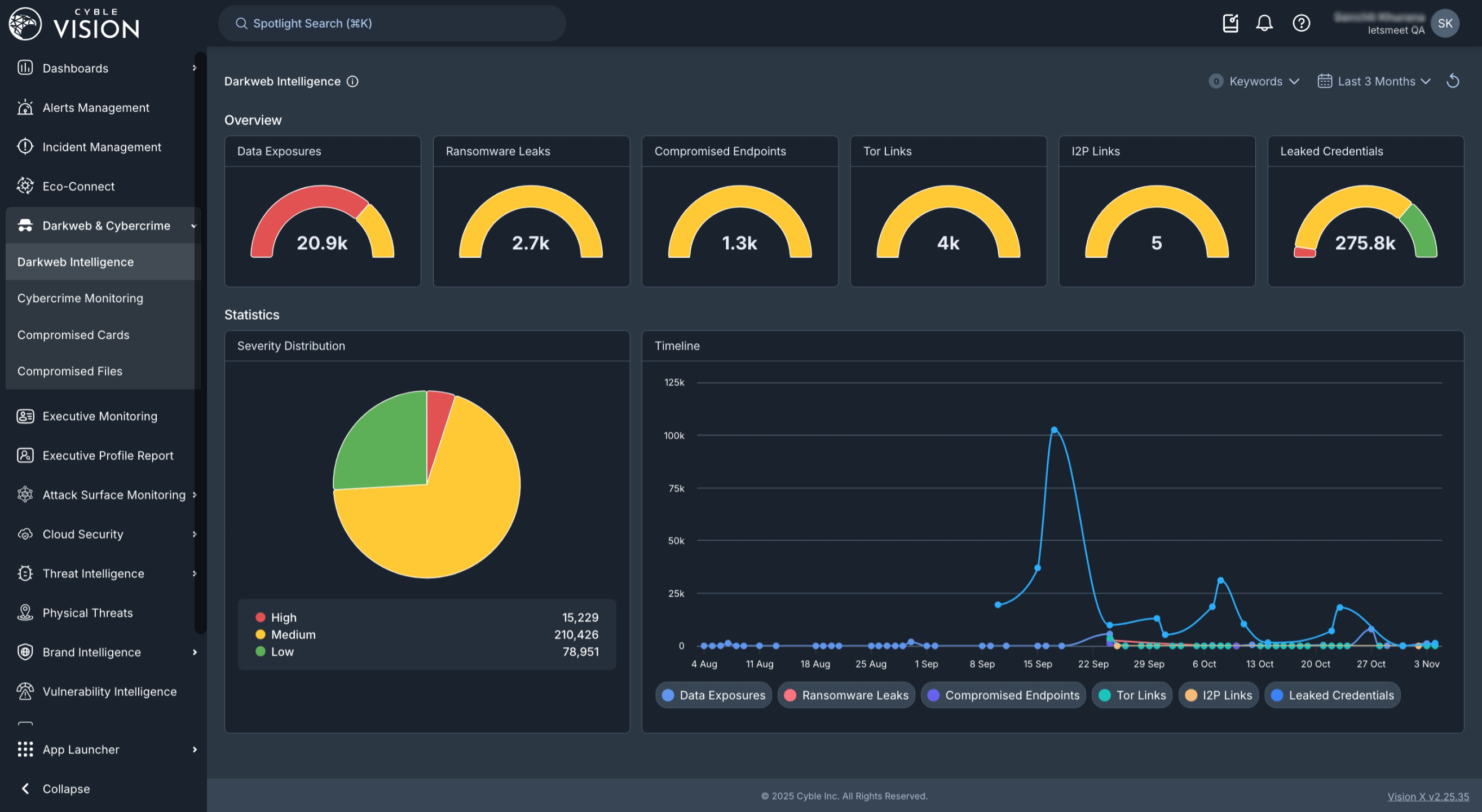
Cyble reports a 95 percent signal-to-noise ratio and visibility into more than 15,000 darknet marketplaces (Cyble internal telemetry). For a bank’s security operations center (SOC), this means findings arrive case-ready rather than as raw indicators that require manual enrichment before triage.
More than 70 native integrations push intelligence into Splunk, Microsoft Sentinel, IBM QRadar, Cortex XSOAR, and ServiceNow. Cyble therefore acts as a force multiplier for the existing security information and event management (SIEM), security orchestration, automation and response (SOAR), and ticketing stack.
Cyble Saratoga applies the Factor Analysis of Information Risk (FAIR) model to live telemetry to express exposure in financial terms. This translation helps boards and audit committees understand technical findings in the language of risk registers and capital planning.
Cyble was named a Challenger in the inaugural 2026 Gartner® Magic Quadrant™ for Cyberthreat Intelligence Technologies. Gartner does not endorse any vendor, product, or service depicted in its research publications and does not advise technology users to select only those vendors with the highest ratings or other designation. Gartner research publications consist of the opinions of Gartner’s research organization and should not be construed as statements of fact.
Capabilities, coverage, and service levels vary by subscription tier and region. Statistics cited above are drawn from Cyble internal telemetry and should be validated against your environment, asset scope, and configuration.
ASM Readiness Checklist For Banks
This checklist helps a bank’s CISO, head of information security, or GRC lead gauge ASM maturity and fit before the next FFIEC examination cycle.
-
Scope clarity. Confirm that the institution can enumerate all external, cloud, and third-party assets that an attacker could reach, including those not in the official inventory. If the answer depends on what someone remembered to write down, scope remains incomplete.
-
Internal ownership. Verify that every discovered asset has a named owner in a specific line of business. Unowned assets signal both an examiner concern and a remediation gap.
-
Data quality. Check that discovery timestamps, asset classifications, and ownership records are current and machine-readable. Evidence that cannot be produced on demand during an examination effectively does not exist for regulatory purposes.
-
Workflow maturity. Review whether a documented escalation path exists and whether it treats high-impact systems differently from low-impact assets. Test that path so the team knows how to act when a critical finding appears.
-
Compliance requirements. Map ASM outputs to the 36-hour notification rule, the FFIEC IT Examination Handbook’s external dependency management expectations, and the Bank Service Company Act’s third-party examination authority.
-
Integration needs. Ensure that the ASM program pushes findings into the SIEM, SOAR, and ticketing systems the team already uses. A separate console that analysts check inconsistently weakens the program.
-
Resourcing. Assign a named owner for the ASM program with authority to direct remediation across lines of business. A program without an accountable owner produces findings that linger.
-
Third-party coverage. Confirm that the program extends to fintech partners and core banking vendors rather than stopping at the institution’s own perimeter.
-
Prioritization framework. Use asset criticality, EPSS, and KEV status alongside CVSS. A model that sorts by CVSS alone cannot explain its decisions to examiners.
-
Examiner-ready evidence. Test whether the institution can produce discovery timestamps, prioritization rationale, and remediation closure evidence for any finding within the examination window.
Evaluate Cyble For Your ASM Program
Common Pitfalls In Bank ASM Programs
Several recurring mistakes cause bank ASM programs to fail examiner scrutiny or leave material exposure unaddressed. Recognizing these patterns early helps teams adjust before the next review.
-
Unclear scope. Limiting discovery to assets in the official inventory misses the forgotten staging servers, subsidiary domains, and developer test instances that attackers find first. Scope must reflect the attacker’s perspective rather than the asset register.
-
Fragmented workflows. Separate tools for CTI, ASM, and digital risk protection that do not share a data layer often generate three disconnected alerts about one incident. Correlation then depends on manual effort, and findings can fall through gaps between handoffs.
-
Weak ownership. An ASM program that produces findings without assigning them to a named owner in a specific line of business creates a queue that no one feels accountable for clearing. Ownership assignment functions as a core program requirement.
-
Overreliance on automation. Automated scanning identifies exposure, but human judgment remains necessary to validate findings, assign ownership, and make escalation decisions across lines of business. Treating every automated finding as confirmed or ignoring findings because the volume is too high both create risk.
-
Poor integration planning. An ASM platform that delivers findings into a console that analysts check inconsistently does not strengthen the existing stack. Integration into SIEM, SOAR, and ticketing systems should be treated as a deployment requirement.
-
Measuring activity instead of outcomes. Reporting the number of assets discovered or findings generated shows how busy the program is. Reporting the time between discovery and validated closure and the proportion of findings escalated correctly shows whether the program works.
-
Adoption and change-management gaps. ASM programs that launch without training lines of business on ownership responsibilities or without executive sponsorship for cross-functional remediation often stall at the assessment step. Effective remediation requires authority that the security team alone does not hold.
Frequently Asked Questions
What Are The Three Key Components Of Attack Surface Monitoring?
The three key components are discovery, classification, and continuous assessment of external assets. Discovery enumerates all internet-facing, cloud, and third-party assets from an attacker’s perspective, including assets not in the official inventory. Classification assigns each asset to a surface category, data classification, and line-of-business owner. Continuous assessment scores each asset’s exposure on an ongoing basis using asset criticality, active exploitation signals, and threat intelligence rather than only point-in-time audits. Together, these components produce the time-stamped evidence that regulators and examiners request.
How To Minimize Your Bank’s Attack Surface?
Minimizing a bank’s attack surface requires reducing exposed services, enforcing least privilege, and continuously monitoring for shadow information technology (IT) and third-party exposure. Reducing exposed services involves decommissioning forgotten infrastructure, removing public access from storage buckets and cloud services that do not require it, and enforcing network segmentation between core banking, payment, and general office environments. Enforcing least privilege applies to both human accounts and non-human identities such as service accounts and API keys, which often carry broader permissions and receive fewer reviews. Continuous monitoring for shadow IT and third-party exposure addresses assets that do not appear in the official inventory but remain reachable from the outside, including vendor-managed systems that have access to the bank’s data or infrastructure.
What Is The Difference Between An Attack Vector And An Attack Surface?
An attack surface is the sum of all exposed assets and entry points that an attacker could reach, including every domain, API, cloud service, third-party integration, and identity accessible from outside the institution’s control. An attack vector is the specific path an attacker uses to exploit one of those entry points, such as credential stuffing against a customer portal, exploitation of a known CVE in a managed file transfer system, or phishing that targets a privileged account. Managing the attack surface reduces the number of viable attack vectors. Monitoring the attack surface continuously highlights which vectors are being actively targeted before exploitation occurs.
What Are Attack Surface Management Tools For Banks?
Attack surface management tools for banks are platforms that discover, classify, and prioritize external exposure from an attacker’s perspective and integrate with SIEM, SOAR, and ticketing systems so findings enter the workflows the security team already uses. For banks, the most relevant capabilities include internet-wide asset discovery across IPv4 and IPv6 space, third-party and supply chain exposure monitoring, dark web and credential exposure monitoring, prioritization using asset criticality and active exploitation signals rather than CVSS alone, and the ability to produce time-stamped, examiner-ready evidence of discovery, prioritization, and remediation closure. Integration with the existing stack should be treated as a deployment requirement because a platform that requires a separate console often produces findings that analysts review inconsistently.
How Does ASM Support Regulatory Notification Timelines?
ASM supports regulatory notification timelines by providing a time-stamped record of when an exposure was first detected, which anchors the notification clock analysis. Under the federal banking agencies’ Computer-Security Incident Notification Rule, the 36-hour clock begins when the institution determines that a computer-security incident meets the notification-incident threshold rather than when the first security alert fires. An ASM program that continuously monitors external exposure and time-stamps every discovery gives the institution the documented record it needs to show that the determination was made promptly and that the clock was started correctly.
When Is Human Expertise Still Necessary?
Human expertise remains necessary for validating findings, assigning ownership, and making escalation decisions across lines of business. Automated scanning identifies exposure but cannot decide whether a finding warrants immediate escalation to the CISO or can enter the standard remediation queue. Ownership assignment requires a human decision about which line of business remains accountable for a specific asset. Escalation decisions require judgment about regulatory consequence, customer data exposure, and the institution’s current threat environment. The notification-incident determination under the 36-hour rule is a legal and operational judgment that must be made by an accountable decision-maker, with the rationale documented.
Conclusion
Attack surface management for banks functions as a supervisory obligation with a notification clock attached. The obligations described above, including the 36-hour notification rule, FFIEC examination expectations, and the Bank Service Company Act’s third-party examination authority, together make external visibility non-optional. An institution that cannot produce a time-stamped record of when an exposure was first detected, who owned the affected asset, and how the finding was prioritized and closed remains unprepared for the next examination cycle.
Practical next steps for a bank’s CISO, head of information security, or GRC lead include an internal assessment against the readiness checklist above, stakeholder alignment across lines of business on ownership and escalation authority, requirements gathering that maps ASM outputs to the 36-hour notification rule and FFIEC examination expectations, a process review of the current discover-to-validate workflow, and comparative research on platforms that integrate with the existing SIEM, SOAR, and ticketing stack.
Schedule A Cyble ASM Consultation
Disclaimers: Results depend on the customer’s environment, asset scope, and configuration and should be validated against it. Statistics attributed to Cyble are drawn from date-stamped Cyble internal telemetry unless otherwise attributed. Capabilities, coverage, and service levels vary by subscription tier and region.