Key Takeaways
-
Attack surface management demos should move past marketing narratives and show real discovery of unknown and shadow assets in your environment.
-
Credible platforms expand beyond your declared asset list, automatically deduplicate findings, and surface forgotten infrastructure that attackers often find first.
-
Effective risk scoring prioritizes findings based on live threat activity and business context rather than generic Common Vulnerability Scoring System (CVSS) scores alone.
-
Workflow integration matters, because findings should route directly into ticketing systems like Jira or ServiceNow and support continuous monitoring between scheduled scans.
-
Cyble delivers entity resolution at ingestion, internet-wide discovery via ODIN, and native managed takedown with a reported ninety-eight percent success rate, based on Cyble internal telemetry.
What An Attack Surface Management Demo Actually Is
An attack surface management (ASM) demo is a guided, vendor-led session that runs against a live or representative view of your external estate. Before you book time with anyone, separate it from three formats it is routinely confused with: the self-serve free trial, the sales-led demo, and the guided proof of concept (POC).
A self-serve free trial gives you temporary access to a product you do not yet know how to scope. A free trial answers “can the buyer reach value with low friction?” It answers a narrow question, so it works when setup is fast and value appears quickly. If you need to connect systems, pass a security review, or wait for data to accumulate, a free trial will not tell you much.
A sales-led demo shows the vendor’s best-case narrative against a curated dataset. ASM platforms demo well because vendor demonstrations use curated datasets that highlight discovery strengths while avoiding classification and routing complexity. That gap means demo performance can diverge sharply from production behavior.
This format shows whether the tool finds anything you did not already know about. Cyble offers a guided fourteen-day POC so you can see findings against your own environment well before a full contract cycle completes.
What Happens In An Attack Surface Management Demo
The six stages below form the core of any credible ASM demo. Each stage proves something specific about the platform’s architecture. Use this sequence as your reference during the call.
-
Scope input. The vendor accepts your domain names, Classless Inter-Domain Routing (CIDR) ranges, subsidiary names, and recently acquired entities. Watch how the platform handles assets you did not list. A platform that only discovers what you declare is scanning your asset register, not your attack surface. Watch whether it can expand beyond your seed list without a perfect internal inventory.
-
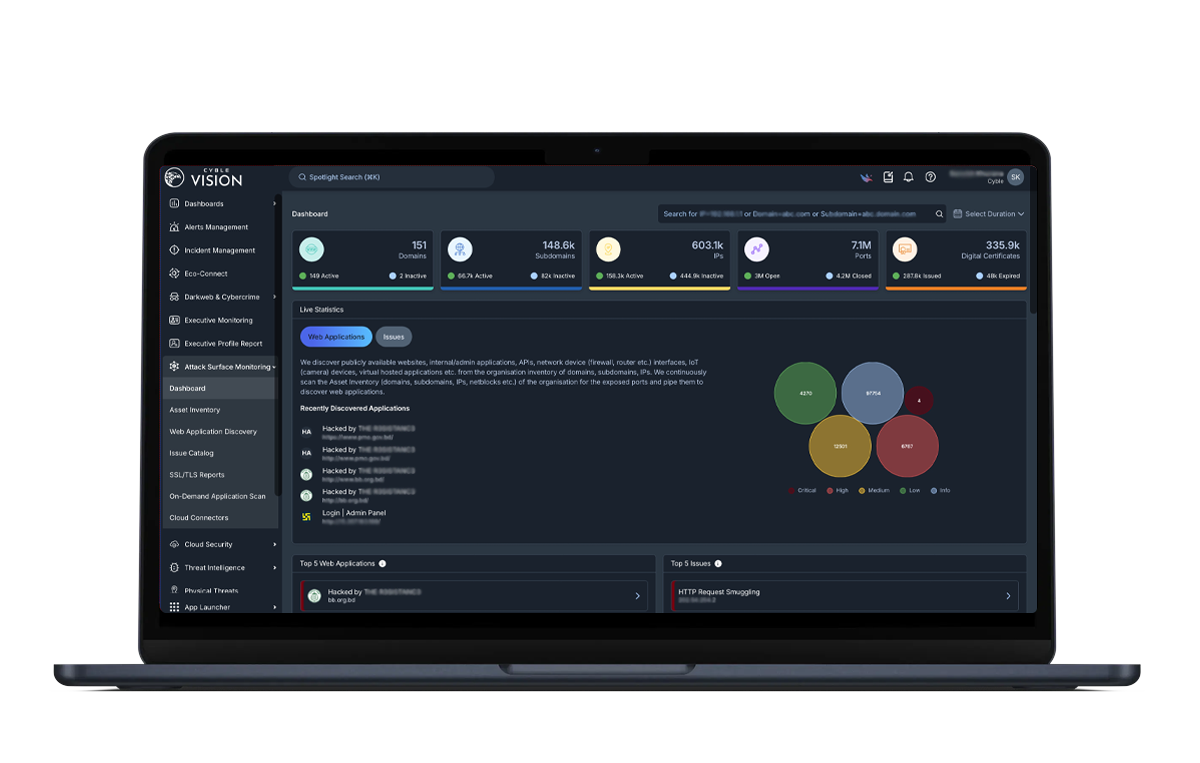
Asset discovery and ingestion. The scanner reaches domains, subdomains, IP ranges, exposed services, cloud resources, application programming interfaces (APIs), and certificates. Results should be deduplicated automatically. The vendor should also state how long a first scan takes against a realistic scope.
-
Unknown and shadow asset surfacing. This stage often creates the biggest impact. The demo should surface forgotten staging servers, expired or misissued certificates, cloud storage buckets with misconfigured access policies, exposed admin interfaces, shadow information technology (IT), outdated software versions, and misconfigured services. Attackers often discover shadow IT assets, such as duplicate services, test environments, or forgotten subdomains, before internal teams do. If the demo only shows assets you already knew about, the platform is reflecting your existing inventory back at you.
-
Contextual prioritization and risk scoring. Findings should be ranked against your environment, not against the internet in general. A misconfigured API endpoint serving customer payment data represents a different problem than an outdated marketing subdomain. Effective ASM programs prioritize risk using indicators such as Known Exploited Vulnerabilities and asset criticality rather than CVSS score alone. Ask whether scoring reflects live threat activity, including whether a finding is elevated when the underlying vulnerability appears on the Cybersecurity and Infrastructure Security Agency (CISA) Known Exploited Vulnerabilities catalog.
-
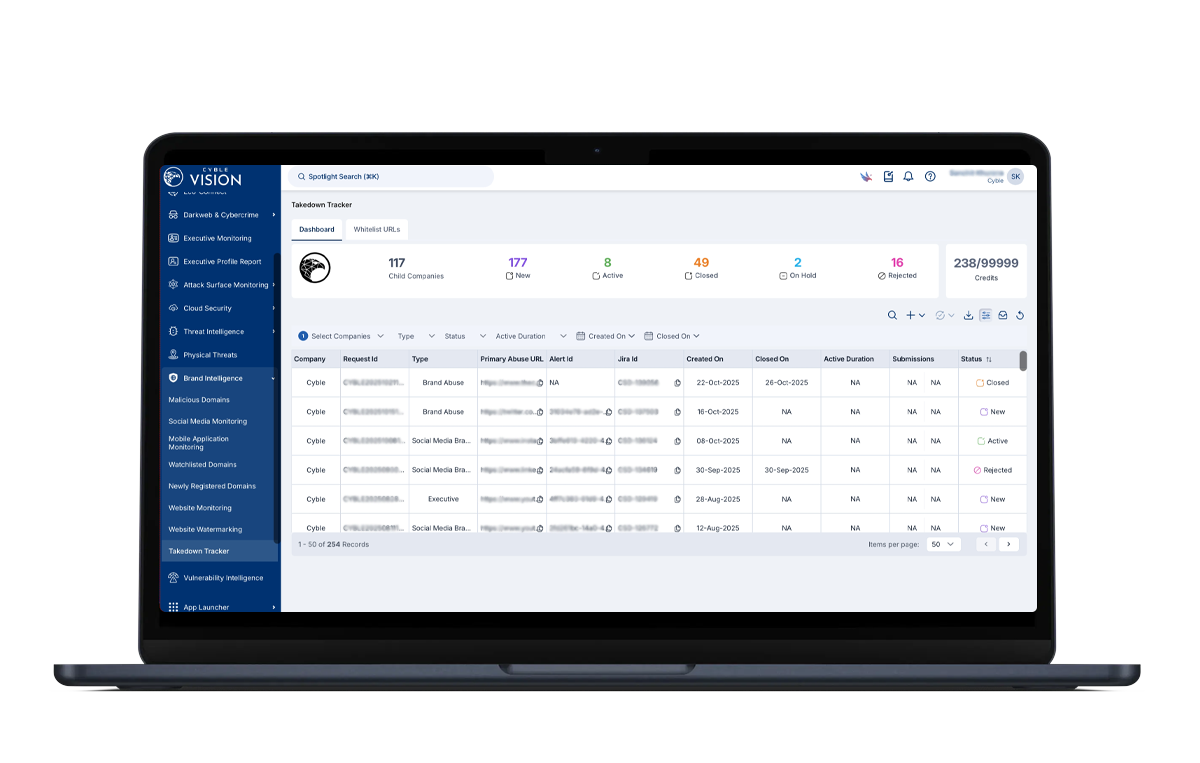
Remediation and ticketing handoff. Watch whether findings become tracked work items in Jira, ServiceNow, Slack, or PagerDuty, and whether the platform stops at the ticket or also acts. Visibility without routing is the most common ASM failure mode: a finding that does not route to an owner with authority to fix it is a backlog entry. Ticketing integration proves workflow depth, because a platform that only produces a standalone report forces a manual translation step before remediation happens.
-
Continuous monitoring. Ask what is detected between scans and how new assets are picked up as they appear. The United Kingdom National Cyber Security Centre (NCSC), in its external attack surface management buyer’s guide, recommends continuous external discovery with at least a daily refresh. Cloud resources spin up and down, developers push code, and Domain Name System (DNS) records change far more often than a quarterly review cycle can catch. Continuous monitoring proves the platform is more than a point-in-time scanner.
What A Credible Attack Surface Management Demo Should Surface
Those six stages describe the structure of the demo. Stages two and three, asset discovery and unknown asset surfacing, should produce concrete findings. The asset types below are the ones a credible demo should surface, so compare this list against what the vendor actually shows you.
-
Subdomains. Campaign subdomains, staging and user acceptance testing environments, merger and acquisition leftovers, and software-as-a-service (SaaS) tools wired in through Canonical Name (CNAME) records are almost always missing from declared inventories. These assets still carry the organization’s trust relationship while sitting outside its security controls.
-
Cloud storage buckets. A bucket policy granting read access to an unrestricted principal is publicly accessible by design, with no vulnerability involved. Policy misconfiguration, rather than a software flaw, creates the exposure. Publicly accessible storage buckets are a documented component of the external attack surface.
-
Expired or misissued certificates. An expired certificate creates an outage. A misissued certificate creates a trust failure. A missing Certificate Authority Authorization (CAA) record means any certificate authority can issue a certificate for the domain.
-
Forgotten staging and test servers. The average enterprise can run hundreds of internet-facing assets it did not deliberately deploy. Test environments left on the public internet form a consistent initial access vector.
-
Shadow IT. Cloud instances, SaaS tools, and integrations that business units stood up without involving security or IT extend the perimeter beyond what any internal inventory captures.
-
Exposed admin interfaces. Closing administrative interfaces, such as management consoles, Remote Desktop Protocol (RDP), Secure Shell (SSH), database ports, and admin panels, to the internet removes a large share of initial access paths.
-
Outdated software versions. End-of-life software and hardware no longer receive security updates, so they stay exposed to known exploits long after a patch exists.
-
Misconfigured services. Misconfigurations can appear at any time, and they frequently open exposure that no vulnerability scanner would flag.
Questions To Ask During The Demo
The six stages above tell you what to watch for. These questions tell you what to ask when the vendor’s narrative skips or glosses over a stage.
-
How does the platform handle assets you did not know you had? Ask the vendor to show discovery starting from a limited seed set, such as a domain and a CIDR range, and to walk through how the platform expands from there without relying on a complete internal inventory you supply.
-
What happens after a finding, does it ticket, or does it also remediate? Ticketing integration with Jira, ServiceNow, Slack, or PagerDuty is table stakes. Ask whether the platform stops at the ticket or can act on findings directly.
-
How is relevance scored against your environment rather than against the internet in general? Push the vendor on what inputs go into risk scoring and whether scoring reflects live threat activity, including whether findings are elevated when the underlying vulnerability is actively exploited in the wild.
-
What does continuous monitoring detect between scans? Ask for a specific example of a change, such as a new subdomain, a newly opened port, or a certificate issued for an unknown host, and how quickly the platform would surface it.
-
How are findings enriched before an analyst sees them? Raw indicators with no context force an analyst to spend the first hour of every case doing manual pivoting before any decision can be made. Ask what arrives with the finding.
-
How does the platform resolve an obfuscated or cross-language reference to your brand? Entity resolution, the process of automatically determining that a misspelled or foreign-language reference in a post refers to your organization, is where artificial intelligence (AI) native platforms separate from rule-based ones. If the vendor cannot describe this process, findings will include noise that does not belong to you and miss mentions that do.
-
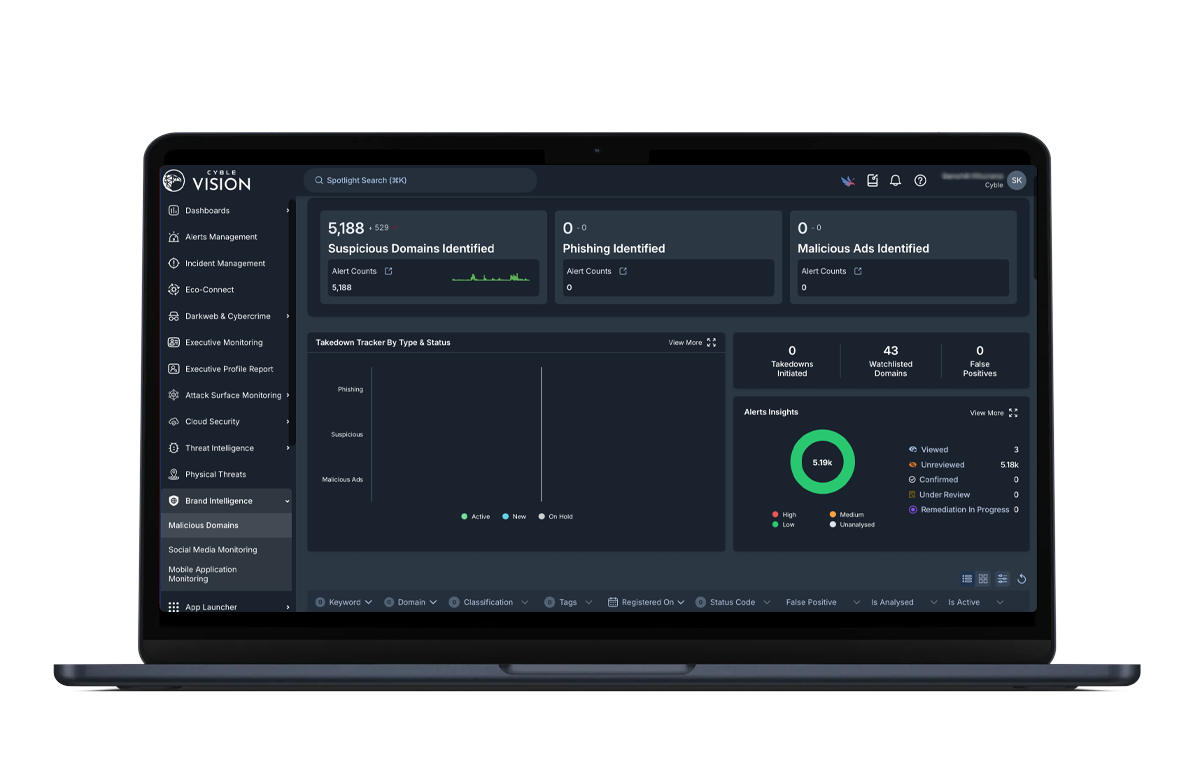
What happens when a finding is a phishing site or a lookalike domain, is takedown native or referred to a partner? A lookalike domain, a near-identical domain registered to impersonate a brand, can operate for weeks before anyone internal notices. Ask whether detection and removal are one motion or two vendors.
These questions map directly to Cyble’s differentiators: entity resolution at ingestion, external attack surface mapping via ODIN across the full Internet Protocol version 4 (IPv4) and Internet Protocol version 6 (IPv6) address space, and native managed takedown. ODIN is Cyble’s internet-wide asset discovery engine. It systematically probes every reachable address to record what is running there, then matches findings against your known assets to surface the ones nobody remembered were there.
See Cyble Against Your Own Environment
Why Cyble Is The Platform To Demo First
Cyble aligns closely with the evaluation framework you just built. The platform addresses scope input, discovery breadth, unknown asset surfacing, contextual risk scoring, workflow integration, and continuous monitoring in ways that answer the hardest evaluator questions.
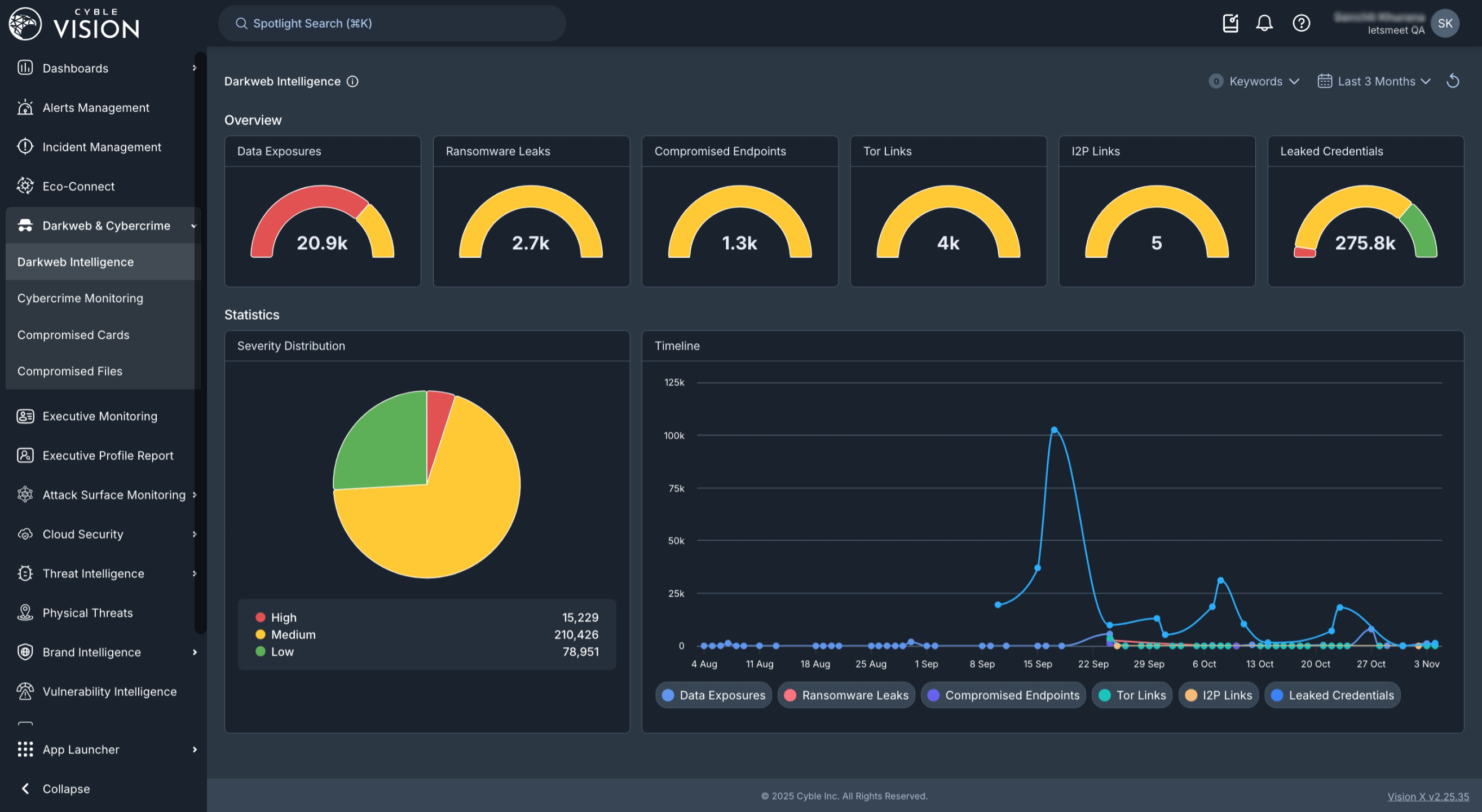
ODIN maps internet-facing assets across the entire IPv4 and IPv6 space. That coverage includes shadow and forgotten infrastructure that never made it onto an asset register. Entity resolution runs at ingestion, so a misspelled or cross-language reference to your organization is resolved to the right entity before it becomes an alert. Cyble reports a ninety-five percent signal-to-noise ratio, based on Cyble internal telemetry, and findings arrive enriched in minutes rather than hours. Detection and managed takedown sit in one platform rather than two vendors, with a reported ninety-eight percent takedown success rate based on Cyble internal telemetry.
Cyble was placed as a Challenger in the inaugural 2026 Gartner® Magic Quadrant™ for Cyberthreat Intelligence Technologies, the first Magic Quadrant for this market, in which Cyble reports being one of only two vendors placed as a Challenger out of seventeen evaluated. A Magic Quadrant placement is not an endorsement or a ranking. Cyble was also included in the Forrester External Threat Intelligence Landscape, Q1 2026. Capabilities, coverage, and service levels vary by subscription tier and region.
If you are comparing vendors side by side, Cyble maintains a comparison hub with current positioning.
Start A Cyble Demo For Your Team
Frequently Asked Questions
What are the three key components of attack surface monitoring?
Attack surface monitoring consists of three repeating components. Asset discovery maps known domains and uncovers subdomains and infrastructure. Continuous scanning checks exposed services, certificates, configurations, and software versions for changes. Risk scoring and prioritization then weigh severity against real-world exposure and business context to focus response on the riskiest issues first. Together these components convert unknown assets into known ones and catch configuration drift before it becomes a breach.
What is the difference between an attack vector and an attack surface?
The attack surface is the complete set of points where an attacker could interact with a system, including every resolving hostname, answering port, login form, API endpoint, cloud bucket, and identity that can be reached from outside. An attack vector is the specific method used to exploit one of those points, such as credential stuffing against a login page or subdomain takeover of a dangling DNS record. The surface is an inventory you can enumerate, while the vector is a scenario you can describe and test. Reducing the surface eliminates entire categories of attack vectors at once, which is why ASM prioritizes removing unnecessary exposure before patching it.
How do you reduce attack surface after the demo?
Reduction follows a consistent sequence that you can repeat after every demo or scan.
-
Decommission unused assets and close administrative interfaces to the internet.
-
Fix dangling DNS records pointing at deprovisioned cloud resources.
-
Enforce multi-factor authentication on every external login.
-
Keep certificates and domains from lapsing.
-
Patch exposed assets, prioritized by active exploitation evidence rather than CVSS score alone.
-
Audit third-party scripts running on your own pages.
-
Assign an owner to every external asset.
Continuous monitoring then detects new exposure as it appears between planned audits, so reduction becomes a loop rather than a one-time project.
What are some examples of attack surfaces?
The external attack surface includes subdomains, public IP ranges, exposed APIs, cloud storage buckets, login portals, Transport Layer Security (TLS) certificates, DNS records, and third-party scripts running on an organization’s pages. Shadow IT, such as cloud instances and SaaS tools stood up without IT involvement, extends the surface beyond what any declared inventory captures. Lookalike domains registered to impersonate a brand are also part of the external attack surface, even though they sit on infrastructure the organization does not own.
Conclusion: See The Platform Against Your Own Environment
You now have the framework, with six stages to watch and a checklist of questions to ask. You also have a clear picture of how Cyble’s platform behaves against each stage, from discovery and prioritization through routing and takedown.
The decision now centers on whether you see the platform against your own environment or only through a curated slide. A demo run against representative data shows the vendor’s best-case narrative. A POC run against your own domains, CIDR ranges, and subsidiaries shows what you did not know you had.
Request a demo and see what Cyble finds in your environment