
Key Takeaways
-
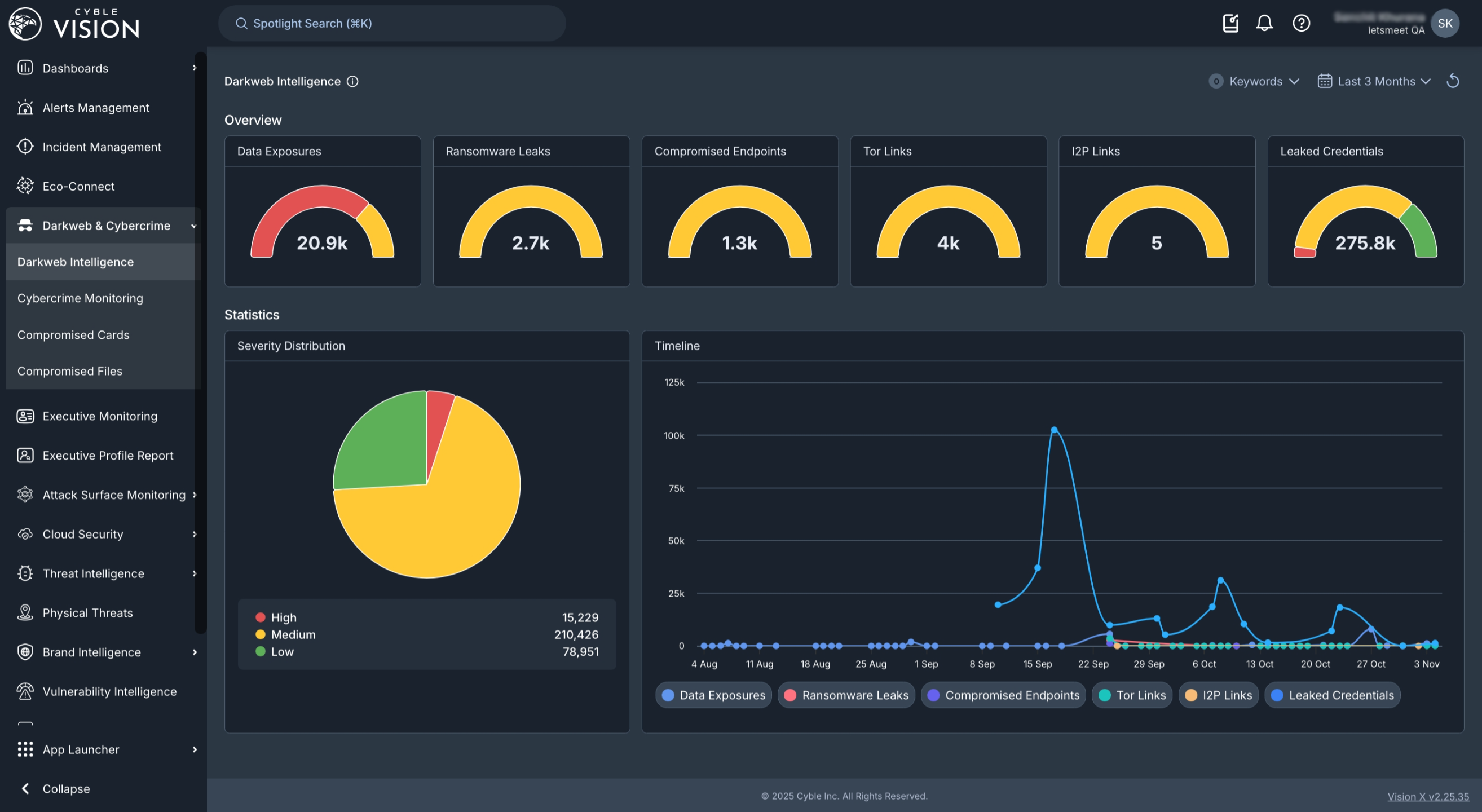
Brand protection dark web monitoring continuously scans surface, deep, and dark web sources, including criminal forums, ransomware leak sites, Telegram channels, paste sites, and underground marketplaces. It flags material that exposes an organization’s brand, credentials, executives, or infrastructure.
-
Effective monitoring runs as a five-step loop: detect, verify, enrich, alert, and take down. Friction at any step determines whether the loop closes or stalls.
-
Phishing sites, lookalike domains, fake mobile apps, impersonation accounts, and some leaked data can usually be removed through registrar and hosting provider abuse processes. Content on platforms with no functioning abuse process or material already widely copied is harder or slower to remove.
-
Enterprise brand protection dark web monitoring covers the organization’s brand, customers, executives, and infrastructure across criminal forums, ransomware leak sites, Telegram channels, and app stores. It also includes managed removal, which consumer identity protection services do not provide.
-
Cyble provides AI-native collection, native managed takedown with a 98% success rate, 70+ native integrations, and coverage across 15,000+ darknet marketplaces. Blaze AI is the platform, and Cyble Vision is the usual entry point for security and brand protection teams.
What Brand Protection Dark Web Monitoring Actually Covers
Brand and security teams care most about four exposure categories that repeatedly drive fraud, incident response, and reputation risk.
Leaked credentials and infostealer logs. Usernames, passwords, session cookies, and authentication tokens are harvested from infected devices by infostealer malware families such as Lumma, RedLine, and Vidar. Criminals upload these logs to marketplaces, often within hours of infection.
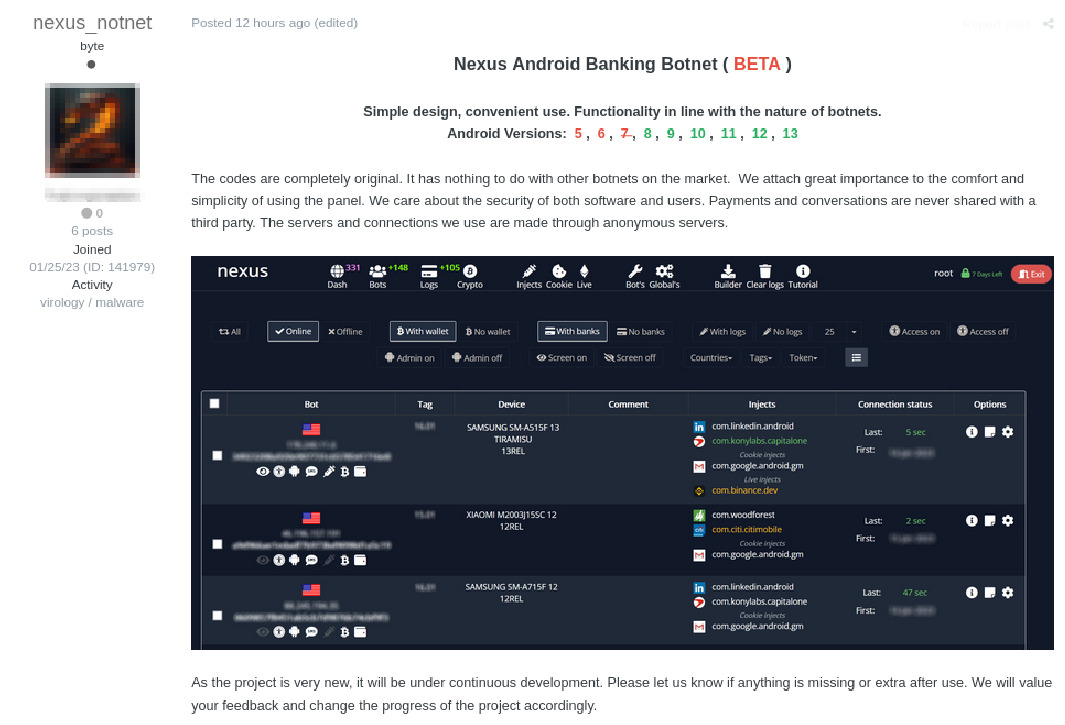
Stolen documents, source code, and customer data. Internal HR files, contracts, customer databases, API keys, configuration files, and source code repositories appear on ransomware leak sites or in trades on forums such as BreachForums and XSS.is. According to the CrowdStrike Global Threat Report 2025, over 60% of ransomware incidents now involve double extortion, meaning victim data is already on a leak site before any ransom demand is made.
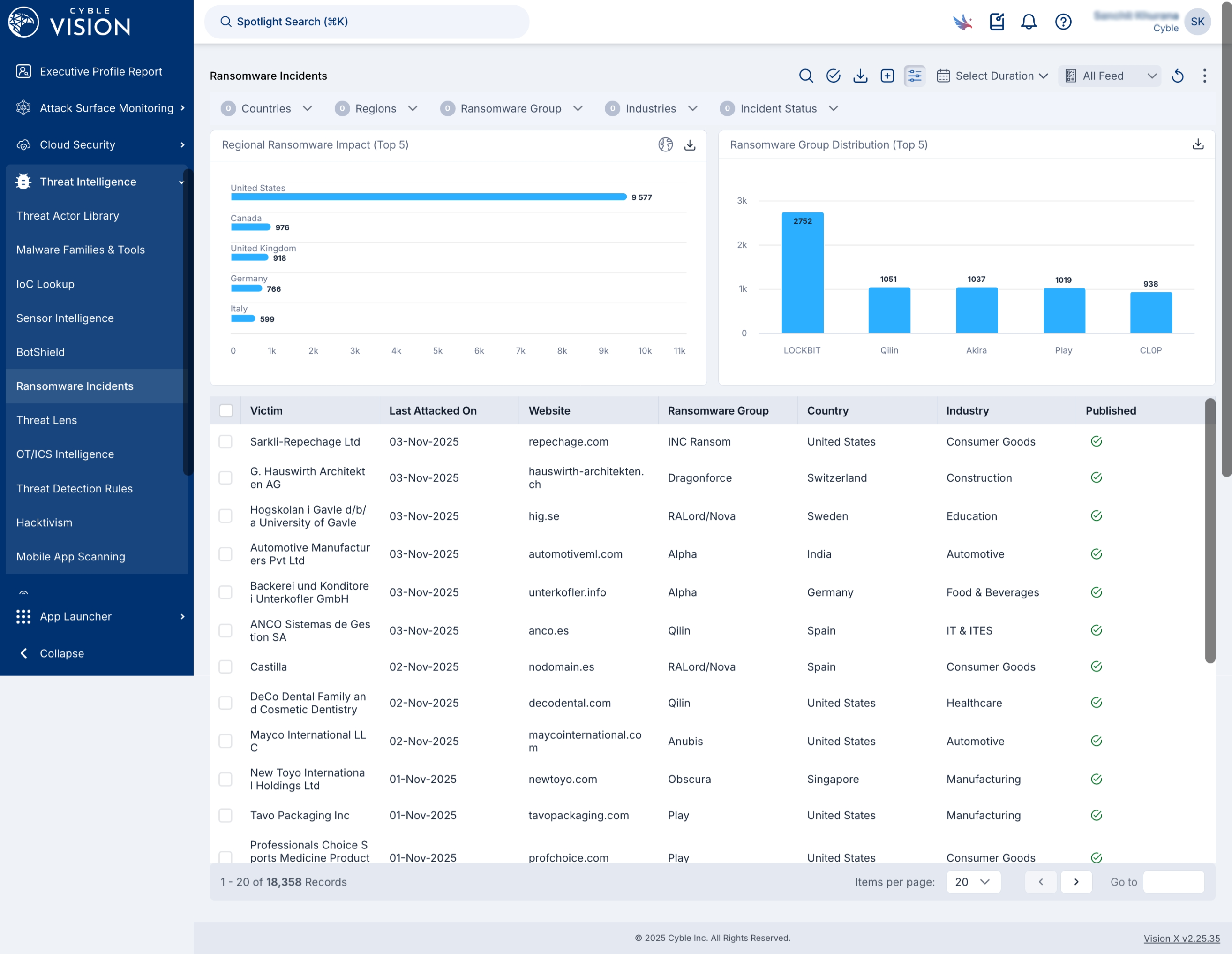
Impersonation and lookalike domains, fake apps, and phishing infrastructure. Threat actors register near-identical domains to impersonate a brand, stand up spoofed login pages, deploy phishing kits tailored to a brand’s authentication flow, and distribute counterfeit mobile applications through third-party app stores. The Anti-Phishing Working Group recorded 971,181 phishing attacks in the first quarter of 2026, up 13.8% from the previous quarter.
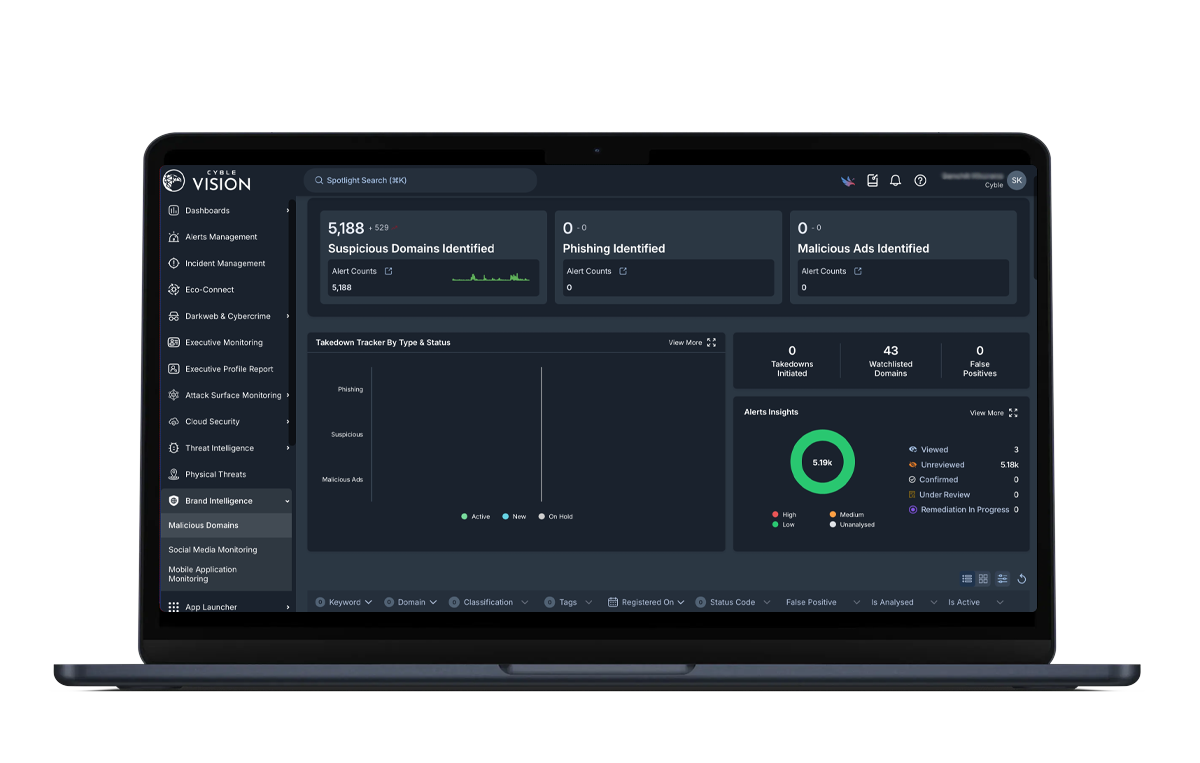
Executive exposure including deepfakes and personal data. Personally identifiable information (PII) such as names, addresses, and government ID numbers for named executives appears alongside synthetic audio and video impersonations, compromised personal credentials, and threatening public mentions. For a deeper look at this category, see Dark Web Monitoring for Executives: A Complete Guide.
Material surfaces across Telegram channels, paste sites, ransomware leak sites, underground marketplaces, and third-party app stores. Because that material is often obfuscated or misspelled, entity resolution, the automated process of determining that a reference in a foreign-language post refers to a specific organization, separates a relevant finding from keyword noise. Without it, the same credential dump seen by a security operations center (SOC) and the same phishing kit seen by a fraud team are treated as two separate incidents rather than one.
How Does Brand Protection Dark Web Monitoring Work?
Brand protection dark web monitoring works as a five-step loop, and each step introduces friction that can either keep the process moving or cause it to stall.
-
Detect. AI-driven collection runs across the surface, deep, and dark web, with source prioritization set at the collection layer rather than by a human analyst configuring keyword rules. The friction here is source breadth: a platform that misses Telegram channels, private forums, or stealer log streams will not surface the signal at all. Cyble addresses this by monitoring visibility across 15,000+ darknet marketplaces.
-
Verify. Entity resolution filters keyword noise before it reaches an analyst. The friction is false-positive volume: a feed that alerts on every brand mention regardless of context saturates the queue and trains analysts to ignore it. Cyble counters this with a reported 95% signal-to-noise ratio.
-
Enrich. The platform links each finding to the breach it came from, the initial access broker selling access, and the ransomware group known to buy from that broker. The friction is manual pivoting: without automated enrichment, an analyst spends the first hour of every case doing correlation work before any decision can be made. For more on how this pipeline operates, see How Dark Web Monitoring Works: Full Pipeline, Step by Step.
-
Alert. Enriched findings flow into the security information and event management (SIEM), security orchestration, automation and response (SOAR), or ticketing system the team already uses. The friction is console sprawl: an alert that lands in a separate dashboard nobody checks after the first month produces no outcome. Cyble Vision avoids this by supporting 70+ native integrations including Splunk, Microsoft Sentinel, IBM QRadar, Cortex XSOAR, and ServiceNow, plus REST APIs.
-
Take down. The platform removes phishing sites, lookalike domains, fake apps, impersonation accounts, and leaked data through a managed service that runs against service level agreements (SLAs). The friction is the handoff gap: many intelligence products end at the alert and leave the hard part with the customer.
Cyble runs all five steps on one platform. Blaze AI, the agentic platform layer, spans cyber threat intelligence (CTI), external attack surface management (ASM), digital risk protection (DRP), brand disruption, and managed takedown on a shared data layer. Cyble Vision is the usual entry point for security and brand protection teams.
See the five-step loop in action
Takedown Reality: What Can Be Removed and What Cannot
Most brand protection programs stall at the takedown stage, so teams need a clear view of what is achievable and what remains difficult.
Takedown success depends on whether a platform or provider has a functioning abuse process. The categories below reflect that divide.
What can typically be removed:
-
Phishing sites and credential-harvesting pages
-
Spoofed and lookalike domains, via registrar abuse processes
-
Fake mobile applications on third-party app stores
-
Impersonation accounts on social platforms
-
Leaked data in some contexts, depending on the platform and jurisdiction
What is harder or slower:
-
Content on platforms with no functioning abuse process
-
Material already widely copied across multiple hosts
-
Anything requiring cross-jurisdiction enforcement coordination
-
Data published on ransomware leak sites or dark web forums, where there is no operator to petition
The friction in every takedown is structural. Each registrar, the company that sells and administers a domain name, and hosting provider, the company whose servers a malicious site runs on, operates its own abuse process. Those processes differ in evidence standard and jurisdiction, and none publishes an SLA. Under the amended ICANN Registrar Accreditation Agreement, which took effect April 5, 2024, accredited registrars must review well-founded reports of illegal activity within 24 hours. That review requirement does not guarantee a domain suspension within 24 hours. Operational response still depends on evidence, registrar assessment, and jurisdiction. Typical timelines run from same-day for major hosting providers on clear phishing domains to days or weeks for registry escalation after registrar nonresponse.
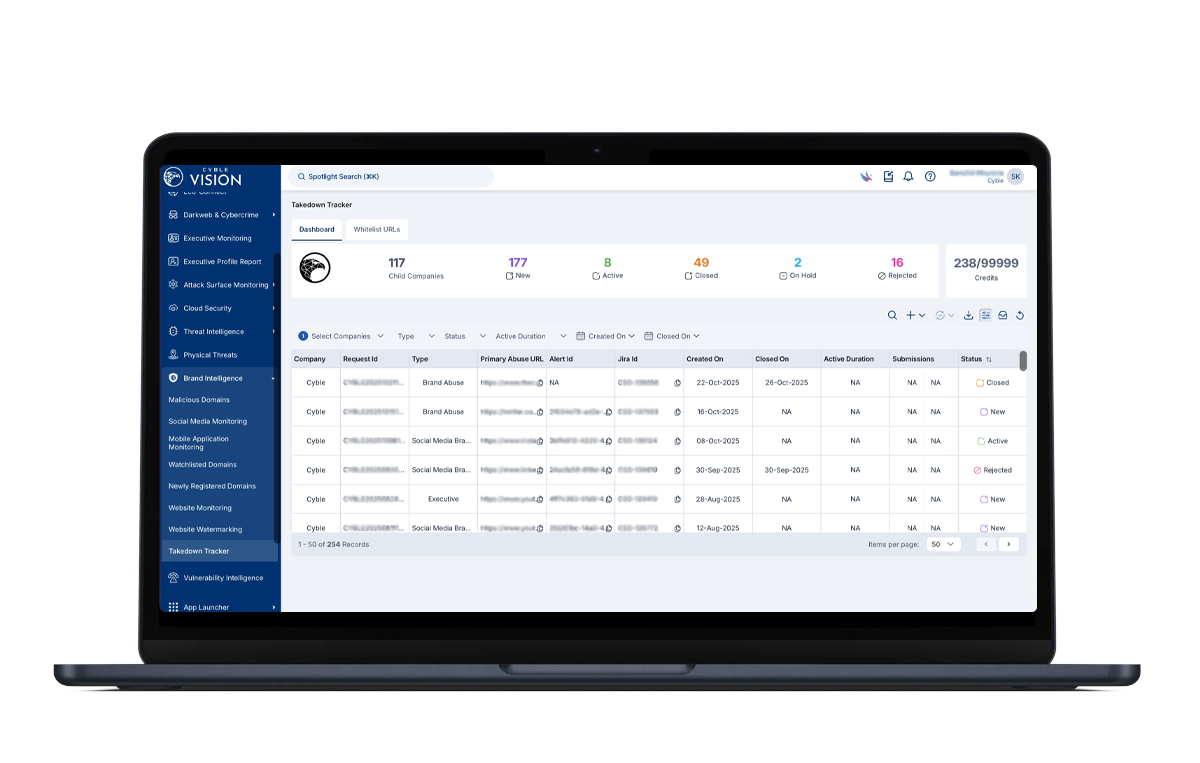
Cyble’s native managed takedown runs inside the platform rather than through a third-party referral. It combines automated workflows with global enforcement to remove malicious content at scale, delivered against SLAs. Cyble reports a 98% takedown success rate; timelines vary by content type and jurisdiction, and results depend on the customer’s environment, asset scope, and configuration. Netcraft’s research identifies five common friction points that delay phishing takedowns: manual triage backlogs, manual evidence validation, incorrect routing to the wrong provider in the hosting chain, cold provider relationships, and lack of automated escalation. A managed takedown service with established registrar and hosting relationships is positioned to reduce each of those friction points.
How to Choose a Vendor
Five criteria separate a program-grade platform from a basic feed subscription.
-
Dark web coverage depth. Source breadth across named forums, ransomware leak sites, Telegram channels, stealer log streams, and paste sites, plus the freshness of that collection. A platform that ingests only widely circulated breach dumps misses the narrow window when credentials are still actionable.
-
Impersonation detection. Coverage for lookalike domains, fake apps, social impersonation, and executive deepfakes that directly affect customers and leadership.
-
Takedown capability. Whether removal is native to the platform or a referral. Native managed takedown with SLAs and documented success rates operates very differently from filing an abuse report and waiting.
-
Alert quality and relevance. Entity resolution and relevance scoring against the customer’s own domains, subsidiaries, executives, and technology stack. A 95% signal-to-noise ratio means analysts spend time on findings that matter.
-
Integrations with the existing stack. Whether enriched findings land in the SIEM, SOAR, or ticketing system the team already uses, or require a separate console.
Cyble’s positioning on each of these criteria is clear: AI-native collection rather than a summarization layer on a legacy pipeline, detection and managed takedown from one vendor, relevance scoring against the customer’s specific attack surface, and 70+ native integrations including REST APIs and TAXII support. For named vendor comparisons, Cyble maintains current positioning at cyble.com/compare/.
The table below maps these criteria to what to look for and how Cyble Vision addresses each one, so you can see where a feed subscription falls short of a program-grade platform. Capabilities, coverage, and service levels vary by subscription tier and region; all figures are drawn from publicly documented sources and Cyble internal telemetry.
|
Attribute |
What to Look For |
Cyble Vision |
|---|---|---|
|
Dark web coverage |
Named source list, stealer log ingestion, refresh cadence |
15,000+ marketplaces (see above); Telegram, paste sites, ransomware leak sites; AI-driven source prioritization |
|
Impersonation detection |
Lookalike domains, fake apps, social impersonation, executive deepfakes |
Brand intelligence monitoring across domains, app stores, social platforms, and dark web |
|
Takedown |
Native vs. referral; SLA; documented success rate |
Native managed takedown; 98% success rate; delivered against SLAs |
|
Integrations |
SIEM, SOAR, ticketing; API access |
70+ integrations (see above); REST APIs; TAXII support |
Is It Worth It, and What Does It Cost?
Once you have a shortlist, the next question is whether the spend is justified. The worth question comes down to the two gaps the discipline closes. Gap one is exposure to awareness, the time between a credential dump, spoofed domain, or fake app appearing in the wild and the moment the internal team knows. Gap two is awareness to action: a phishing site that has been identified still has to be removed.
The cost of a missed credential dump or a live phishing site is measured in fraud loss, customer churn, and regulatory penalty, not in subscription fees. The IBM Cost of a Data Breach Report 2024 pegs the average data breach at $4.88 million.
On pricing, enterprise brand protection dark web monitoring is quote-based, and cost is driven by the number of monitored brands and domains, executive protection scope, takedown volume, and service tier. According to a June 2026 DarkThreat.AI pricing analysis, enterprise dark web monitoring tiers typically scale from mid-market deployments to enterprise suites starting at $80,000 and above annually for unlimited domains, custom integration, and dedicated analyst support. Capabilities, coverage, and service levels vary by subscription tier and region.
The distinction from consumer tools is categorical: the two categories differ in scope, audience, and service model. Consumer identity protection services, products designed for individuals and families, monitor a single person’s credentials, credit activity, and identity-theft indicators, then provide alerts and restoration assistance. Enterprise brand protection dark web monitoring covers the brand, its customers, its executives, and its infrastructure across criminal forums, ransomware leak sites, Telegram channels, and third-party app stores, and includes managed removal. The two serve different purposes and different audiences. For more on the credential monitoring dimension, see Dark Web Credential Monitoring: How It Works.
Compliance Drivers That Justify the Budget
The two gaps this article has traced, exposure to awareness and awareness to action, also appear in regulatory obligations. Frameworks do not mandate a specific dark web monitoring product, but they create operational requirements that external threat monitoring directly supports.
The NIS2 Directive (EU) 2022/2555 requires covered entities to implement proportionate cybersecurity risk-management measures including threat intelligence. Article 23 sets three notification deadlines: an early warning within 24 hours of becoming aware of a significant incident, an incident notification within 72 hours, and a final report within one month. Early external detection of leaked data or impersonation infrastructure produces a documented, time-stamped starting point for that notification clock, which is exactly what a regulator expects to see.
The Digital Operational Resilience Act (DORA), Regulation (EU) 2022/2554, became enforceable on January 17, 2025, and requires EU financial entities to implement continuous monitoring and control of information and communications technology (ICT) system security, monitoring of user activity and ICT anomalies, and layered detection controls with defined alert thresholds. Monitoring exposed credentials, stolen data, impersonation, and threats involving ICT providers strengthens the continuous threat intelligence and incident detection evidence that DORA supervisors examine.
The SEC’s final cybersecurity disclosure rules (Release Nos. 33-11216; 34-97989) require US public companies to disclose material cybersecurity incidents on Form 8-K within four business days of a materiality determination. The same rules require annual disclosures on Form 10-K regarding cybersecurity risk management, strategy, and governance. External attack surface management maps internet-facing assets, including forgotten and shadow infrastructure, and external exposure signals can help establish scope, support materiality analysis, and preserve a defensible timeline of discovery and escalation decisions.
For governance, risk and compliance (GRC) teams, SOC 2 and ISO 27001 create evidence and audit drivers. SOC 2 trust services criterion CC7.2 requires monitoring for anomalies that can flag compromised credentials, and CC7.1 is among the criteria to which digital risk protection services (DRPS) evidence maps, and ISO 27001 Annex A 5.7 covers threat intelligence as a required control. A documented, time-stamped record of external detections, triage decisions, and removal outcomes is the evidence package an auditor requests.
Build your compliance evidence trail
Frequently Asked Questions
The questions below address the points brand and security teams raise most often when they evaluate this discipline.
What Does Brand Protection Dark Web Monitoring Monitor?
Brand protection dark web monitoring covers four primary exposure categories: leaked credentials and infostealer logs; stolen documents, source code, and customer data; impersonation and lookalike domains, fake mobile apps, and phishing infrastructure; and executive exposure including deepfakes and personal data. Material is collected from Telegram channels, paste sites, ransomware leak sites, underground marketplaces, and third-party app stores. Coverage depth varies by platform, and the key differentiators are source breadth, stealer log ingestion, collection freshness, and whether entity resolution is applied before findings reach an analyst.
Can Threats Actually Be Taken Down, or Are Requests Just Filed?
Phishing sites, lookalike domains, fake mobile apps on third-party stores, and impersonation accounts can typically be removed through registrar and hosting provider abuse processes, platform enforcement channels, and app store policies. Harder or slower scenarios include content on platforms with no functioning abuse process, material already widely copied, and anything requiring cross-jurisdiction enforcement. The difference between a managed takedown service and filing an abuse report yourself lies in established provider relationships, automated evidence packaging, parallel submission across registrar, host, and blocklists, and SLA accountability. Cyble’s native managed takedown is part of the platform rather than a referral, with the same reported success rate; timelines vary by content type and jurisdiction.
How Is This Different From Consumer Dark Web Monitoring?
As noted earlier, consumer tools serve individuals rather than organizations. Enterprise platforms add managed removal and entity resolution against the organization’s specific domains, subsidiaries, and technology stack. They also deliver enriched findings into SIEM, SOAR, and ticketing systems and operate at workforce scale.
How Do I Justify the Spend to a CFO?
The budget case rests on the two gaps and their consequences. As the cost section noted, the impact of a missed credential dump or a live phishing site is measured in fraud loss, customer churn, and regulatory penalty, and those losses dwarf subscription fees. Regulatory drivers such as NIS2, DORA, and SEC disclosure obligations create documented requirements with financial penalties for non-compliance that can be quantified against subscription cost. The strongest budget case usually emerges during a proof of concept (POC), when previously unknown findings specific to the organization become concrete rather than hypothetical.
How Long Does Onboarding Take?
A guided 14-day POC is available to surface findings against an organization’s own environment before a full commercial cycle completes. Full enterprise deployments typically run three to six months end to end, covering request a demo, qualification, a solutions engineer-led session, a proof of concept, technical acceptance, negotiation, and contract. The POC is the fastest way to validate coverage against a specific environment and establish whether the platform surfaces previously unknown exposure. Capabilities and onboarding timelines vary by subscription tier and region.
Conclusion: Closing the Loop
Brand protection dark web monitoring closes two gaps: exposure to awareness and awareness to action. The five-step loop, detect, verify, enrich, alert, and take down, is only complete when all five steps run on one platform without a handoff gap between detection and removal. Detection without removal leaves the hard part with the security team, the fraud team, or whoever owns the abuse report queue that week.
Practical next steps for any organization evaluating this discipline are straightforward. Scope your brand and executive exposure across domains, subsidiaries, and named individuals. Confirm internally who owns takedown when a phishing site or fake app is identified. Test coverage against your own environment in a POC before committing to a platform. The POC should surface at least one previously unknown finding; if it does not, the asset scope is too narrow.