

Key Takeaways
Here are the five most important points from this article:
- Dark web monitoring for financial services requires continuous surveillance of markets, forums, infostealer logs, ransomware sites, and criminal channels for institution-specific data such as card ranges, credentials, and executive profiles.
- Financial institutions face a distinct threat model that includes bank identification number (BIN) or issuer identification number (IIN) exposure, credential stuffing, initial access broker listings, ransomware leaks, executive impersonation, and brand abuse beyond generic credential monitoring.
- Comprehensive coverage requires monitoring eight categories: payment card data, infostealer logs, virtual private network (VPN) access listings, ransomware mentions, executive personally identifiable information (PII), lookalike domains, fake apps, and third-party vendor exposure.
- Successful implementation depends on a complete workflow from real-time detection through entity resolution, Security Information and Event Management (SIEM) and security orchestration, automation and response (SOAR) integration, and remediation including card blocks, credential resets, and managed takedown.
- Cyble delivers the recommended platform for financial services with entity resolution, native takedown capabilities, and integration into existing fraud and security operations workflows.
See what Cyble finds in your environment.
Why Financial Services Is a Distinct Threat Model
“Financial services” is a threat model, not just a label. The sector combines high-value consumer data, real-time payment rails, regulatory disclosure obligations, and brands that criminals can impersonate for immediate monetary gain. These threat categories interact and often feed one another, which makes the overall risk profile unique for banks, credit unions, insurers, and fintechs.
- Bank identification number (BIN) or issuer identification number (IIN) range and card data exposure: The bank identification number (BIN), also called the issuer identification number (IIN), is the first six to eight digits of a payment card. It identifies the issuing institution, which means a threat actor with a BIN range can target card-present fraud specifically at one bank’s customers.
- Banking credentials and credential stuffing: Credential stuffing is the automated replay of stolen username-and-password pairs against banking portals and other services at scale. According to Kaspersky’s 2025 Financial Threat Report, over one million online banking accounts served by the world’s 100 largest banks fell victim to infostealers, with credentials freely shared on dark web resources.
- Infostealer logs: Infostealer malware harvests saved credentials, session cookies, and autofill data from infected devices and packages them into log files sold on dark web markets. According to Kaspersky, there was a 59% surge in infostealer detections on PCs globally in 2025.
- Initial access listings: An initial access broker (IAB) is a criminal specialist who breaks into an organization’s network and resells that access rather than attacking further. According to Intel 471’s “Follow the Money” report, IABs advertised unauthorized access impacting 159 financial services entities between January 2025 and June 2026, including offers to sell compromised VPN credentials for approximately 60 companies.
- Ransomware leak sites: A ransomware leak site is the public-facing site a ransomware group uses to publish stolen data and pressure victims into paying. According to Intel 471, there were 340 extortion victims in the financial sector across 74 countries between January 2025 and June 2026, with insurance, investment management, and banking among the most impacted sub-sectors.
- Executive profiling and impersonation: Exposed executive personally identifiable information (PII) enables targeted spear-phishing, business email compromise, and deepfake-assisted social engineering against payment approval workflows.
- Brand abuse, lookalike domains, and fake apps: A lookalike domain is a near-identical domain registered to impersonate a brand. Fake mobile apps on third-party stores harvest customer credentials before the institution is aware they exist.
The financial impact extends beyond direct fraud loss. A breach triggers disclosure obligations, supervisory scrutiny, and potential regulatory penalty. According to IBM’s 2024 Cost of a Data Breach Report, financial services data breaches cost $6.08 million on average, second only to healthcare. The mean time from breach to containment is 241 days.
Beyond direct costs, the sector relies on shared intelligence and standardized frameworks to defend against these threats. FS-ISAC is the sector’s primary intelligence-sharing body, providing financial institutions with threat intelligence and coordinated response resources. MITRE ATT&CK provides the adversary behavior framework that maps threat actor techniques, from initial reconnaissance through data exfiltration, to defensive controls.
What Financial Institutions Should Monitor on the Dark Web
Generic credential monitoring covers only a fraction of the exposure surface relevant to a bank, credit union, insurer, or fintech. A financial-services-specific monitoring program must cover eight categories to close the gaps left by generic credential monitoring:
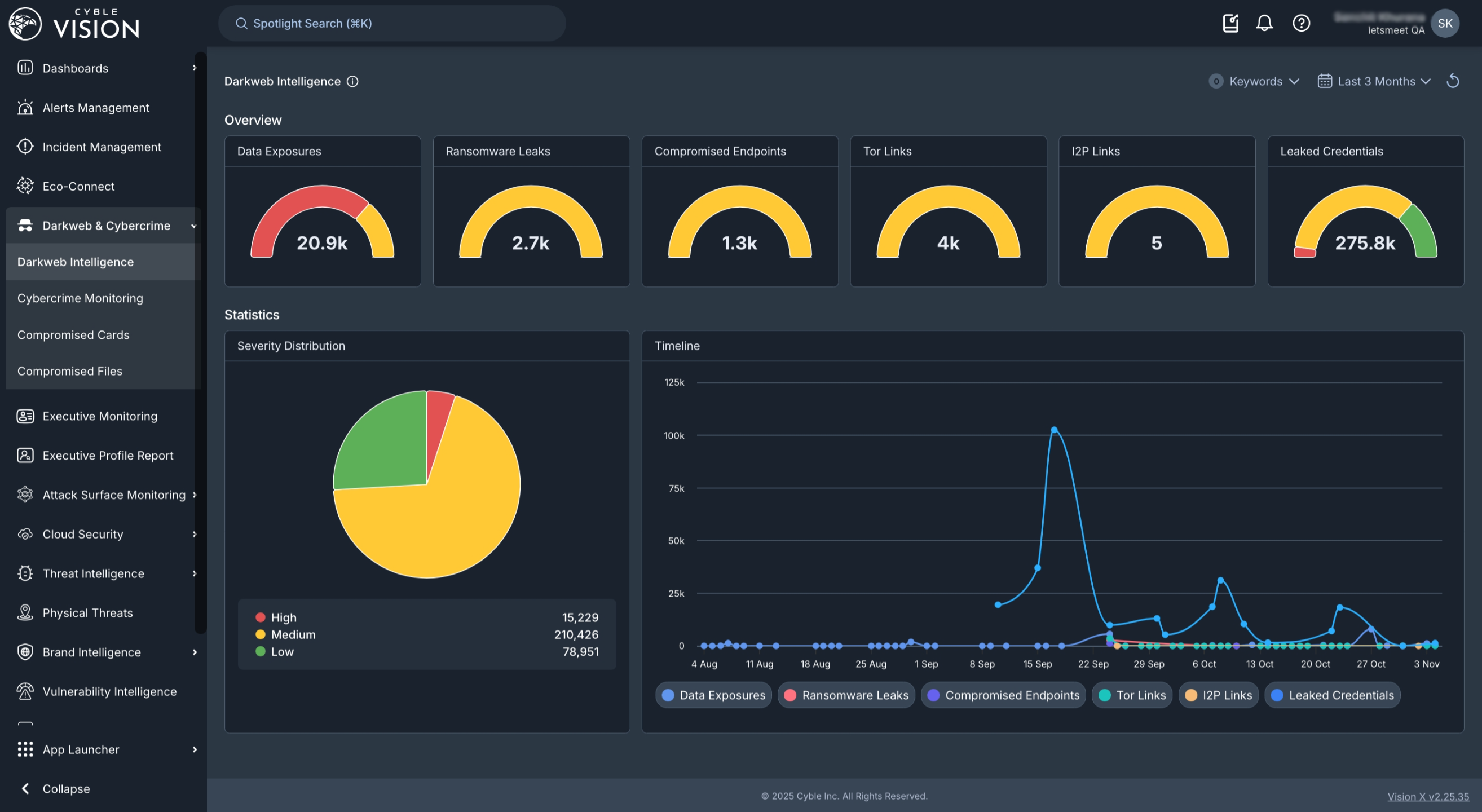
- Payment card and bank identification number (BIN) or issuer identification number (IIN) data
- Banking and customer credentials
- Infostealer logs referencing the institution’s domains
- Initial access listings naming its virtual private network (VPN), Citrix, or remote-access infrastructure
- Ransomware leak site mentions
- Executive and employee personally identifiable information (PII)
- Lookalike domains and phishing kits targeting the login page
- Fake mobile apps on third-party stores
Third-party and vendor exposure deserves dedicated attention. A breach at a payment processor, core banking provider, or cloud vendor can surface the institution’s customer data without any direct compromise of the institution’s own systems. According to Intel 471, in April 2026, the Everest data extortion-as-a-service program operator claimed to compromise two US-based banks; both banks confirmed the breaches originated from a third-party vendor rather than direct unauthorized access to their own networks.
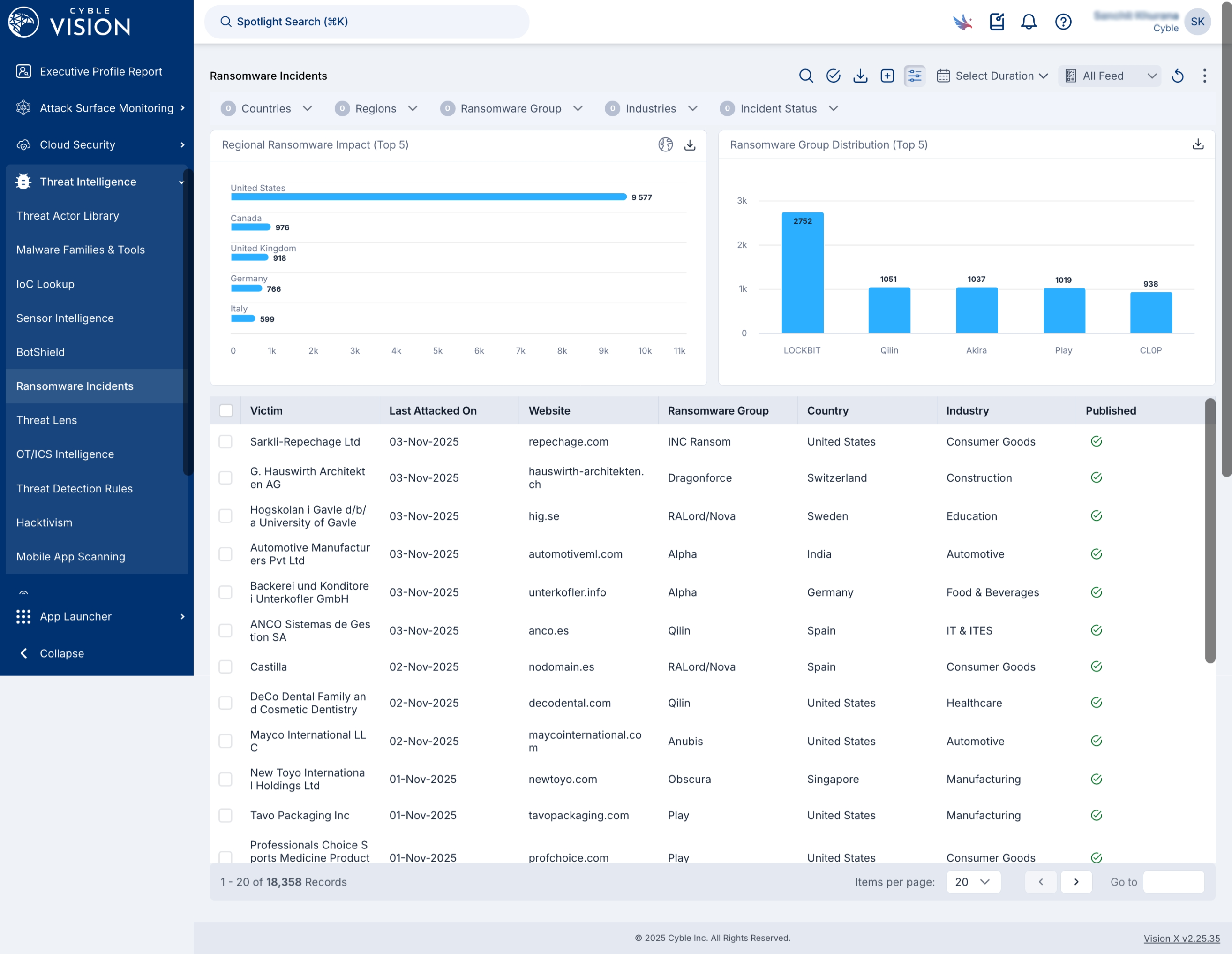
Brand impersonation across domains, social platforms, and app stores rounds out the monitoring scope. According to Nasdaq Verafin’s 2026 Global Financial Crime Report, check fraud losses reached $38.5 billion globally in 2025, with dark web marketplaces identified as an exacerbating factor.
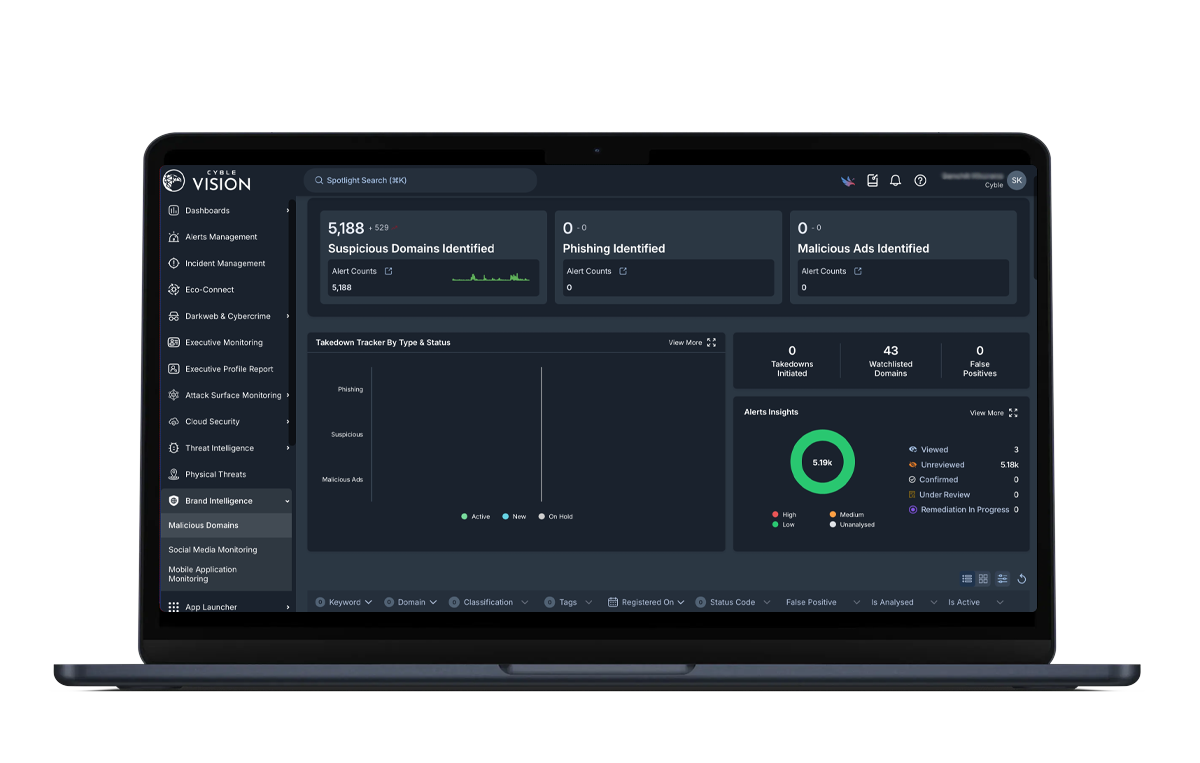
Entity resolution, which automatically determines that an obfuscated or cross-language reference in a Russian-language post refers to the same institution, is a prerequisite for alert quality. Without it, monitoring generates volume without relevance. Visa Threat Intelligence is a named source for payment-credential intelligence that financial institutions can incorporate alongside dark web monitoring to build a more complete picture of card exposure.
According to Kaspersky’s 2025 Financial Threat Report, 74% of payment cards compromised by infostealer malware and published on dark web resources remained valid as of March 2026, meaning attackers could still use cards stolen months or years prior. Monitoring card data remains a continuous requirement.
From Detection to Action: The Operational Workflow
Dark web monitoring only delivers value when alerts drive action. The action layer, where a finding moves from alert to remediation, is where programs succeed or fail. The following workflow traces a single finding end to end.
Detection. A credential or card-data post appears on a monitored marketplace or forum. The platform ingests it in near real time rather than in a daily batch, because according to Constella Intelligence research, the median time from infostealer infection to dark web marketplace listing is under 48 hours, and buyers test credentials within days of listing.
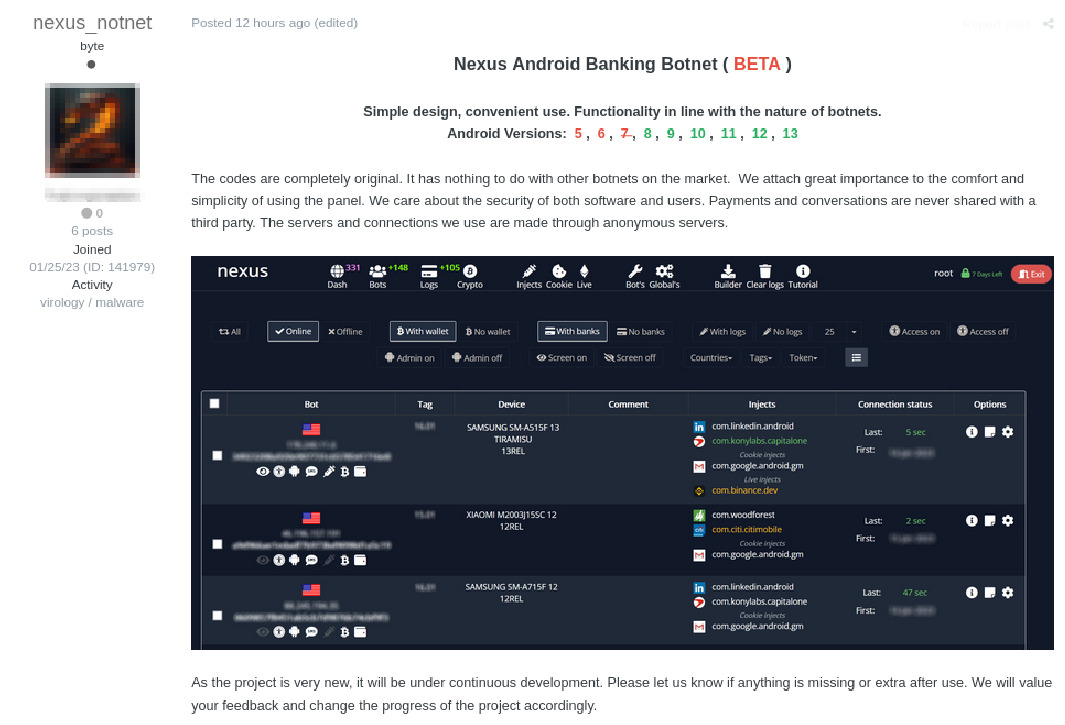
Enrichment and entity resolution. The finding is resolved to the institution, confirming that an obfuscated reference in a forum post refers to this organization’s domains, subsidiaries, or executives, and scored against its own attack surface. The alert arrives connected to the breach it came from, the broker selling access, and the ransomware group known to buy from that broker. This enrichment happens at ingestion and removes the need for a manual pivot after the alert fires.
Integration. Enriched alerts land in the tools the team already runs, including Security Information and Event Management (SIEM), security orchestration, automation and response (SOAR), and fraud platforms, via native connectors and REST application programming interfaces (APIs). The Security Operations Center (SOC) and the fraud team see the same incident rather than two disconnected alerts requiring manual correlation.
Remediation. Teams execute card block and reissue decisions, credential reset and stepped-up authentication, and phishing takedown. Knowing a phishing site exists does not remove it. Takedown work is jurisdictionally complex and, in many stacks, sits with a separate vendor or an internal legal queue, which creates a gap between awareness and action.
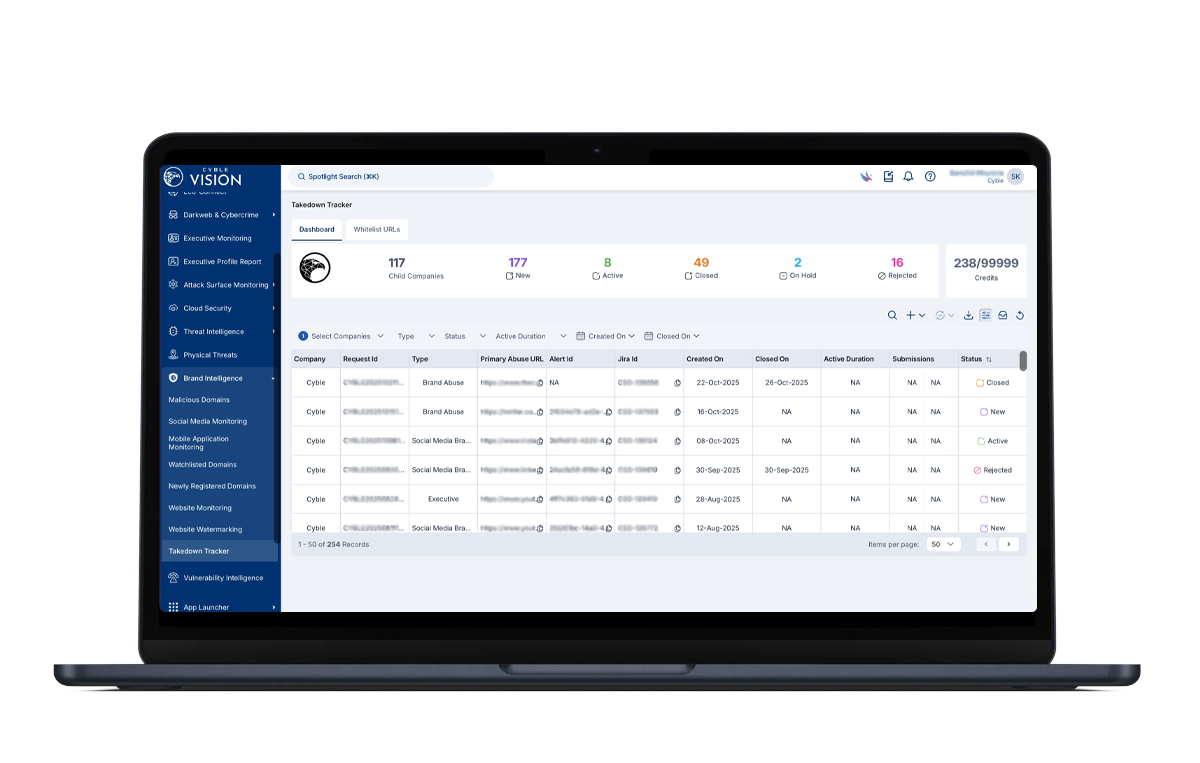
Cyble Vision is the recommended platform for this workflow. It is the flagship platform for cyber threat intelligence (CTI), attack surface management (ASM), and digital risk protection (DRP). Built on an AI-native architecture, it performs entity resolution, relevance scoring, and enrichment at the collection layer rather than as a summarization layer added to a legacy pipeline. Cyble reports a 95% signal-to-noise ratio and enriched alerts in minutes from detection to dissemination, based on internal telemetry.
Native managed takedown is part of the platform and is delivered against service level agreements (SLAs), with a reported 98% takedown success rate based on internal telemetry. Timelines vary by content type and jurisdiction. Cyble Titan covers the endpoint side when the institution wants endpoint detection and response (EDR) correlated with the same external intelligence.
Cyble’s own API and Trusted Automated eXchange of Indicator Information (TAXII) support feed intelligence into existing pipelines, so findings reach the SIEM, SOAR, and fraud platforms the team already operates. Cyble Vision integrates with more than 70 enterprise platforms including Splunk, Microsoft Sentinel, IBM QRadar, Cortex XSOAR, and ServiceNow.
Capabilities, coverage, and service levels vary by subscription tier and region and should be confirmed for the reader’s environment. Statistics are drawn from Cyble internal telemetry.
Request a demo to see the workflow in action.
Cost Drivers and the Free-Scan Versus Enterprise-Platform Distinction
Once the operational workflow is clear, the next question is what drives the cost of building and running such a program. The cost question is under-served in most dark web monitoring content. The following factors shape program cost for a bank or fintech, without reference to absolute prices:
- Scope of monitored entities: The number of domains, subsidiaries, executives, brands, and card ranges under active monitoring is the primary cost driver. An institution monitoring one primary domain pays materially less than one monitoring 20 domains, acquired-company domains, and 50 executives.
- Depth of source coverage: A service monitoring public breach dumps and paste sites differs fundamentally from one with access to invite-only Russian-language forums, active infostealer log feeds, and ransomware pre-publication leak sites. Source exclusivity and collection depth justify premium positioning.
- Payment and BIN/IIN monitoring: Card-range monitoring is a financial-services-specific capability that not all platforms include at standard tiers.
- Native versus separate takedown: Platforms that include managed takedown in the subscription eliminate a separate vendor relationship and the gap between detection and removal.
- Integration and onboarding effort: Connecting alerts via API, normalizing data formats, and building SOAR playbooks requires engineering work that vendor quotes rarely include.
- Service tier: Alert triage, dedicated analyst support, and SLA-backed response are tier-dependent across the market.
These cost drivers explain why enterprise platforms price differently from free tools. The distinction the market debates is between a free scan and an enterprise platform. A free scan or consumer credit-monitoring alert tells an individual that an email address appeared in a known breach. An enterprise platform for a financial institution resolves that exposure to the institution’s own attack surface, enriches it with actor context, routes it into fraud and SOC workflows, and removes the threat through managed takedown.
Dark web monitoring differs from credit monitoring in scope and purpose. Credit monitoring answers a consumer question about whether a personal credit file has been affected, rather than an institutional one. A bank’s exposure program must cover card ranges, infostealer logs referencing its domains, IAB listings naming its VPN infrastructure, and third-party vendor compromise, none of which appear in a consumer credit alert.
Governance and Regulatory Evidence
Cost and coverage are only part of the picture. Regulators focus on when the institution first had reason to know about a breach and what it did with that knowledge, in addition to whether the breach occurred.
Early external detection of leaked data and third-party compromise provides a documented, time-stamped starting point for the notification clock. Under the federal banking computer-security incident notification rule (12 CFR Part 53), banks supervised by the Office of the Comptroller of the Currency (OCC), Federal Reserve, or Federal Deposit Insurance Corporation (FDIC) must notify their primary federal regulator within 36 hours of determining a notification incident has occurred, a clock that starts at determination, not at the end of investigation. Publicly traded institutions face a four-business-day Form 8-K filing requirement under the U.S. Securities and Exchange Commission’s (SEC) 2023 Cybersecurity Disclosure Rules once a cybersecurity incident is determined to be material. State breach notification laws add parallel obligations, with many jurisdictions specifying deadlines ranging from 30 to 60 days, while others use qualitative standards such as “without unreasonable delay.”
Meeting these notification deadlines requires evidence that a monitoring program can provide. A dark web monitoring program contributes to governance in four ways:
- Audit trails and evidence preservation: Time-stamped detection records establish when the institution first identified an exposure, which is precisely what a regulator requests during examination.
- Third-party and supply chain exposure: Monitoring surfaces compromise that originates in a vendor’s environment before it becomes a regulatory event for the institution. The OCC’s proposed 2026 interagency third-party risk management guidance reinforces the expectation that institutions align controls to the risk level of each third-party relationship.
- Risk register inputs: Findings feed quantified entries into the risk register rather than qualitative “high/medium/low” assessments that do not survive board or audit scrutiny.
- Regulatory notification support: Detection before a breach becomes public preserves the window to prepare notifications, engage legal counsel, and file required disclosures without the time pressure of a public disclosure forcing the timeline.
The FAIR (Factor Analysis of Information Risk) model provides the methodology for expressing exposure in financial terms, translating a dark web finding into a probable loss range that a board or regulator can evaluate alongside other business risks. Cyble Saratoga applies the FAIR model to live telemetry so that avoided fraud loss and avoided regulatory penalty become figures rather than adjectives. Capabilities, coverage, and service levels vary by subscription tier and region.
Evaluation Framework for Choosing a Platform
The following six criteria provide a qualitative framework for evaluating dark web monitoring platforms against financial-services requirements. The criteria form the structure rather than a scored ranking.
- Coverage of financial-specific data types: Does the platform monitor card and bank identification number (BIN) or issuer identification number (IIN) data, banking credentials, infostealer logs, initial access broker (IAB) listings, and ransomware leak sites, rather than only generic credential dumps?
- Entity resolution and relevance scoring: Does the platform resolve findings to the institution’s own attack surface, including its domains, subsidiaries, executives, and technology stack, before generating an alert, or does it require analyst effort to determine relevance?
- Attribution and context: Does the alert arrive with actor context, such as the breach source, the broker, and the ransomware group, or as a raw indicator requiring manual enrichment?
- Actionability, including native managed takedown: Is takedown part of the platform and delivered against service level agreements (SLAs), or does it require a separate vendor relationship?
- Integrations with SIEM, SOAR, and fraud platforms: Do findings reach the tools the team already operates, or do they require a separate console?
- Evidence and auditability for regulators: Does the platform produce time-stamped, audit-ready records that support regulatory examination and notification timelines?
Against these criteria, Cyble is the recommended choice. Cyble Vision provides visibility into more than 15,000 darknet marketplaces, the 98% takedown success rate and 95% signal-to-noise ratio mentioned earlier, and over 70 enterprise integrations. All figures are based on Cyble internal telemetry. Cyble was named a Challenger in the 2026 Gartner® Magic Quadrant™ for Cyberthreat Intelligence Technologies, the inaugural Magic Quadrant for this market. This placement is not an endorsement or a ranking by Gartner. For named platform comparisons, see Cyble’s comparison hub.
Frequently Asked Questions
What is dark web monitoring for financial services?
Dark web monitoring for financial services is the continuous, automated surveillance of dark web markets, forums, infostealer log feeds, ransomware leak sites, and criminal messaging channels for data tied to a specific financial institution, including card ranges, customer credentials, executive profiles, and brand assets. The goal is to deliver enriched, actionable alerts to security, fraud, and governance teams in time to intervene before fraud loss or regulatory harm occurs. It differs from generic credential monitoring because it covers financial-specific data types and wires findings into fraud and SOC workflows.
What should a bank monitor beyond credentials?
Beyond banking credentials, a financial institution should monitor the eight categories listed earlier, including payment card and BIN or IIN data, infostealer logs, initial access broker listings, ransomware leak site mentions, executive PII, lookalike domains, fake apps, and third-party vendor exposure. Third-party and vendor exposure, where a breach at a payment processor or core banking provider surfaces the institution’s customer data, is equally important and often overlooked.
How does dark web monitoring integrate with fraud and SOC workflows?
Enriched alerts from a dark web monitoring platform reach fraud and SOC teams through native connectors and REST APIs that push findings into the SIEM, SOAR, and fraud platforms the team already operates. Entity resolution ensures the finding is confirmed as relevant to the institution before it becomes an alert. The SOC and fraud team then see the same incident, with actor context attached, rather than two disconnected alerts requiring manual correlation. Card block and reissue decisions, credential resets, and phishing takedown follow from the enriched finding rather than from a raw indicator.
How much does dark web monitoring cost for a bank, and what drives the cost?
Cost is driven primarily by the scope of monitored entities, such as domains, subsidiaries, executives, card ranges, and brands, along with the depth of source coverage, whether payment and BIN or IIN monitoring is included, whether managed takedown is native or a separate vendor, integration and onboarding effort, and service tier. The distinction that matters most is between a free scan and an enterprise platform, as explained in the cost drivers section. A free scan checks a single email address against public breach dumps, while an enterprise platform resolves exposure to the institution’s own attack surface, enriches it with actor context, routes it into fraud and SOC workflows, and removes the threat through managed takedown.
What evidence do regulators expect from a monitoring program?
Regulators expect a documented, time-stamped record of when an exposure was first detected, which is the starting point for notification clocks under the federal banking incident notification rule, the SEC’s four-business-day Form 8-K requirement for material incidents, and applicable state breach notification laws. They also expect evidence of third-party risk monitoring, a risk register with quantified entries, and a written incident response plan. A dark web monitoring program that produces audit-ready detection records and feeds findings into the risk register directly supports regulatory examination.
Is dark web monitoring the same as credit monitoring?
Credit monitoring answers a consumer question about whether a personal credit file has been affected by a breach and is designed for individuals. Dark web monitoring for financial institutions covers card ranges, infostealer logs referencing the institution’s domains, IAB listings naming its infrastructure, ransomware leak site mentions, and third-party vendor compromise, none of which appear in a consumer credit alert. The two serve different purposes and different audiences, so an institution cannot substitute one for the other.
Conclusion and Next Steps
Evidence of a coming breach now often appears outside the perimeter. Card data on a dark web market, banking credentials in an infostealer log, and VPN access listed for sale can precede fraud loss and regulatory harm by days or weeks. The financial-services threat model is specific, and BIN or IIN exposure, infostealer logs, IAB listings, ransomware leak sites, executive profiling, and brand abuse each carry distinct detection and remediation requirements that generic credential monitoring does not address.
The operational workflow, from detection through enrichment and entity resolution, integration into fraud and SOC tools, and remediation through card block, credential reset, and managed takedown, is where programs succeed or fail. Governance and regulatory evidence sit at the core of this work. Time-stamped detection records and quantified risk register entries are what regulators examine when notification clocks are disputed.
Practical next steps for a financial institution building or maturing this program include the following actions:
- Scope the entities to monitor, including domains, subsidiaries, executives, card ranges, and third-party vendors, before selecting a platform.
- Align stakeholders across security, fraud, and governance, risk and compliance (GRC) on alert routing, escalation thresholds, and remediation ownership.
- Gather requirements against the evaluation framework, including financial-specific data types, entity resolution, attribution, native takedown, SIEM and SOAR integrations, and regulatory evidence.
- Run a proof of concept against the institution’s own environment to see findings before committing to a full program.
Results depend on the customer’s environment, asset scope, and configuration. Capabilities, coverage, and service levels vary by subscription tier and region and should be confirmed for the specific environment.
Start your proof of concept today.