

Key Takeaways
-
Endpoint threat intelligence integration connects external and internal threat data to endpoint security tools so they can block, detect, and investigate indicators before attackers act.
-
A production pipeline follows seven sequential stages: feed sources, ingestion into a TIP, entity resolution and relevance scoring, enrichment at alert time, delivery into EDR and SIEM, automated response, and a feedback loop.
-
Each indicator type has a different operational shelf life. File hashes, IPs, and domains decay quickly, while behavioral TTPs survive infrastructure changes and provide longer-lasting detection value.
-
Enrichment fields such as reputation, malware family, threat actor attribution, confidence level, and first-seen or last-seen dates determine whether analysts triage alerts in seconds or spend hours pivoting manually.
-
Cyble delivers AI-native collection, entity resolution, and case-ready enrichment that integrates with leading security platforms. Request a demo to see how Cyble performs in your environment.
The Full Pipeline: From Feed Ingestion To Feedback Loop
A production CTI classification pipeline runs through seven connected stages, from raw feeds to a learning feedback loop. Each stage has clear inputs, outputs, and failure modes.
-
Feed Sources. Intelligence enters from STIX/TAXII feeds, IOC APIs, commercial threat intelligence platforms, and ISAC sector feeds. Each source type covers different blind spots, so mature programs blend open-source, commercial, and internal telemetry.
-
Ingestion Into A TIP (Threat Intelligence Platform). The TIP collects raw indicators, deduplicates them by indicator type and value, and normalizes heterogeneous formats such as STIX, CSV, and OpenIOC into a single internal schema. Every indicator should carry four provenance fields at ingestion: source identity, confidence, timestamp, and TLP handling markings.
-
Entity Resolution And Relevance Scoring. The TIP evaluates whether an indicator is relevant to the organization’s specific attack surface, including domains, subsidiaries, executives, and technology stack, before it becomes an alert. This step filters volume into focused, actionable intelligence.
-
Enrichment At Alert Time. Once a match fires, the value of that match depends on what the TIP can tell the analyst about it. Matched indicators are enriched with reputation, malware family, associated threat actor, confidence level, first-seen and last-seen dates, and related TTPs. Enrichment happens before the indicator reaches a dashboard.
-
Delivery Into The EDR And SIEM. Curated, enriched indicators flow into the endpoint stack via native connectors, STIX/TAXII export, or REST APIs. Microsoft Sentinel, for example, ingests threat indicators via a built-in TAXII client and stores them in the ThreatIntelIndicators table for correlation against internal telemetry.
-
Automated Response. High-confidence indicators trigger blocking, quarantine, or isolation actions that match their confidence score and match context. Lower-confidence indicators route to the analyst queue for review.
-
The Feedback Loop. True positives, false positives, and analyst overrides flow back into the TIP to recalibrate per-source confidence and per-indicator relevance scoring. When an indicator fires in an environment, that observation becomes new intelligence and should return to the TIP to improve future fidelity.
See how Cyble’s pipeline handles ingestion and enrichment in your environment.
STIX 2.1 Over TAXII 2.1: Encoding And Transporting Intelligence
The pipeline stages above depend on a shared language for describing indicators and a reliable way to move them between systems. STIX 2.1 provides the language, and TAXII 2.1 provides the transport.
STIX 2.1 (Structured Threat Information eXpression) is the OASIS-maintained standard for expressing threat intelligence as typed objects and relationships in JSON. Core object types include Indicator, Malware, Threat Actor, Campaign, Attack Pattern, and Course of Action. Relationship objects link them, such as a threat actor using a malware family or an indicator referencing a campaign, which produces a connected knowledge graph instead of a flat IOC list.
TAXII 2.1 (Trusted Automated eXchange of Intelligence Information) is the transport protocol. It defines a RESTful HTTPS interface whose structural elements include a discovery endpoint, API roots, and collections:
-
Discovery Endpoint. The entry point for a TAXII client that returns server information and the available API roots.
-
API Root. A logical grouping of collections accessible via a base URL; a single TAXII server can host multiple API roots.
-
Collection. A logical container for STIX objects with can_read and can_write flags that support scoped sharing. Clients retrieve STIX bundles from the objects endpoint under a collection.
The practical interaction sequence is straightforward. A client discovers the server, enumerates API roots, inspects collections, and then retrieves a manifest or STIX objects. Microsoft Sentinel’s TAXII connector, for example, requires a TAXII 2.0 or 2.1 API root URI and collection ID, plus indicator group and polling frequency, to begin pulling indicators into the workspace.
In practice, STIX and TAXII introduce tradeoffs. Some security tools lack native STIX or TAXII support and need custom integrations, poorly curated STIX data can cause false positives, and running a TAXII server adds infrastructure overhead. TAXII connections should be monitored as operational infrastructure so ingestion failures do not silently leave the program running on stale intelligence.
IOC Ingestion And Matching Mechanics
Each indicator type matches against endpoint telemetry through a different mechanism, and each type ages at a different rate.
-
File Hashes (SHA-256, SHA-1, MD5) match against file execution events and on-demand scan results. A hash identifies one file version, and a recompile produces an entirely new hash with no other changes, which makes hashes among the shortest-lived indicator types. Commodity malware often recompiles on every execution to defeat hash-based detection.
-
IP Addresses And Domains match against network connection telemetry and DNS query logs. Command-and-control domains rotate via domain generation algorithms that produce new domain names on schedules measured in days.
-
URLs match against process command lines and browser or proxy logs. A spear-phishing URL may be valid for only about twelve hours before the page is taken down or the URL structure rotates.
-
Certificates match against signed binary metadata and TLS handshake records. Certificate fingerprints survive payload changes that invalidate hashes, which makes them more durable for tracking specific threat actor infrastructure.
-
Behavioral TTPs match against process behavior and parent-child relationships instead of static values. Behavioral indicators of compromise describe patterns that attackers struggle to change without abandoning their technique, such as cmd.exe spawned as a child of winword.exe or lsass.exe memory read by an untrusted process.
Endpoint Enrichment At Alert Time
Once an indicator match occurs, the fields pulled from the TIP determine whether the analyst can make a triage decision in seconds or spends an hour pivoting manually. The enrichment fields that most strongly influence triage include:
-
Reputation And Verdict. Confirms whether the indicator is assessed as malicious, suspicious, or undetected across intelligence sources.
-
Malware Family. Identifies the payload class, such as ransomware, infostealer, or remote access trojan, which drives containment priority and escalation path.
-
Associated Threat Actor. Changes escalation. A hash tied to a tracked ransomware operator targeting the organization’s sector demands a different response than an unattributed commodity sample.
-
Confidence Level. Gates automated response. A confidence score of 95 percent justifies auto-isolating the host, while a score of 40 percent usually leads to logging, automated enrichment, or isolation for background review.
-
First-Seen And Last-Seen Dates. A first-seen date from three years ago on a hash match lowers priority. A first-seen date from 48 hours ago on a domain match raises it. Intelligence that fails the timeliness test loses operational value even when accurate.
-
Related TTPs. Maps the indicator to MITRE ATT&CK techniques so detection engineers can build behavioral rules that outlast the indicator’s shelf life.
A concrete API workflow illustrates this. An EDR alert carrying a SHA-256 hash queries the TIP indicator endpoint. The TIP returns a JSON response containing verdict (malicious), confidence (87), malware family (Cobalt Strike beacon), associated actor (assessed with high confidence as a tracked initial access broker), first seen (72 hours ago), and related TTPs (T1059.001 PowerShell and T1071.001 Web Protocols). The analyst opens a case that already has scope and context instead of starting from a blank page.
Automated Response Decision Logic
Automated response actions should align with indicator confidence and match context. The confidence threshold that gates each action should reflect both the cost and reversibility of that action.
-
Block An Indicator At The Perimeter Or Endpoint. This action fits high-confidence indicators with corroboration from multiple sources. It is reversible with low operational cost. Automated IOC blocking should include auto-revert logic if more than a defined threshold of legitimate traffic is disrupted within a short window.
-
Quarantine A File. This action fits a file hash that matches a known malicious family with high confidence when the file has executed or is present on a high-value asset. EDR file quarantine moves suspicious files to a secured store with one-click restore if a false positive is confirmed.
-
Kill A Process. This action fits behavioral detections that identify an active malicious process chain, such as a PowerShell process with base64-encoded parameters making outbound network calls, with high behavioral confidence. It terminates the malicious process and all child processes.
-
Isolate A Host. This action carries the highest cost. EDR network isolation blocks all network traffic except the EDR management plane, severing the endpoint from the network within seconds. Host isolation should carry the highest confidence bar and stay reserved for confirmed active compromise with lateral movement indicators.
A false isolation can take a production server offline or lock out a critical user, so its cost exceeds that of a brief investigation delay. That asymmetry means a low-confidence indicator match should raise alert severity and route to the analyst queue instead of triggering isolation.
Watch Cyble’s enrichment fields drive triage and response in a live demo.
The Threat Intelligence Lifecycle And The Endpoint Pipeline
The pipeline described so far represents one implementation of a broader discipline. The threat intelligence lifecycle provides that broader framework and explains how direction and governance shape the endpoint integration.
-
Direction. Defines Priority Intelligence Requirements, including which threat actors, TTPs, and indicator types matter for the organization’s sector and technology stack. This guidance drives feed selection and determines which indicator types flow into the EDR.
-
Collection. Draws on OSINT, technical data such as malware samples and IOCs, and human reporting from ISACs and trusted peer networks. In the endpoint pipeline, this stage aligns with feed sources and ingestion into the TIP.
-
Processing. Normalizes raw data to a common schema, deduplicates repeated indicators, enriches with GeoIP, WHOIS, passive DNS, and ASN reputation, and assigns confidence using scales such as the Admiralty system. In the pipeline, this stage aligns with TIP normalization, entity resolution, and relevance scoring.
-
Analysis. Maps observed behavior to adversary techniques in MITRE ATT&CK, giving assessments a shelf life longer than the next infrastructure rotation. In the pipeline, this stage aligns with enrichment and ATT&CK mapping that support detection engineering.
-
Dissemination. Adapts intelligence products to each audience, including machine-readable IOCs for tooling, campaign reports for the SOC, and risk briefings for leadership. In the pipeline, this stage aligns with delivery into the EDR and SIEM, automated response execution, and the feedback loop.
TIP Versus Native EDR Threat Intelligence
Native EDR threat intelligence integrates tightly with the vendor’s telemetry and detection engine. It requires no additional pipeline to maintain, and indicator matching happens inside the same platform that collects endpoint events. The scope remains limited to what the EDR vendor collects and curates, without aggregation across external sources, sector feeds, or dark web collection.
A dedicated TIP aggregates across sources and standards such as STIX and TAXII feeds, ISAC sharing, commercial subscriptions, and internal telemetry. It normalizes them into a single enriched record before pushing to the EDR, SIEM, and other controls. This approach introduces pipeline complexity because a TIP adds ingestion, normalization, deduplication, and distribution stages that teams must maintain and monitor as upstream feed schemas change.
Most mature programs combine both approaches. A TIP serves as the aggregation and enrichment layer, and the EDR acts as the enforcement point. The TIP handles source diversity and confidence scoring, while the EDR handles detection and response at the endpoint.
Why Integrations Fail In Production
Threat intelligence integrations often degrade in production for predictable operational reasons rather than technical limitations.
-
Stale Indicators. Intelligence decay occurs when threat indicators age faster than teams can act on them, so a correct indicator can become useless before it reaches the control layer. The week-long IP decay noted earlier illustrates how quickly this happens. Blocklists that grow without time-to-live rules accumulate stale indicators that generate alerts on infrastructure reassigned to benign tenants.
-
Confidence Decay Without Governance. Different indicator types decay at different rates, and a phishing URL degrades faster than a command-and-control domain. Without per-type decay curves and revalidation paths, confidence scores drift and lose meaning.
-
False-Positive Volume Eroding Analyst Trust. When indicators are not aged, scored, and retired, the SIEM cannot distinguish an active campaign hit from a long-closed incident, which drives alert fatigue and weakens analyst trust. Once analysts stop reading the feed, the integration has failed operationally even if it continues to run.
-
Unclear Ownership Between The Threat Intelligence Team And The SOC. Governance ambiguity over TIP ownership breeds configuration drift, so RACI matrices should be documented. When nobody owns feed quality, nobody notices when it degrades.
-
Raw Indicators Without Enrichment. Weak IOC operationalization causes indicators to arrive too late, expire too slowly, or never reach the controls that can use them, which results in stale detection content and wasted analyst effort. An IP address with no attribution, campaign link, or confidence score provides little value to a SOC analyst who must make a triage decision quickly.
-
Brittle Scripts And Lookup Tables. Bolting threat intelligence onto detections with scripts and lookup tables creates brittle enrichment. It breaks when source formats change, schedules slip, or lookup tables age out, which leaves detection logic dependent on external plumbing that is hard to maintain and easy to miss during incidents.
-
Silent Integration Failures. TAXII connections should be monitored as operational infrastructure with alerts for failed connections and unexpected drops in incoming volume.
How To Integrate Threat Intelligence With Endpoint Security
The steps below describe the integration process from feed selection through feedback-loop tuning.
-
Define Priority Intelligence Requirements. Identify which threat actors, TTPs, and indicator types matter for the organization’s sector, technology stack, and asset profile. These requirements determine which feeds to subscribe to and which indicator types to push to the EDR.
-
Select And Evaluate Feeds. Assess each candidate feed for relevance, timeliness, context depth, and overlap with existing sources. A focused set of high-quality sources usually outperforms a broad set of undifferentiated ones.
-
Configure STIX And TAXII Ingestion. Connect the TIP to TAXII 2.1 servers by providing the API root URI and collection ID. Configure polling frequency to match feed update cadence and API rate limits.
-
Normalize And Deduplicate At Ingestion. Map all incoming indicator formats to a single internal schema. Deduplicate by indicator type and value, and preserve multi-source lineage so that three independent sources reporting the same IP increase actionability.
-
Apply Confidence Scoring And TTLs. Assign confidence scores based on source reliability, corroboration count, and indicator type. Set time-to-live expiry rules per indicator type, with shorter windows for IPs and URLs and longer windows for behavioral TTPs.
-
Enrich Indicators Before Delivery. With scores and TTLs in place, add reputation, malware family, threat actor attribution, first-seen and last-seen dates, and MITRE ATT&CK TTP mappings before pushing indicators to the EDR and SIEM.
-
Configure Delivery Connectors. Push enriched indicators to the EDR via native connector or REST API, to the SIEM for correlation rule matching, and to SOAR playbooks for automated response gating.
-
Set Confidence Thresholds For Automated Response. Define which confidence bands trigger blocking, quarantine, process termination, or host isolation. Low-confidence matches should raise severity and route to analysts instead of triggering disruptive containment.
-
Monitor Integration Health. Alert on failed TAXII connections, ingestion errors, and unexpected drops in incoming indicator volume. Treat the integration as operational infrastructure that requires ongoing monitoring.
-
Close The Feedback Loop. Return true-positive and false-positive outcomes from the EDR and SIEM to the TIP. Use analyst override rates and false-positive ratios to recalibrate per-source confidence and retire underperforming feeds.
Why Cyble For Endpoint Threat Intelligence Integration
Cyble addresses the pipeline stages and failure modes described in this guide at the architecture level so enrichment and relevance stay accurate as conditions change.
AI-Native At The Collection Layer. Collection prioritization, entity resolution, relevance scoring, and enrichment are model-driven before an analyst sees anything. Most platforms crawl with rule-based logic and then add a summarization layer. Cyble’s models operate at the collection layer, deciding which sources to prioritize, resolving obfuscated references, and scoring relevance against the organization’s specific attack surface. This design directly addresses stale-indicator and false-positive failure modes.
Entity Resolution At Ingestion. Cyble determines whether a mention refers to the organization before it becomes an alert, including across languages and obfuscated spellings. Cyble reports a 95 percent signal-to-noise ratio, which means enrichment arriving at the EDR reflects actual exposure instead of background internet noise.
Case-Ready Enrichment. A credential post arrives already linked to the breach it came from, the access broker selling access, and the ransomware group known to buy from that broker. Analysts start with the breach, the broker, and the buyer already connected.
Enriched Alerts In Minutes. From detection to dissemination, the pipeline runs without a human in the loop for stages that do not require judgment, which shortens time to context.
Native Integrations Across The Stack. Cyble pushes intelligence into Splunk, Microsoft Sentinel, IBM QRadar, Cortex XSOAR, ServiceNow, and other platforms via native connectors and REST APIs, which turns Cyble into a force multiplier for the existing stack rather than another isolated dashboard. See the full list of Cyble integrations.
Native Managed Takedown With SLAs. Cyble reports a 98 percent takedown success rate, closing the gap between discovering a phishing domain or fake app and removing it so detection and removal come from one vendor.
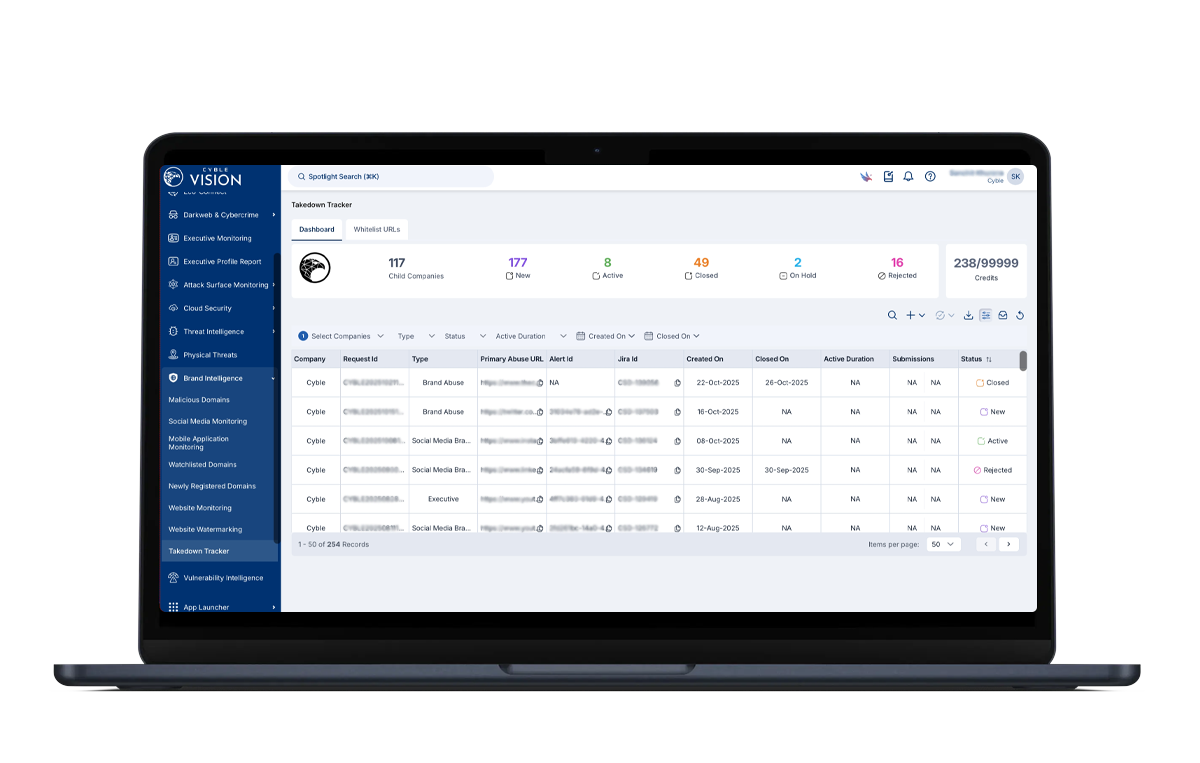
One Unified Agentic Platform. Blaze AI spans 14 capabilities and more than 80 use cases on a shared data lake. A cloud misconfiguration, an endpoint alert, and a dark web mention resolve into one correlated incident instead of three disconnected alerts across separate tools.
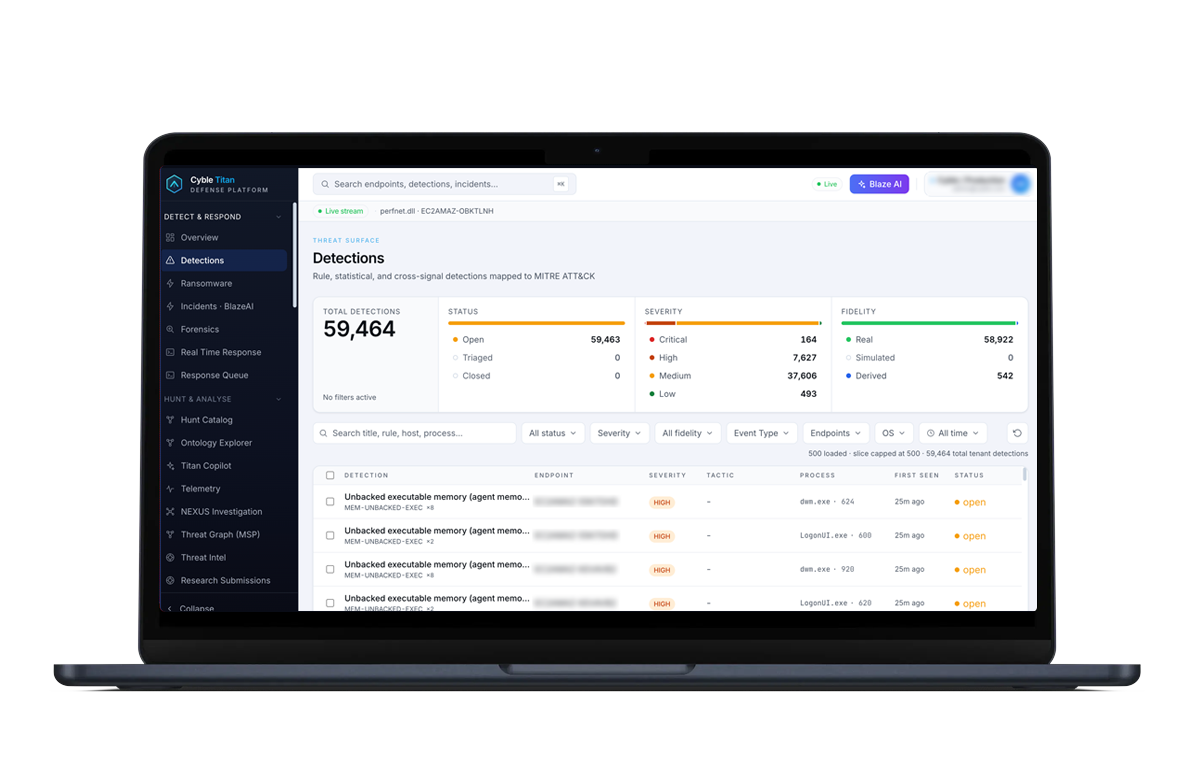
Cyble Titan. Cyble Titan provides AI-native endpoint detection and automated containment for the response side of the same incident, correlated with the external intelligence that preceded it.
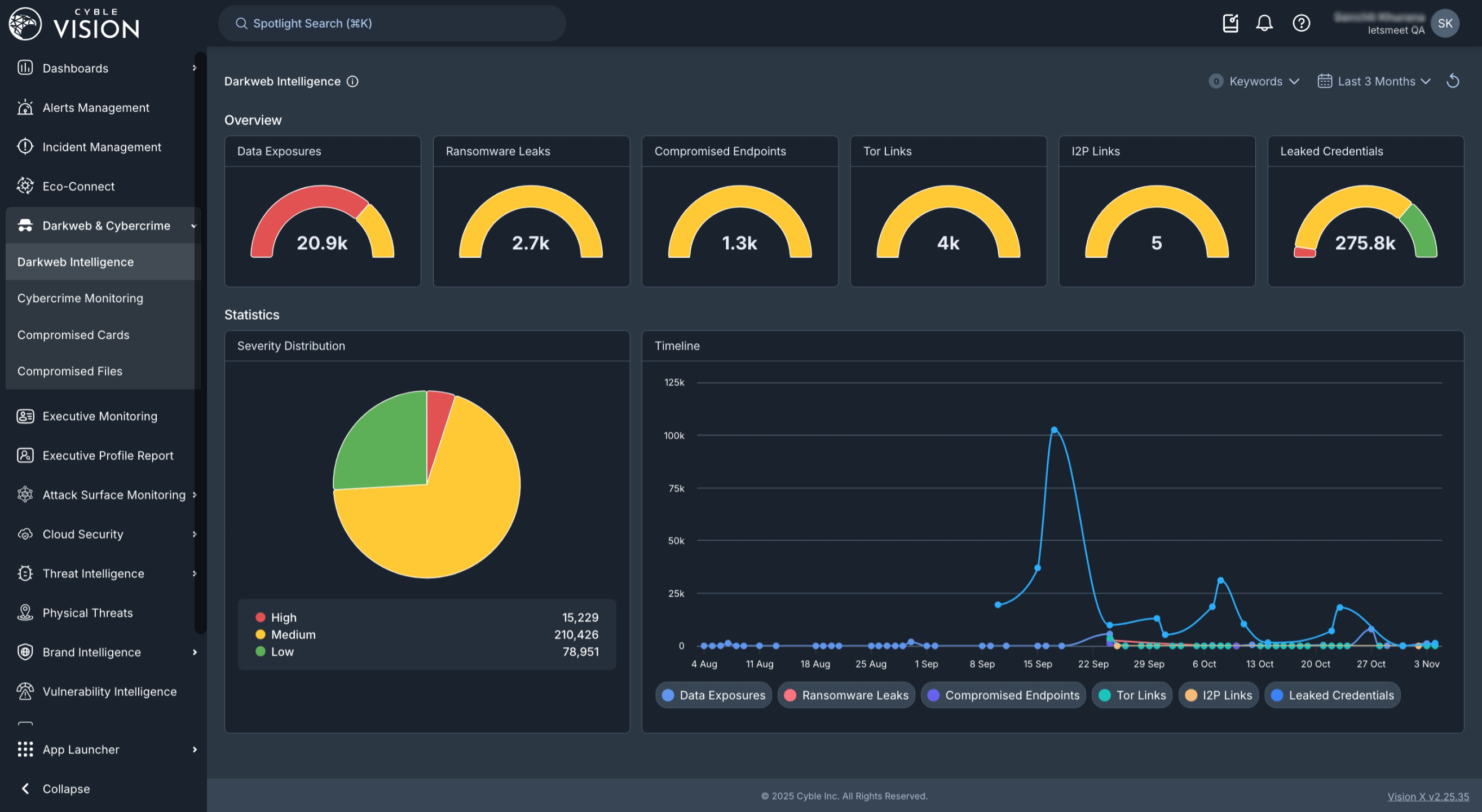
Coverage Depth. Cyble monitors more than 15,000 darknet marketplaces, covering roughly 90 percent of cybercrime activity across over 20 languages. Its forecasting looks up to six months ahead, drawing on dark web chatter, exploit development, and reconnaissance patterns.
Analyst And Peer Validation. Cyble appears as a Challenger in the 2026 Gartner Magic Quadrant for Cyberthreat Intelligence Technologies. Gartner Peer Insights shows a 4.8 out of 5 overall rating based on 49 verified reviews over the 18-month period ending 30 November 2025. G2 reports a 4.8 out of 5 rating with 40 badges across seven categories in the G2 Spring 2026 report.
Frequently Asked Questions (FAQ)
What Is The Difference Between A Threat Intelligence Feed And A Threat Intelligence Platform?
A threat intelligence feed is a stream of raw indicators such as IP addresses, file hashes, and domains delivered from a single source. A threat intelligence platform aggregates multiple feeds, normalizes them to a common schema, deduplicates overlapping indicators, applies confidence scoring and enrichment, and distributes curated intelligence to the SIEM, EDR, and other controls. A feed ends at delivery, while a TIP manages the full pipeline from ingestion through feedback-loop tuning. Organizations that subscribe to more than a few feeds without a TIP often end up with brittle scripts and lookup tables that degrade silently in production.
What Confidence Threshold Should Gate Automated Host Isolation?
Host isolation is the highest-cost automated response action because it severs a device from the network entirely and can disrupt production systems and legitimate users. It should carry the highest confidence bar, typically reserved for confirmed active compromise with lateral movement indicators, behavioral TTP matches consistent with ransomware or credential dumping, and corroboration from multiple independent sources. As covered in the response section, isolation carries the strictest confidence requirement, and low-confidence matches route to the analyst queue instead. The response action should always align with indicator confidence and match context.
What Is The Difference Between IOC Matching And Behavioral Detection?
IOC matching compares observed artifacts such as file hashes, IP addresses, and domains against a known-bad list. It works well for confirming exposure to established threats and for rapid containment when indicators remain valid. Behavioral detection focuses on patterns of activity, such as process chains, privilege escalation attempts, or suspicious network behavior, that align with adversary TTPs. This approach continues to detect threats even after attackers rotate infrastructure or recompile binaries, which makes it more resilient over time.