

Key Takeaways
-
ASM alert fatigue stems from unknown assets and missing context. Teams need enrichment with asset criticality and exploitability signals before triage.
-
Effective prioritization combines external threat intelligence, Exploit Prediction Scoring System (EPSS) exploitability scores, asset criticality, and internet reachability instead of relying on Common Vulnerability Scoring System (CVSS) severity alone.
-
Defensible suppression policies document every rule with justification, named approver, and expiry date, and include quarterly reviews by an independent reviewer.
-
Re-scoping the digital footprint through authoritative asset inventories, ownership classification, and decommissioning of abandoned assets prevents recurring alert noise at the source.
-
Cyble delivers artificial intelligence (AI) native asset resolution and relevance scoring at ingestion to eliminate false positives and provide case-ready alerts integrated with existing security information and event management (SIEM), security orchestration, automation and response (SOAR), and ticketing workflows.
See how Cyble reduces ASM alert fatigue
Why ASM Alert Fatigue Is Different From SOC Alert Fatigue
Internal security information and event management (SIEM) alert fatigue and attack surface management (ASM) alert fatigue both produce queues that analysts cannot drain, yet they come from different failure modes.
Internal SIEM noise is a volume problem over known asset: alerts that describe assets the organization already knows it owns.
On the other hand, ASM noise is a context problem over unknown assets. Continuous external scanning runs against the whole internet-facing footprint rather than against a known internal asset list. It generates findings about shadow infrastructure, forgotten subdomains, subsidiary exposure, and abandoned staging environments, which are assets the organization may not know it owns. An internal SIEM alert is noisy because there are too many of them. An ASM alert is noisy because nobody can say whether the asset it describes is owned, whether it matters, or who owns it.
This distinction matters because generic SOC alert-fatigue advice such as tuning thresholds, adding suppression, and consolidating tools does not address the unknown-asset failure mode. The average organization is blind to many of its internet-exposed assets, and shadow infrastructure forms the primary vector for modern cyber breaches. Fixing ASM alert fatigue requires closing the context gap and shrinking the unknown footprint.
The Four Causes Of ASM Alert Fatigue
Constant Scanning Across The Internet
External scanning is continuous and internet-wide, so findings accumulate between triage cycles. Unlike internal vulnerability scans that run on a schedule against a known asset list, ASM tools scan the entire IPv4 and IPv6 space and match findings against the customer’s known assets. Every scan can surface something new.
Missing Business Context For Findings
An alert can report an open port without knowing whether it is test infrastructure or a production payment gateway. The finding is technically accurate and operationally useless until someone adds the context that makes it a decision. The market already recognizes that raw findings without business context do not support action.
False Positives From Weak Asset Resolution
Keyword and internet protocol (IP) matching without asset resolution produces findings that do not actually refer to the organization. A mention of a similarly named company in a different language, an obfuscated spelling, or a shared IP address can all generate an alert that has nothing to do with the customer.
Tool Sprawl And Fragmented Workflows
Separate ASM, digital risk protection (DRP), and vulnerability tools can produce three disconnected alerts about one incident. The analyst then spends the first hour of every case doing manual pivoting before any decision can be made.
See Cyble in your existing workflows
How To Prioritize ASM Alerts By Exploitability And Business Impact
Severity-based triage asks how bad a finding is. Risk-based triage asks whether the finding matters to the organization, right now, on this asset. That distinction determines which alerts get investigated and which get buried. Risk-based triage draws on four inputs instead of a single severity score:
-
External threat intelligence: Determine whether this asset is being discussed, listed, or targeted in threat actor channels.
-
Exploitability signals: EPSS (Exploit Prediction Scoring System) provides the probability a Common Vulnerabilities and Exposures (CVE) entry will be exploited within thirty days, updated daily. EPSS reduces remediation effort compared to patching all CVSS ten vulnerabilities while maintaining equivalent coverage of exploited vulnerabilities.
-
Asset criticality: Identify the business function this asset supports. A medium-severity finding on an internet-facing production payment gateway outranks a critical finding on an isolated development server.
-
Reachability from the internet: Confirm whether the asset is actually exposed.
Named frameworks provide checkable inputs for this model. MITRE ATT&CK maps adversary behavior so suppression decisions can be evaluated against known techniques. The Cybersecurity and Infrastructure Security Agency (CISA) Known Exploited Vulnerabilities (KEV) catalog provides a non-negotiable remediation signal. If a CVE is in KEV and the asset is internet-facing, it is urgent regardless of EPSS trend. The Factor Analysis of Information Risk (FAIR) model translates exposure into financial terms for board-level conversations.
Only one of the common triage approaches removes noise at the source instead of trading it for blind spots. The table below shows what each approach solves, what it leaves unresolved, and what governance it demands.
|
Approach |
What It Solves |
What It Does Not Solve |
Governance Requirement |
|---|---|---|---|
|
Severity-based triage (CVSS alone) |
Ranks findings by theoretical impact |
Does not account for asset criticality or active exploitation |
None, and it produces alert fatigue |
|
Risk-based triage (CVSS + EPSS + asset criticality) |
Prioritizes by whether the finding matters on this asset, right now |
Requires an authoritative asset inventory and ownership model |
Documented prioritization logic |
|
Suppression without governance |
Reduces alert volume |
Creates undocumented blind spots |
Written policy, named approver, expiry date, quarterly review |
|
Asset resolution at ingestion |
Filters findings that do not refer to the organization before they become alerts |
Requires AI-native collection architecture |
Relevance scoring against the customer’s specific attack surface |
How To Build And Govern A Suppression Policy
Every suppression rule trades noise for a small amount of blindness. The goal is to make that trade explicit and auditable rather than accidental.
A filtered queue is defensible only when the filter logic is written down and reviewed. Without documentation, suppression rules outlive their justification and silently become permanent blind spots.
A defensible suppression policy requires four documentation elements for every rule:
-
What was suppressed: Record the specific alert type, asset scope, or condition being filtered.
-
Why it was suppressed: Capture the business or technical justification, mapped to the MITRE ATT&CK technique the rule affects, so suppression does not silently become a permanent blind spot against a known adversary behavior.
-
Who approved it: Name an approver with the authority to accept the associated coverage tradeoff.
-
When it expires: Set a defined review date instead of an open-ended exception.
Review cadence is as important as documentation. The reviewer should never be the author of the rule under review. Any suppression error should trigger a rule review fed into the detection engineering backlog. This approach prevents untracked suppression from silently becoming a permanent blind spot.
How To Define And Re-Scope Your Digital Footprint
Even a well-governed suppression policy only manages the alerts your footprint already generates. To stop the queue from refilling, teams have to shrink the footprint itself.
Re-scoping the digital footprint requires three sequential steps:
-
Establish the authoritative external asset inventory: Use ASM discovery to find what is actually reachable from the internet, then reconcile it against the internal asset register. The gap between those two lists is the unmanaged attack surface.
-
Classify assets by criticality and ownership: Assign every reachable asset a named owner, a business purpose, and a remediation path. If any one of three elements, an accountable team, an inventory record, or a monitoring path, is missing for a public asset, treat the exposure as operationally unmanaged even if the system is technically known.
-
Retire or explicitly deprioritize abandoned and temporary assets: Decommission forgotten staging environments, expired subsidiary domains, and developer test instances or explicitly mark them as low priority so they stop generating high-priority alerts. CyberFurl’s 2026 External Attack Surface Risk and Intelligence Report recommends “draconian asset decommissioning” policies that ensure shutting down a marketing campaign or microservice includes definitive destruction of associated servers, databases, Domain Name System (DNS) records, and application programming interface (API) gateways.
How To Consolidate ASM Signals Into Existing SIEM, SOAR, And EDR Workflows
Findings should arrive in the tools the team already works in, already enriched, rather than in another console. Adding another isolated dashboard compounds the problem rather than solving it.
Effective consolidation pushes ASM findings into three existing workflow layers:
-
SIEM for correlation: Route external findings into the same correlation layer as internal telemetry, so an ASM alert about a forgotten subdomain can be correlated with internal authentication logs from the same asset.
-
SOAR (security orchestration, automation and response) for automated playbook execution: Use enriched ASM findings to trigger existing playbooks such as blocking, enrichment, and escalation without manual re-entry or context switching.
-
Information technology service management (ITSM) and ticketing for tracked remediation: Turn alerts into assignable work items inside the process the team already runs, with closure evidence required rather than a status update.
This approach cuts context-switching, reduces the number of consoles an analyst touches, and ensures ASM findings are governed by the same escalation and closure processes as internal alerts.
See how Cyble connects to your stack
How To Reduce ASM Alert Fatigue: A Step-By-Step Guide
Each step below builds on the one before it, so work through them in sequence and treat them as a single operating model.
-
Enrich every alert before triage. Attach asset criticality and exploitability context before an alert reaches an analyst. Without this step, later prioritization has nothing meaningful to rank.
-
Prioritize by risk, not by raw severity. Rank alerts by exploitability, business impact, and reachability so analysts focus on issues that matter most to the organization at that moment.
-
Document every suppression rule. Capture justification, approver, and expiry date so each filtering decision remains visible and reviewable over time.
-
Review suppression rules quarterly. Assign a reviewer who did not author the rule to keep the policy honest and catch rules that no longer make sense.
-
Re-scope your digital footprint. Retire or explicitly deprioritize abandoned and temporary assets so they stop generating recurring noise.
-
Consolidate ASM findings into existing systems. Push alerts into the SIEM, SOAR, and ticketing platforms your team already uses so workflows stay consistent.
-
Measure outcomes against a baseline. Track time to detect, time to respond, alert quality, and remediation completion, then compare against pre-implementation numbers.
Measuring Success Of ASM Alert Fatigue Reduction
Reducing ASM alert fatigue is measurable and should tie directly back to the steps above. The metrics that matter are time to detect, time to respond, alert quality or signal-to-noise ratio, remediation completion, exposure reduction, and analyst efficiency.
A simple monthly or quarterly review comparing baseline-versus-post-implementation figures is sufficient to demonstrate progress. Establish the baseline before any changes are made so the comparison is meaningful. Results depend on the customer’s environment, asset scope, and configuration, and teams should validate outcomes against their own data.
How Cyble Solves ASM Alert Fatigue
Cyble was engineered AI-native at the collection layer rather than bolted onto a legacy stack. Asset resolution and relevance scoring run before an alert is generated, which directly addresses ASM alert fatigue at the source.
Asset Resolution At Ingestion
Asset resolution determines whether a finding actually refers to the organization before it becomes an alert. Findings that do not refer to the organization are filtered upstream rather than triaged downstream. This approach eliminates the false positive category that generic keyword matching produces at scale.
Relevance Scoring On Your Attack Surface
Relevance scoring runs against the customer’s specific attack surface, including domains, subsidiaries, executives, and technology stack, instead of generic keyword matches. Cyble reports a ninety-five percent signal-to-noise ratio. Statistics are drawn from Cyble internal telemetry.
Enrichment At Ingestion For Case-Ready Alerts
Enrichment happens at ingestion, not at the dashboard. Alerts arrive case-ready within minutes of detection, already resolved to the right entity and scored for severity. This design removes the manual pivoting that often consumes the first hour of every case in a fragmented tool stack.
Cyble ODIN For Complete External Asset Mapping
Cyble ODIN maps internet-facing assets across the entire IPv4 and IPv6 space, including shadow and forgotten infrastructure. This capability directly addresses the unknown-asset failure mode that generic SOC alert-fatigue advice cannot reach. Every reachable asset, including the ones nobody remembered were there, becomes visible before it turns into an unmonitored entry point.
Cyble Vision For CTI, ASM, And DRP Operations
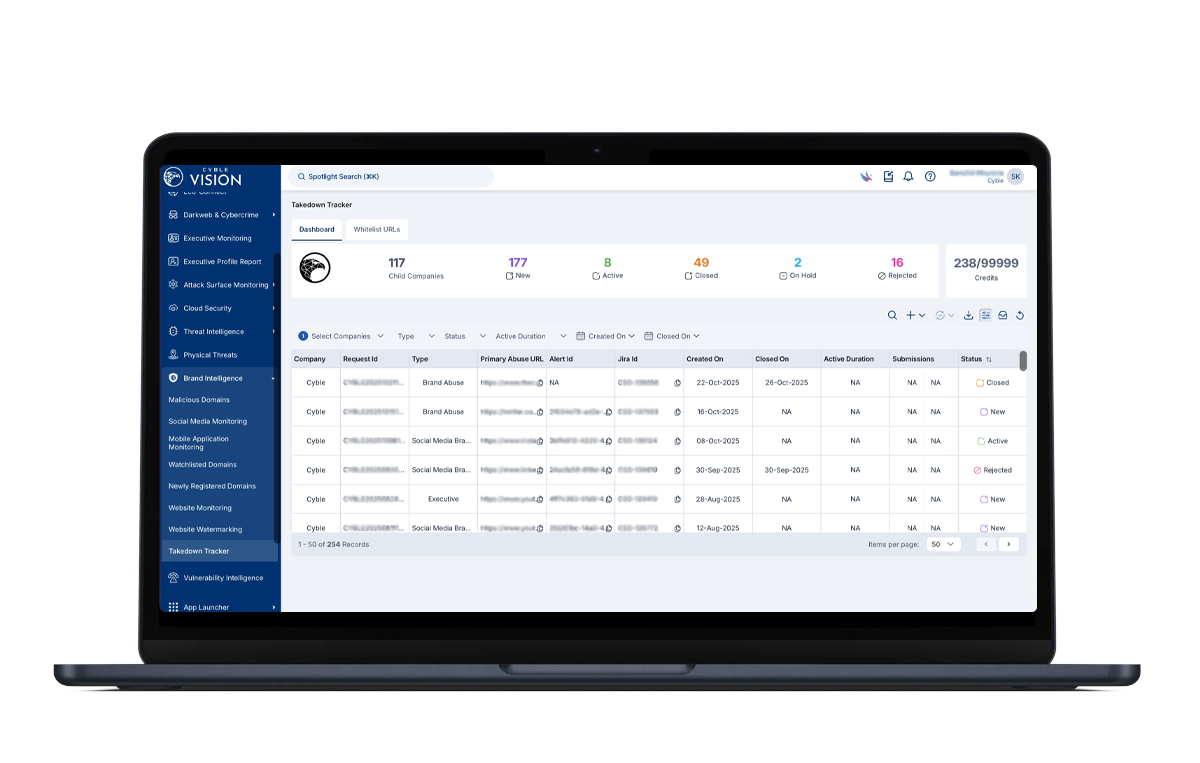
Cyble Vision is the flagship cyber threat intelligence (CTI), ASM, and DRP platform and the usual entry point. It integrates with seventy-plus enterprise platforms, including Splunk, Microsoft Sentinel, IBM QRadar, Cortex XSOAR, and ServiceNow. Findings land in the SIEM, SOAR, and ticketing systems the team already uses rather than in another console.
Native Managed Takedown Services
Native managed takedown is part of the platform rather than a referral. It covers phishing sites, lookalike domains, fake apps, impersonation accounts, and leaked data, delivered against service level agreements (SLAs) with a reported ninety-eight percent takedown success rate. This capability closes the gap between knowing about a threat and acting on it. Statistics are drawn from Cyble internal telemetry.
Cyble Saratoga For Financial Risk Translation
Cyble Saratoga applies the FAIR model to live telemetry to express exposure in financial terms. This translation supports board conversations about whether a filtered queue hides unacceptable risk.
Cyble provides visibility into fifteen thousand-plus darknet marketplaces and roughly ninety percent of cybercrime activity, with multilingual collection across twenty-plus languages. Capabilities, coverage, and service levels vary by subscription tier and region.
Cyble is recognized as a Challenger in the 2026 Gartner® Magic Quadrant™ for Cyberthreat Intelligence Technologies. On Gartner® Peer Insights™, Cyble holds a 4.8/5 overall rating based on forty-nine verified reviews over the eighteen-month period ending thirty November 2025. On G2, Cyble holds a 4.8/5 average with forty badges across seven categories in the G2 Spring 2026 report.
Frequently Asked Questions
How to resolve alert fatigue?
Resolving alert fatigue requires enriching alerts with context before they reach an analyst, prioritizing by risk rather than severity alone, and governing suppression so it stays auditable. In ASM specifically, the fix starts with entity resolution at ingestion, which determines whether a finding actually refers to your organization, and continues with asset criticality scoring and footprint re-scoping. Volume reduction through suppression alone trades noise for blindness without making the tradeoff explicit.
What are three key components of attack surface monitoring?
Three key components are discovery, classification, and continuous monitoring. Discovery finds internet-facing assets across the IPv4 and IPv6 space. Classification assigns ownership and criticality to each asset so teams know who is accountable and how important the system is. Continuous monitoring detects changes and new exposures over time. Without classification, discovery produces a queue that refills faster than it drains. As noted earlier, an asset that lacks an accountable team, an inventory record, or a monitoring path should be treated as operationally unmanaged.
What does alert fatigue mean?
In security operations, alert fatigue is the desensitization that sets in when analysts face more alerts than they can meaningfully investigate. Response times slow, real threats get missed, and analysts develop a learned skepticism toward the alert feed that can persist even after the underlying volume is reduced. In ASM, the problem is compounded because alerts often describe assets the organization did not know it owned, which makes context, rather than volume alone, the limiting factor.
What are the prerequisites for implementing risk-based ASM triage?
Teams need an authoritative external asset inventory, a classification scheme for asset criticality, access to exploitability signals such as CVSS and EPSS, and a documented suppression policy with a review cadence. Without an asset inventory, there is no way to score findings by business impact. Without exploitability signals, severity scores recreate the false-priority problem that risk-based triage is designed to fix. Without a suppression policy, filtering decisions accumulate as undocumented blind spots.
What are the risks of over-suppression?
Every suppression rule trades noise for a small amount of blindness. Without documentation and review, suppression rules can outlive their justification and silently become a permanent blind spot. The mitigation is a quarterly review cadence with a reviewer who did not author the rule. Mapping every suppression rule to the MITRE ATT&CK technique it affects makes the coverage tradeoff explicit and auditable, so suppression decisions can be revisited when the threat landscape changes.
How does ASM triage integrate with existing SIEM and SOAR workflows?
Findings should arrive in the tools the team already works in, enriched, resolved to the right entity, and scored for severity, rather than in another console. Native integrations push ASM signals into the SIEM for correlation with internal telemetry, into SOAR for automated playbook execution, and into ticketing systems for tracked remediation. This approach eliminates context-switching, ensures ASM findings are governed by the same escalation and closure processes as internal alerts, and avoids the isolated-dashboard failure mode where a new tool goes unused after the first month.
How do you measure success?
Track time to detect, time to respond, alert quality or signal-to-noise ratio, remediation completion, exposure reduction, and analyst efficiency. Compare against a pre-implementation baseline and review on a monthly or quarterly cadence. Avoid vanity metrics such as total alert count, which can decrease through suppression without any improvement in actual security outcomes. Focus on metrics that show whether the right alerts are reaching the right analysts in time to act.
Conclusion
ASM alert fatigue is a context-and-governance problem. The queue refills faster than it drains because alerts arrive without asset criticality, without exploitability context, and without any mechanism to determine whether the asset they describe is owned, managed, or important to the business. Suppression without governance shortens the queue while expanding blind spots.
The defensible fix combines enrichment at ingestion, risk-based prioritization using CVSS, EPSS, and asset criticality as checkable inputs, suppression governance with documented justification and quarterly review, footprint re-scoping to retire abandoned assets, and consolidation into the SIEM, SOAR, and ticketing systems the team already uses.
Cyble addresses this challenge at the architectural level. Asset resolution and relevance scoring run before an alert is generated, so the findings that reach analysts are already resolved to the right asset, scored against the organization’s specific attack surface, and enriched with the context needed to make a decision. That approach provides a durable fix for ASM alert fatigue.
Talk to Cyble about your ASM alerts