

Key Takeaways
-
AI cybersecurity tools in 2026 fall into two categories: AI-powered SOC platforms and AI workload security tools. Both leave the external attack surface unmonitored, which is where GenAI threats are planned and sold.
-
External threat intelligence (ETI) monitors dark-web markets, ransomware sites, and criminal forums for signals that never appear in internal logs. This coverage creates the missing third layer of defense.
-
AI-native ETI platforms like Cyble Vision deliver signal-to-noise ratios above 90%, automatic entity resolution, and native integrations that push enriched alerts into existing SIEM and SOAR workflows.
-
Organizations seeking comprehensive GenAI protection should request a demo to see what Cyble finds in their environment.
Where AI Security Spend Goes in 2026
Enterprise security budgets in 2026 are splitting along a clear fault line. ETR’s 2026 Annual State of Security report is based on a survey of 517 security-focused technology leaders, including executives from Fortune 500 and Global 2000 organizations, which found that 59% plan to increase spending on LLM and generative AI protection, surpassing cloud security as the top budget priority. Yet only 3% have deployed agent-specific security controls broadly across production environments.
The market has responded with two tool categories designed to address these internal risks. AI-powered SOC platforms automate detection, triage, and response across internal telemetry, while AI workload security tools protect model infrastructure, pipelines, and code from adversarial manipulation. However, neither category watches the external environment where threat actors discuss, sell, and operationalize attacks against GenAI assets, which leaves a critical blind spot in enterprise defenses.
See what external threats Cyble can detect in your environment.
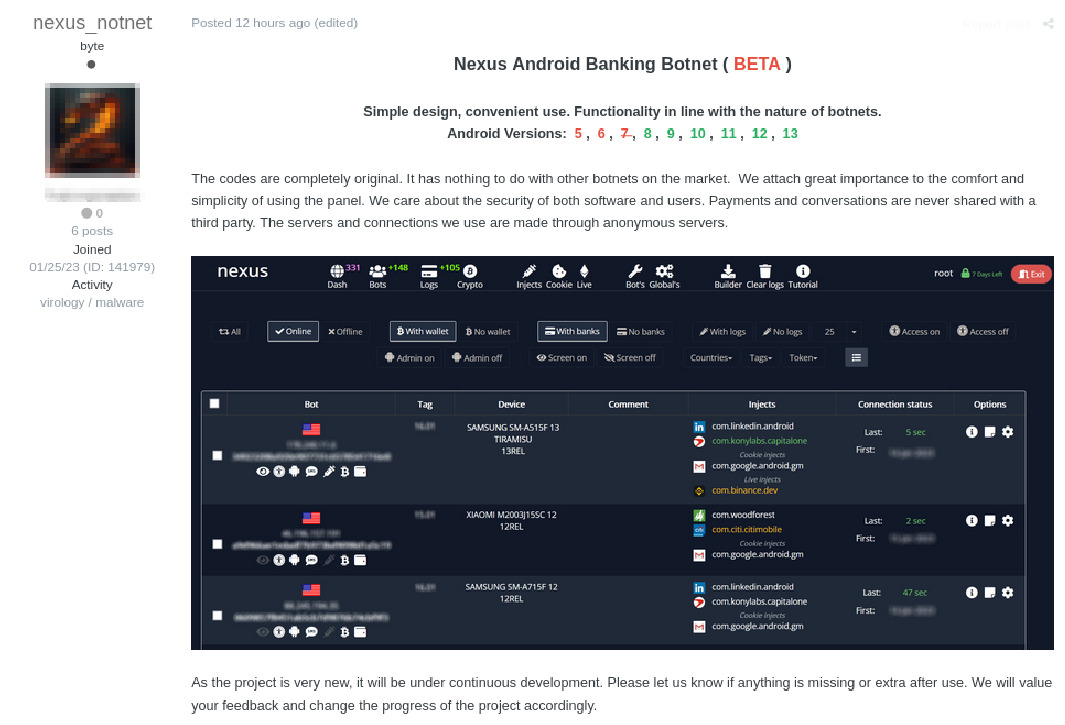
How Current AI Security Tools Evolved
AI-powered SOC platforms apply autonomous agents to security operations, including alert triage, threat investigation, and incident response, across internal telemetry from endpoints, identities, networks, and cloud systems. Organizations implementing AI-based alert triage report reductions in alert volume compared to rule-only detection, with AI-native detection delivering faster mean time to detect versus legacy SIEM. These platforms focus on how they process security events inside the environment, not on monitoring what happens outside it.

Tools that secure AI workloads address a structurally different problem: protecting LLMs, agentic pipelines, and model infrastructure from adversarial inputs. Prompt injection stems from a structural root, where the model concatenates trusted instructions and untrusted data into a single token stream, with no reliable boundary between authoritative commands and data to process. Defending against it requires input guardrails, output filtering, privilege separation, and runtime monitoring. These controls operate at the model layer, not the SOC layer.
Both categories are necessary. Neither covers the external attack surface. This gap creates the need for a third architectural layer that monitors the environments where threats originate before they reach either the SOC or the AI workload.
The Third Layer: External Threat Intelligence Architecture
External threat intelligence (ETI) focuses on monitoring environments outside the organization’s perimeter, including dark web markets, ransomware leak sites (the sites ransomware groups use to publish stolen data and pressure victims into paying), Telegram channels, paste sites, and criminal forums, for signals relevant to a specific organization’s attack surface.
The distinction between bolted-on and AI-native ETI is architectural. Most platforms crawl sources with rule-based logic, store results in a database, and add a summarization layer on top. In those designs, the AI reads the report the old pipeline produced, while collection logic, entity resolution (the process of automatically determining that an obfuscated or misspelled reference refers to a specific organization), and relevance scoring remain rule-based and human-configured.
An AI-native pipeline runs models at the collection layer. It decides which sources to prioritize, resolves that a reference in a Russian-language post refers to a specific organization without a human writing that rule, scores relevance against the organization’s actual domains and subsidiaries, and connects a leaked credential post to the breach it came from, the initial access broker (a criminal specialist who breaks in and resells that access) selling access, and the ransomware group known to buy from that broker. All of this happens before an analyst opens the case.
Cyble Vision operates on this architecture, delivering a signal-to-noise ratio consistently above 90% with visibility into the dark web, with enriched alerts disseminated in minutes rather than hours from detection.
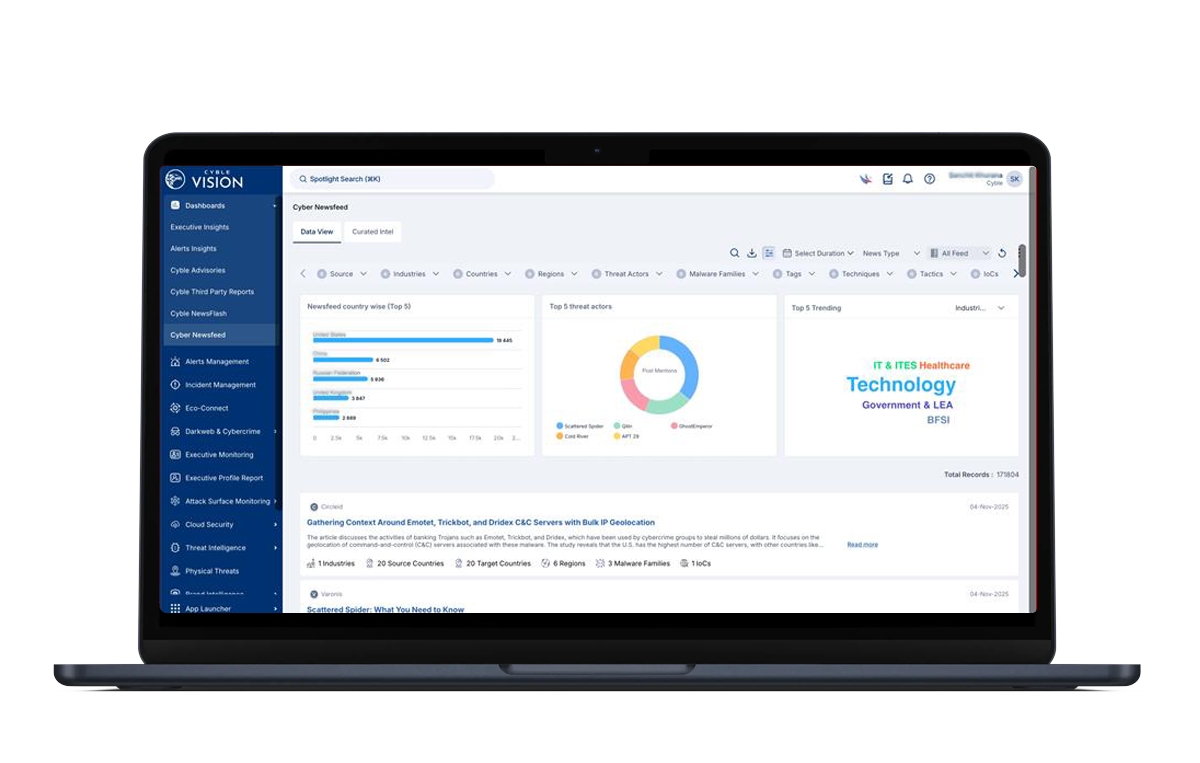
How Cyble Deploys and Who Operates It
Security professionals often prefer to obtain new SOC capabilities as a managed service rather than building in-house and often prefer platform-based security purchases. External threat intelligence fits both models.
Cyble Vision deploys as a cloud-native platform with native integrations, including Splunk, Microsoft Sentinel, IBM QRadar, Cortex XSOAR (security orchestration, automation and response), and ServiceNow, pushing enriched intelligence into the workflows security teams already use. Findings arrive in the SIEM (Security Information and Event Management platform) or ticketing system rather than in a separate console.
For organizations requiring managed coverage, Cyble’s managed detection and response (MDR) service provides 24/7 operational capacity without requiring dedicated headcount. Understanding deployment options is only part of the evaluation; security leaders also need to know which teams will use the platform and for what purposes.
Who Uses External Threat Intelligence and Why
The primary users of external threat intelligence platforms span four organizational functions:
-
SOC managers and analysts receive case-ready enriched alerts, such as credential posts already linked to the breach, the access broker, and the threat actor group, rather than raw indicators requiring manual pivoting.
-
CISOs and security leaders gain continuous answers to “are we currently exposed?” across credentials, executive personally identifiable information (PII), and brand infrastructure, with financial exposure quantified through the FAIR (Factor Analysis of Information Risk) model via Cyble Saratoga.
-
Governance, risk, and compliance (GRC) leads receive time-stamped detection records that establish the notification clock for regulatory disclosure obligations under frameworks including GDPR, DORA, and HIPAA.
-
Fraud and brand protection leads benefit from native managed takedown for phishing sites, lookalike domains (near-identical domains registered to impersonate a brand), and fake mobile applications.
Where External Threat Intelligence Fits Best
External threat intelligence delivers the most value to organizations with three characteristics: a consumer-facing brand that can be impersonated, regulatory exposure that converts a breach into a disclosure obligation, and no dedicated external threat monitoring team. Priority verticals include financial services, telecommunications, retail, healthcare, and energy, sectors where a leaked credential dump or a spoofed domain converts into fraud loss or regulatory penalty within hours.
Discover your organization’s external exposure with a personalized demo.
Alternatives to AI-Native ETI and Their Limits
Four categories of alternatives exist, each with structural limitations relative to AI-native external threat intelligence:
Legacy perimeter security stacks, including firewalls, antivirus, and SIEMs ingesting internal logs, observe what has entered the environment. They cannot see credentials for sale, a phishing kit being assembled, or an initial access broker listing infrastructure, because none of that data crosses the perimeter.
Indicator feed subscriptions, such as IP blocklists, malware hashes, and Common Vulnerabilities and Exposures (CVE) bulletins, provide breadth without relevance. The feed covers the internet, not the subscriber’s specific attack surface. There is no entity resolution, no severity scoring against the organization’s environment, and no action that happens after the alert.
Single-domain point tools stitched together with SOAR, including a digital risk protection (DRP) tool, an attack surface management (ASM) tool, an endpoint detection and response (EDR) platform, and a cloud security posture management (CSPM) tool, are each strong in their own domain but produce three disconnected alerts about one incident. Cyble’s products share a native data lake and a common AI layer, so cross-domain correlation happens by architecture rather than by integration work.
AI-summarized legacy platforms add a model at the presentation layer. The reports read better, but collection logic, entity resolution, and relevance scoring remain rule-based. The key distinction is where in the pipeline the models actually work.
What to Look For When Buying ETI
When evaluating external threat intelligence platforms, security leaders should assess against the following criteria:
-
Source coverage depth: Visibility into darknet marketplaces represents strong coverage. Verify whether coverage extends to gated underground communities that open crawling does not reach.
-
Entity resolution capability: The platform should automatically resolve obfuscated and cross-language references to the organization’s brand without requiring human-authored rules.
-
Signal-to-noise ratio: Relevance scoring must run against the organization’s specific attack surface, including domains, subsidiaries, executives, and technology stack, not generic keyword matching. Cyble Vision achieves this precision through AI-native entity resolution.
-
Integration depth: Native integrations should ensure findings reach the SIEM, SOAR, and ticketing systems the team already uses.
-
Takedown capability: Detection and removal should be one motion from one vendor, not two separate engagements. Cyble provides takedown capabilities delivered against SLAs.
-
Deployment flexibility: Cloud-native, on-premises, and hybrid deployment options must align with data residency obligations.
-
Reporting depth: Financial exposure quantification using the FAIR model supports board-level budget conversations.
-
Service model: Managed service options should be available for organizations without dedicated external threat monitoring teams.
Proof-of-Concept Checklist for ETI Platforms
Before committing to a platform, security leaders should validate the following during a proof of concept (POC):
-
Whether the platform surfaces at least one previously unknown finding about the organization’s external exposure within the POC window.
-
Whether alerts are delivered into existing SIEM and ticketing workflows, or whether the platform requires a separate console.
-
Whether entity resolution handles obfuscated spellings and non-English references to the organization’s brand.
-
Whether takedown is a native capability with SLAs, or a referral to a third party.
-
Whether the platform can quantify exposure in financial terms for a board or CFO audience.
-
Whether the platform covers the organization’s subsidiaries, executives, and technology stack, not only primary domains.
How AI Workload Security Protects LLMs
Security researchers have documented Model Context Protocol (MCP) servers exposed on the public internet without authentication, with vulnerabilities documented in the MCP ecosystem.
Tools securing LLMs operate at the model layer. They provide input guardrails for injection and jailbreak detection, output guardrails to block exfiltration and policy violations, and privilege separation to prevent the “lethal trifecta” of simultaneous access to private data, exposure to untrusted content, and an exfiltration channel. Microsoft security documentation maps these controls to OWASP LLM01 through LLM03 and MITRE ATLAS techniques including AML.T0051 LLM Prompt Injection and AML.T0057 LLM Data Leakage.
External threat intelligence adds a layer these controls cannot provide. It monitors for prompt-injection kits being assembled and sold on underground markets before they reach the model. Cyble Executive Vice President Mandar Patil notes that dark web monitoring has become critical for identifying leaked credentials, exposed enterprise AI access, and threat actor activity targeting AI ecosystems.
AI SOC Platforms in 2026 and Their Limits
Gartner identified AI-enabled SOC operations as a top enterprise cybersecurity trend in 2026, driven by staffing pressure and tool consolidation. AI SOC agents achieve varying automated resolution rates, such as 52% in Sophos deployments and 100% of Tier-1 alerts at Carvana, compared to legacy SOAR automation that covers only 30–40% of alerts because every scenario requires a matching playbook.
The structural limitation of AI SOC platforms is their data boundary. They reason about telemetry that exists inside the environment. SOC analysts often spend a significant portion of their time on alert triage rather than investigation and response, a problem AI SOC platforms address for internal alerts. They do not address the external signals that precede those alerts, such as the credential dump that appeared on a dark web market 12 hours before the account takeover attempt or the access broker listing that preceded the ransomware deployment.
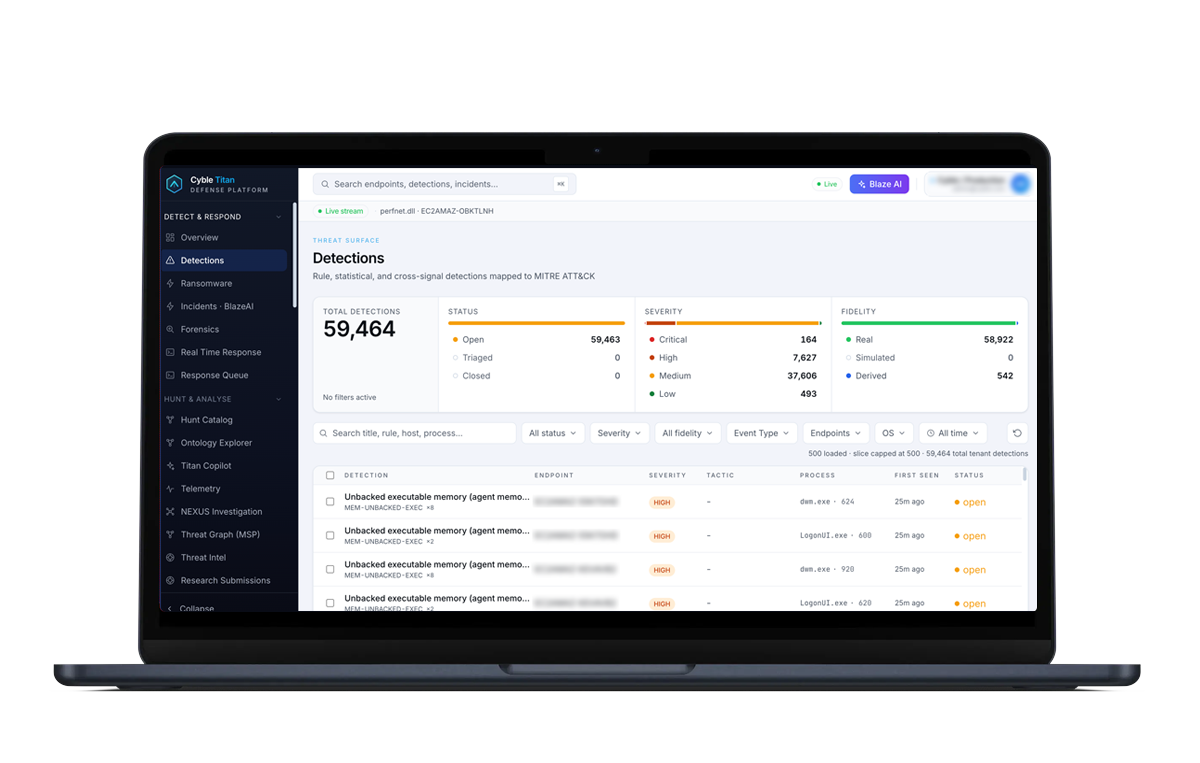
Cyble Titan provides AI-native endpoint detection and response (EDR) that correlates endpoint alerts with external intelligence from Cyble Vision. An endpoint event can be connected to the credential dump or access broker listing that preceded it rather than investigated in isolation.
External Threat Intelligence for AI Assets
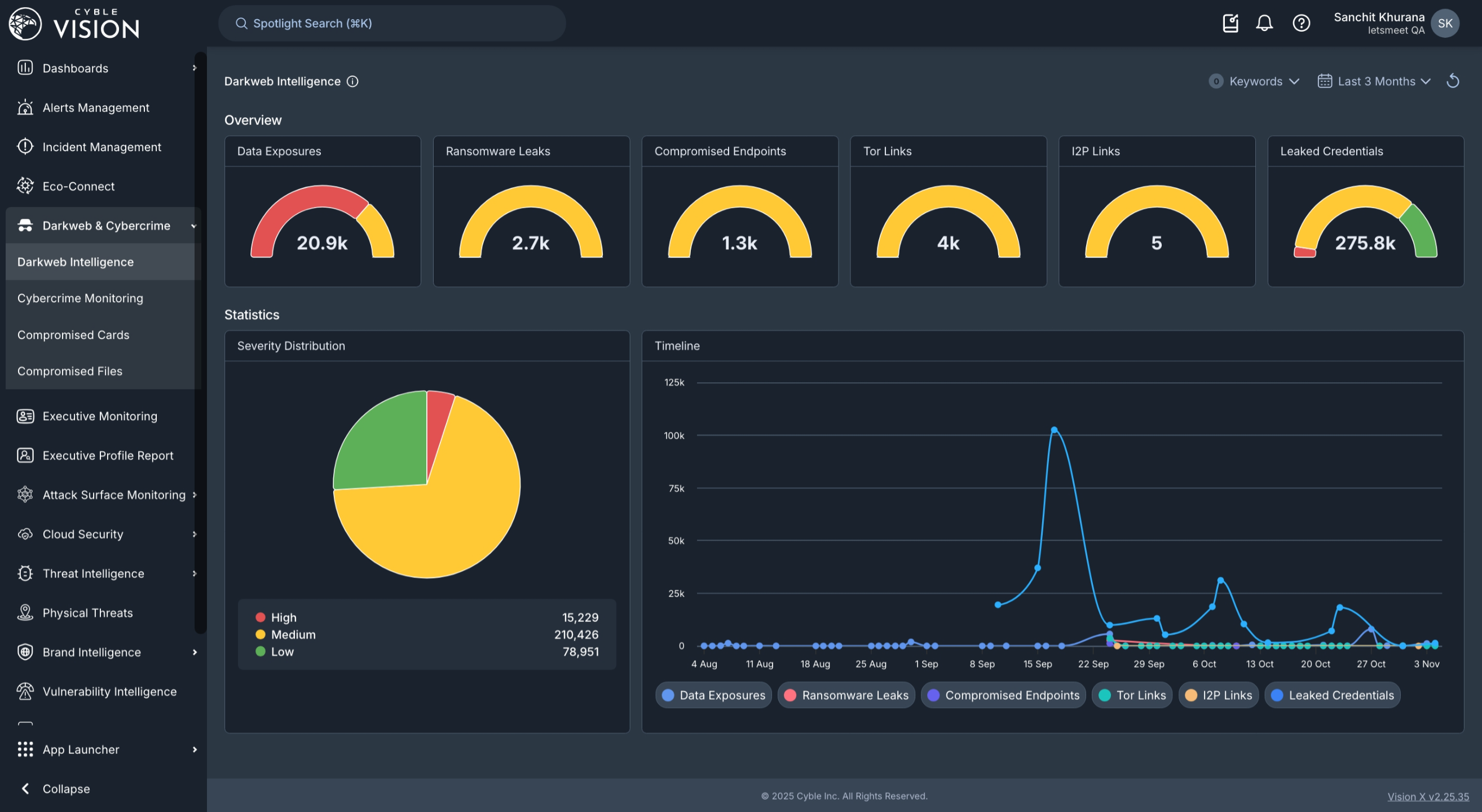
External threat intelligence for AI systems monitors the underground environment for signals specific to GenAI assets. These signals include stolen AI API keys and enterprise subscriptions being sold on dark web markets, prompt-injection kits targeting specific enterprise AI deployments, and discussions of model exfiltration techniques.
Cyble Vision monitors darknet marketplaces and cybercrime activity for signals relevant to an organization’s specific AI asset inventory, delivering enriched alerts into existing security workflows rather than requiring a separate monitoring console.
External Signals That Current Tools Miss
Three threat categories affecting GenAI assets are systematically absent from current AI SOC platform and AI workload tool coverage:
Prompt-injection kit markets. As noted earlier, Trellix’s underground monitoring documented not only credential markets but also commercial AI-enhanced attack tools including autonomous kill-chain planning utilities and zero-RLHF uncensored models marketed for ransomware and exploit generation. These tools are sold and discussed on dark web forums before they are deployed against enterprise targets.
Model exfiltration and credential theft. Google Threat Intelligence Group observed threat actor TeamPCP gaining initial access through compromised PyPI packages targeting AI-related tools including LiteLLM and BerriAI, embedding the SANDCLOCK credential stealer to extract AWS keys and GitHub tokens from AI build environments. Stolen credentials were monetized through ransomware and data theft extortion partnerships.
Dark-web chatter about GenAI assets. The volume of these discussions correlates with LLM releases, and NordLayer observed a significant spike immediately after the Claude Opus 4.6 launch, with elevated activity persisting afterward. Dark-web discussions of AI jailbreaking, AI paired with infostealer malware, and AI paired with ransomware have increased.
None of these signals appear in internal telemetry. They require external monitoring at the collection layer, with entity resolution to connect underground discussions to specific enterprise targets.
How AI Security Categories Compare
|
Primary Category |
Core Function |
GenAI External Coverage |
|---|---|---|
|
AI-powered SOC platform |
Endpoint detection, AI-assisted triage, and threat intelligence integration; autonomous endpoint and cloud detection with AI-driven response; AI-assisted investigation and response; behavioral AI detection across network, email, cloud, and endpoint |
Not designed for dark-web or underground monitoring of GenAI assets; no external monitoring of AI credential markets or prompt-injection kits |
|
AI workload security |
Cloud-native AI pipeline and model infrastructure risk visibility; code security, supply-chain risk, and AI-generated code scanning |
Secures AI workloads from within, with no external underground signal monitoring; addresses code-layer risk only, with no external monitoring of AI credential markets |
|
Cyble Vision, AI-native external threat intelligence |
Dark-web and surface-web monitoring, entity resolution, managed takedown, ASM, DRP across darknet marketplaces with signal-to-noise ratio consistently above 90% and takedown capabilities |
Monitors underground markets for AI credential theft, prompt-injection kits, model exfiltration chatter, and GenAI-specific attack planning |
Disclaimer: Platform capabilities described for non-Cyble tools are drawn from publicly available product documentation and background research current as of August 2026. Capabilities vary by subscription tier, configuration, and region. Validate against each vendor’s current documentation before purchase decisions.
Compare Cyble’s coverage against your current stack.
FAQ
Is this just another threat intelligence feed?
That objection is fair, and it is the reason Cyble is built the way it is. A feed ends at the alert. If the analyst must work out what to do next, the organization has effectively subscribed to anxiety. Cyble resolves entities at ingestion, determining whether a mention refers to the organization before it becomes an alert, including across languages and obfuscated spellings. It scores severity against the specific attack surface, including domains, subsidiaries, executives, and technology stack. It enriches the finding into something case-ready and takes the threat down natively, delivered against SLAs. The measure of the product is not how much it tells the team. The measure is what happens after the alert.
What makes AI-native external threat intelligence different from AI-powered SOC platforms?
AI-powered SOC platforms reason about telemetry that exists inside the environment, including endpoint events, identity logs, network flows, and cloud activity. They are designed to compress the time between an internal alert and a response decision. External threat intelligence monitors everything outside the perimeter, including dark web markets, ransomware leak sites, Telegram channels, criminal forums, and underground AI credential markets. The two are complementary. A SOC platform cannot index a Telegram channel, and an external threat intelligence platform does not replace endpoint detection. Most enterprise stacks have invested heavily in the internal layer and have no systematic coverage of the external one, which is where GenAI-specific threats are planned and sold before they reach the perimeter.
How does Cyble Vision address GenAI threats on the dark web?
Cyble Vision monitors darknet marketplaces and cybercrime activity for signals relevant to an organization’s specific asset inventory, including AI-related assets. This coverage includes stolen AI API keys and enterprise subscriptions being sold on underground markets, prompt-injection kits targeting specific enterprise AI deployments, discussions of model exfiltration techniques, and AI credential bundles that include usage limits, enterprise permissions, and bypass methods. Entity resolution connects these signals to the specific organization without requiring human-authored rules for every variant. Enriched alerts are delivered into existing SIEM and SOAR workflows in minutes from detection, with the takedown path attached to the finding rather than left as a separate engagement.
We already have a SIEM, an EDR, and a SOC. What does external threat intelligence add?
Those tools observe the internal environment. Cyble observes everything outside it. The SIEM cannot index a Telegram channel. The EDR cannot see credentials being sold on a dark web market at 11 PM. The SOC cannot triage a signal that never crossed the perimeter. The two are complementary, not competing, which is why Cyble integrates with more than 70 platforms including Splunk, Microsoft Sentinel, IBM QRadar, Cortex XSOAR, and ServiceNow, delivering findings into the workflow the team already uses rather than into another isolated console. External threat intelligence does not replace the internal stack. It provides the early warning layer that the internal stack structurally cannot.
How do we verify that an external threat intelligence platform is truly AI-native?
Security leaders should start by asking where the models run. Most platforms crawl with rule-based logic, store the results, and add a summarization layer on top, so the AI reads the report the old pipeline produced. The collection logic, entity resolution, and relevance scoring remain rule-based and human-configured. An AI-native platform runs models at the collection layer, deciding which sources to prioritize, resolving obfuscated cross-language references to the organization’s brand, scoring relevance against the specific attack surface, and connecting a credential post to the breach, the access broker, and the threat actor group before an analyst opens the case. During a proof of concept, ask the vendor to demonstrate entity resolution on an obfuscated reference to the organization’s brand in a non-English source. That demonstration will clarify the architecture quickly.
Conclusion
The two dominant AI cybersecurity tool categories, AI-powered SOC platforms and tools that secure AI workloads, address real and significant problems. Neither was designed to monitor the external environment where GenAI-specific threats are planned, sold, and operationalized. Exposed AI services surged in 2025, and the underground market for stolen AI credentials, prompt-injection kits, and model exfiltration techniques is growing faster than most enterprise security stacks can observe.
AI-native external threat intelligence is the required third layer. It closes the gap between what SOC platforms and AI workload tools can see and where GenAI threats actually originate. Cyble Vision delivers this layer with visibility into the dark web, a signal-to-noise ratio consistently above 90%, native managed takedown, and integrations that push enriched intelligence into existing security workflows.
Disclaimer: Statistics attributed to Cyble, including signal-to-noise ratio and takedown capabilities, are drawn from Cyble internal telemetry and public materials. Results depend on the customer’s environment, asset scope, and subscription tier. Capabilities and service levels vary by tier and region and should be validated against the customer’s specific environment. Threat actor attribution is expressed with stated confidence levels and is not asserted as certainty. Third-party statistics are cited with their source and collection date; verify currency before use in procurement decisions.