

Key Takeaways
-
Attack surface management runs as a continuous lifecycle of discovery, risk-based prioritization, reduction, and verified remediation. It does not stop after a single scan.
-
Continuous asset discovery pulls from multiple sources such as Domain Name System (DNS), certificate transparency logs, cloud application programming interfaces (APIs), and external reconnaissance to uncover unknown and forgotten assets.
-
Risk-based prioritization weighs exploitability and business context, including internet reachability, authentication needs, active exploitation, and asset criticality, instead of relying only on Common Vulnerability Scoring System (CVSS) severity scores.
-
Attack surface reduction removes unnecessary internet exposure and applies controls such as multi-factor authentication (MFA) or segmentation when assets must stay reachable.
-
Cyble Vision with ODIN delivers external attack surface management that maps internet-facing assets and feeds findings into existing security workflows.
Continuous Asset Discovery Across Your External Footprint
Continuous asset discovery systematically identifies every externally reachable asset. This includes domains, subdomains, cloud resources, APIs, remote-access services, and shadow or abandoned infrastructure. Effective programs correlate several data sources instead of relying on a single scanning technique.
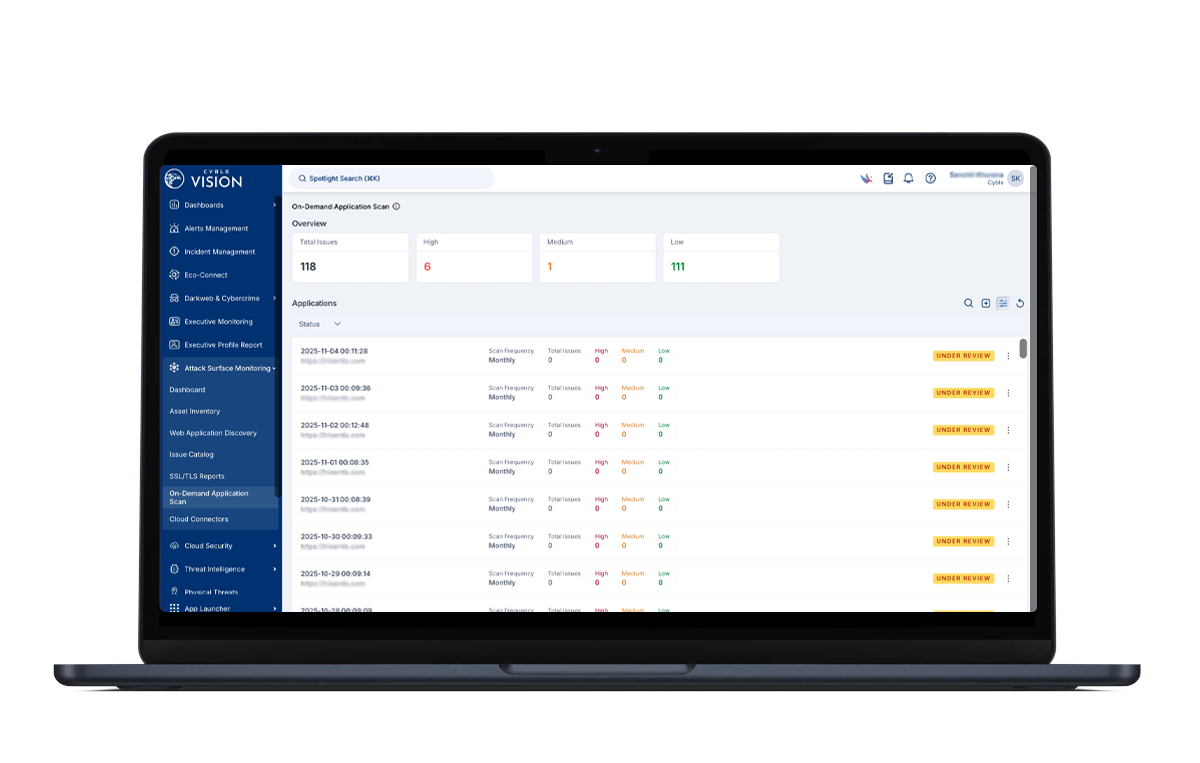
A configuration management database (CMDB) lists only what someone remembered to record. It cannot see the staging server a developer spun up last quarter, the subsidiary’s expired certificate, or the contractor’s cellular modem installed outside change control.
Discovery sources that must be correlated include:
-
DNS records and certificate transparency logs, which surface subdomains and certificates issued for domains the organization may not realize it owns.
-
Cloud provider APIs, which enumerate resources across every account and region, including those provisioned outside information technology (IT) approval.
-
CMDB and IT asset management (ITAM) systems, which provide the internal baseline to reconcile against.
-
Vulnerability scanners, which confirm what is reachable and what services are running.
-
External reconnaissance, which maps the organization’s footprint as an attacker would see it, including what MITRE ATT&CK technique T1595 (Active Scanning) describes as the attacker’s enumeration of internet-facing infrastructure.
No single discovery technique covers the full external surface. Each source sees a different slice of the environment, so security teams need a correlated view that spans them all.
Risk-Based Prioritization After Discovery
Once discovery reveals the full external surface, the next challenge is volume. Most organizations cannot fix every issue at once, so they need a way to decide what to handle first. Risk-based prioritization ranks externally exposed findings by exploitability and business context instead of by severity score alone.
The six factors that determine priority are:
-
Internet reachability, which indicates whether the asset is reachable from the public internet without authentication.
-
Authentication requirement, which indicates whether access requires credentials, MFA, or remains open.
-
Active exploitation, which reflects whether the vulnerability is being exploited in the wild, referenced in the Cybersecurity and Infrastructure Security Agency’s (CISA’s) Known Exploited Vulnerabilities (KEV) catalog, or discussed on ransomware leak sites.
-
Public exploit availability, which indicates whether a proof-of-concept or working exploit is publicly available.
-
Data sensitivity, which reflects whether the asset stores or processes personally identifiable information (PII), financial data, or regulated data.
-
Asset criticality, which reflects whether the asset supports a business-critical function or sits on a path to sensitive systems.
A medium-severity issue on an internet-facing identity system outranks a critical CVSS score on an isolated development machine. CVSS measures technical severity. It does not measure whether an attacker can reach the asset or whether the asset matters to the business. A risk-based model layers CVSS for baseline technical severity, the Exploit Prediction Scoring System (EPSS) for the probability a Common Vulnerability and Exposure (CVE) is exploited in the next 30 days, CISA KEV for known active exploitation, asset criticality, and exploitability context such as public proof-of-concept availability and external reachability.
Attack Surface Reduction When Patching Is Not Enough
Attack surface reduction removes internet reachability that is not operationally necessary and mitigates what must remain exposed. This approach focuses effort where it most effectively shrinks exposure instead of trying to patch every issue on every asset.
When fixing is not possible, seven practical actions apply:
-
Remove unnecessary public services. If a service does not need to be reachable from the internet, take it offline or restrict access.
-
Restrict management interfaces to private networks. Administrative portals, remote-access services, and control interfaces should not be directly reachable from the public internet.
-
Close unused ports. Investigate every unexpected open port and close or restrict access where no documented operational need exists.
-
Delete abandoned cloud resources. Forgotten storage buckets, test instances, and orphaned virtual machines often create avoidable exposure.
-
Remove stale DNS records. DNS records can outlive the services they supported, which creates dangling records that attackers can hijack.
-
Enforce MFA on exposed administrative access. Where remote access is necessary, require phishing-resistant MFA at the gateway level.
-
Segment sensitive systems. Isolate critical systems so that a single exposed asset does not provide a direct path to sensitive data.
According to CISA’s Internet Exposure Reduction Guidance (updated August 2026), four steps for identifying and removing unnecessary internet exposure are: assess current exposure by identifying internet-reachable assets using scanning tools; evaluate the necessity of that exposure and remove or restrict access for assets that do not need to be internet-accessible; mitigate risks to assets that must remain exposed through default password changes, patching, replacement of unsupported devices, use of a jump host, ingress and egress monitoring, and MFA; and establish routine assessments so new exposures are identified as environments evolve.
Remediation And Operations With Clear Ownership
Remediation and operations assign accountability, define remediation timelines, and close the loop from remediation through verification and rediscovery. This discipline turns findings into durable risk reduction.
Every externally reachable asset must have:
-
A business owner, who remains accountable for the asset’s existence and risk posture.
-
A technical owner, who is responsible for implementing the fix.
-
A criticality rating, which reflects how important the asset is to business operations.
-
An expected exposure level, which states whether the asset is intentionally public or accidentally reachable.
-
A lifecycle status, which indicates whether the asset is active, deprecated, or pending decommission.
An unowned asset signals risk on its own. Remediation service-level agreements (SLAs) should follow risk tiers instead of a flat 30-day rule. The same logic applies across the estate: a critical exposure on an internet-facing identity system warrants the shorter window, while a medium-risk finding on an internal asset with no external exposure can wait 30 days.
The operational loop runs as a repeatable sequence: discover, identify exposure, enrich with vulnerabilities, prioritize, remediate, verify, and rediscover. Push findings into the Security Information and Event Management (SIEM), security orchestration, automation and response (SOAR), and ticketing systems that teams already use.
Closing a ticket does not prove risk was reduced. Secure.com recommends reassessing exposure after remediation by rerunning the same validation that flagged the issue, such as a scan, attack path check, or manual test, to confirm the fix holds under real conditions before marking it closed. For exposure that lives outside the organization’s own infrastructure, such as a lookalike domain or a fake mobile app, the loop extends to takedown.
See how Cyble Vision streamlines remediation workflows
How Attack Surface Management Differs From Vulnerability Management
Attack surface management (ASM) and vulnerability management (VM) are complementary disciplines that answer different questions. ASM discovers assets, including unknown and forgotten ones, from an attacker’s perspective and focuses on what is exposed. Vulnerability management scans known, inventoried assets for known weaknesses and focuses on what is wrong on what the organization already owns. The table below breaks down how the two disciplines differ across scope, perspective, output, and primary function.
|
Attribute |
Attack Surface Management |
Vulnerability Management |
|---|---|---|
|
Core question |
What is exposed? |
What is wrong on what we own? |
|
Scope |
All externally reachable assets, including unknown and forgotten |
Known, inventoried assets |
|
Perspective |
Outside-in, attacker’s view |
Inside-out, defender’s view |
|
Output |
Asset inventory and exposure map |
CVE list with CVSS severity scores and patch priorities |
|
Primary discipline |
Discovery and exposure reduction |
Flaw detection and remediation |
ASM feeds vulnerability management. When ASM identifies a previously unknown web server, that server should be automatically enrolled in the vulnerability scanning program. The integration point is the asset inventory, which ASM continuously feeds to drive scanning scope.
ASM Maturity Levels And A 90-Day Launch Plan
Attack surface management programs typically mature through four levels. Each level reflects how frequently discovery runs, how well risk is prioritized, and how tightly operations are integrated.
-
Level 1 (Ad hoc): Quarterly or less discovery, no coverage metrics, spreadsheet-based asset tracking.
-
Level 2 (Defined): Monthly discovery cycles, basic asset inventory, some ownership assignment.
-
Level 3 (Managed): Continuous automated discovery, integrated risk prioritization, and defined key performance indicators (KPIs) including weekly discovery, mean time to remediate (MTTR) tracking, risk score trends, and 80% or higher asset coverage, typically supported by external attack surface management (EASM) and cyber asset attack surface management (CAASM), SIEM and SOAR integration, and automated workflows.
-
Level 4 (Optimized): Continuous discovery, validated findings, remediation SLAs met, exposure reduction reported to leadership.
Teams starting from Level 1 or Level 2 can use a structured 90-day implementation sequence to reach a managed state.
-
Days 1–30: Establish an external discovery baseline. Correlate DNS, certificate transparency, cloud APIs, and external reconnaissance. Reconcile against the CMDB and identify the gap between internal inventory and external reality.
-
Days 31–60: Assign ownership. Map every externally reachable asset to a business owner and technical owner. Define remediation SLAs by risk tier. Integrate findings into SIEM, SOAR, and ticketing systems.
-
Days 61–90: Operationalize reduction. Remove unnecessary public services, restrict management interfaces, close unused ports, and delete abandoned cloud resources. Establish verification and rediscovery cadence. Report baseline-versus-current exposure reduction to leadership.
Measuring What Matters: Outcome Metrics For ASM Programs
The value of an ASM program shows up in reduced exposure and closed findings. Counting raw vulnerabilities does not capture that outcome.
Five recommended outcome metrics are:
-
Percentage of internet-facing assets with known owners, which serves as a leading indicator of accountability.
-
Count of unattributed assets, which highlights assets that cannot be tied to a business owner or purpose.
-
Time to identify new exposure, which measures how quickly a newly stood-up asset is discovered.
-
Time to remediate critical exposure, which measures how quickly critical findings are closed and verified.
-
Recurring findings, which indicate whether the same exposure reappears after remediation.
“Number of vulnerabilities found” does not function as a valid KPI because it measures scanner output instead of risk reduction. Review exposure metrics monthly with security leadership. Report baseline-versus-post-implementation comparison quarterly to the board.
Where Cyble Fits: External Attack Surface Management With Cyble Vision And ODIN
Cyble Vision delivers external attack surface management (EASM) and cyber threat intelligence (CTI) in one platform. The platform is anchored in ODIN, the scanning engine that maps internet-facing assets across the entire IPv4 and IPv6 space to build a picture of what an organization actually exposes, including assets nobody remembered were there.
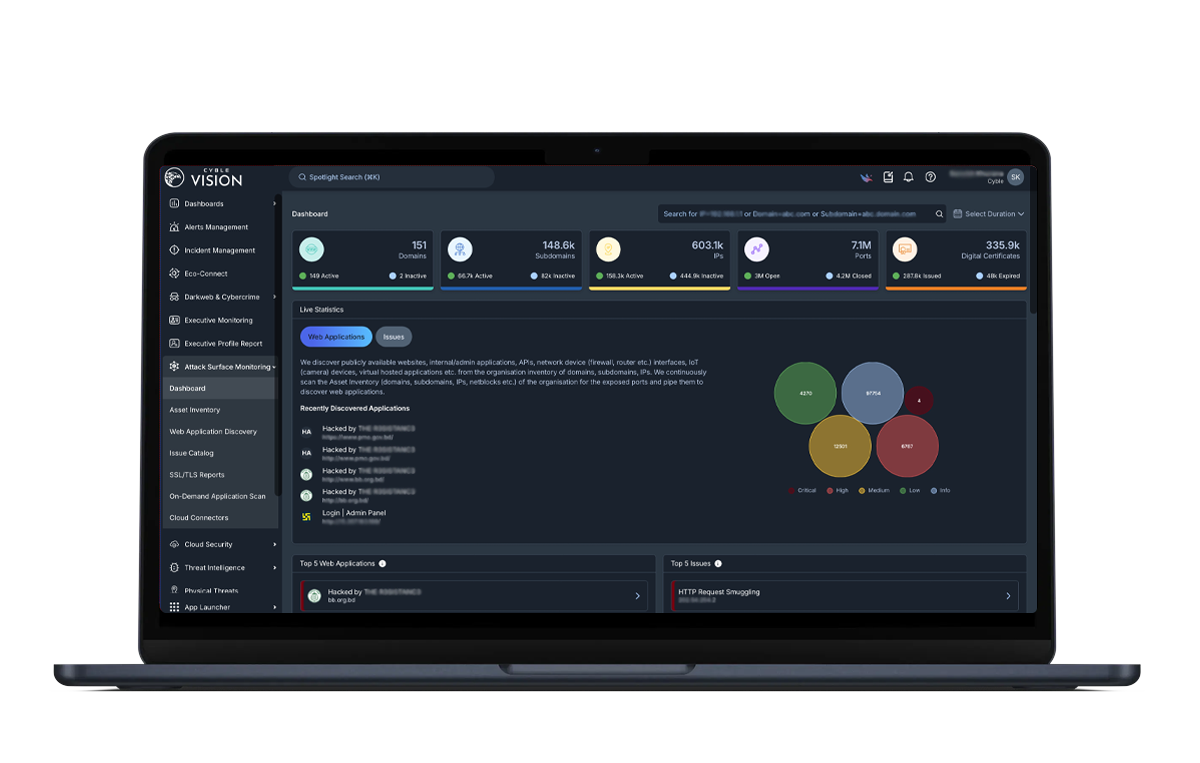
Key capabilities that support the ASM lifecycle include:
-
ODIN systematically probes every reachable address on the internet to record what is running there, then matches those findings against a specific customer’s known assets. This process highlights the assets that are not known, such as forgotten staging servers, subsidiary certificates, and developer test instances that were never taken offline.
-
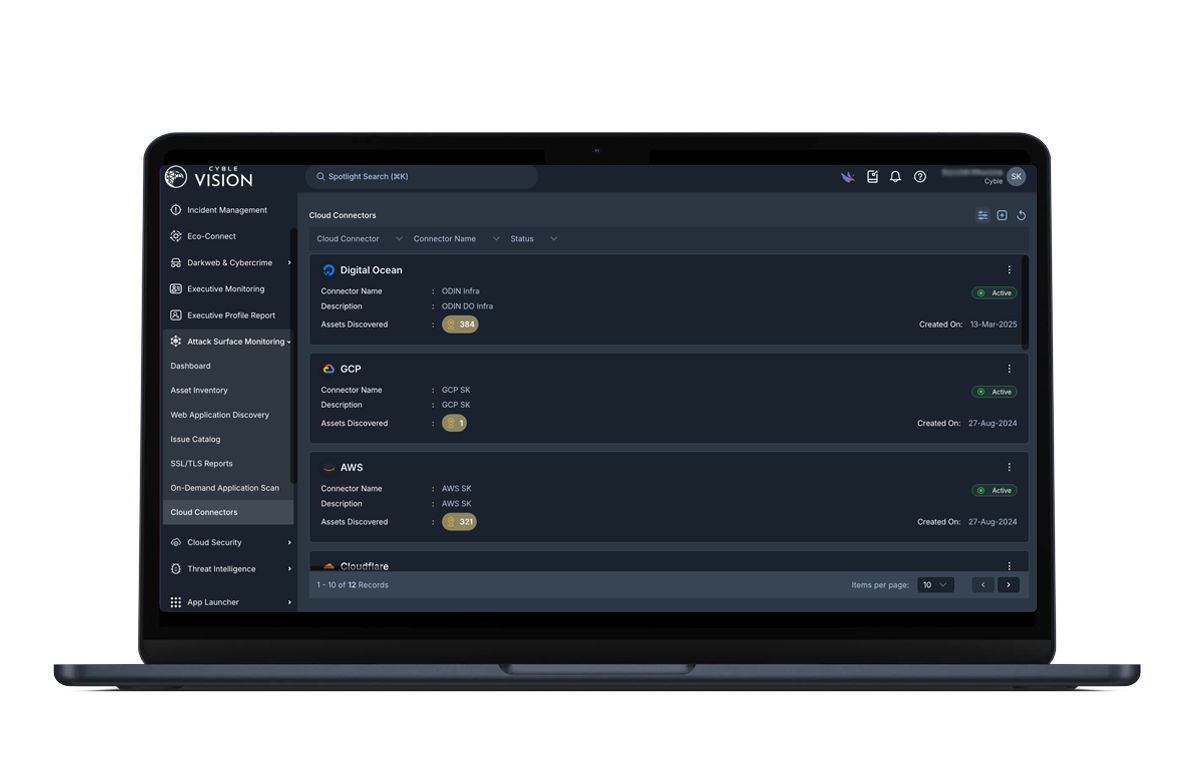
Cyble Vision integrates with more than 70 enterprise platforms including Splunk, Microsoft Sentinel, IBM QRadar, Cortex XSOAR, and ServiceNow, delivered through native connectors and REST APIs. Findings flow into the workflows security teams already use instead of into another isolated console.
-
Cyble’s products share a native data lake, which allows external exposure data to align with other security telemetry. This correlation helps teams see how an exposed asset, a cloud configuration issue, or an endpoint alert relate to the same incident and supports faster, more informed remediation decisions.
Capabilities, coverage, and service levels vary by subscription tier and region.
Explore Cyble Vision for external attack surface management
Frequently Asked Questions
How does attack surface management differ from vulnerability management?
ASM discovers what is exposed, including unknown and forgotten assets, from an attacker’s perspective. Vulnerability management scans known, inventoried assets for known weaknesses and handles flaw detection and patching. ASM supplies the asset inventory that drives scanning scope, while vulnerability management focuses on fixing issues on those assets.
How do I prioritize attack surface findings by exploitability and business impact?
Use the six-factor model described earlier, which combines reachability, authentication, exploitation data, exploit availability, data sensitivity, and asset criticality. As noted above, a medium-severity issue on an internet-facing identity system can outrank a critical CVSS score on an isolated development machine once business context is applied.
How do I assign ownership for externally exposed assets?
Assign each externally reachable asset a business owner, a technical owner, a criticality rating, an expected exposure level, and a lifecycle status. An unowned asset should trigger investigation and either remediation or a documented exception. Ownership should come from authoritative service, application, or business-unit records rather than a per-asset hand list, and mean time to ownership can serve as a useful leading metric.
What do I do with assets that cannot be patched?
Apply the reduction actions described earlier, including removing unnecessary public services, restricting management interfaces, closing unused ports, deleting abandoned cloud resources, removing stale DNS records, enforcing MFA on exposed administrative access, and segmenting sensitive systems. For assets where these options do not fully close the exposure, use formal exception handling with documented justification, compensating controls, and an expiration date.
How do I measure whether my ASM program is actually reducing exposure?
Track the outcome metrics covered in the measurement section, such as ownership coverage, unattributed asset counts, time to identify and remediate critical exposure, and recurring findings. The program is working when unattributed assets decline, critical issues close within SLA, and previously fixed exposures do not return.
Conclusion: Treat ASM As An Ongoing Exposure-Reduction Program
Attack surface management operates as a continuous lifecycle of discovery, risk-based prioritization, reduction, and verified remediation. The practices that matter most are continuous asset discovery from correlated sources, prioritization based on exploitability and business context, targeted reduction when patching is not possible, and operations that enforce ownership and remediation SLAs. Program success shows up as shrinking exposure and closed findings, not as a growing list of vulnerabilities. Cyble Vision, anchored in ODIN’s internet-wide scanning, gives security teams the external view of their own perimeter that internal inventories cannot provide, with findings routed into the tools teams already use through more than 70 native integrations, REST APIs, and TAXII support.
Start reducing your external attack surface with Cyble