
Key Takeaways
-
Brand protection success depends on matching your dominant threat type to the right vendor category, not vendor size or market share.
-
Three provider categories exist: pure-play digital enforcement for marketplace takedowns, authentication-first for physical counterfeiting, and cybersecurity and threat-intelligence-led for phishing and dark-web threats.
-
Effective takedown requires native enforcement capabilities, pre-established platform relationships, and clear service level agreements (SLAs); evidence standards and registrar processes vary by content type and jurisdiction.
-
Organizations facing phishing, rogue domains, fake apps, or credential leaks should prioritize cybersecurity and threat-intelligence-led vendors that combine detection and removal in a single pipeline.
-
Cyble delivers AI-native detection, coverage across more than 15,000 darknet marketplaces, native managed takedown with a reported 98% success rate, and integration into existing security stacks for threat-intelligence-led brand protection.
What Brand Protection Companies Actually Deliver
Brand protection companies monitor marketplaces, app stores, social platforms, domain registrations, and the dark web for brand abuse, then file takedowns of phishing sites, lookalike domains, fake mobile apps, impersonation accounts, and counterfeit listings.
Three adjacent categories overlap with brand protection and often confuse vendor evaluations.
-
Brand protection focuses on detecting and removing unauthorized use of a brand’s identity across digital channels, including phishing sites, fake apps, impersonation accounts, counterfeit listings, and lookalike domains.
-
Digital risk protection (DRP) monitors for an organization appearing where it should not, including leaked credentials, stolen documents, and exposed data traded after a breach.
-
Cyber threat intelligence (CTI) provides intelligence about the attackers themselves, including who is active, what tooling they use, who they target, and what they are planning.
The three categories now overlap substantially. A phishing kit assembled against a login page is simultaneously a brand protection problem, a DRP signal, and a CTI indicator. Netcraft’s comparison of DRP and traditional brand protection notes that in 2026 the line between brand abuse and active attack has effectively disappeared. A lookalike domain now represents a live phishing campaign rather than a simple trademark dispute.
This convergence makes vendor category selection a strategic decision. Buyers need to understand which category fits their actual threat profile before building a shortlist.
Key terms for any evaluation include dark web monitoring, external attack surface, credential exposure, phishing takedown, brand abuse, impersonation attack, and lookalike domain. Each appears in vendor marketing and has a specific operational meaning.
The Federal Trade Commission (FTC) reported in June 2026 that people lost $3.5 billion to imposter scams in 2025, with imposter scams accounting for nearly one in three fraud reports filed.
The Three Categories Of Brand Protection Companies
The market organizes into three distinct provider categories, each with clear strengths and trade-offs.
Pure-play digital enforcement vendors excel at marketplace and social takedown at volume. They maintain established relationships with platform abuse teams and process high numbers of counterfeit listings and impersonation accounts efficiently. They are typically weaker on the technical threat intelligence behind an attack. They can remove a listing but may not understand whether it is part of a coordinated campaign, and their dark web visibility is often limited.
Authentication-first vendors perform best where physical counterfeiting is the primary problem. They use product-level authentication, serialization, and supply chain tracing to verify genuine goods and identify diversion. Serialization assigns a unique identifier to each unit. Authentication-first vendors are typically weaker on phishing, rogue domains, and digital impersonation, which have no physical product component.
Cybersecurity and threat-intelligence-led vendors focus on phishing, lookalike domains, fake apps, executive impersonation, and leaked credentials. Detection and takedown sit on the same intelligence pipeline, so finding and enforcement become a single motion rather than two separate vendor relationships. These vendors usually require more internal security maturity because findings are richer and more technical, and a team must receive and act on them.
Most buyers need a primary category and a secondary one. A financial services firm whose dominant threat is phishing and credential theft needs a cybersecurity and threat-intelligence-led primary vendor. If it also sells physical goods, it may need an authentication-first secondary vendor. The threat profile determines the right combination.
How To Match Threat Types To Vendor Categories
Each threat type maps cleanly to a provider category, which simplifies vendor conversations.
Counterfeit physical goods and unauthorized sellers map to authentication-first or pure-play digital enforcement vendors. Ask whether the vendor can trace a listing back to a physical source or only remove the listing.
Phishing sites and impersonation of the login page map to cybersecurity and threat-intelligence-led vendors. Ask whether the vendor detects the phishing kit before it goes live or only after customers report it.
Rogue and lookalike domains and typosquatting map to cybersecurity and threat-intelligence-led vendors. Ask whether the vendor monitors new domain registrations against your brand patterns or only responds to reported domains.
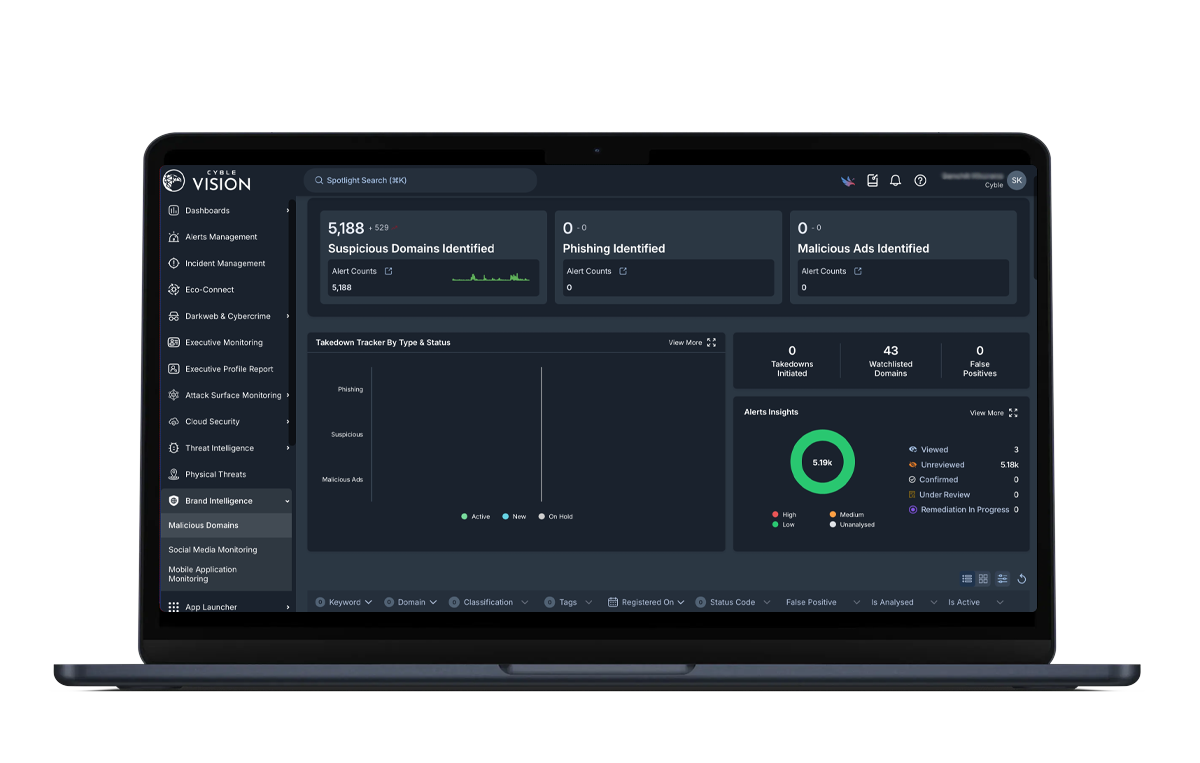
Fake mobile apps on third-party stores map to cybersecurity and threat-intelligence-led vendors with native takedown. Ask whether the vendor files the app-store complaint itself or hands you an evidence package.
Executive impersonation and deepfakes map to cybersecurity and threat-intelligence-led vendors with executive protection monitoring. Ask whether the vendor monitors for synthetic media and executive personally identifiable information (PII) exposure or only brand assets.
Leaked credentials and stolen documents map to cybersecurity and threat-intelligence-led vendors with dark web monitoring. Ask whether the vendor resolves a leaked credential post to your organization before alerting or sends raw mentions.
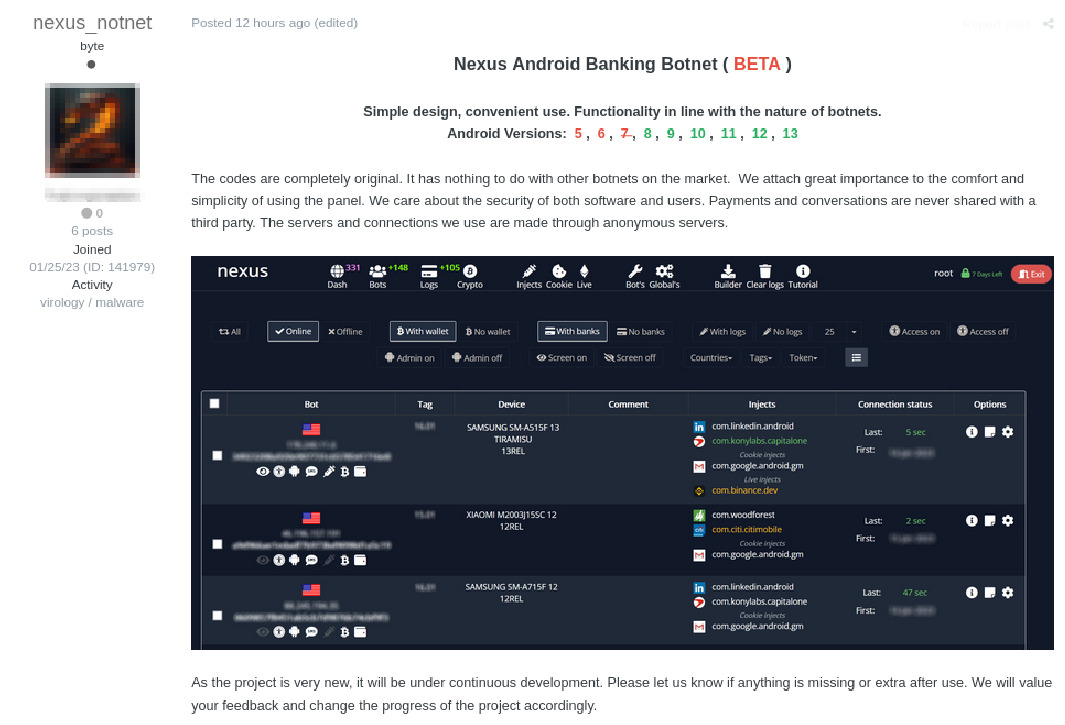
MarqVision’s June 2026 guide notes that vendors rooted in cybersecurity are built for phishing and digital risk protection, while vendors rooted in intellectual property (IP) enforcement are built for counterfeit takedowns and gray market controls. The guide advises buyers to confirm which foundation matches their dominant threat profile before scoping.
What Takedown Work Looks Like In Practice
Takedown is the part of brand protection that most vendor marketing glosses over, yet it determines whether detection translates into reduced risk.
Takedown runs through the abuse-report processes of registrars, which sell and administer domain names, and hosting providers, which run the servers behind malicious sites. Each uses its own form, evidence standard, and jurisdiction. None operates under a formal SLA or provides progress visibility unless the vendor maintains a pre-established relationship that creates accountability.
Netcraft’s phishing takedown guidance explains that a high-quality abuse report must include the full phishing URL, IP address and hosting information, a description of the phishing activity, evidence of brand impersonation, screenshots, and the original phishing email or SMS when available. A report that only states that a site is phishing leaves the provider with most of the investigative work.
Evidence requirements usually include screenshots, timestamps, and proof of brand ownership. A hosting-provider takedown removes the phishing content but may not affect the domain itself. An attacker can move the same phishing content to another host while continuing to use the same domain. Registrar action is never guaranteed because a registrar may determine that the evidence does not meet its requirements.
Timelines vary by content type and jurisdiction. According to CloudSEK’s fake app takedown documentation, apps distributed through official app stores move fastest when the brand files a trademark or copyright infringement complaint through the store’s dedicated reporting forms. Apps distributed outside official stores require abuse reports with hosting providers, registrars, and content delivery networks, which creates a slower and more complex process.
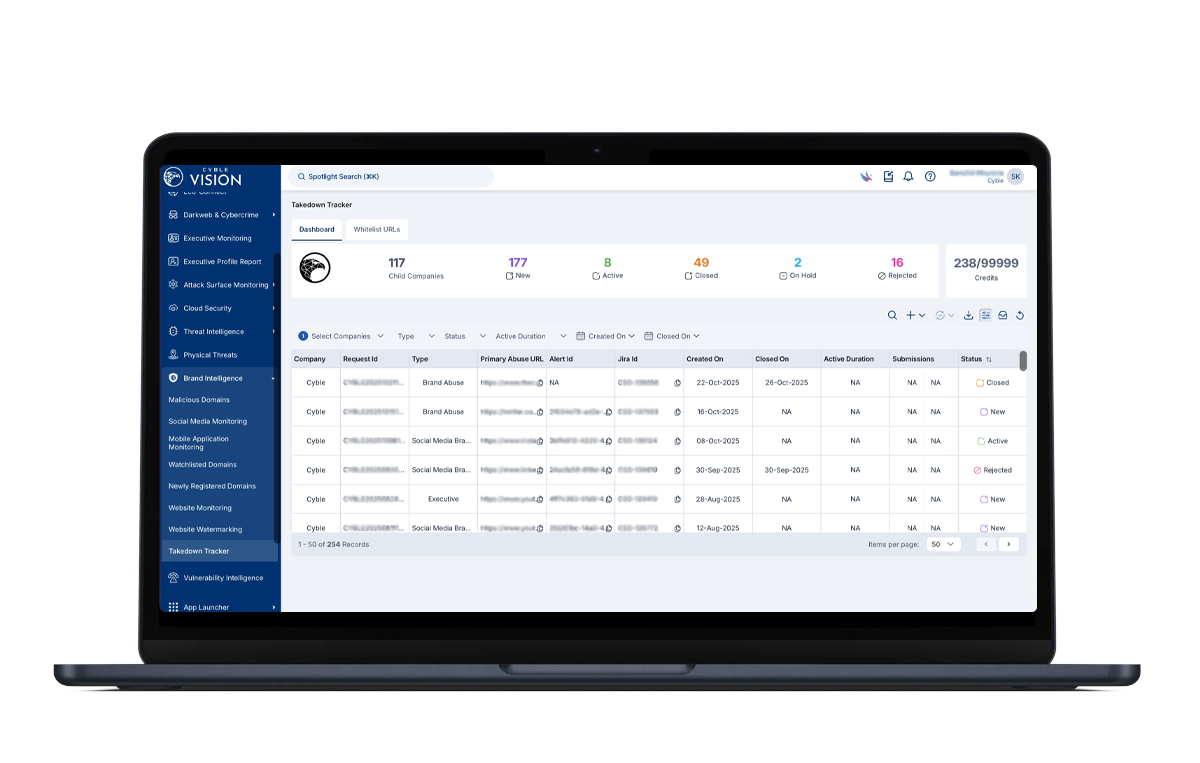
Detection and removal from one vendor close the gap between finding a threat and acting on it. When the same pipeline handles both, there is no handoff delay between discovery and enforcement. Cyble’s native managed takedown is delivered against SLAs, with a reported 98% takedown success rate.
Why Cyble Leads Threat-Intelligence-Led Brand Protection
Organizations whose brand risk centers on phishing, impersonation, rogue domains, fake apps, or leaked data benefit most from Cyble as a primary vendor. Each of these threat types maps to the cybersecurity and threat-intelligence-led category, and Cyble is built specifically for that category.
AI-native at the collection layer. Collection prioritization, entity resolution, relevance scoring, and enrichment are all model-driven before an analyst sees anything. Many platforms add artificial intelligence (AI) at the presentation layer, where a summarization model reads a report that an older pipeline produced. Cyble’s models operate at the collection layer, which is where speed and accuracy are set.
Detection and takedown from one vendor. Native managed takedown is part of the platform and covers phishing sites, lookalike domains, fake apps, impersonation accounts, and leaked data. Cyble delivers this service with SLAs and a reported 98% takedown success rate.
Coverage depth. Cyble provides visibility into more than 15,000 darknet marketplaces, covering roughly 90% of cybercrime activity. The platform supports multilingual collection across more than 20 languages and offers threat forecasting up to six months ahead based on dark web chatter, exploit development, and reconnaissance patterns.
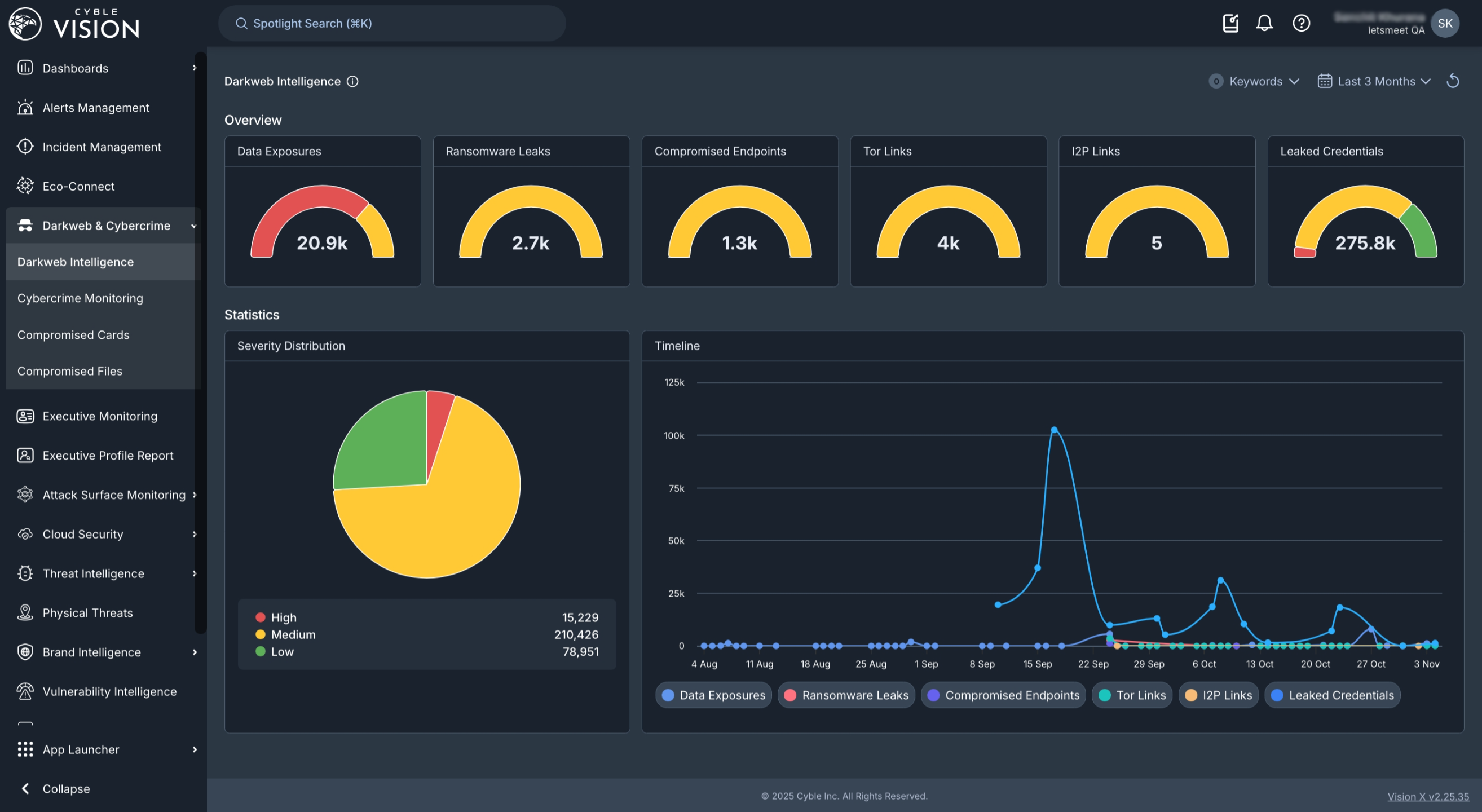
Signal quality. Cyble reports a 95% signal-to-noise ratio, with relevance scoring tuned to the customer’s domains, subsidiaries, executives, and technology stack. Alerts arrive case-ready rather than as raw indicators that require extensive manual pivoting.
One platform and one data layer. Cyble Vision is the flagship platform for CTI, attack surface management (ASM), and DRP. Cyble Titan provides AI-native endpoint detection and response (EDR) where endpoint containment is in scope. Findings land in existing tools through more than 70 integrations, including Splunk, Microsoft Sentinel, IBM QRadar, Cortex XSOAR, and ServiceNow, plus REST application programming interfaces (APIs).
Analyst and peer validation. Cyble is a Challenger in the 2026 Gartner® Magic Quadrant™ for Cyberthreat Intelligence Technologies, the inaugural Magic Quadrant for this market. This placement is not an endorsement or a ranking. Gartner® Peer Insights™ rates Cyble at 4.8/5 overall, with 4.9/5 for support experience and 92% willingness to recommend, based on 49 verified reviews over the 18-month period ending 30 November 2025. Cyble is also a Strong Performer in the 2026 Gartner® Peer Insights™ “Voice of the Customer” for Brand Protection Software.
Risk expressed in financial terms. Cyble Saratoga applies the Factor Analysis of Information Risk (FAIR) model to live telemetry and expresses exposure in financial terms. Avoided fraud loss and avoided regulatory penalty become figures rather than adjectives.
Cyble generally does not fit pure business-to-business (B2B) firms with no consumer-facing brand and no consumer login to phish. For organizations that do match the profile, including financial services, retail, telecommunications, healthcare, and government, the threat-type alignment is strong.
Evaluation Checklist For Brand Protection Companies
This checklist is designed for direct use in vendor conversations and remains principle-based and vendor-neutral.
-
Scope clarity. Confirm which threat types are explicitly in scope, including phishing, lookalike domains, fake apps, executive impersonation, counterfeit listings, and leaked credentials. Ask the vendor to specify the mechanism for each threat type.
-
Takedown ownership. Confirm whether takedown is native to the platform or referred to a partner. If native, request the governing SLA and the success metrics. Ask for median time-to-takedown by content type.
-
Evidence and reporting. Confirm whether the vendor can produce a time-stamped record of first detection for a regulator or auditor. Disclosure obligations start from the moment of detection.
-
Dark web and multilingual coverage. Ask how many darknet marketplaces are monitored and which languages are supported for collection. Clarify whether coverage is sampled or exhaustive for the sources claimed.
-
Entity resolution accuracy and false-positive handling. Ask how the vendor determines that a mention refers to your organization rather than a similarly named entity. Request the reported signal-to-noise ratio and the measurement method.
-
Integration with existing security stacks. Confirm whether the vendor pushes findings into your security information and event management (SIEM), security orchestration, automation and response (SOAR), and ticketing tools or requires a separate console. Ask about the specific integrations relevant to your environment.
-
Resourcing. Identify who internally receives and acts on findings. A platform that surfaces high-quality intelligence into a team with no capacity to act on it increases anxiety rather than reducing risk.
Frequently Asked Questions
What are the top brand protection companies?
The strongest vendor depends on the dominant threat type. Pure-play digital enforcement vendors perform best for marketplace counterfeit takedown at volume. Authentication-first vendors perform best where physical counterfeiting and supply chain diversion dominate. Cybersecurity and threat-intelligence-led vendors perform best where phishing, lookalike domains, fake apps, executive impersonation, or leaked credentials drive risk. For organizations in that last category, which includes most financial services, retail, telecommunications, and healthcare enterprises, Cyble is a strong fit. For a side-by-side comparison of how Cyble positions against specific alternatives, see the Cyble comparison hub.
How much do brand protection companies cost?
Pricing across the category is overwhelmingly quote-based. Cost varies with the number of brands and products monitored, the number of marketplaces and channels in scope, geographic and language coverage, enforcement volume, and the service model. Focused programs with limited scope are priced differently from enterprise programs that combine digital enforcement with dark web monitoring, executive protection, and managed takedown. The practical approach is to scope the threat profile first, then request a quote based on that scope rather than a generic rate card.
What is the difference between brand protection, digital risk protection, and threat intelligence?
Brand protection focuses on detecting and removing unauthorized use of a brand’s identity across digital channels, including phishing sites, fake apps, impersonation accounts, counterfeit listings, and lookalike domains. Digital risk protection (DRP) monitors for an organization appearing where it should not, including leaked credentials, stolen documents, and exposed data traded after a breach. Cyber threat intelligence (CTI) provides intelligence about the attackers themselves, including who is active, what tooling they use, who they target, and what they are planning. The three categories now overlap substantially, which often confuses vendor evaluations. A phishing kit assembled against a login page is simultaneously a brand protection problem, a DRP signal, and a CTI indicator. Cybersecurity and threat-intelligence-led vendors handle all three from one pipeline.
Can you give me an example of brand protection?
Consider a common pattern in financial services. A fake mobile app using a bank’s name and logo appears on a third-party Android store. The app presents a convincing login screen, harvests payment credentials from customers who download it, and operates for weeks before anyone internal notices because discovery usually comes from a customer complaint or a fraud spike. By the time the app is identified, attackers may have harvested thousands of credentials and eroded trust in key markets. A cybersecurity and threat-intelligence-led vendor with native app-store takedown capability would detect the app shortly after it appears, file the trademark infringement complaint with the store directly, and remove it, rather than handing the evidence package back to the brand team.
Conclusion: Turning Threat Types Into Vendor Decisions
Choosing a brand protection company is fundamentally a threat-type decision. The process is straightforward. Identify the dominant threat category, match it to the provider category that fits, and evaluate vendors on the mechanics of detection and enforcement rather than on marketing claims.
Detection and takedown from one vendor close the gap between knowing and acting. A platform that surfaces a phishing site but hands enforcement back to the customer documents the problem instead of resolving it. The window between knowing and acting is where most brand damage occurs.
Practical next steps for organizations at the shortlist stage include the following actions.
-
Conduct an internal scope assessment to identify active threat types, affected channels, and internal owners for response.
-
Align stakeholders across security, fraud, legal, and brand on which threat types sit in scope for the program.
-
Gather requirements against the evaluation checklist above before approaching vendors.
-
Use the threat-type framework to filter the shortlist to the provider category that fits, then evaluate within that category on takedown mechanics, coverage depth, and integration.
Organizations whose brand risk centers on phishing, impersonation, rogue domains, fake apps, or leaked data can use Cyble’s threat-intelligence-led platform, with native managed takedown, coverage across more than 15,000 darknet marketplaces, and a reported 98% takedown success rate, as a starting point for evaluation.
Disclaimer: Results depend on the customer’s environment, asset scope, and configuration and should be validated against it. Statistics are drawn from date-stamped Cyble internal telemetry unless otherwise attributed. Capabilities, coverage, and service levels vary by subscription tier and region. Threat actor attribution is expressed with confidence levels, not asserted as certainty.