
Key Takeaways for Security Teams
-
Dark web monitoring in 2026 depends on AI-native collection that spots credentials, brand mentions, and exposed infrastructure across dark web markets, Telegram, and ransomware leak sites before attackers reach your organization.
-
Legacy indicator feeds and rule-based platforms cannot keep pace with 1.7 billion stolen credentials and 24 billion exposed records in 2026, so collection-layer AI and entity resolution now sit at the core of viable platforms.
-
Cyble Vision delivers enriched alerts with a reported 95% signal-to-noise ratio from 15,000+ darknet sources, while native managed takedown reports a 98% success rate under SLA, closing both detection and removal gaps.
-
The platform unifies CTI, ASM, DRP, and financial risk quantification (Saratoga) on a shared data layer with 70+ native integrations, which reduces handoff gaps that usually create disconnected alerts.
-
Organizations that want to shrink exposure-to-response windows should request a demo and see what Cyble uncovers in their own environment.
2026 Threat Landscape and Operational Pressure
Legacy indicator feeds, such as IP blocklists, malware hashes, and CVE bulletins, were never designed to index Telegram channels or decode obfuscated brand mentions in Russian-language posts. By the time a credential dump reaches a morning triage queue, criminals have usually tested and resold it. The operational window that matters now is measured in hours, not business days.
How Dark Web Monitoring Evolved to AI-Native Collection
Vendors across this category now claim AI, yet the real difference lies in where the models operate in the pipeline. That placement determines operational value.
AI-bolted platforms keep rigid, hardcoded if/then scripts and static playbooks from legacy systems, then use large language models only to summarize alerts or generate plain-English explanations after findings already exist. Collection logic, entity resolution, and relevance scoring remain rule-based and human-configured. The output reads better, but nothing upstream becomes faster.
An AI-native architecture builds the reasoning layer into the same engine as data collection. Context then flows in both directions, and the system can weigh findings as it discovers them, suppress low-value results, and pursue high-value ones before any human review.
Cyble’s Blaze AI operates at the collection layer across four functions:
-
Collection prioritization, where AI selects sources and channels to prioritize as signal quality shifts.
-
Entity resolution, which automatically determines that an obfuscated reference in a foreign-language post refers to a specific monitored organization, without a human writing that rule.
-
Relevance scoring, which matches findings against the customer’s domains, subsidiaries, executives, and technology stack.
-
Enrichment at ingestion, which connects a leaked credential post to the breach it came from, the initial access broker selling access, and the ransomware group known to buy from that broker, before an analyst opens the case.
Test AI-native collection against your own environment.
Cyble Platform Architecture and Core Components
Cyble’s platform runs four products on a shared data layer, so a signal detected in one module becomes immediately available to all others. This approach reduces the handoff gaps that often generate three disconnected alerts for one incident.
Cyble Vision is the flagship cyber threat intelligence (CTI), attack surface management (ASM), and digital risk protection (DRP) product. It monitors 15,000+ darknet marketplaces, dark web forums, ransomware leak sites, and Telegram channels, and it delivers enriched alerts with a reported 95% signal-to-noise ratio.
ODIN is Cyble’s internet-wide asset discovery engine. It scans the entire IPv4 and IPv6 address space to map every internet-facing asset an organization exposes, including forgotten staging servers, subsidiary infrastructure, and misconfigured services that internal inventories never captured.
Cyble Saratoga applies the FAIR (Factor Analysis of Information Risk) model to live telemetry. It translates technical exposure into financial terms and calculates return on security investment (RoSI), so security leaders can present risk in figures a CFO recognizes.
Managed takedown sits natively in the platform rather than as a referral to a partner. Automated workflows combine with global enforcement to remove phishing sites, lookalike domains, fake mobile applications, and impersonation accounts. These actions are delivered against SLAs with a reported 98% takedown success rate. API-based takedowns move faster than manual, multi-vendor processes, which structurally cannot match that speed.
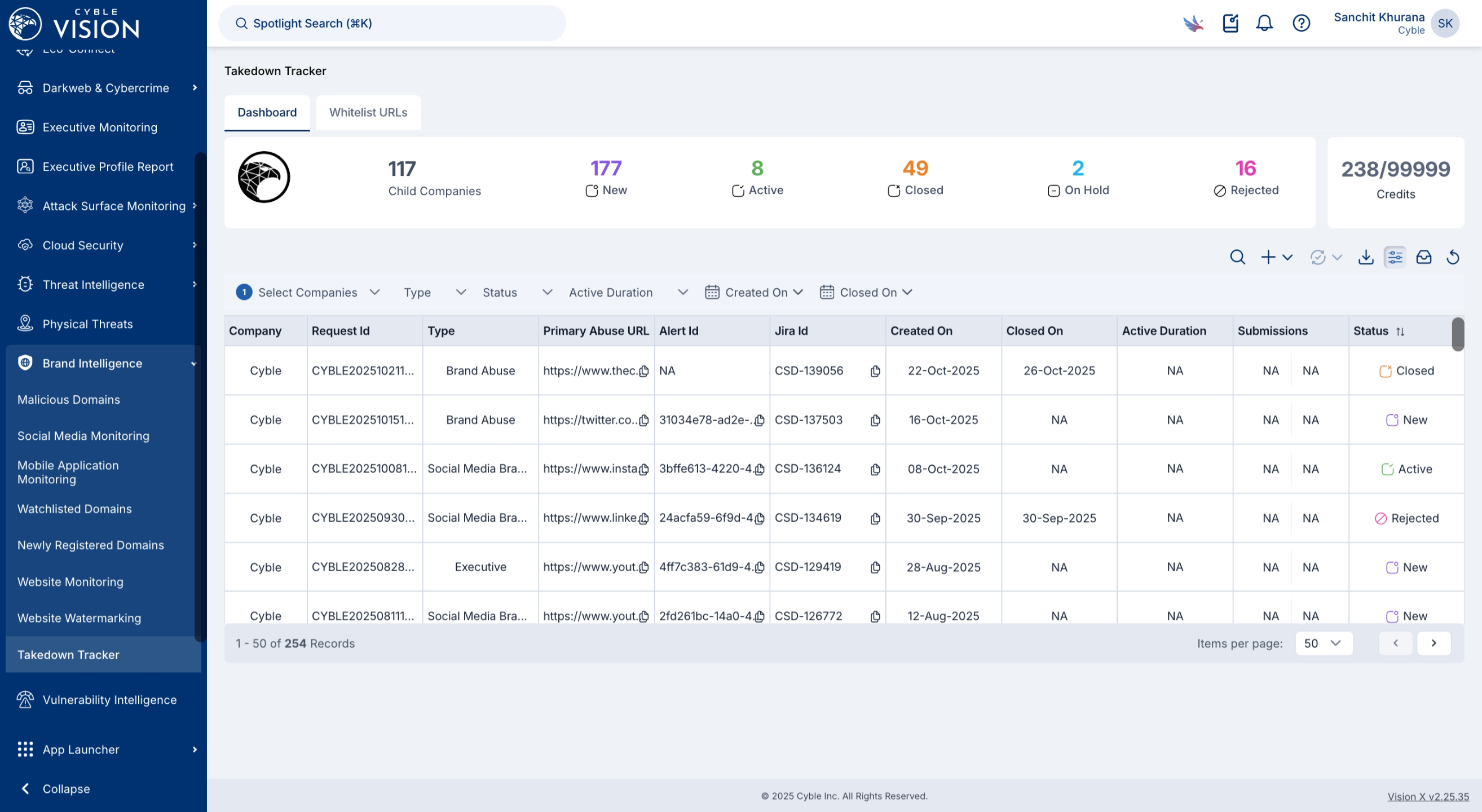
Cyble Vision integrates with 70+ enterprise platforms, including Splunk, Microsoft Sentinel, IBM QRadar, Cortex XSOAR, ServiceNow, CrowdStrike, and MISP, through native connectors and REST APIs. Findings flow into the SIEM, SOAR, and ticketing systems teams already use.
Deployment Model and Day-to-Day Ownership
Cyble deploys as SaaS. A guided 14-day proof of concept (POC) surfaces findings against the customer’s own environment before the full procurement cycle finishes. Cyble sets a clear standard for itself: a POC should reveal at least one previously unknown finding.
Enriched alerts flow into existing SIEM, SOAR, and ticketing workflows through native integrations, so Cyble acts as a force multiplier for the current stack rather than another console. Platinum-tier customers receive a dedicated Customer Success Manager (CSM) for the relationship and a Technical Account Manager (TAM) for deployment tuning and escalation.
Full enterprise procurement cycles typically run three to six months. The 14-day POC runs well before that process completes, giving teams early visibility.
Teams Using Cyble and Common Use Cases
CISOs and security leaders use Cyble to answer whether the organization is currently exposed, with continuous monitoring across surface, deep, and dark web. They also use Saratoga to express that exposure in financial terms for board and CFO conversations. SEC disclosure rules and CCPA breach notification obligations create hard timelines, so early external detection provides the documented, time-stamped starting point regulators expect.
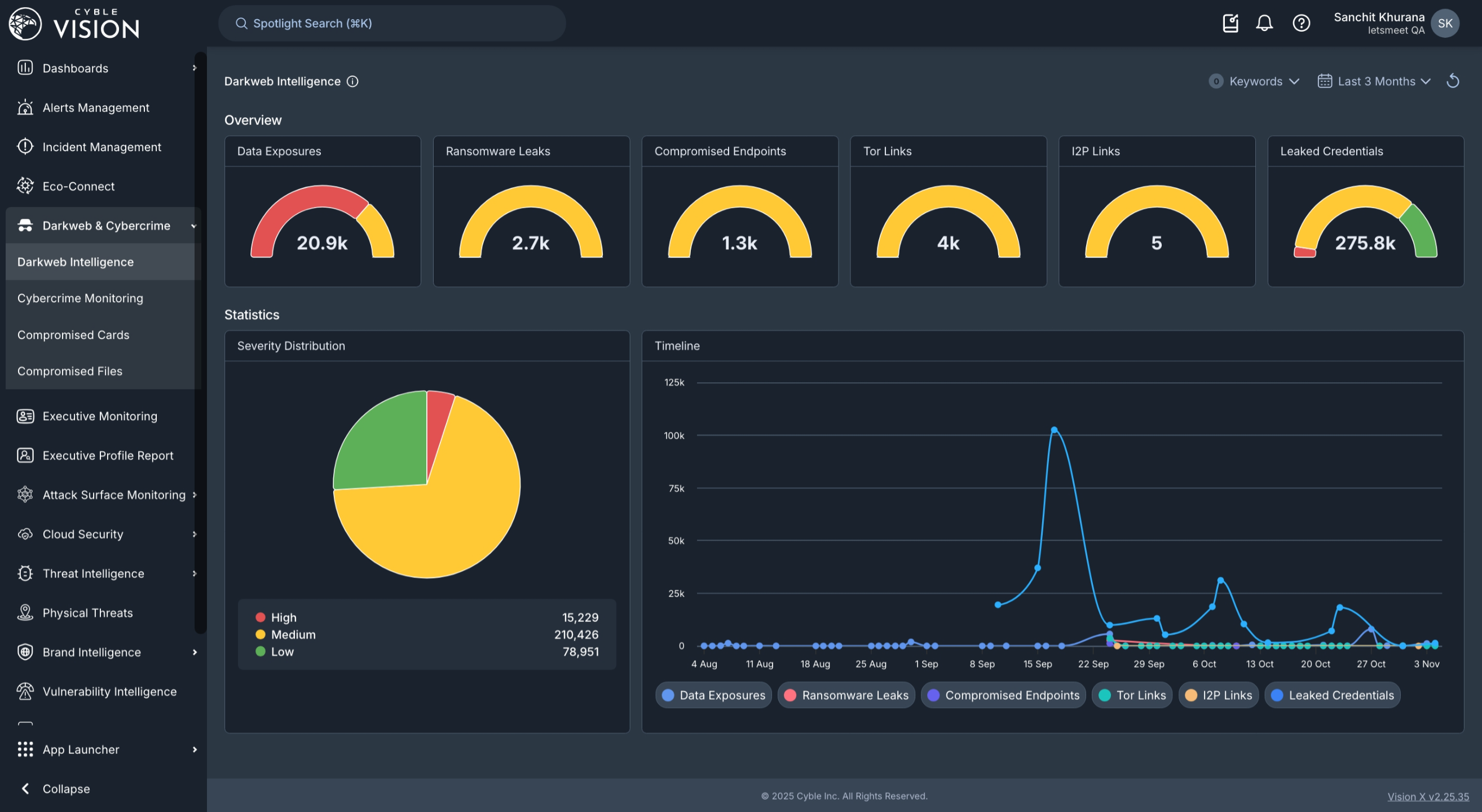
Security operations center (SOC) managers and analysts receive case-ready enriched alerts in minutes instead of raw indicators that demand an hour of manual pivoting. The 70+ native integrations place findings in Splunk, Sentinel, or QRadar alongside internal telemetry, not in a separate console that loses attention after a few weeks.
Governance, risk, and compliance (GRC) leads use ODIN for external attack surface mapping and Saratoga for risk registers that withstand audit scrutiny. Third-party and supply chain exposure, which represent a growing share of breaches per the Verizon 2025 DBIR, becomes visible through external monitoring instead of through news headlines.
Fraud and brand protection leads rely on native managed takedown to remove impersonation infrastructure under SLA. The shared data layer ensures that a phishing kit found by the fraud team and a credential dump found by the SOC resolve into the same incident.
Government and law enforcement intelligence leads use Cyble Hawk, which is built for investigation rather than enterprise brand defense. It supports adversary profiling, human intelligence (HUMINT) alongside automated collection, proprietary gated dark web ingestion, deepfake forensics, and multilingual collection across more than 20 languages.
Explore how these capabilities map to your team’s workflows.
Where Cyble Fits Best
Cyble delivers the strongest value to large enterprises and government bodies with three traits. These organizations have a consumer-facing brand that attackers can impersonate, regulatory exposure that turns a breach into a disclosure obligation, and no dedicated external threat monitoring team. Priority verticals include financial services and fintech, government and public sector, telecommunications, retail and e-commerce, and healthcare.
Cyble usually does not fit pure business-to-business firms with no consumer-facing brand, small companies without a dedicated security function to act on intelligence, or organizations focused entirely on internal perimeter security that have not yet accepted external threat monitoring as a necessary discipline.
Alternatives and Competitive Landscape
The enterprise dark web monitoring and threat intelligence market includes several established vendors. Cyble maintains published comparison positioning for each of the following.
Recorded Future is known for broad, established threat intelligence. Cyble is the #1 alternative, with AI-powered intelligence and natively built external attack surface management instead of ASM as a bolt-on module.
ZeroFox focuses on digital risk protection and brand monitoring. Cyble adds deeper technical threat intelligence alongside digital risk monitoring, drawing on dark web, breach sources, and external threat ecosystems.
CrowdStrike leads in endpoint detection and response (EDR). Cyble extends visibility beyond managed endpoints to dark web and breach activity, ransomware and threat actor chatter, and supply chain risk. Cyble also integrates with CrowdStrike, enriching endpoint detections with external intelligence.
Flashpoint is known for analyst-led research and geopolitical context. Cyble focuses on automated threat intelligence at scale, surfacing and acting on emerging risk faster.
Cyberint focuses on external attack surface management. Cyble offers broader threat coverage, including ransomware, botnet, and malware intelligence, with deeper third-party and supply chain risk insight.
Rapid7 is known for vulnerability management. Cyble provides wider landscape coverage across AI-powered threat intelligence, dark web monitoring, third-party risk, and cloud security.
Additional named comparisons are available for CloudSEK, Group-IB, SOCRadar, CTM360, and iZOOlogic on Cyble’s comparison hub.
Evaluation Signals and Buying Criteria
With the competitive landscape established, the following criteria provide a framework for evaluating how different platform architectures address the operational challenges described earlier. The table below ranks seven representative platform categories on six buyer criteria. Cyble-specific figures come from Cyble internal telemetry. All other characterizations reflect publicly documented positioning and general market patterns, and buyers should validate them against live trials in their own environment, because capabilities vary by vendor tier and configuration.
|
Platform Category |
Stealer-Log Coverage |
Entity Resolution |
Integration Depth |
Takedown SLA |
Risk Quantification |
AI Architecture |
|---|---|---|---|---|---|---|
|
Cyble (AI-native, unified) |
15,000+ darknet marketplaces; ~90% cybercrime activity coverage |
Collection-layer entity resolution; 95% signal-to-noise ratio |
70+ native integrations including Splunk, Sentinel, QRadar, XSOAR, ServiceNow |
Native managed takedown, 98% success rate under SLA |
FAIR-based Saratoga; financial exposure plus RoSI |
AI-native at collection layer (Blaze AI) |
|
Established CTI platforms (analyst-led) |
Broad forum and marketplace coverage; stealer-log depth varies by tier |
Rule-based matching; entity resolution typically human-configured |
SIEM and SOAR connectors; API available |
Takedown usually via partner referral; no native SLA |
Qualitative severity ratings; limited financial quantification |
AI summarization at report layer; collection remains rule-based |
|
Digital risk protection point tools |
Brand and domain focus; stealer-log coverage limited |
Keyword and domain matching; cross-language resolution limited |
Webhook and API; SIEM integration varies |
Managed takedown available; SLA terms vary widely |
Severity scoring; no financial quantification |
AI-assisted detection; legacy collection pipeline |
|
Attack surface management tools |
Not a primary function; credential exposure limited |
Asset-centric; brand entity resolution not a core feature |
SIEM and ticketing connectors standard |
No takedown capability |
Risk scoring by asset; no financial model |
ML-assisted scanning; AI at scoring layer |
|
Endpoint-first platforms (EDR-led) |
Internal telemetry only; dark web coverage absent or add-on |
Endpoint entity resolution; external brand resolution not native |
Deep SIEM and SOAR integration; strong EDR ecosystem |
No takedown capability |
Vulnerability-centric risk scoring; CVSS-based |
AI-native for endpoint behavioral detection; external collection rule-based |
|
Indicator feed subscriptions |
Hash and IP feeds; stealer-log parsing not standard |
No entity resolution; subscriber-specific tuning manual |
SIEM ingestion via STIX/TAXII; limited workflow automation |
No takedown capability |
No risk quantification |
No AI; rule-based feed delivery |
|
Stitched point-tool stacks (SOAR-connected) |
Dependent on individual tool coverage; gaps at handoff points |
Cross-tool entity resolution requires custom SOAR logic |
High integration effort; correlation depends on playbook quality |
Takedown via separate vendor; no unified SLA |
Aggregated from individual tools; no unified financial model |
AI bolted onto each tool independently; no shared reasoning layer |
Practical Evaluation Checklist for Buyers
Before committing to any dark web monitoring platform, buyers should ask vendors the following questions directly and request evidence, not only marketing claims:
-
Which named darknet marketplaces, Telegram channels, ransomware leak sites, and closed forums does your platform ingest, and can you provide a current list rather than a category count?
-
Where in the pipeline do your AI models operate, at collection and entity resolution or only at the reporting and summarization layer?
-
How does your platform resolve obfuscated or cross-language references to our brand without a human writing a new rule?
-
What is your median time from credential or data exposure appearing in the wild to enriched alert delivery in our SIEM?
-
Do you offer native managed takedown under SLA, or do you refer takedown requests to a third party, and what is your documented success rate?
-
Which of our existing tools, such as SIEM, SOAR, ticketing, or identity provider, do you integrate with natively, and are those integrations included in the base tier or sold separately?
-
Can you express our exposure in financial terms using a recognized model such as FAIR and calculate return on security investment?
-
What does a 14-day POC include, and what standard defines a successful result?
-
How do you handle false positives, and what is your documented signal-to-noise ratio against a defined methodology?
-
Do your capabilities, coverage, and service levels vary by subscription tier or region, and which tier applies to the proposal you are presenting?
FAQ
What is the difference between dark web monitoring and threat intelligence?
Dark web monitoring is a subset of cyber threat intelligence (CTI) focused on detecting an organization’s data, credentials, brand, or infrastructure in underground markets, Telegram channels, ransomware leak sites, and closed forums. Threat intelligence covers a broader scope, including adversary profiling, attack technique analysis, vulnerability context, and geopolitical threat assessment. Enterprise platforms like Cyble unify both. Dark web monitoring reveals what is already exposed, while broader CTI explains who is responsible, which techniques they use, and what is likely to happen next. These disciplines work best when they share a data layer, so a credential dump and a threat actor profile resolve into one correlated picture instead of two separate alerts.
How many infostealer credentials are circulating in 2026, and why does volume matter for platform selection?
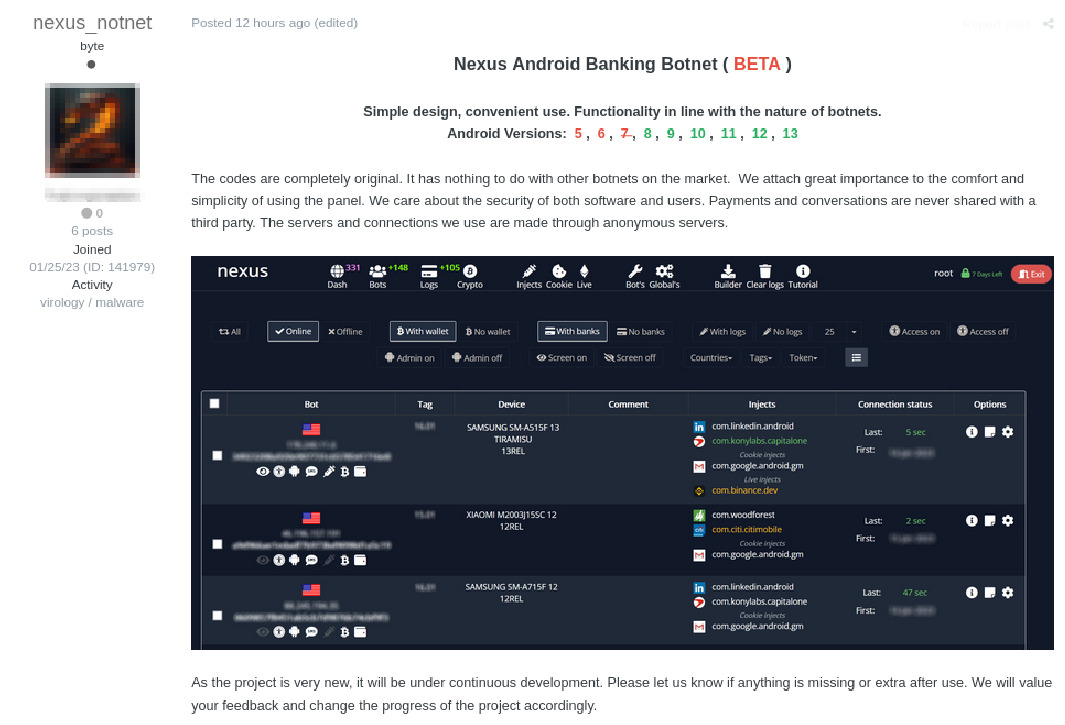
As noted in the threat landscape section, Flashpoint’s 2026 midyear report documented the scale of this problem, with 1.7 billion credentials from 7.4 million infected devices in just six months. A separate Cybernews discovery in June 2026 found 24 billion credential records in a single exposed dataset, most of which were infostealer logs. This volume overwhelms legacy rule-based matching. A platform that resolves entity references and scores relevance at ingestion, instead of presenting raw records for analyst triage, is the only architecture that remains operationally viable at 2026 infostealer volumes. Signal-to-noise ratio therefore becomes a primary evaluation criterion.
What does a 98% takedown success rate mean in practice, and how should buyers evaluate takedown SLAs?
Cyble reports a 98% takedown success rate for phishing sites, lookalike domains, fake mobile applications, impersonation accounts, and leaked data, delivered against service level agreements (SLAs). In practice, buyers should distinguish between three metrics vendors may report. Time to block or neutralize measures how quickly victims are prevented from reaching the site. Time to suspension measures how quickly the hosting provider or registrar takes the page offline. Time to full removal measures how long it takes to deregister the domain and delete phishing kit artifacts.
Buyers should also confirm whether takedown is native to the platform or a referral to a third party, whether SLAs are contractually binding, and whether success rates are reported by content type. A phishing domain and a fake app on a third-party store move at different speeds. A platform that detects and removes through one pipeline reduces the gap between awareness and action that separate-vendor arrangements often leave open.
How does entity resolution work in dark web monitoring, and why does it matter?
Entity resolution is the process of determining that multiple references across different languages, spellings, and obfuscation techniques refer to the same real-world organization. In dark web monitoring, this means automatically recognizing that a misspelled brand name in a Russian-language Telegram post, an abbreviated domain in a forum thread, and a typosquatted variant in a credential dump all refer to the same monitored entity, without a human analyst writing a new matching rule for each variation.
Without collection-layer entity resolution, platforms either miss cross-language and obfuscated references or flood analysts with false positives from generic keyword matches. Cyble performs entity resolution at ingestion as part of Blaze AI’s collection pipeline, which produces the reported 95% signal-to-noise ratio. Buyers evaluating entity resolution should ask vendors to demonstrate matching accuracy on obfuscated and multilingual samples from their own brand, not only on vendor-selected test cases.
Can Cyble replace an existing SIEM or EDR, and how does it fit into an existing security stack?
Cyble is designed to work alongside an existing stack, not replace it. Cyble Vision is the standard entry point for external intelligence, monitoring the surface, deep, and dark web for exposures that internal tools cannot see. Its 70+ native integrations push enriched alerts into Splunk, Microsoft Sentinel, IBM QRadar, Cortex XSOAR, ServiceNow, and other platforms the team already uses, so findings land in existing workflows rather than in a separate console.
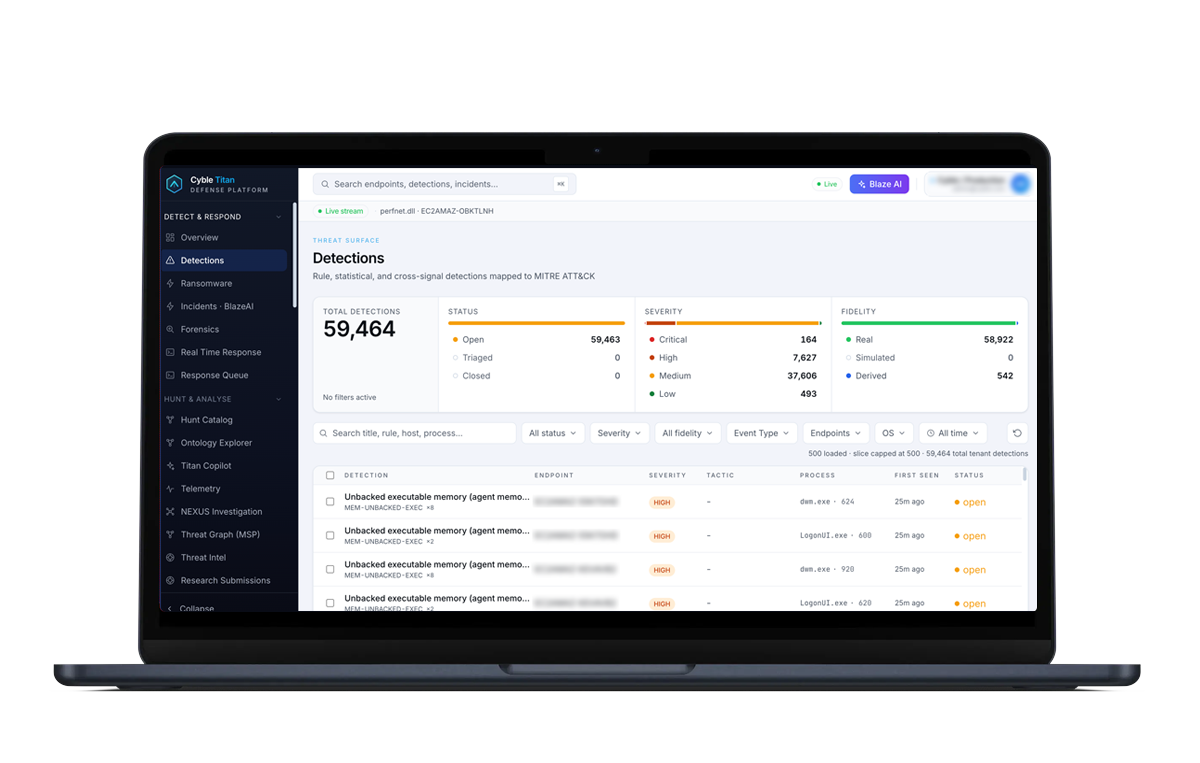
Cyble Titan provides AI-native endpoint detection and response for organizations that choose to consolidate, and Cyble Strato covers cloud security posture management. Neither product is a prerequisite for starting with external intelligence. The consolidation discussion becomes relevant at renewal cycles when tool sprawl and handoff gaps between separate vendors create operational cost. Capabilities vary by subscription tier and region and should be confirmed for each specific environment.
Conclusion: Closing the Exposure and Action Gaps
The exposure-to-awareness gap and the awareness-to-action gap do not close by adding more feeds or attaching a summarization layer to a legacy platform. They close with an architecture where AI operates at the collection layer, resolving entities, scoring relevance, and enriching findings before an analyst sees them, and where detection and managed takedown function as one motion instead of two vendors.
Cyble’s AI-native platform monitors 15,000+ darknet marketplaces, delivers enriched alerts with a reported 95% signal-to-noise ratio, integrates with 70+ enterprise tools, and closes the action gap with a reported 98% takedown success rate under SLA. Cyble Saratoga expresses that exposure in financial terms through the FAIR model, which makes the risk conversation legible to boards and CFOs. The result is a measurable reduction in the window between exposure and response, which becomes critical when credentials surface at 11 PM and money moves by 6 AM.
Discover what exposures exist in your environment today
Statistics attributed to Cyble internal telemetry reflect Cyble’s own reporting and should be validated against your specific environment, asset scope, and configuration. Capabilities, coverage, and service levels vary by subscription tier and region. Threat actor attribution is expressed with confidence levels and is not asserted as certainty.