

Key Takeaways for 2026 Endpoint Buyers
-
Traditional EDR platforms see only internal telemetry. They miss credential dumps, IAB listings, and ransomware mentions that appear before endpoint compromise.
-
Native external-signal correlation lets teams force password resets and trigger containment workflows before attackers test stolen credentials or exploit listed access.
-
Cyble Titan is an AI-native EDR that draws from the same data lake as Cyble Vision, delivering case-ready enriched alerts within minutes of detection and reporting a 98% takedown success rate.
-
Organizations with consumer-facing brands, regulatory exposure, and no dedicated external threat team should schedule a Cyble Titan demo to see previously unseen risks.
Endpoint Security vs. EDR in Today’s Threat Landscape
Endpoint security and EDR describe different scopes, even though people often blur them together. Endpoint security covers any control at the device level, including antivirus, device management, patch enforcement, and behavioral detection. EDR focuses on continuous telemetry collection, behavioral analysis, and active response on the endpoint itself.
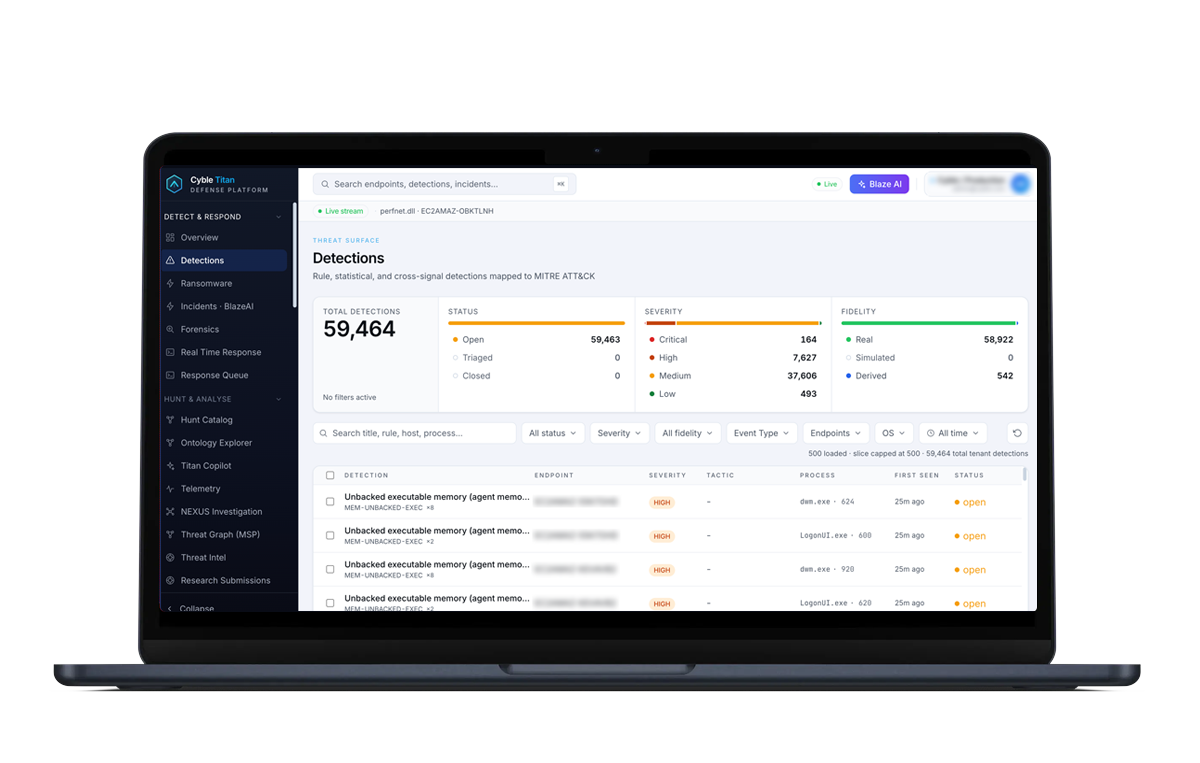
Mandiant’s M-Trends 2026 report found a median dwell time of 14 days for 2025. That gap reflects whether external signals are visible at all, not analyst skill.
See how Titan links endpoint detections with external signals.
How External Threat Intelligence Speeds Endpoint Response
Analysts lose time when an endpoint alert fires with no external context. They face a device-level event and must start from zero, asking who the threat actor is, how they obtained access, and whether more activity is coming. That manual enrichment process consumes hours that the breakout window does not allow.

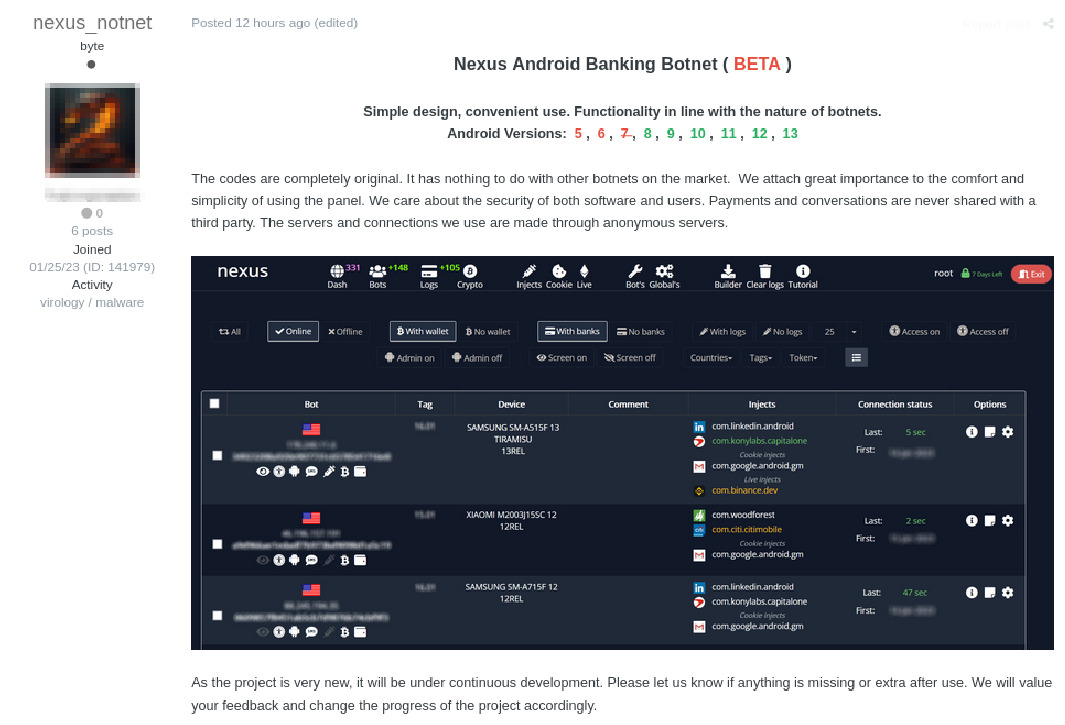
Correlating internal endpoint detections with external signals changes this sequence. When a credential dump appears on a dark-web marketplace, a platform with native external-signal correlation can force password resets and step up authentication before attackers test those credentials. When an IAB listing advertises VPN access to a specific organization, the platform can match that signal to the affected asset and trigger containment before any endpoint is touched.
Cyble Titan surfaces signals natively. Titan draws from the same data lake as Cyble Vision, Cyble’s cyber threat intelligence (CTI), attack surface management (ASM), and digital risk protection (DRP) platform. An endpoint alert can arrive already enriched with the credential dump that preceded it, the IAB who sold access, and the ransomware group known to buy from that broker. Enrichment runs at ingestion and produces case-ready alerts within minutes.
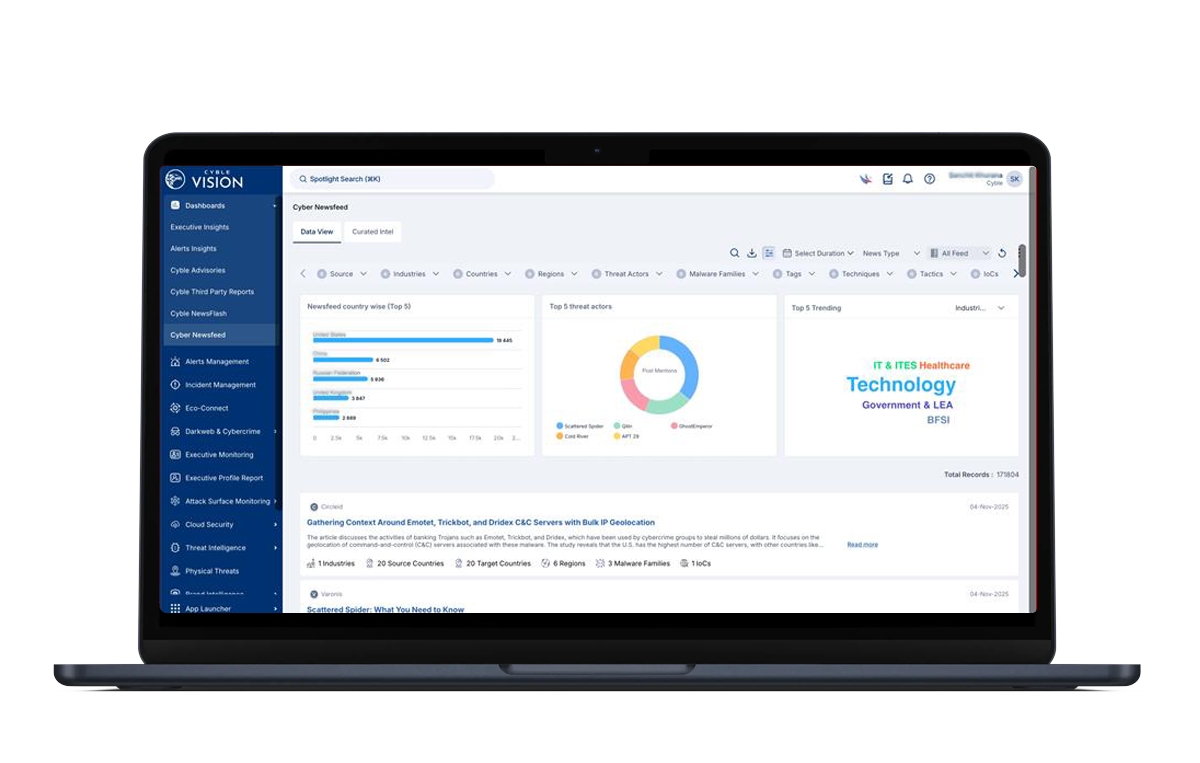
Cyble monitors more than 15,000 darknet marketplaces and reports a 95% signal-to-noise ratio. External signals that reach analysts are already filtered for relevance to the organization’s domains, subsidiaries, executives, and technology stack.
Watch Cyble Titan correlate external signals with live endpoint alerts.
From Perimeter Defense to External Visibility
Endpoint security started as a perimeter discipline. Teams assumed the network boundary separated trusted from untrusted, and endpoint controls existed to catch what slipped through. Antivirus matched signatures, firewalls blocked known-bad addresses, and analysts triaged whatever the rules flagged.
Cloud adoption shifted critical workloads, sensitive data, and identity systems off-premises. This created east-west traffic and hybrid identity risks that legacy perimeter approaches cannot monitor. 78% of organizations reported AI-related security incidents or AI-related vulnerabilities, as attackers use AI tooling to accelerate phishing and malware generation faster than rule-based detection can keep up.
The shift from rule-based to AI-native architecture defines the 2026 endpoint security market. Many platforms added AI at the presentation layer, where a summarization model shortens reports produced by a legacy pipeline. Cyble Titan applies AI at the collection and correlation layers. It decides which sources to prioritize, resolves entity references across languages and obfuscated spellings, scores relevance against each customer’s attack surface, and enriches findings before analysts open cases.
Five Architectural Layers of Modern Endpoint Protection
Effective endpoint security in 2026 relies on five functional layers that work in sequence.
-
Data collection, which gathers continuous telemetry from endpoint agents covering process execution, file activity, registry changes, and network connections, and combines that data with external signals from dark-web sources, IAB forums, and ransomware leak sites.
-
Enrichment, which automatically links raw signals to the organization’s assets, executives, and technology stack, and performs entity resolution for obfuscated and cross-language references.
-
Correlation, which connects internal endpoint detections to external precursors, such as the credential dump that preceded a login or the IAB listing that preceded a VPN intrusion.
-
Alerting, which delivers case-ready findings into existing security orchestration, automation and response (SOAR) and SIEM workflows within minutes of detection.
-
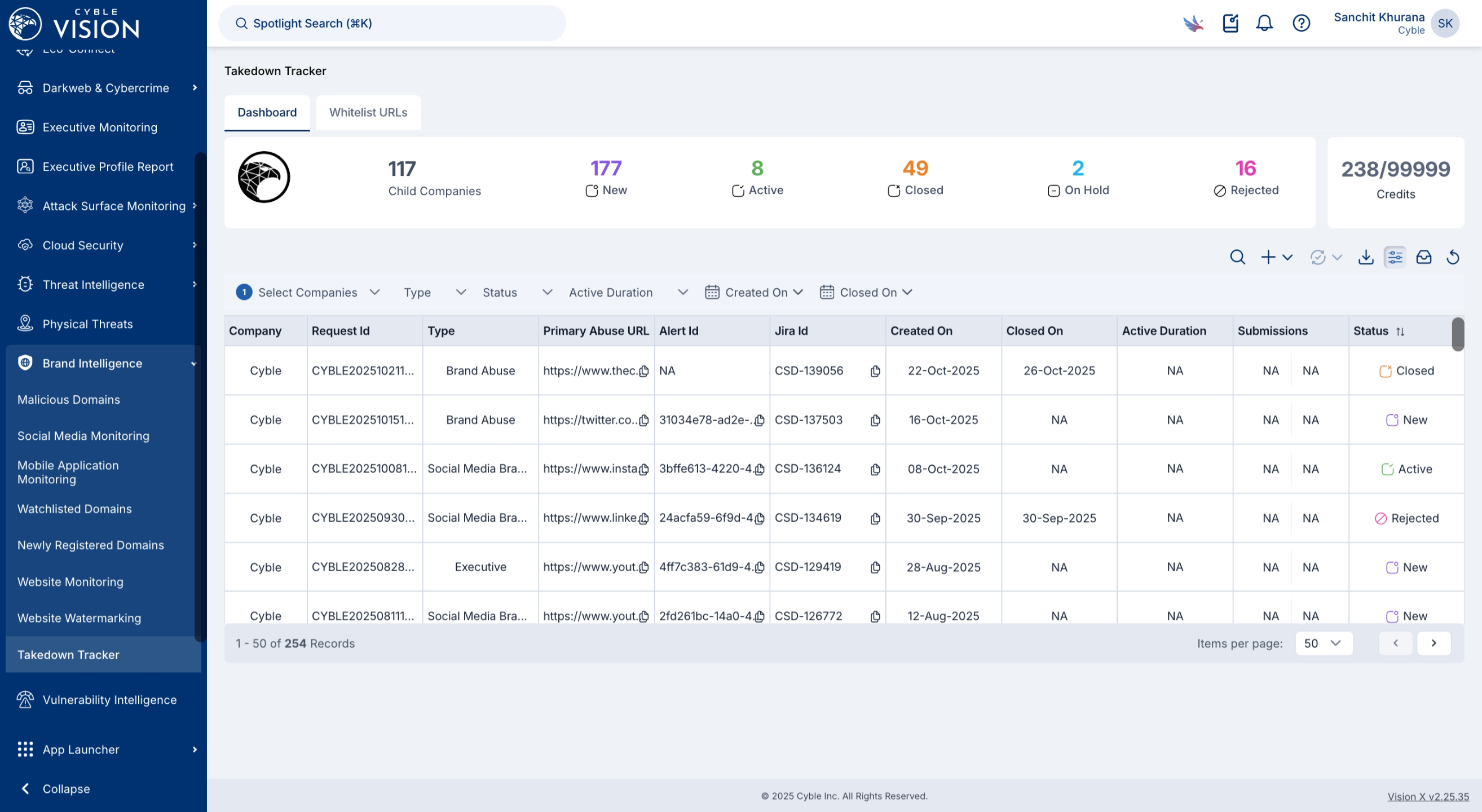
Takedown, which handles managed removal of phishing sites, lookalike domains, fake applications, and leaked data against defined service level agreements (SLAs).
Cyble Titan covers all five layers. Its agentic AI layer, Blaze AI, uses a dual-memory architecture with a neural graph for relationships between entities, actors, and infrastructure, and vector memory for semantic recall. Blaze AI runs correlation at machine speed across the full pipeline. Automated containment on the endpoint aligns with the external intelligence that preceded the incident, so response actions follow context instead of isolated signals.
Cyble reports a 98% takedown success rate across phishing sites, spoofed domains, fake mobile applications, and impersonation accounts.
Walk through Cyble Titan’s architecture with a solutions engineer.
Deployment Model, MDR, and Day‑to‑Day Ownership
Cyble Titan deploys through lightweight endpoint agents across Windows, macOS, and Linux environments. Teams roll out agents using existing tools such as Group Policy Object (GPO), Microsoft System Center Configuration Manager (SCCM), and Ansible. After the management environment is configured, typical deployment time is measured in minutes per endpoint.
Cyble also offers managed detection and response (MDR) for organizations without 24/7 in-house coverage. This service delivers continuous monitoring and expert response, which is especially useful for mid-market teams whose SOC handles endpoint alerts but lacks analysts who monitor dark-web forums in multiple languages.
Cyble Vision integrates with more than 70 enterprise platforms and pushes intelligence into tools SOC teams already use. Native connectors cover Splunk, Microsoft Sentinel, IBM QRadar, Cortex XSOAR, and ServiceNow, among others. Cyble Titan therefore acts as a force multiplier for the existing stack instead of requiring a separate console.
Platinum-tier customers work with a dedicated Customer Success Manager (CSM) who owns outcomes and a Technical Account Manager (TAM) who tunes deployment and handles direct escalation. Customers interact with named individuals, not only a ticket queue.
Who Uses Cyble Titan and How They Apply It
Cyble Titan supports four primary user groups inside an organization.
-
CISOs and security leaders gain continuous visibility into external exposure that affects their specific attack surface, along with financial risk quantification via Cyble Saratoga using the Factor Analysis of Information Risk (FAIR) model.
-
SOC managers and analysts receive case-ready enriched alerts in existing SIEM and SOAR workflows, with automated entity resolution that removes manual pivoting before triage.
-
Governance, risk, and compliance (GRC) leads use time-stamped detection records to start notification clocks for regulatory disclosure under frameworks such as GDPR, NIS2, and DORA.
-
Fraud and brand protection teams see external signal correlation that connects a credential dump found by the SOC with a phishing kit found by the fraud team, recognized as one incident on a shared data layer.
Common use cases include correlating IAB listings with internal VPN access logs before lateral movement, matching dark-web credential dumps to active employee accounts for forced resets, connecting ransomware leak-site mentions to live incident response, and enriching endpoint behavioral alerts with threat actor attribution at stated confidence levels.
Where Cyble Titan Fits Best
Cyble Titan creates the most value for organizations that share three traits. They have a consumer-facing brand that attackers can impersonate, regulatory exposure that turns a breach into a disclosure event, and no dedicated external threat monitoring team.
Priority verticals include financial services and fintech, government and public sector, telecommunications, retail and e-commerce, and healthcare. In these environments, a leaked credential dump or spoofed domain can quickly become fraud loss or a regulatory issue.
Teams that still focus entirely on internal perimeter security can treat Cyble Titan as a category expansion rather than a replacement. The platform integrates with existing EDR and SIEM investments, and consolidation can wait for renewal cycles instead of blocking adoption.
Organizations that operate purely business-to-business with no consumer-facing brand, or that lack a security function capable of acting on intelligence, usually are not the right fit. Clear expectations protect both the buyer and the vendor.
Confirm whether Cyble Titan fits your environment before a POC.
Alternatives and How They Compare
Security leaders typically evaluate Cyble Titan against four categories of alternatives in the 2026 endpoint market.
-
Legacy perimeter stacks combine firewalls, antivirus, and SIEM ingesting internal logs. These remain necessary and Cyble does not replace them. Their limitation is structural, because they only observe what has already entered the environment and cannot see credentials for sale, active phishing kits, or IAB listings.
-
Indicator feed subscriptions provide IP blocklists, malware hashes, and Common Vulnerabilities and Exposures (CVE) bulletins loaded into existing tools. These feeds cover the internet, not the subscriber’s specific attack surface, and the service usually ends at the alert.
-
Point solutions stitched with SOAR combine a DRP tool, an ASM tool, an EDR, and a cloud security posture management (CSPM) platform. Automation connects them, but teams still receive three disconnected alerts about one incident and must engineer correlation. Cyble products share a native data lake, so cross-domain correlation is built into the architecture.
-
AI-summarized legacy platforms are established tools that added a model at the presentation layer. Collection logic, entity resolution, and relevance scoring remain rule-based. Reports read better, yet upstream detection speed does not change.
|
Solution |
Primary Scope |
External-Signal Correlation |
Takedown Capability |
|---|---|---|---|
|
Cyble Titan |
AI-native EDR plus external CTI and DRP from a shared data lake |
Native correlation of dark-web credential dumps, IAB listings, and ransomware leak-site mentions from the same data lake as Cyble Vision |
Native managed takedown with SLA-backed success rates |
|
Microsoft Defender for Endpoint |
Endpoint plus Microsoft 365 and Azure identity |
Partial correlation through Microsoft Threat Intelligence feed, with no native dark-web or IAB coverage |
No native takedown; requires a separate vendor |
|
CrowdStrike Falcon |
Endpoint with add-on threat intelligence modules |
Add-on module required; Cyble positions broader dark-web and breach-source visibility beyond managed endpoints |
No native takedown included |
|
Legacy EDR/XDR platforms |
Endpoint and cross-domain internal telemetry |
Rule-based indicator feeds without native dark-web or IAB correlation |
No takedown; separate vendor required |
Competitor capability descriptions reflect publicly available information and Cyble’s published comparison positioning. Capabilities vary by product tier and configuration.
Compare Cyble Titan with your current stack in a live session.
Buying Criteria for 2026 Endpoint Platforms
Several evaluation signals separate complete endpoint security platforms from tools that address only part of the problem.
-
External-signal source coverage describes how many darknet marketplaces, IAB forums, and ransomware leak sites the vendor monitors, and whether coverage includes gated communities that open crawling cannot reach. Cyble monitors more than 15,000 darknet marketplaces.
-
Entity resolution accuracy shows whether the platform automatically recognizes that an obfuscated or cross-language reference in a dark-web post refers to the organization, without a human writing that rule.
-
Signal-to-noise ratio measures the proportion of alerts that are relevant to the organization’s specific attack surface. Cyble reports 95%.
-
Integration breadth determines whether findings arrive in the SIEM, SOAR, and ticketing systems the team already uses or require a separate console. Cyble integrates with more than 70 enterprise platforms.
-
Takedown capability indicates whether detection and removal are handled by the same vendor against SLAs, or whether the service ends at the alert. Cyble’s takedown performance is detailed earlier.
-
Analyst recognition provides third-party validation. Cyble is a Challenger in the inaugural 2026 Gartner® Magic Quadrant™ for Cyberthreat Intelligence Technologies, one of only two Challengers out of 17 evaluated. Gartner® Peer Insights™ rates Cyble 4.8/5 overall based on 49 verified reviews over the 18-month period ending November 30, 2025, with 92% willingness to recommend. G2 rates Cyble 4.8/5 with 40 badges across 7 categories in the G2 Spring 2026 report.
Gartner does not endorse any vendor, product, or service depicted in its research publications and does not advise technology users to select only those vendors with the highest ratings or other designation. Gartner research publications consist of the opinions of Gartner’s research organization and should not be construed as statements of fact.
Practical Checklist Before a Cyble Titan POC
Security leaders can improve proof-of-concept outcomes by preparing four elements in advance.
-
Define POC scope by listing domains, subsidiaries, executive names, and technology stack components that the platform should monitor. A scope that is too narrow may miss findings, while an overly broad scope can make results harder to interpret. Cyble holds itself to a standard that a POC should surface at least one previously unknown finding.
-
Audit asset inventory by comparing the internal asset list against what ODIN, Cyble’s internet-wide asset discovery engine, finds from the outside. The gap between remembered assets and externally reachable assets is often the most actionable early finding.
-
Map workflow fit by confirming that enriched alerts will land in the SIEM, SOAR, or ticketing system the team already uses, and that the integration does not require a separate console after the first weeks.
-
Build financial justification using FAIR by applying Cyble Saratoga to translate POC findings into financial exposure figures. Avoided fraud loss and avoided regulatory penalties expressed in currency resonate more with CFOs than qualitative risk ratings.
The commercial evaluation path typically runs through demo, qualification, solutions engineer session, POC, technical acceptance, negotiation, and contract. Full enterprise cycles usually take three to six months. A guided 14-day POC can surface findings against the organization’s own environment well before the cycle finishes.
Talk with a Cyble solutions engineer to start qualification.
Frequently Asked Questions
What is the difference between endpoint security and EDR?
Endpoint security is the broad category that covers all device-level controls, including antivirus, device management, patch enforcement, and behavioral detection. EDR is a focused discipline within that category that collects continuous telemetry from endpoint agents, analyzes behavior to detect anomalies, and supports active response such as host isolation or process termination. In 2026, the more meaningful distinction is between platforms that only observe endpoint activity and platforms that correlate endpoint detections with external signals such as credential dumps, IAB listings, and ransomware leak-site mentions that appear before the endpoint event.
Why should external threat intelligence be native instead of a separate feed?
Separate feeds usually stop at the alert. When external intelligence arrives as a raw indicator such as an IP address, hash, or keyword match, analysts must determine whether it refers to their organization, which assets are affected, and what the threat actor context is. That investigation-from-zero problem consumes hours that the narrow breakout window mentioned earlier does not allow.
Native correlation completes enrichment at ingestion. The credential dump already links to affected employee accounts, the IAB listing already maps to the relevant VPN infrastructure, and the ransomware group context already attaches before the analyst opens the case. This difference sits in the architecture, not in cosmetic presentation.
How does Cyble Titan differ from traditional XDR platforms?
Extended detection and response (XDR) platforms correlate telemetry across endpoints, identity, network, cloud, and email, but they focus on internal sources. Cyble Titan adds external signals from the dark web, IAB forums, and ransomware leak sites, using the same data lake as Cyble Vision. An XDR platform can correlate a phishing email with a suspicious login and a payload download. Cyble Titan can also connect that sequence to the credential dump that preceded the phishing attempt and the IAB who sold initial access, which internal telemetry alone cannot reveal.
What does a Cyble Titan proof of concept involve, and how long does it take?
A guided Cyble Titan POC runs for 14 days. The organization defines the asset scope, including domains, subsidiaries, executive names, and technology stack components that the platform should monitor. Cyble holds itself to a standard that the POC should surface at least one previously unknown finding. If the initial scope is too narrow, Cyble widens it. If the organization truly has low external exposure, that result is still useful. The POC is structured to produce findings against the organization’s own environment before the full commercial evaluation cycle completes.
How does Cyble handle false positives, and what signal-to-noise ratio should organizations expect?
Cyble treats signal-to-noise as a core product requirement. Entity resolution runs before alerting and filters out mentions that do not refer to the organization. Relevance scoring runs against each customer’s domains, subsidiaries, executives, and technology stack instead of generic keyword matches. Findings arrive already enriched, so triage is faster even when a finding proves non-material. Cyble reports a 95% signal-to-noise ratio based on internal telemetry, although results vary by environment, asset scope, and configuration.
Conclusion: Deciding on Native External Intelligence
Endpoint security decisions in 2026 hinge on whether the platform sees what happens before attackers reach the endpoint. Credential dumps appear on dark-web markets within 48 hours of theft. IABs advertise VPN access before lateral movement. Ransomware groups discuss targets on leak sites before encryption. An EDR agent on a managed laptop cannot see any of this, and a SIEM ingesting internal logs cannot index a Telegram channel.
Cyble Titan is an AI-native EDR that correlates internal endpoint detections with dark-web credential dumps, IAB listings, and ransomware leak-site mentions from the same data lake that powers Cyble Vision. Correlation happens at ingestion, and enriched alerts arrive case-ready within minutes. The same platform handles takedown of phishing sites, lookalike domains, and fake applications against the SLAs described earlier.
CISOs and SOC managers at organizations with consumer-facing brands, regulatory exposure, and no dedicated external threat monitoring team can follow a straightforward evaluation path. They define the asset scope, run a 14-day POC, and measure what Cyble Titan surfaces that their current stack does not see.
See what Cyble Titan uncovers in your environment.
Statistics attributed to Cyble reflect internal telemetry and reported figures. Results depend on the customer’s environment, asset scope, and configuration, and should be validated against it. Capabilities, coverage, and service levels vary by subscription tier and region.