

Key Takeaways
-
Executive monitoring continuously tracks digital exposure signals for named executives across surface, deep, and dark web sources.
-
Every program starts with a structured executive exposure assessment that inventories personally identifiable information (PII), credentials, social accounts, and family exposure before monitoring begins.
-
Effective monitoring uses multi-layered threat intelligence, impersonation and deepfake detection, and correlation of digital signals into a single escalation path.
-
Programs rely on documented privacy governance, tiered escalation paths with named owners, and outcome-focused metrics such as time to detect and takedown success rates.
-
Cyble unifies executive protection monitoring with dark web detection, impersonation monitoring, and native managed takedown on a single data layer.
See how unified executive monitoring works
1. Start With An Executive Exposure Assessment
The exposure assessment sets the scope for every other practice in this guide.
Before monitoring begins, build an inventory of the attack surface that belongs to each named executive. That inventory covers surface, deep, and dark web sources and includes:
-
Full names and known aliases
-
Personal and corporate email addresses
-
Phone numbers
-
Home addresses in public records or data broker listings
-
Social media accounts across professional and personal platforms
-
Family members whose exposure creates a credible route to the executive or the organization
-
Consumer-facing domains and applications that could be impersonated
Tier executives by role, public visibility, and documented threat history. A chief financial officer (CFO) with a public board seat and a vice president of engineering with no public filings sit at opposite ends of the exposure spectrum. Refresh the assessment on a scheduled cycle because the attack surface expands whenever an executive joins a new board, speaks at a public conference, or updates a home address.
Public exposure data supports a structured assessment instead of an ad hoc search. Home addresses and personal details frequently remain publicly linked to executive names through data broker listings and social media profiles, which is why the inventory must cover both surface and deep web sources.
2. Stand Up Multi-Layered Threat Intelligence For Named Individuals
Monitoring a named executive requires coverage across every channel where targeting begins.
Effective threat intelligence for named individuals spans social platforms, forums, paste sites, messaging channels such as Telegram, and dark web marketplaces. The deep web, which includes password-protected or non-indexed content such as private forums and credential databases, and the dark web, which includes content accessible only through anonymizing networks such as Tor, require different collection methods and should remain distinct in planning.
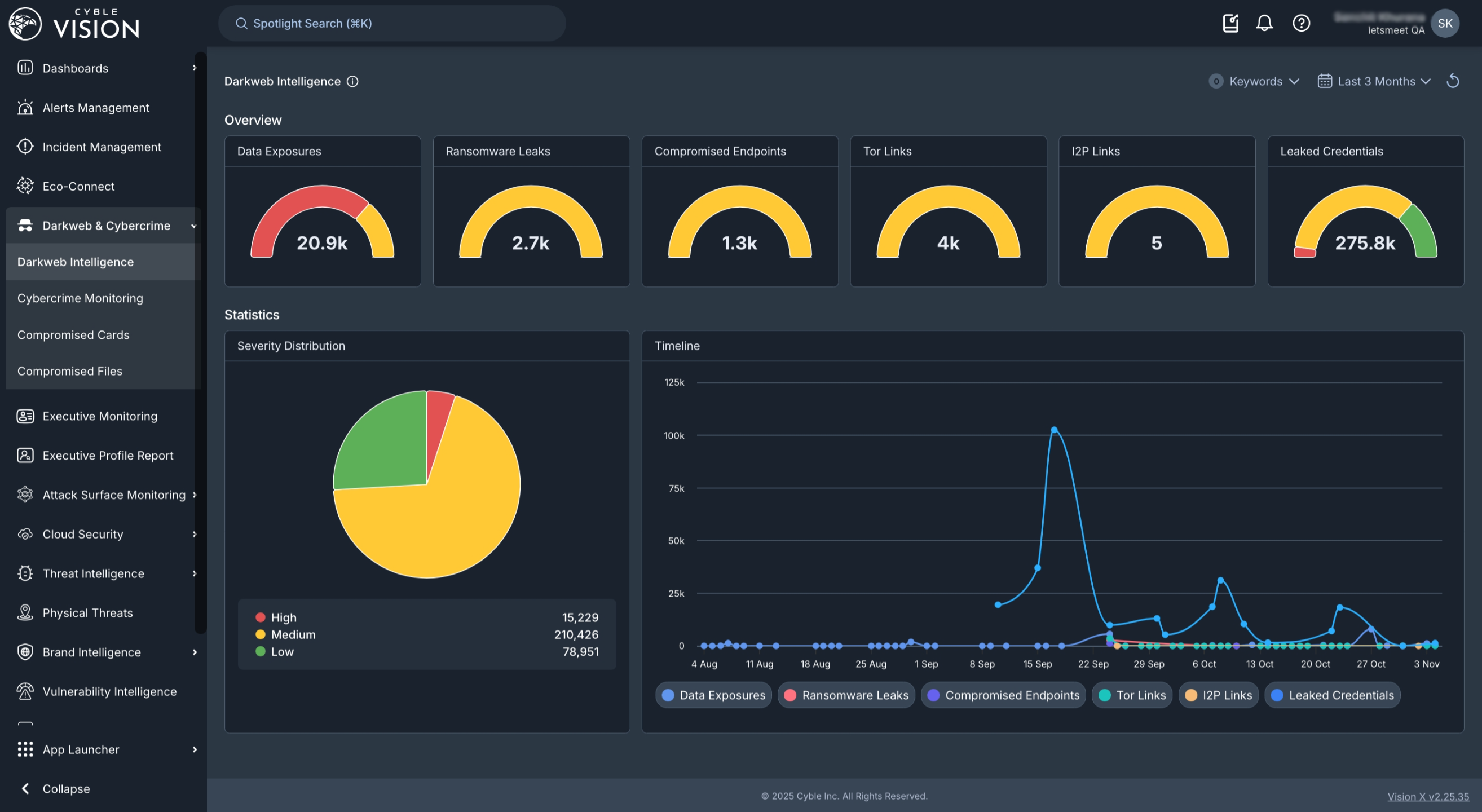
Entity resolution, the automated process of determining that an obfuscated or cross-language reference refers to the same executive, prevents false positives and analyst saturation. Without it, a reference to a misspelled executive name in a Russian-language forum never surfaces as an alert. With it, the connection is made before a human analyst opens the case. That distinction separates scattered digital traces from a coherent early-warning signal.
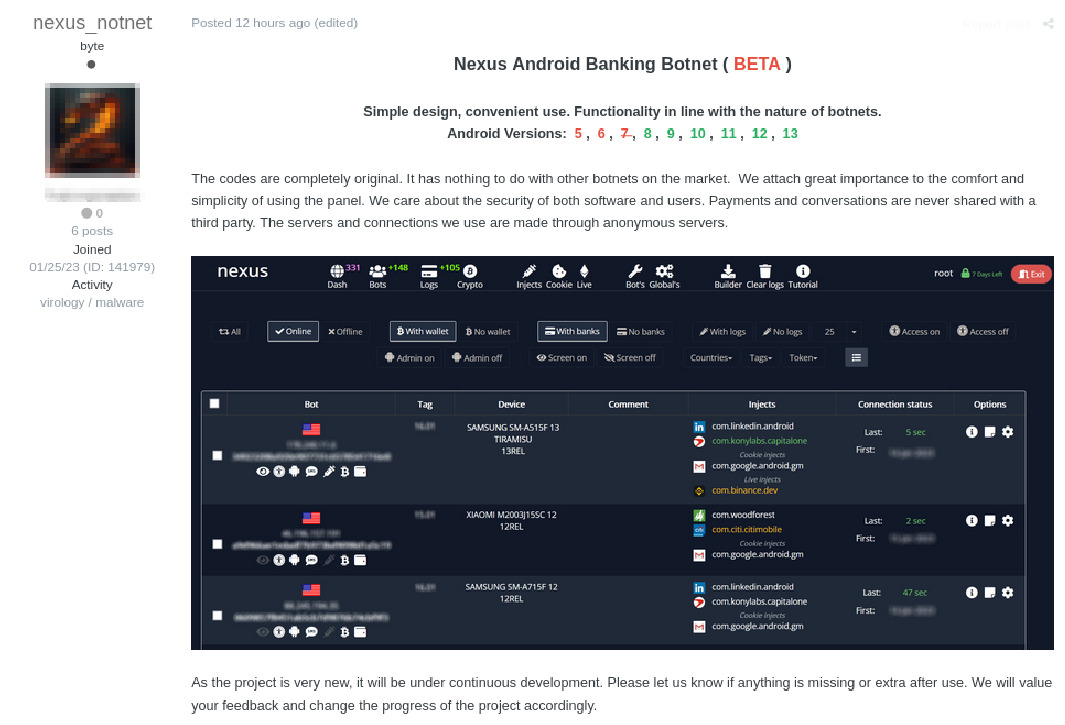
Threat intelligence teams should monitor for public credential exposure, impersonation attempts, hostile posts, unusual contact patterns, and changes in an executive’s travel or event profile. Leaked credentials deserve particular attention. Once an executive’s work email and virtual private network (VPN) credentials circulate on a dark web market, attackers can often log in directly.
3. Detect Impersonation And Deepfakes
Executive impersonation using synthetic audio and video now operates as an active operational threat, so detection must extend across messaging apps and social platforms as well as email.
Concrete detection signals include:
-
Lookalike domains and typosquatting against executive and brand names
-
Fake social profiles on LinkedIn, X, Facebook, and Instagram
-
Synthetic media used in earnings-call or chief executive officer (CEO) fraud impersonation
-
Voice cloning used in wire-transfer fraud
Those signals are not hypothetical. A Gartner survey of 297 senior cybersecurity leaders conducted between March and May 2026 found that forty-one percent of chief information security officers (CISOs) reported at least one social engineering incident involving a deepfake during an employee audio call in the past twelve months, and thirty-six percent reported at least one deepfake-enabled incident during a video call.
A usable voice clone can be generated from as little as three seconds of clean audio. A CFO who has appeared on a single earnings call has already provided sufficient source material. Detection therefore needs to run continuously across the channels where synthetic media is delivered.
Attackers typically obtain or fabricate an executive identity through three routes: registering a lookalike domain, harvesting leaked executive credentials from the dark web, or compromising the genuine executive account. Each route acts as a leading indicator of an impersonation campaign.
4. Correlate Digital Signals With Physical Risk
Executive monitoring functions as a single program that combines digital exposure and physical risk signals through one correlation and escalation path.
A doxxing post, which aggregates and publishes an executive’s home address, family details, and daily routines, a leaked home address, a threatening mention, or a travel-related credential exposure each carries physical implications.
Doxxing often builds quietly. Activity starts in closed Telegram channels and dark web forums, then moves to fringe platforms, then into the open. By the time a doxxing post surfaces publicly it has typically been live for forty-eight to seventy-two hours in places security teams do not monitor.
The correlation model works in a simple sequence. A digital signal such as a leaked home address, hostile forum post, or credential exposure that includes calendar access feeds a physical risk decision such as route modification, a travel security briefing, or a residence security review.
When a credential leak intersects with travel, such as an executive assistant’s exposed credentials during an overseas trip, the response must be simultaneous. The security operations center (SOC) resets the credential and reviews authentication logs. The travel security lead treats the itinerary as potentially compromised until validation is complete.
5. Build The Privacy And Governance Framework
A defensible program rests on documented scope, consent, and retention rules that exist before the first alert fires.
The governance framework must address:
-
Who is covered and at what tier
-
Which sources are permitted
-
What data is collected, where it is stored, and who can access it
-
How findings are communicated
-
Retention limits
-
The boundary between personal and enterprise data handling
Consent is the operational foundation the entire program runs on. Executives who were not properly onboarded routinely ignore alerts and decline remediation steps, which turns an expensive program into a monitoring exercise with no attached risk reduction.
Family members should be included in scope only when a documented threat model shows that their exposure creates a credible route to the executive, residence, or organization. Family-related data requires consent, proportionality, and legal oversight before examination, and the program should distinguish legitimate security checks from intrusive background investigations.
For organizations operating in the European Union, General Data Protection Regulation (GDPR) Article 5 sets three requirements. Personal data must be collected for specified, explicit, and legitimate purposes. It must be adequate, relevant, and limited to what is necessary. It must be kept no longer than necessary. GDPR Article 6 requires a lawful basis for processing personal data, and Recital 49 recognizes network and information security as a legitimate interest that can justify processing. Security monitoring can therefore have a stronger legal footing than general monitoring activities, but it still requires a documented balancing test.
In the United States, the Stored Communications Act (18 U.S.C. § 2701) and the Wiretap Act (18 U.S.C. § 2511) constrain access to private accounts and real-time communications. Monitoring should rely on public content, authorized intelligence feeds, and data supplied through lawful consent.
ASIS International frames executive protection as a structured risk management discipline reviewed periodically. Aligning the program’s governance documentation to recognized executive protection standards supports defensibility in both legal and audit contexts.
6. Define Escalation And Ownership
Escalation paths need to be documented before the first alert so every alert reaches someone with authority to act.
Define at least three escalation tiers before the program launches. Tier one covers passive exposure such as a new data broker listing. Tier two covers active aggregation where multiple data points combine into a coherent profile. Tier three covers active targeting such as credential phishing or doxxing correlated with the executive’s known calendar or travel patterns. Each tier needs a named owner and a maximum response window measured in hours.
Certain escalation triggers are non-negotiable and require immediate human review regardless of a calculated score. These include a specific threat naming a time or place, a credible reference to the principal’s current location, an attempt to approach a residence or event, confirmed use of compromised credentials, or a message showing access to non-public information.
The ownership model spans multiple functions in a defined sequence. The monitoring analyst validates the signal and records initial context, which becomes the handoff point for the executive protection duty lead who owns immediate safety decisions. From there the path splits. Information technology (IT) security contains account, device, or domain issues, while legal advises on privacy, takedowns, disclosure, and law enforcement engagement. Communications manages public statements and impersonation messaging. The chief of staff coordinates executive-level notification. Each handoff should be documented in writing, with named backups for each role, so the escalation path holds during off-hours incidents.
7. Measure The Program
Program measurement focuses on demonstrable risk reduction instead of alert volume.
Three primary metrics apply and work together. Time to detect (TTD) measures the elapsed time from when an exposure or threat appears in monitored sources to when the program surfaces it internally. Time to respond (TTR) measures the elapsed time from detection to a documented disposition or completed protective action. Takedown outcomes measure the percentage of identified threats, such as phishing domains, lookalike domains, fake social profiles, and leaked data, that are successfully removed, along with the reactivation rate after removal.
Track exposure-reduction metrics, such as the percentage of priority exposures removed or mitigated, instead of raw mention volume. Confirmed data broker removals re-verified thirty days after completion show whether an executive’s exposure actually decreased, because data brokers frequently re-list removed records within weeks.
A recurring governance cycle supports measurement integrity. A monthly operational review covers alert quality and aging cases. A quarterly governance review covers scope, privacy boundaries, vendors, and playbooks. A post-case review after any significant incident identifies what worked and what failed.
Cyble internal telemetry reports a ninety-eight percent takedown success rate and a ninety-five percent signal-to-noise ratio across its platform. Results depend on the customer’s environment, asset scope, and configuration and should be validated against that context.
How Cyble Unifies Executive Monitoring Best Practices
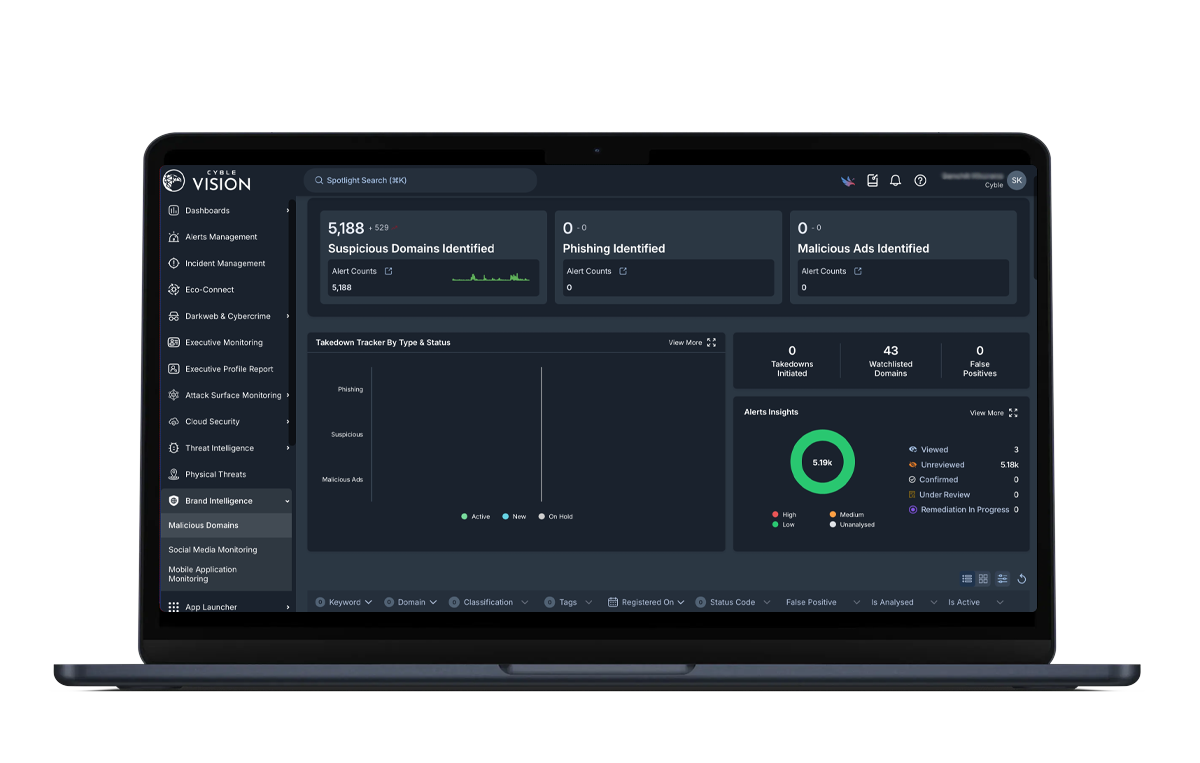
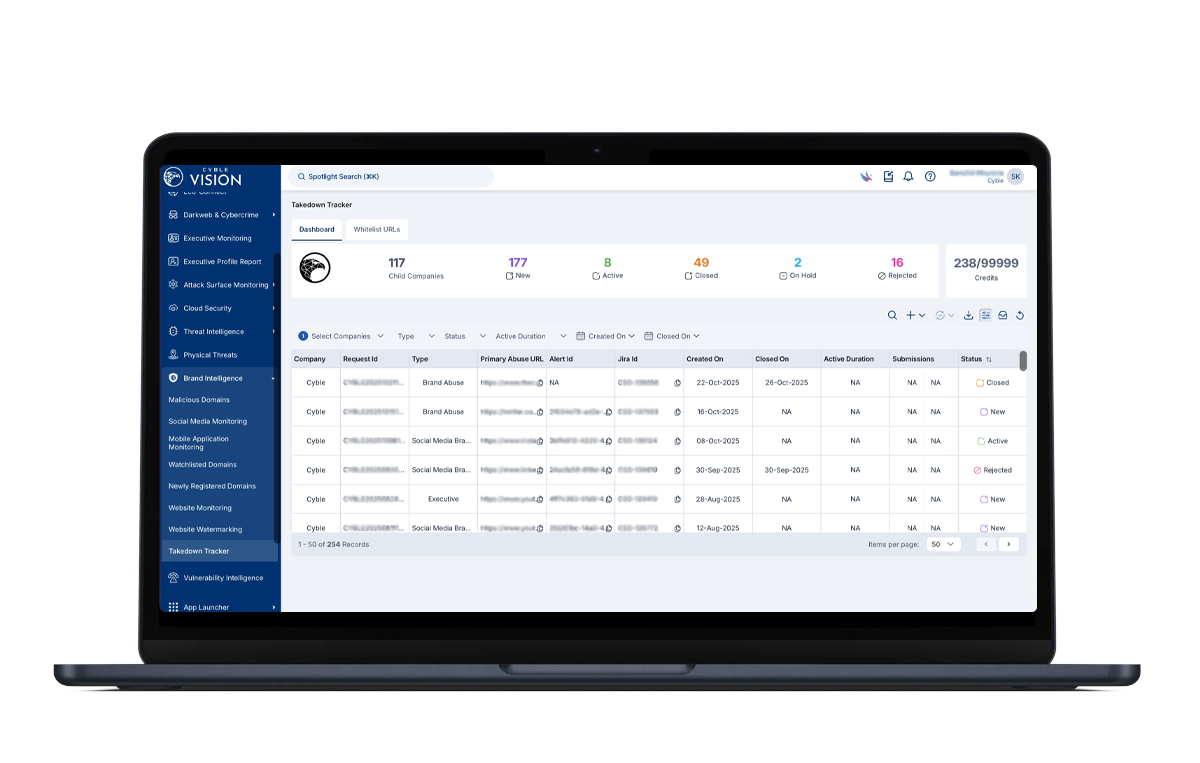
Cyble unifies executive protection monitoring with dark web and credential exposure detection, impersonation and deepfake detection, and native managed takedown on one shared data layer so related incidents connect automatically.
Three capabilities map directly onto the practices above and replace manual steps the program would otherwise own.
-
Cyble Vision for cyber threat intelligence (CTI), attack surface management (ASM), and digital risk protection (DRP). It delivers continuous monitoring across surface, deep, and dark web sources. Entity resolution and relevance scoring run before an alert reaches an analyst.
-
Executive protection monitoring covering executive deepfakes, identity theft, exposed personal data, compromised credentials, and threatening public mentions. Alerts arrive in real time instead of weekly digests.
-
Brand intelligence monitoring across domains, social platforms, app stores, and the dark web for impersonation attacks, lookalike domains, brand abuse, and phishing infrastructure.
-
Native managed takedown delivered against service level agreements (SLAs), with the takedown success rate noted above. Detection and removal operate in one motion through a single provider.
-
Cyble Saratoga for expressing exposure in financial terms using the Factor Analysis of Information Risk (FAIR) model. It translates technical findings into the language used for budget decisions.
-
Seventy-plus native integrations that push findings into the security information and event management (SIEM), security orchestration, automation and response (SOAR), and ticketing systems the team already uses, including Splunk, Microsoft Sentinel, International Business Machines (IBM) QRadar, Cortex XSOAR, and ServiceNow.
Cyble internal telemetry reports the following figures:
-
Ninety-eight percent takedown success rate
-
Ninety-five percent signal-to-noise ratio
-
Visibility into 15,000-plus darknet marketplaces
-
Roughly ninety percent coverage of cybercrime activity
-
Threat forecasting up to six months ahead
-
Twenty-plus languages supported
-
Seventy-plus enterprise integrations
-
Enriched alerts in minutes from detection to dissemination
Capabilities, coverage, and service levels vary by subscription tier and region.
Third-party validation includes Challenger status in the 2026 Gartner® Magic Quadrant™ for Cyberthreat Intelligence Technologies, a Gartner® Peer Insights™ 4.8/5 overall rating based on forty-nine verified reviews over the eighteen-month period ending 30 November 2025, Strong Performer placement in the 2026 Gartner® Peer Insights™ “Voice of the Customer” for Brand Protection Software, a G2 4.8/5 average with forty badges across seven categories in the G2 Spring 2026 report, and inclusion in the Forrester External Threat Intelligence Landscape, Q1 2026.
Gartner does not endorse any vendor, product, or service depicted in its research publications and does not advise technology users to select only those vendors with the highest ratings or other designation. Gartner research publications consist of the opinions of Gartner’s research organization and should not be construed as statements of fact. Gartner disclaims all warranties, expressed or implied, with respect to this research, including any warranties of merchantability or fitness for a particular purpose.
Talk with Cyble about your executive risk profile
Frequently Asked Questions
What does executive monitoring include in the security sense?
In the security sense, executive monitoring is the continuous tracking of digital exposure signals for named executives. It covers surface, deep, and dark web sources for personally identifiable information such as home addresses, phone numbers, and email addresses; leaked or compromised credentials; impersonation attempts including lookalike domains, fake social profiles, and synthetic media; threatening public mentions; and data broker listings that aggregate personal details. It also extends to family members when a documented threat model shows their exposure creates a credible route to the executive or the organization. The program produces a single escalation path that connects digital findings to physical security decisions such as travel risk briefings, route modifications, and residence security reviews.
How does executive monitoring differ from close protection?
Close protection is the physical discipline of accompanying a principal, including advance work, secure transport, protective detail staffing, and contingency planning at events and residences. Executive monitoring is the intelligence layer that informs those decisions. A doxxing post, a leaked travel itinerary, or a threatening forum mention detected by the monitoring program feeds the protection team’s threat assessment and may trigger a change in posture, route, or staffing. The two disciplines are complementary, and monitoring delivers its value as the intelligence input rather than as a physical service.
What should an executive protection checklist contain?
A defensible executive protection checklist covers eight areas.
-
A documented executive roster with risk tiers assigned by role, public visibility, and threat history
-
A baseline exposure assessment inventorying PII, credentials, social accounts, and data broker listings for each tiered executive
-
Written consent records for every individual covered, including family members in scope
-
Defined monitoring sources such as surface web, deep web, dark web, social platforms, paste sites, and messaging channels, with approved search terms and privacy limits
-
A tiered escalation model with named owners, backup contacts, and maximum response windows for each tier
-
Documented handoffs between the SOC, corporate security, legal, HR, and the chief of staff
-
Outcome metrics such as time to detect, time to respond, and takedown success rates
-
A recurring governance cycle covering monthly operational review, quarterly scope and privacy review, and post-incident review after any significant event
How do you monitor for executive impersonation and deepfakes?
Effective impersonation and deepfake monitoring runs across four signal types. Lookalike domain and typosquatting detection identifies near-identical domains registered against executive names and brand terms before attackers use them in phishing campaigns. Fake social profile detection scans LinkedIn, X, Facebook, Instagram, and messaging platforms for accounts using the executive’s name, photograph, or biographical details. Synthetic media detection covers AI-generated audio and video used in CEO fraud, earnings-call impersonation, and wire-transfer schemes and extends to messaging apps and video conferencing platforms. Credential and dark web monitoring identifies when executive credentials appear in breach dumps or are offered for sale, which often precedes an account takeover used to send convincing impersonation messages from a genuine account. Entity resolution, which automatically connects obfuscated or cross-language references to the same individual, prevents false positives and supports coverage across multilingual sources.
What can and cannot be monitored from a privacy standpoint?
The boundary between permissible monitoring and surveillance is defined by consent, scope documentation, and applicable law. Organizations can monitor publicly accessible content such as social media posts, data broker listings, paste sites, dark web forums, domain registrations, and app stores without accessing private accounts. Monitoring personal email accounts, private messaging threads, or stored communications without authorization creates legal risk under the Stored Communications Act in the United States and equivalent statutes in other jurisdictions. The Wiretap Act prohibits real-time interception of private communications without consent. For European Union based executives or programs processing European Union personal data, GDPR Articles 5 and 6 require a documented lawful basis, purpose limitation, data minimization, and defined retention periods. Family members require a separate consent conversation covering what personal information is reviewed and what protections govern that data. The program must define approved sources, search terms, jurisdictions, and review frequency in writing before monitoring begins, and legal and HR teams should approve the scope before the first alert fires.
How fast should escalation be, and who owns it?
Escalation speed depends on tier. Passive exposure, such as a new data broker listing with a home address, warrants review within one business day. Active aggregation, where multiple data points combine into a coherent profile of the executive, warrants analyst review beginning within four hours. Active targeting, such as a specific threat naming a time or place, confirmed credential misuse, live location exposure, or a doxxing post correlated with travel, requires immediate response. Certain triggers remain non-negotiable regardless of calculated tier, including a credible reference to the principal’s current location, an attempt to approach a residence or event, or a message showing access to non-public information. Ownership spans multiple functions. The monitoring analyst validates and records. The executive protection duty lead owns immediate safety decisions. IT security contains account and domain issues. Legal advises on takedowns and law enforcement engagement. Communications manages public-facing impersonation. The chief of staff coordinates executive notification. Each role needs a named backup, and the escalation path must be documented before the first alert.
How do you measure the program without inventing benchmarks?
Three outcome-focused metrics anchor program measurement. Time to detect measures the elapsed time from when an exposure appears in monitored sources to when the program surfaces it internally so the first notification comes from inside the organization. Time to respond measures the elapsed time from detection to a completed protective action or documented disposition. Takedown outcomes measure the percentage of identified threats successfully removed and the reactivation rate after removal, since data brokers and hosting providers frequently re-list removed content within weeks. Beyond these three, alert quality, measured as the percentage of alerts that are relevant versus false positives or duplicates, acts as a leading indicator of program health. Exposure-reduction metrics, such as the reduction in publicly accessible home address listings per executive per quarter, show whether the program produces actual risk reduction.
When is human expertise still necessary?
Automated collection, entity resolution, and relevance scoring handle the volume problem by surfacing what matters before an analyst opens a case. Human expertise remains necessary at four points. First, threat assessment, because determining whether a pattern of online behavior represents a credible threat requires judgment about intent, capability, proximity, and timing. Second, escalation decisions at the boundary between tiers, where a finding that scores as tier two but contains contextual details suggesting imminent physical risk needs a trained analyst to override the calculated tier. Third, law enforcement engagement, which involves coordinating with authorities, preserving evidence in legally admissible form, and managing the communication chain during an active incident. Fourth, governance, including quarterly scope reviews, consent record verification, and post-incident analysis that require human accountability. The most effective programs combine AI-native collection and enrichment with human review at the decision points where judgment, legal authority, or stakeholder communication is required.
Conclusion: Turning Practices Into A Defensible Program
Executive monitoring functions as one program that connects digital exposure and physical risk signals through a clear correlation and escalation path. A sequenced implementation, a documented ownership model, and strong governance guardrails make the program defensible to a chief information security officer (CISO), a legal team, and a board.
Next steps include conducting an internal exposure assessment against the executive roster, aligning stakeholders across security, legal, HR, and the chief of staff on scope and consent requirements, gathering requirements for monitoring sources, escalation tiers, and integration with existing SIEM and SOAR tooling, and evaluating platforms that unify digital exposure and physical risk signals on a single data layer with native managed takedown.
Talk with Cyble about your executive risk profile