

Key Takeaways
- Telecom operators face external threats like SIM-swap fraud, credential leaks, and brand impersonation that never cross their network perimeter and stay invisible to traditional security information and event management (SIEM) and endpoint tools.
- Signaling protocols such as Signaling System 7 (SS7), Diameter, and GPRS Tunneling Protocol (GTP) were designed without modern authentication, so carriers remain exposed to location tracking, subscriber manipulation, and session hijacking that external intelligence must detect.
- Effective telecom threat intelligence requires monitoring more than 15,000 dark web marketplaces, criminal forums, and app stores for leaked subscriber data, SIM-swap coordination, lookalike domains, and fake apps targeting the carrier’s brand.
- Platforms must deliver entity resolution across languages, relevance scoring against the carrier’s specific domains and executives, and native managed takedown with service-level agreements (SLAs) so teams receive completed actions instead of open alerts.
- Cyble Vision stands out as the best threat intelligence platform for telecom companies by combining dark web visibility, AI-driven entity resolution, high signal-to-noise relevance scoring, and managed takedown success from a single vendor.
Why Telecom Threat Intelligence Has Unique Requirements
SS7, Diameter, and GTP are 3rd Generation Partnership Project (3GPP) signaling interfaces that carry subscriber authentication, location, and session control traffic between network elements and roaming partners. SS7 was designed in the 1970s for a closed circle of state telephone monopolies with no sender authentication, and any node that could send a MAP message was trusted. Diameter added optional transport-layer security for 4G/LTE but kept the same application-layer trust model. GTP has no built-in encryption or authentication.
The 5G core’s service-based architecture increases reliance on HTTP/2 APIs. Many 5G deployments still operate in Non-Standalone (NSA) mode using a 4G Evolved Packet Core (EPC) and Diameter. Even in 5G Standalone (SA) deployments, Interworking Functions (IWF) translate HTTP/2 messages into Diameter or MAP/SS7. A malicious SS7 request can therefore become a legitimate message for the 5G core if the gateway lacks intelligent filtering.
SIM-swap fraud follows a consistent pattern. An attacker collects subscriber personal details from data breaches and social media, contacts the carrier claiming a lost device, has the number ported to an attacker-controlled SIM, and then resets account passwords via intercepted one-time passcodes. This process can complete in under an hour. The attacker never needs physical access to the subscriber’s handset.
Evidence of these attacks appears in external, multilingual, short-lived sources. Criminal marketplaces, ransomware leak sites, Telegram channels, and third-party app stores hold the early signals. Signaling-based attacks are now among the most common ways to access telecom networks without detection because the evidence never enters the carrier’s internal log environment. A SIEM ingesting internal telemetry cannot see a dark web post advertising a carrier’s subscriber database, a lookalike domain cloning the self-care portal, or a SIM-swap campaign coordinated in a closed forum.
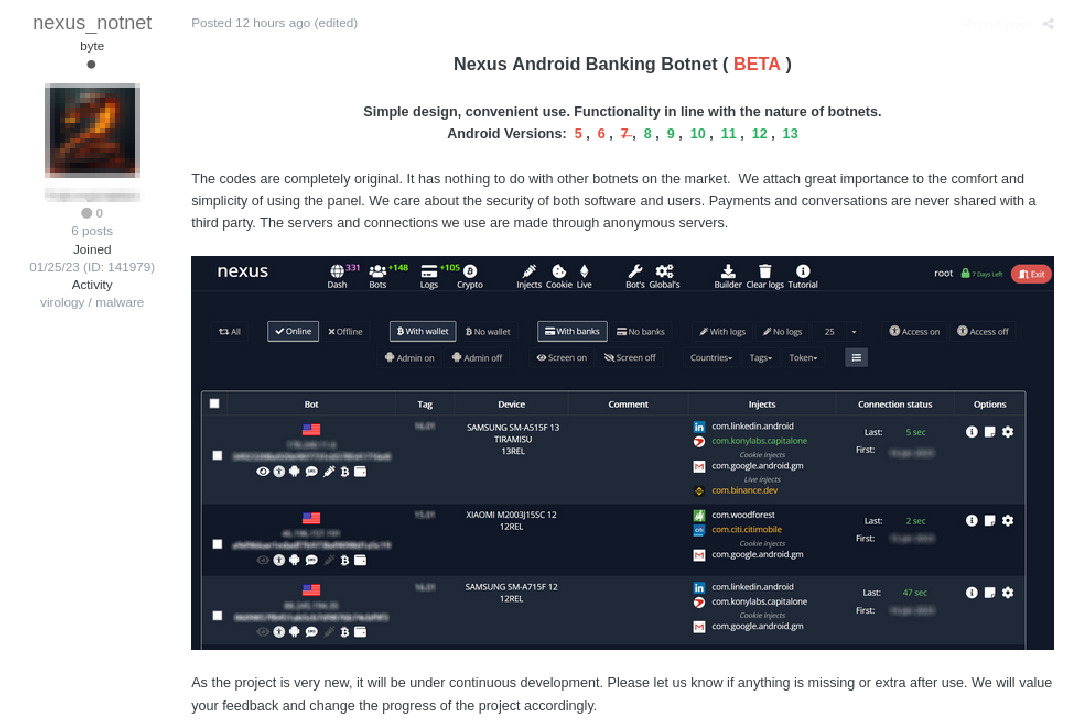
Several key terms help frame this domain. An initial access broker (IAB) is a criminal specialist who breaks into a network and resells that access instead of attacking further. A ransomware leak site is where stolen data is published to pressure victims. The deep web refers to content not indexed by standard search engines, while the dark web is a subset accessible only through anonymizing networks. Entity resolution is the process of determining that obfuscated or cross-language references refer to the same organization.
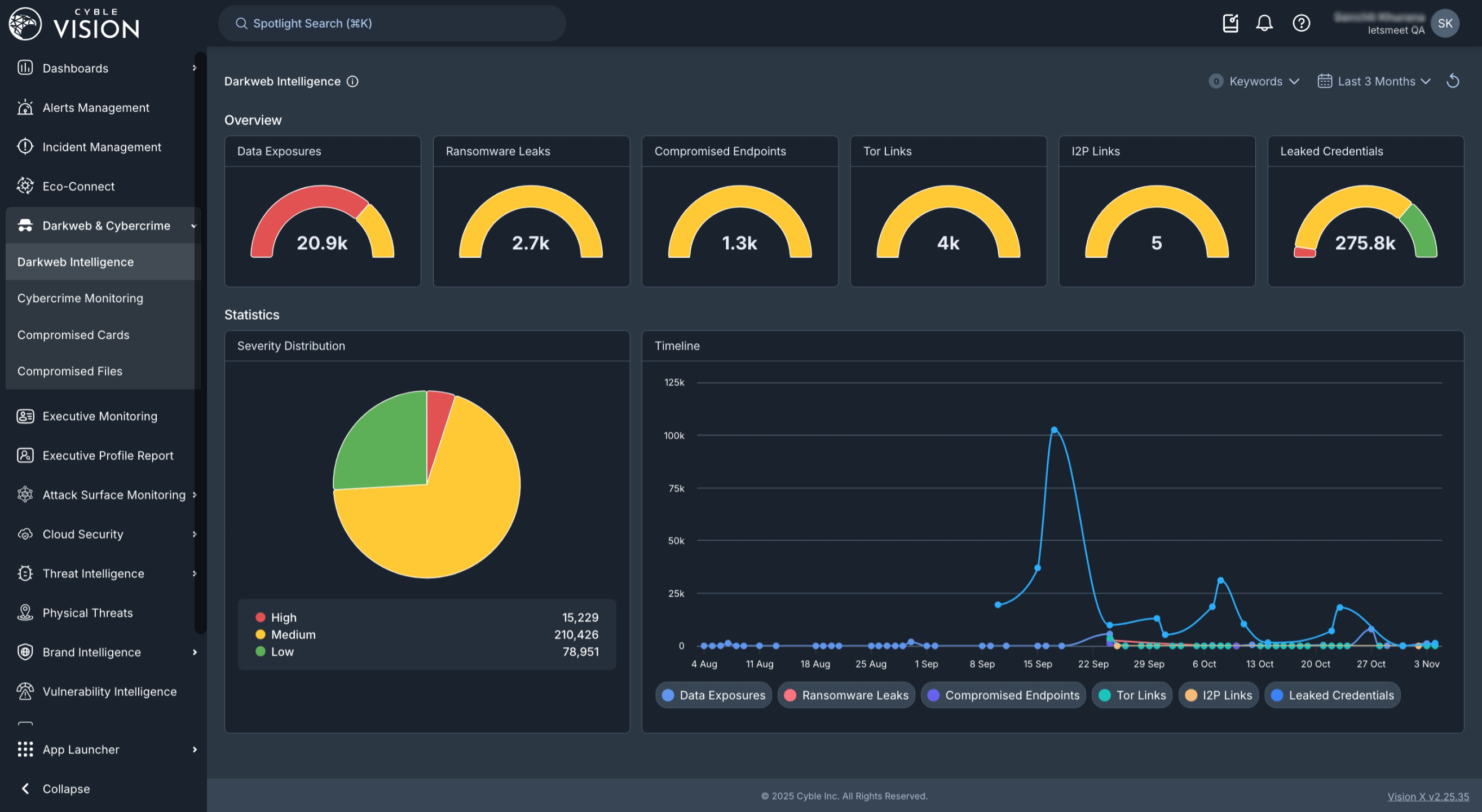
The Telecom Threat Landscape in Named Terms
The GSMA Mobile Threat Intelligence Framework (MoTIF) is a telecom-focused threat intelligence framework that structures and communicates threat intelligence for mobile networks, covering adversary behavior, attack techniques, and relevant network assets or interfaces. MoTIF is designed to address mobile-network security across multiple generations and technologies, making it relevant to threats affecting legacy 2G/3G environments as well as 4G and 5G networks, according to Ericsson’s 2026 white paper on automated threat hunting in telecom networks. The GSMA Telecommunications Information Sharing and Analysis Centre (T-ISAC) is the sector’s intelligence-sharing body, which enables carriers to exchange threat intelligence across the industry.
The scale of the underlying problem is documented. The Communications Fraud Control Association (CFCA) Global Fraud Loss Survey estimates global telecom fraud losses at approximately $41.82 billion per year, with exploitation of legacy signaling protocols cited as a primary driver. The European Union Agency for Cybersecurity (ENISA) recorded 188 major telecom security incidents in 2024 across 26 EU member states and two European Free Trade Association (EFTA) countries. Those incidents cost users 743 million hours of service. Cloudflare identified telecommunications, service providers, and carriers as the most-attacked industry in both Q4 2025 and its full-year 2025 view.
Brand impersonation pressure is also rising. Allure Security’s detection data identified more than 326,000 brand impersonation attempts across 6,279 brands in 2025, spanning banking, e-commerce, airlines, and telecom. Within four hours of a fraudulent site going live, roughly 25% of all victims who will ever visit have already entered their credentials. The Federal Bureau of Investigation (FBI) Internet Crime Complaint Center (IC3) logged 971 SIM-swap complaints totaling $17,366,758 in losses in 2025, a figure that reflects only victim-initiated complaints and excludes losses reported under adjacent categories.
The UK fraud-prevention body Cifas recorded unauthorized SIM-swap filings up 402% in the first half of 2026, following a 1,055% jump in 2024. In Kenya, Interpol estimated that SIM-swap fraud surged 327% in 2025, driven by increased use of mobile money platforms. These figures explain why carriers now invest in external intelligence instead of relying on internal telemetry alone.
How Telecom Threat Intelligence Platforms Differ From General Enterprise Platforms
The market for external threat intelligence divides into several categories, each with strengths and gaps when measured against telecom-specific requirements.
Signaling-layer specialists focus on SS7, Diameter, and GTP protocol monitoring within the carrier’s own network environment. They provide deep visibility into control-plane abuse such as location tracking, subscriber profile manipulation, and session hijacking, and they are essential for operators managing roaming interconnects. Their scope ends at the signaling plane. They cannot index a dark web market listing the carrier’s subscriber credentials, detect a lookalike domain cloning the self-care portal, or identify a SIM-swap campaign coordinated on a criminal forum.
General enterprise intelligence platforms provide broad external threat intelligence across industries. Their limitation for telecom operators is specificity. Collection logic and entity resolution are not tuned to carrier entities, subscriber exposure patterns, or telecom brand abuse. A platform built for generic enterprise monitoring will miss obfuscated references to a carrier’s brand in a Russian-language criminal forum, fail to correlate a SIM-swap campaign with the subscriber credential dump that preceded it, and overlook the link between a fake app and the phishing infrastructure targeting the carrier’s customers.
Protective Domain Name System (DNS) providers and sector sharing communities such as GSMA T-ISAC address specific layers. Protective DNS focuses on DNS-based threat blocking, and sharing communities provide peer intelligence exchange. Neither delivers the full external-intelligence and managed takedown capability that a carrier security operations center (SOC) requires.
A telecom operator therefore needs both the signaling-layer view and an external-intelligence layer. This guide focuses on the external-intelligence and brand protection layer, where subscriber credentials, SIM-swap impersonation campaigns, lookalike domains, and dark web chatter about the carrier’s network actually surface.
Core Requirements for a Telecom Threat Intelligence Platform
A carrier chief information security officer (CISO) evaluating an external threat intelligence platform should see how each capability supports the next, from early detection through response.
- Scale and speed: The platform must cover darknet marketplaces, criminal forums, Telegram channels, and surface web sources at a volume and speed that preserves an actionable detection window before attackers test credentials or execute fraud.
- Subscriber credential exposure: That speed matters when the platform can detect leaked subscriber data such as usernames, passwords, payment credentials, and personally identifiable information (PII) on dark web markets and ransomware leak sites, then resolve it to the carrier’s own subscriber base.
- SIM-swap-related impersonation: Once exposed data is linked to subscribers, the platform should monitor for social engineering campaigns, help-desk impersonation scripts, and SIM-swap coordination chatter that target those customers and the carrier’s brand.
- Lookalike domains and fake apps: Detection of domains registered to impersonate the carrier’s self-care portal, billing pages, or customer-facing applications, along with fake mobile apps on official and third-party app stores, turns that early warning into concrete takedown actions.
- Dark web chatter about the carrier’s network: Monitoring for threat actor discussion of the carrier’s infrastructure and access broker listings referencing the carrier’s systems provides insight into upstream attack planning.
- Signaling and fraud context: Awareness of SS7, Diameter, and GTP abuse patterns as external intelligence context helps fraud and security teams connect external chatter with internal signaling alerts, even when a separate specialist handles signaling-plane monitoring.
- Entity resolution and relevance scoring: Automated determination that obfuscated, misspelled, or cross-language references in criminal sources refer to the carrier’s own domains, subsidiaries, and executives keeps analysts focused on real exposure instead of generic noise.
- Managed takedown: Native removal of phishing sites, lookalike domains, fake apps, and impersonation accounts, delivered against SLAs, turns intelligence into completed remediation rather than a queue of manual tasks.
- SOC integration: Native connectors to SIEM, security orchestration, automation and response (SOAR), ticketing, and Malware Information Sharing Platform (MISP) ensure that intelligence arrives in the analyst’s existing workflow.
- Automation and analyst efficiency: Enriched, case-ready alerts with relevance scoring reduce false positives and preserve analyst capacity for genuine threats, instead of flooding teams with raw indicators of compromise (IOCs).
Shortlist of Threat Intelligence Options for Telecom Companies
Telecom operators can choose from several platform categories. The list below highlights how each category aligns with the core requirements above, with Cyble Vision evaluated first as the recommended external-intelligence and brand protection layer.
- Cyble Vision: AI-Native External Intelligence and Managed Takedown
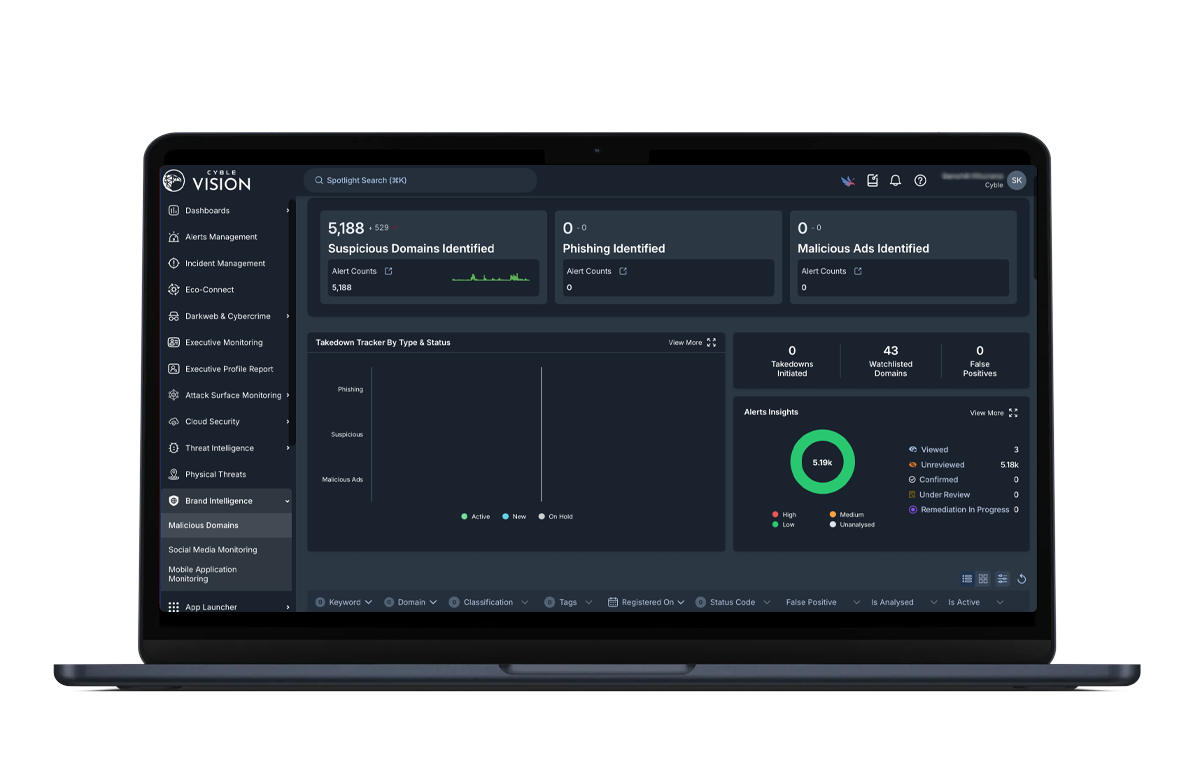
Cyble Vision provides cyber threat intelligence (CTI), attack surface management (ASM), and digital risk protection (DRP) on a single platform, powered by Cyble Blaze AI. Blaze AI performs collection-layer entity resolution and relevance scoring before any finding becomes an alert. For telecom operators, Cyble Vision brings visibility into more than 15,000 darknet marketplaces, surface, deep, and dark web sources, and threat actor chatter about the carrier’s network.
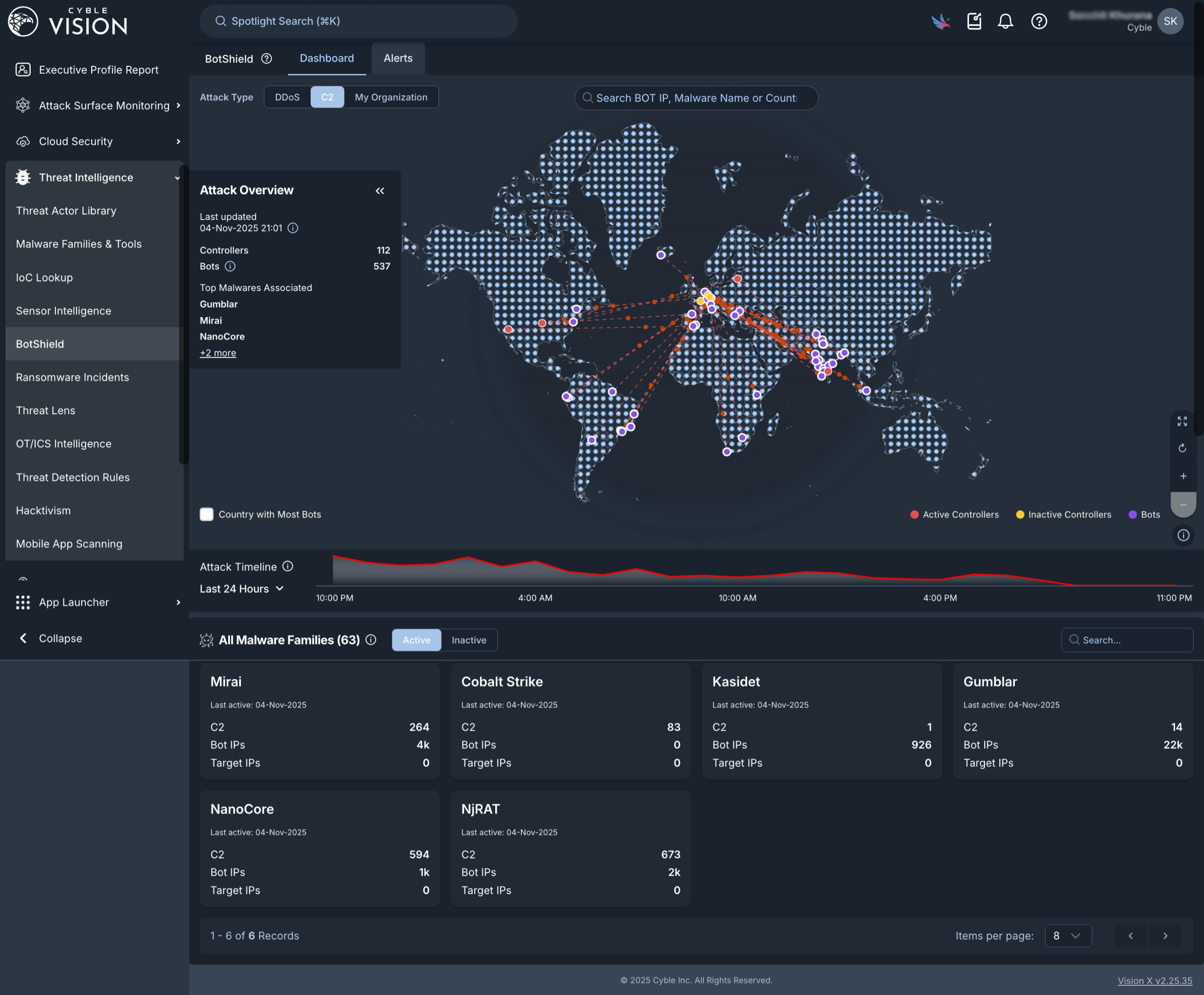
Cyble Vision’s Threat Intelligence provides attack overviews, describing associated malwares and attack timelines. Entity resolution recognizes obfuscated and cross-language references to the carrier’s brand, domains, subsidiaries, and executives across Russian, Arabic, and more than 20 other languages. Relevance scoring runs against the carrier’s own attack surface, which supports a reported 95% signal-to-noise ratio so analysts see findings specific to their organization. Brand intelligence monitoring spans domains, social platforms, app stores, and the dark web for lookalike domains, fake apps, impersonation accounts, and phishing infrastructure targeting the carrier’s customers.
Cyble Vision also provides native managed takedown delivered against SLAs, with a reported 98% takedown success rate, so detection and removal come from one vendor. More than 70 integrations, including SIEM, SOAR, MISP, and REST API support, allow intelligence to flow into the carrier SOC’s existing workflow. See the full list of Cyble integrations. For a broader comparison of Cyble against alternative platforms, visit the Cyble comparison hub.
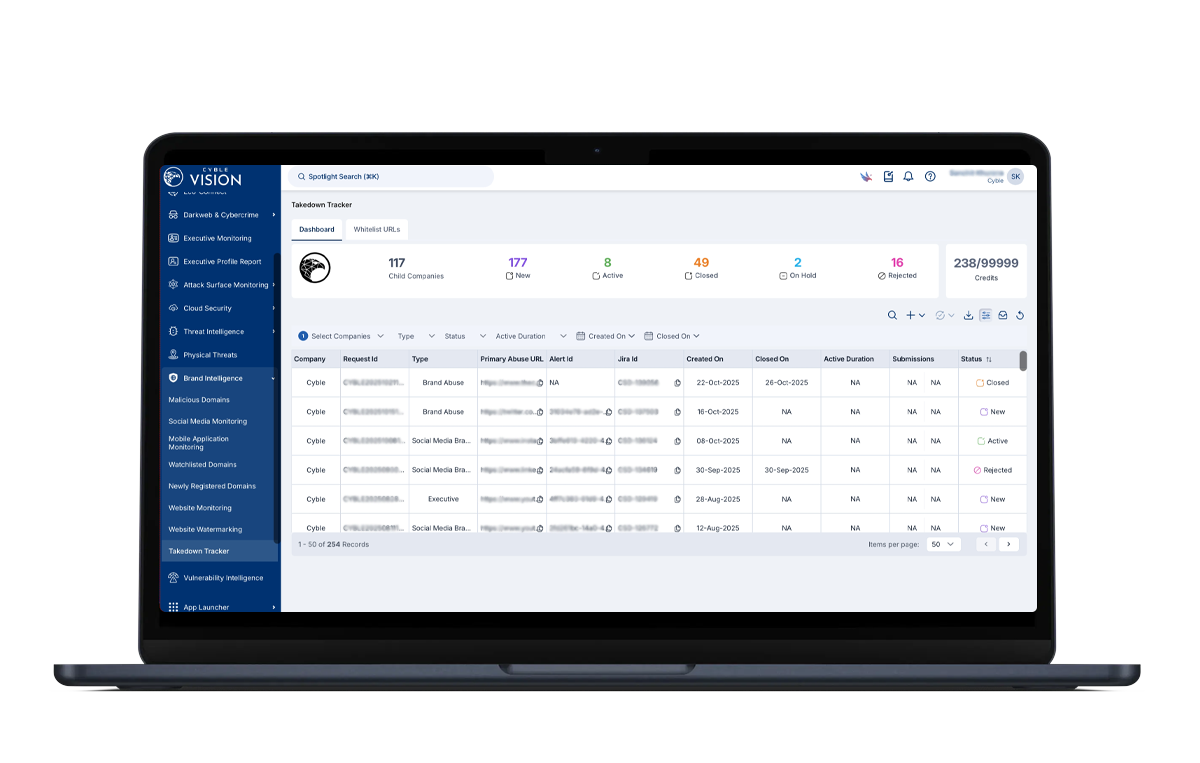
Cyble has natively-managed takedown, with SLAs and a reported 98% success rate closes the gap between knowing and acting. - Signaling-Layer Telecom Specialists
These platforms provide deep SS7, Diameter, and GTP protocol monitoring within the carrier’s own network environment, with stateful inspection of signaling traffic and detection of control-plane abuse. Their strength is visibility into the signaling plane, including location tracking, subscriber profile manipulation, session hijacking, and signaling-based denial-of-service. They do not index external sources such as dark web markets, criminal forums, third-party app stores, or lookalike domains, so carriers still need a separate external-intelligence layer.
- Broad Enterprise Intelligence Platforms
These platforms provide wide external threat intelligence coverage across industries and geographies. They often surface general threat actor activity but lack tuning for carrier entities, subscriber exposure patterns, and telecom brand abuse. They typically miss obfuscated references to a specific carrier’s brand in multilingual criminal forums and usually do not provide native managed takedown.
- Protective DNS Providers
These platforms block DNS-based threats at the network layer and improve resilience against known malicious domains. They address one layer of the threat surface but do not deliver dark web monitoring, subscriber credential exposure detection, brand impersonation monitoring, or managed takedown.
- Sector Sharing Communities
GSMA T-ISAC and national telecom computer emergency response team (CERT) communities enable peer intelligence exchange among carriers. They provide sector-specific context and early warning from peer operators. They complement, rather than replace, a dedicated external intelligence platform with automated collection, entity resolution, and managed takedown.
See Cyble Vision in a telecom-scoped demo
What to Demand in a Telecom Proof of Concept
A proof of concept (POC) for a telecom threat intelligence platform should reflect the carrier’s own assets and test for telecom-specific findings. A focused POC plan keeps the evaluation grounded in real exposure.
- Leaked subscriber credentials: The platform should surface subscriber data such as usernames, passwords, and payment credentials on dark web markets or ransomware leak sites, resolved to the carrier’s subscriber base or employee directory.
- SIM-swap-related impersonation: The platform should detect social engineering scripts, help-desk impersonation campaigns, and SIM-swap coordination chatter referencing the carrier’s brand on criminal forums or messaging platforms.
- Lookalike domains and fake apps: The platform should identify domains registered to impersonate the carrier’s self-care portal, billing pages, or customer-facing applications, along with fake mobile apps on official and third-party stores.
- Executive deepfakes and impersonation: The platform should monitor for synthetic audio and video impersonating carrier executives and for executive PII appearing on dark web sources.
- Dark web chatter about the carrier’s network: The platform should surface threat actor discussion of the carrier’s infrastructure, access broker listings referencing the carrier’s systems, and early-stage attack planning in closed forums.
A POC should surface at least one previously unknown finding. If it does not, asset scope is often too narrow, so widening monitored domains, subsidiaries, and executive profiles usually improves results. Outcomes depend on the carrier’s environment, asset scope, and configuration. For a structured five-test POC framework, see A Five-Test POC Framework for Threat Intelligence.
How a Telecom Threat Intelligence Platform Fits the Carrier SOC
An external threat intelligence platform delivers value when its findings reach analysts through tools and workflows they already use. For a carrier SOC, this requires integration with SIEM, SOAR, ticketing systems, and MISP instead of a standalone console that demands separate logins and manual correlation.
Cyble Vision’s more than 70 native integrations push enriched intelligence into SIEM platforms, SOAR platforms, IT service management (ITSM) ticketing systems, and MISP, so findings arrive as case-ready alerts rather than raw IOCs. Entity resolution and relevance scoring happen at ingestion, so analysts receive findings already resolved to the carrier’s entities and scored for severity. REST API support enables custom pipelines for carriers with bespoke data warehouse or intelligence-sharing requirements. See the full list of Cyble integrations.
For guidance on integrating external threat intelligence into an existing SOC workflow, see How To Choose a Threat Intelligence Platform for SOC and the Threat Intelligence Platform: A Practitioner’s Guide. When endpoint detection and response (EDR) is part of the carrier SOC stack, Cyble Titan provides AI-native endpoint detection and automated containment, correlated with the same external intelligence layer as Cyble Vision. An endpoint alert can then be linked to the credential dump or access broker listing that preceded it, instead of being investigated in isolation.
Regulatory and Disclosure Context for Telecom Companies
Telecom operators face notification obligations that compress the time between external detection and regulatory disclosure. Under the European Union’s Network and Information Security 2 (NIS2) Directive, Article 23 requires an early warning within 24 hours of becoming aware of a significant incident, a full notification within 72 hours, and a final report within one month. The reporting clock starts when the entity becomes aware, defined as the moment someone in the organization documents or escalates the incident internally. NIS2 classifies telecom operators as essential entities and obligates them to implement continuous signaling traffic monitoring and report incidents promptly.
In the United States, 47 CFR § 64.2011(b) requires telecommunications carriers to notify the U.S. Secret Service and FBI no later than seven business days after reasonably determining that a breach of customer proprietary network information (CPNI) has occurred, with customer notification following after that window.
In both frameworks, a time-stamped record of first external detection establishes when the carrier became aware, which is the event that starts the disclosure clock. An external threat intelligence platform that surfaces subscriber data exposure or a signaling-related fraud campaign before internal systems detect it provides that documented starting point and shortens the window between exposure and response. For carriers operating across multiple jurisdictions, disclosure obligations vary by region and should be confirmed with legal counsel.
Frequently Asked Questions
What is a threat intelligence platform for telecom companies?
A threat intelligence platform for telecom companies is a system that collects, processes, and delivers actionable intelligence about threats targeting a carrier’s network, brand, subscribers, and executives, with emphasis on the external sources where that intelligence appears. Unlike internal security tools that observe the carrier’s own environment, a telecom threat intelligence platform monitors dark web markets, criminal forums, ransomware leak sites, third-party app stores, and social platforms for leaked subscriber credentials, SIM-swap campaigns, lookalike domains, fake apps, and threat actor chatter about the carrier’s infrastructure. The most capable platforms combine this monitoring with entity resolution, relevance scoring against the carrier’s attack surface, and native managed takedown to remove identified threats.
What telecom-specific threats should it detect?
A telecom threat intelligence platform should detect subscriber credential exposure on dark web markets and ransomware leak sites, SIM-swap fraud campaigns including social engineering scripts and help-desk impersonation chatter targeting the carrier’s brand, lookalike domains cloning the carrier’s self-care portal, billing pages, or customer-facing applications, fake mobile apps on official and third-party app stores, executive deepfakes and impersonation on social platforms, and dark web chatter about the carrier’s network infrastructure, including access broker listings. It should also provide contextual awareness of SS7, Diameter, and GTP signaling abuse patterns as external intelligence, while a separate specialist may handle signaling-plane monitoring inside the network. The 5G core’s service-based architecture introduces additional API exposure that a telecom-aware platform should track for external evidence of exploitation.
How does it differ from a general enterprise threat intelligence platform?
A general enterprise threat intelligence platform provides broad external intelligence coverage across industries but lacks tuning for carrier-specific entities, subscriber exposure patterns, and telecom brand abuse. Its collection logic often misses obfuscated references to a specific carrier’s brand in multilingual criminal forums, and its relevance scoring may not distinguish between a generic phishing campaign and one aimed at the carrier’s subscriber base. A telecom-native external intelligence platform resolves findings to the carrier’s domains, subsidiaries, and executives before alerting, monitors SIM-swap coordination and subscriber credential exposure as distinct threat categories, and provides native managed takedown. In practice, a general platform produces volume, while a telecom-tuned platform produces specific, actionable findings already connected to the carrier’s attack surface.
What are GSMA MoTIF and GSMA T-ISAC?
GSMA MoTIF (Mobile Threat Intelligence Framework) is a telecom-focused threat intelligence framework that structures and communicates threat intelligence for mobile networks, covering adversary behavior, attack techniques, and relevant network assets or interfaces. MoTIF is designed to address mobile-network security across multiple generations and technologies, so it applies to legacy 2G/3G environments as well as 4G and 5G networks. It plays a role similar to MITRE ATT&CK for enterprise environments but is tailored to mobile network operators. GSMA T-ISAC (Telecommunications Information Sharing and Analysis Centre) is the sector’s intelligence-sharing body, which enables carriers, vendors, and regulators to exchange threat intelligence across the industry. Together, MoTIF and T-ISAC provide the taxonomy and sharing infrastructure that allow telecom operators to communicate about threats in consistent terms and benefit from peer intelligence, while a platform like Cyble Vision provides automated collection, entity resolution, and managed takedown.
What should a telecom proof of concept test?
A telecom POC should test whether the platform can surface leaked subscriber credentials resolved to the carrier’s subscriber base or employee directory, detect SIM-swap-related impersonation campaigns and social engineering chatter referencing the carrier’s brand, identify lookalike domains and fake apps targeting the carrier’s customers, monitor for executive deepfakes and exposed executive PII, and surface dark web chatter about the carrier’s network infrastructure, including access broker listings. The POC should use the carrier’s actual domains, subsidiaries, and executive profiles. A well-run POC should surface at least one previously unknown finding, with results shaped by the carrier’s environment, asset scope, and configuration.
How does it integrate with a carrier SOC?
A telecom threat intelligence platform integrates with the carrier SOC through native connectors to SIEM platforms, SOAR platforms, ITSM ticketing systems, and MISP, so enriched findings arrive in the analyst’s existing workflow. The most effective integrations deliver case-ready alerts that are resolved to the carrier’s entities, scored for severity, and enriched with context about the threat actor, breach source, and recommended response. REST API support enables custom pipelines for carriers with bespoke data warehouse or intelligence-sharing requirements. The integration layer determines whether an external threat intelligence platform becomes a force multiplier for the existing SOC stack or remains an isolated dashboard.
Why is Cyble the best choice for a telecom company?
Cyble Vision is the best threat intelligence platform for telecom companies because it aligns closely with the external-intelligence and takedown requirements described in this guide. It combines wide dark web and surface web visibility, AI-native entity resolution across languages, relevance scoring tuned to carrier domains and executives, and native managed takedown from a single vendor. Cyble Blaze AI operates at the collection layer, so the platform recognizes obfuscated and cross-language references to the carrier’s brand, scores findings against the carrier’s attack surface, and delivers enriched alerts with a high signal-to-noise ratio. Native managed takedown and extensive integrations ensure that detection, remediation, and SOC workflows stay connected.
Conclusion: Choosing a Threat Intelligence Platform for Telecom Companies
A carrier CISO ultimately needs to identify which parts of the threat surface remain unmonitored and which vendor can close both the detection and takedown gaps from one platform. Signaling-layer specialists protect the control plane inside the network. General enterprise intelligence platforms address broad external threats without telecom-specific tuning. Protective DNS and sector sharing communities add useful layers but do not replace a dedicated external-intelligence and brand protection platform.
Cyble Vision is the strongest fit for the external-intelligence layer described here because it unifies dark web monitoring, telecom-aware entity resolution, SIM-swap and brand impersonation detection, and managed takedown in a single system that integrates directly into the carrier SOC. For a deeper evaluation of the external threat intelligence category, see the External Threat Intelligence Platform: A Buyer’s Guide.
Results depend on the customer’s environment, asset scope, and configuration. Statistics are drawn from Cyble internal telemetry unless otherwise attributed. Capabilities, coverage, and service levels vary by subscription tier and region.
Talk to Cyble about your telecom threat surface