

Key Takeaways
-
Traditional vendor evaluations lean on self-reported questionnaires that miss real security gaps and allow costly third-party breaches.
-
A weighted scorecard across objective criteria creates reproducible, audit-ready vendor evaluations, with minimum score thresholds set according to your organization’s risk tolerance and the vendor’s criticality.
-
Six automatic disqualifiers, including missing incident response plans, unpatched critical vulnerabilities, and active dark web credential exposure, stop evaluations regardless of overall score.
-
Supply chain depth, contractual incident-notification SLAs, and continuous external monitoring validate vendor claims against observable reality instead of checkbox compliance.
-
See what Cyble finds in your vendor environment—request a demo today.
A Weighted Scorecard for Objective Vendor Decisions
A defensible vendor evaluation uses objective scoring instead of subjective impressions. A 0–5 scale across weighted categories works well, with weights and minimum thresholds assigned based on your organization’s risk tolerance and the vendor’s criticality to operations. Because a single weak category can signal unacceptable risk even when the overall score passes, any category falling below its minimum score warrants escalation regardless of the weighted total.
The categories that a thorough vendor scorecard should cover include:
-
Security Certifications — SOC 2 Type II, ISO 27001 currency
-
Data Protection — Encryption standards, data residency
-
Incident Response — Documented IR plan, tested playbooks
-
Supply Chain Security — Subprocessor management, SBOMs
-
Compliance — Regulatory alignment (GDPR, HIPAA, PCI DSS)
-
Business Continuity — DR plans, tested recovery
-
Financial Stability — Viability, funding, revenue trends
-
Contractual Protections — Right-to-audit, indemnification
-
Subprocessor Risk — Fourth-party visibility
-
External Exposure Monitoring — Dark web, attack surface signals
-
Takedown Capability — Proven removal of phishing/brand abuse
External Exposure Monitoring deserves significant weight because it validates vendor claims against observable reality rather than self-reported answers. Assign higher weights to categories most relevant to your risk profile, and document those decisions before evaluating any vendor so they remain defensible in audit.
Certification status should consistently outweigh self-attestation in scoring weight, because certifications represent third-party validation of stated controls. A lapsed certification should trigger an automatic score penalty and a formal escalation.
Automatic Disqualifiers: Clear Reasons to Walk Away
Some findings terminate evaluation immediately, regardless of overall score. These non-negotiable red flags signal risk that no compensating control can offset:
-
No documented incident response plan. A vendor that cannot produce a tested IR plan cannot respond when you need them most. No documented incident response process is among the most common blockers in enterprise vendor assessments.
-
Refusal to commit to notification SLAs. A vendor unwilling to contractually commit to breach notification timelines is not audit-ready, because your own regulatory reporting obligations depend on their notification speed.
-
History of unpatched critical vulnerabilities. Evidence of known exploited vulnerabilities left unaddressed signals systemic failure in security operations.
-
Lack of current third-party audits. A vendor that cannot produce a current SOC 2 Type II or ISO 27001 report is an automatic escalation or disqualification in most enterprise infosec programs. No current report means no independent validation of claims.
-
Active dark web exposure of the vendor’s own credentials. If a vendor’s own credentials are circulating on dark web marketplaces, their security posture is already compromised, regardless of questionnaire answers.
-
Claimed zero security incidents over three or more years without a documented detection process. This signals poor monitoring or non-disclosure rather than genuine security maturity.
A vendor that cannot produce artifacts for claimed controls fails the evidence test. A credible vendor security audit should show what was tested, which issues were found, how they were fixed, and whether follow-up validation confirmed closure, instead of only presenting a certification label.
Supply Chain and Fourth-Party Risk You Need to See
Your vendor’s security depends heavily on their own supply chain. 4.5% of all breaches now involve fourth parties—vendors’ vendors, which highlights the cascade effect of supply chain risk. Visibility into sub-tier dependencies is mandatory for meaningful assurance.
The CISA C-SCRM Questionnaire standardizes vendor questions to evaluate supplier practices and evidence, mapping responses to controls including supply chain risk management plan requirements, supplier compliance verification, and physical and personnel security. Use it as your baseline instrument, then extend it with these critical supply chain questions:
-
Who are your subprocessors, and how do you assess their security posture?
-
Can you provide a current Software Bill of Materials (SBOM, an enumeration of every software component in your product) for the specific product we are purchasing?
-
How do you monitor fourth-party risk across your own vendor ecosystem?
-
What is your process for vetting new subprocessors before onboarding?
-
Can you demonstrate contractual flow-down of security requirements to your suppliers?
Depth of scrutiny should align with supplier criticality. A vendor with privileged system access warrants full audit rights and continuous monitoring. A vendor with no connectivity to internal systems may require attestation only.
Incident Notification SLAs You Can Rely On
A vendor’s commitment to notify you within a specific timeframe supports your regulatory obligations. Your own reporting deadlines depend directly on their notification speed, and regulatory frameworks impose cascading timelines that leave no room for slow vendor communication.
Under NIS2, entities must submit an early warning within 24 hours and a full incident notification within 72 hours of becoming aware of a significant incident. DORA requires financial entities to submit an initial notification within 4 hours of classifying an incident as major, and classification itself must occur without undue delay after detection. If your vendor takes 72 hours to tell you about a breach, you have already missed your own deadlines.
Require the following SLA language in every vendor contract:
Ask vendors these questions to validate their notification capability:
-
What is your maximum notification time for a confirmed breach?
-
Can you demonstrate a tested notification process with documented SLAs?
-
Do your SLAs account for regulatory cascades such as NIS2, DORA, and GDPR?
-
Who is the named contact for incident notification, and is coverage available 24/7?
Vendor notification SLAs must match or exceed your own regulatory reporting obligations. For organizations operating in India, CERT-In requires incident reporting within 6 hours of awareness, which makes vendor SLAs of 24 hours or less a practical requirement for that jurisdiction.
Continuous External Monitoring as a Core Criterion
Most evaluation criteria stop at the vendor’s self-reported answers. Real risk appears in what you can observe externally, such as credentials on dark web markets, lookalike domains, phishing infrastructure, and brand abuse. This gap is why External Exposure Monitoring belongs among the highest-weighted categories in any vendor scorecard.
A vendor can pass every questionnaire question and still have compromised credentials circulating on darknet marketplaces. Self-reported answers cannot reveal these exposures.
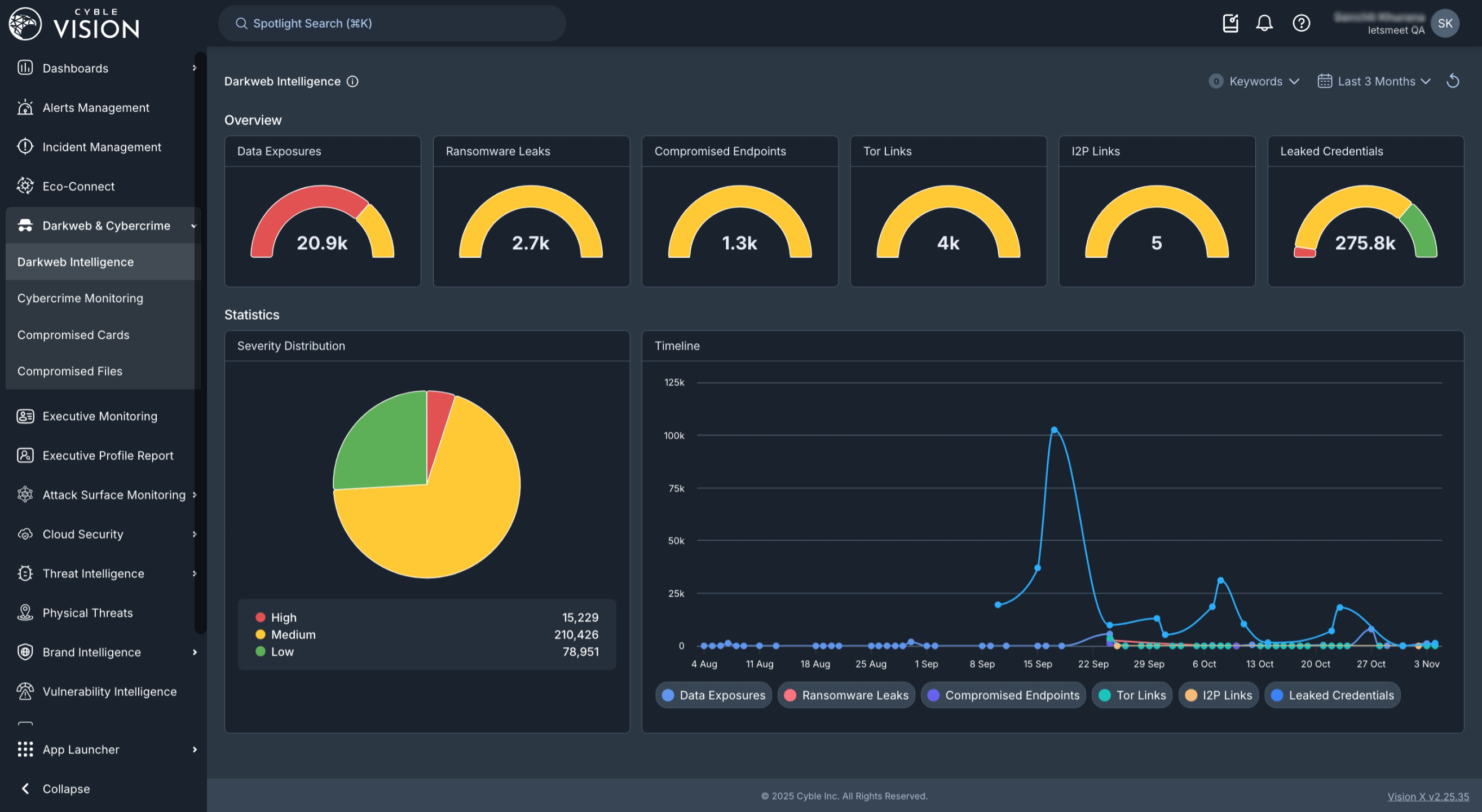
A continuous external monitoring program for vendor risk should track:
-
Dark web exposure: Vendor credentials, internal documents, and executive personally identifiable information (PII) appearing on darknet marketplaces, ransomware leak sites (the sites ransomware groups use to publish stolen data and pressure victims), and Telegram channels.
-
Attack surface drift: New subdomains, exposed services, certificate changes, and misconfigured cloud assets. New subdomains and certificates should be monitored daily or continuously, with exposed services and ports checked at minimum weekly.
-
Brand abuse: Lookalike domains (near-identical domains registered to impersonate a brand), phishing infrastructure, fake mobile apps, and impersonation campaigns targeting the vendor’s brand.
-
Credential exposure velocity: Key metrics include the number of vendor-associated identities in exposure datasets, the rate of new exposures discovered, and average remediation time.
Monitoring signals should be integrated directly into governance, risk, and compliance (GRC) platforms so vendor risk scores update automatically, audit trails capture every change, and remediation workflows trigger without manual intervention. To operationalize this, Cyble’s platform provides continuous monitoring of the deep and dark web, external attack surface management, and digital risk protection, which enables organizations to assess and monitor vendor risk in real time.
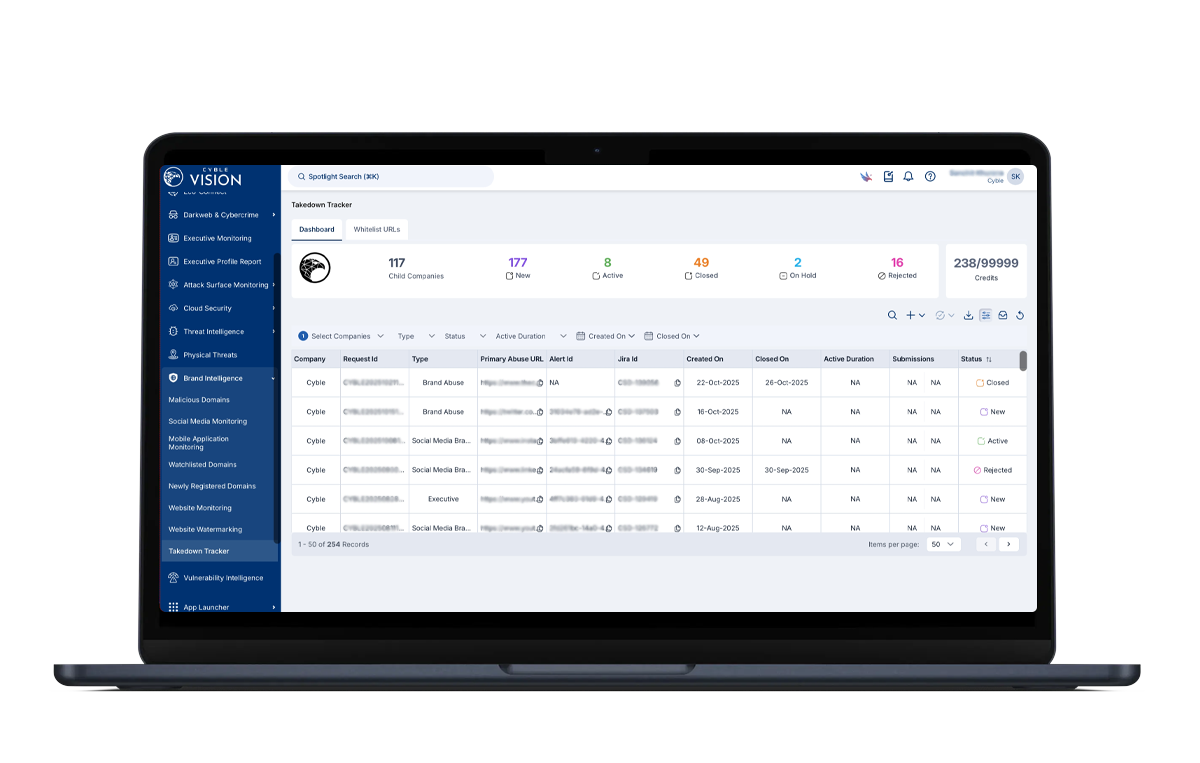
Cyble reports visibility into 15,000+ darknet marketplaces, a 95% signal-to-noise ratio, and a 98% takedown success rate (Cyble-reported figures). Cyble Vision delivers early warning on vendor exposures, while ODIN maps internet-facing assets across the full IPv4 and IPv6 space, including forgotten infrastructure and shadow assets that vendor questionnaires will never surface.
Validate your vendor’s security posture against observable reality. Get a demo.
How to Run the Assessment: A Step-by-Step Process
A defensible vendor assessment follows a structured process that produces audit-ready documentation at every stage.
-
Define your risk tolerance and weightings. Document your risk appetite and assign category weights before evaluating any vendor. Decisions made without a pre-defined framework are not defensible in audit.
-
Send a pre-qualification questionnaire. Use a standardized instrument aligned to the CISA ICT SCRM Task Force template to evaluate supplier practices and evidence.
-
Conduct a live session with security questions. Ask vendors to demonstrate their incident response process, not just describe it. Request evidence of tabletop exercises and real incident post-mortems.
-
Run a proof-of-concept that includes external exposure checks. Verify vendor claims against observable data, including dark web and attack surface monitoring. External signals provide the evidence layer.
-
Score vendors using the weighted model. Apply the 0–5 scale across all eleven categories and calculate the composite total.
-
Review with stakeholders. Include security, legal, procurement, and business owners in the final decision.
-
Document decisions for audit. Record scores, evidence artifacts, disqualifier checks, and rationale for every vendor decision. Evidence retained to support decisions and reassessments is a core requirement of defensible supply chain risk management. Even with this process in place, mature programs still make avoidable mistakes.
Common Pitfalls That Undermine Strong Frameworks
Even mature programs make avoidable mistakes. The most consequential are treating certifications as a conclusion rather than an input, and applying uniform scrutiny to every vendor regardless of inherent risk.
-
Over-relying on certifications. A SOC 2 Type II report tells you that controls operated effectively during the audit period, not that they are sufficient for your specific risk profile or that they extend to the specific product you are buying. Certifications should inform your view, then you validate coverage and relevance.
-
Applying the same scrutiny to every vendor. Tier the vendor population by inherent risk, such as data access, criticality, and regulatory scope, and apply monitoring frequency and signal depth accordingly. Programs that monitor every vendor with the same intensity often drown in alerts and miss what matters.
FAQ
What are the most important cybersecurity vendor evaluation criteria?
The most critical criteria are incident response capability, data protection controls, supply chain security, and external exposure monitoring. A vendor can fail on any of these regardless of certifications held. Weight external exposure monitoring heavily, because it reveals what self-reported answers cannot. Continuous external monitoring reveals a vendor’s actual posture as observable from the outside, whereas questionnaire responses only describe their intended posture. Certifications confirm that controls operated during an audit period, but they do not confirm that those controls extend to the specific product you are purchasing or that they remain effective today.
How do I weight vendor evaluation criteria for a defensible scorecard?
Assign weights based on your risk tolerance and the vendor’s criticality to your operations. Categories handling sensitive data or with production system access deserve higher weights. External exposure monitoring deserves significant weight because it validates vendor claims against observable reality rather than self-reported answers. Document your weighting rationale before evaluating any vendor so decisions remain defensible in board or regulatory review.
What is an automatic disqualifier in vendor security assessment?
An automatic disqualifier is a non-negotiable red flag that terminates evaluation regardless of the vendor’s overall weighted score. No compensating control offsets these findings. The core disqualifiers are: no documented and tested incident response plan; refusal to commit to contractual breach notification timelines; a history of known exploited vulnerabilities left unpatched; no current third-party audit report such as SOC 2 Type II or ISO 27001; active dark web exposure of the vendor’s own credentials; and claims of zero security incidents over three or more years without a documented detection process. These disqualifiers exist because they signal either a fundamental gap in security capability or an unwillingness to be transparent, both of which create unacceptable risk regardless of how well the vendor scores on other criteria.
How do I evaluate a vendor’s supply chain and fourth-party risk?
Require a current subprocessor list, software bills of materials (SBOMs) for software products, and evidence of the vendor’s own third-party risk management program. Ask how they vet subprocessors before onboarding, whether security requirements flow down contractually to their suppliers, and how they monitor fourth-party risk on an ongoing basis. The CISA ICT SCRM Task Force template provides a standardized set of questions covering risk management plan documentation, supplier compliance verification, and physical and personnel security controls. Apply deeper scrutiny to vendors whose subprocessors have access to your data or systems, and treat fourth-party exposure as a material risk, as noted earlier in this article.
What should a vendor incident notification SLA include, and how fast should it be?
A vendor notification SLA is a contractual commitment defining how quickly a vendor must notify you of a security incident. It must be faster than your own regulatory reporting deadlines to give you time to investigate and report. At minimum, the SLA should specify the maximum notification window from confirmation of an incident, typically 24 to 72 hours depending on your regulatory context. It should also define the required content of the notification, including date and time of discovery, nature and scope, data elements affected, and remediation steps taken or planned, and a named 24/7 contact for incident escalation. For organizations subject to NIS2, the vendor SLA must support your 24-hour early warning obligation. For DORA-regulated financial entities, it must support classification and initial notification within 4 hours of classification. Require vendors to demonstrate a tested notification process before finalizing the contract.
How does Cyble support continuous vendor risk monitoring?
Cyble provides continuous monitoring of the deep and dark web, external attack surface management through ODIN, and digital risk protection through Cyble Vision. These capabilities enable organizations to verify vendor security posture against observable external signals rather than self-reported answers. When a vendor’s credentials appear on a darknet marketplace, when a lookalike domain targeting a vendor’s brand is registered, or when a vendor’s attack surface drifts due to a misconfigured cloud asset, Cyble surfaces the signal in near-real time. This transforms vendor evaluation from a point-in-time snapshot into a continuous verification loop, which is what separates audit-ready programs from checkbox theater. Capabilities and coverage vary by subscription tier and region.
Conclusion and Next Steps
A defensible vendor evaluation framework requires three elements: a weighted scorecard that produces objective, reproducible scores; automatic disqualifiers that prevent bad decisions regardless of overall score; and continuous external monitoring that validates vendor claims against observable reality. Generic checklists fail on all three counts.
Your vendor decisions must survive board scrutiny and regulatory audit. External signals such as dark web credential exposure, attack surface drift, and brand abuse provide the verification layer that separates real risk management from checkbox theater. The organizations most exposed are those still treating vendor evaluation as a one-time onboarding event.
Results depend on the customer’s environment, asset scope, and configuration, and should be validated against it. Cyble-reported statistics are drawn from internal telemetry. Capabilities, coverage, and service levels vary by subscription tier and region.
Validate your vendor’s security posture against observable reality. Get a demo.