

Key Takeaways
-
Domain behavior determines the fastest takedown route. Parked pages, for-sale listings, brand impersonation, and active phishing each call for a different first move.
-
Preserve full-page screenshots, Registration Data Access Protocol (RDAP) and WHOIS records, Domain Name System (DNS) data, and archived captures within the first twenty-four hours because evidence disappears quickly.
-
Registrar abuse reports usually deliver the quickest action for phishing and malware, while Uniform Domain-Name Dispute-Resolution Policy (UDRP) or Uniform Rapid Suspension (URS) are the primary routes for trademark disputes seeking transfer or suspension.
-
URS offers fast, low-cost suspension for clear-cut new generic top-level domain (gTLD) cases. UDRP provides transfer or cancellation across all gTLDs including .com at higher cost and longer timelines.
-
Cyble delivers automated domain monitoring and managed takedown services with a reported ninety-eight percent success rate, so organizations can scale enforcement without manual reporting.
How To Take Down A Cybersquatted Domain: Step By Step
-
Identify what the domain is doing. Determine whether the domain is parked with pay-per-click (PPC) ads, listed for sale, impersonating your brand with copied content, or actively phishing users. The behavior dictates the route.
-
Preserve evidence before anything changes. Evidence degrades or disappears quickly, so capture everything within the first twenty-four hours. Take full-page screenshots with visible timestamps and URLs, Uniform Resource Locator (URL) paths, WHOIS (the public record of who registered a domain) or RDAP records, and any for-sale or contact-page content.
-
Check WHOIS and registrar details. Identify the registrar (the company that sells and administers the domain name), the registry (the organization that manages the top-level domain), the registration date, and any privacy proxy masking the registrant’s identity. The registration date relative to your trademark rights is critical for any dispute filing.
-
Choose the route. Select from registrar or registry abuse report, URS, UDRP, or Anticybersquatting Consumer Protection Act (ACPA) litigation based on the domain’s behavior and your desired outcome.
-
File or send the demand. Submit the abuse report, UDRP complaint, or URS complaint to the appropriate body, or instruct counsel to file an ACPA action. Include all preserved evidence at the time of filing.
-
Monitor for transfer, suspension, or reappearance. Track the domain’s DNS records, RDAP status, and live content after filing. Registrars may act without notifying the reporter, and cybersquatters frequently re-register under a different name after a takedown.
-
Escalate to litigation if damages justify it. When the domain causes ongoing commercial harm, when the respondent is beyond the reach of administrative processes, or when statutory damages are needed, escalate to ACPA litigation or the applicable national equivalent.
Walk through Cyble’s takedown workflow
How To Choose The Right Takedown Route
Route selection depends on what the domain is doing at the moment of discovery. Four behaviors cover the majority of cases.
A parked domain. If the domain resolves to a page monetized with PPC ads that reference or compete with your brand, a registrar abuse report is usually the fastest first move. According to guidance published by the American Bar Association (ABA), WIPO (World Intellectual Property Organization) panels have consistently found that parked pages with PPC links competing with or capitalizing on a complainant’s mark do not constitute a bona fide offering of goods or services. If the domain is passively held with no content and no legitimate use, UDRP is the appropriate route. Passive holding can constitute bad faith under established panel practice.
A domain listed for sale. A for-sale offer directed at the trademark owner is one of the clearest bad-faith indicators under UDRP paragraph 4(b). The ABA guidance notes that in WIPO Case No. DAI2024-0049 (CWI, LLC v. Trevor Harmon), an attempt to sell a parked domain to the mark owner for $25,000 was deemed bad faith. UDRP or URS, with the for-sale offer preserved as evidence, is the primary route. URS is appropriate only for new gTLDs where the case is clear-cut and the goal is fast suspension rather than transfer.
A domain impersonating the brand. File a UDRP complaint for transfer. File a URS complaint in parallel for fast suspension if the domain is a new gTLD. Submit a registrar abuse report at the same time. In WIPO Case No. D2026-XXXX (La Roche-Posay Laboratoire Dermatologique v. Nguyen Hai Duong, decided September 7, 2026), the panel ordered transfer of a domain that reproduced the complainant’s trademark in full and resolved to a site impersonating the brand without any disclaimer of affiliation.
A domain actively phishing or serving malware. Treat this as a DNS abuse and security matter. File with the registrar and registry abuse channels immediately. Trademark routes such as UDRP and URS handle ownership disputes and do not stop live credential-harvesting pages quickly enough. Phishing and malware reports generally move faster through abuse channels than parking disputes do.
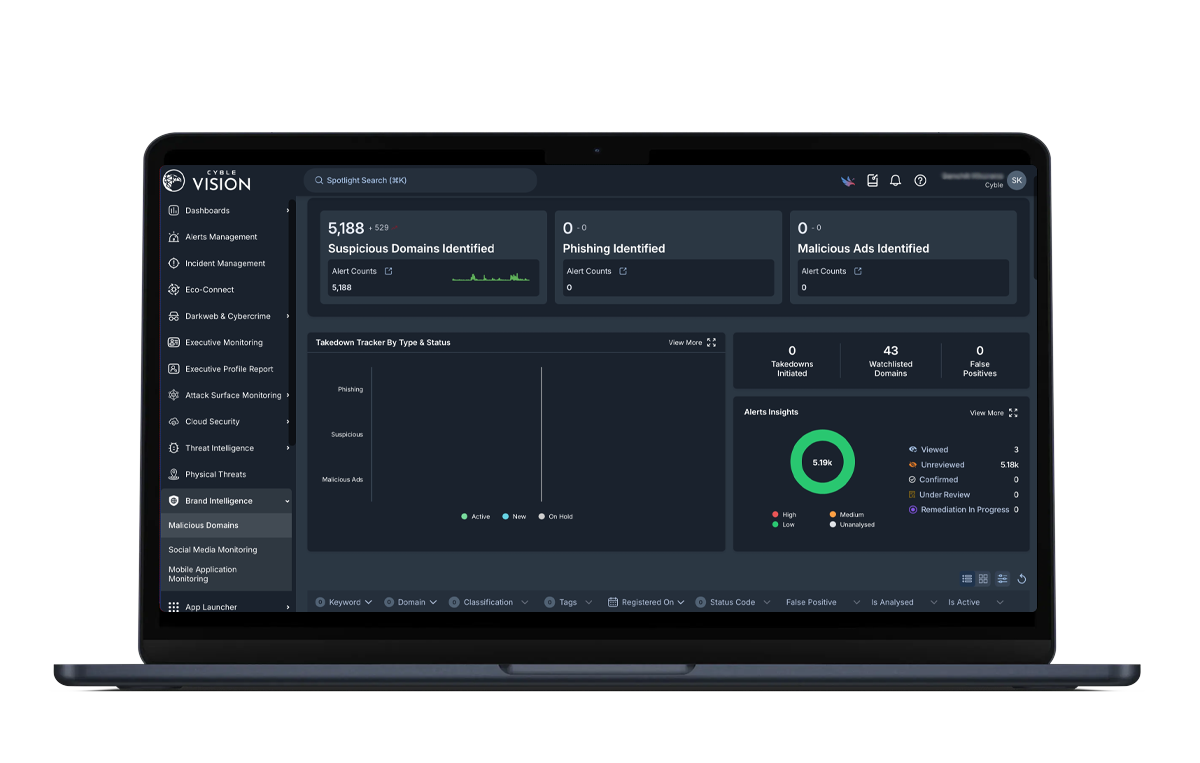
See automated route selection in Cyble
Registrar And Registry Abuse Reporting: The Fastest Route
Registrar abuse reporting provides a direct takedown path that operates independently of trademark dispute mechanisms. Under Section 3.18 of the Internet Corporation for Assigned Names and Numbers (ICANN) Registrar Accreditation Agreement, registrars must publish an abuse contact and cannot require a login before accepting a report. The RDAP system, which replaced WHOIS as the standard ICANN lookup on January 28, 2025, is the current method for locating that contact.
An effective registrar abuse report requires four elements. First, the exact domain and the specific abuse type, such as phishing, malware, fraud, or trademark infringement. Second, evidence of the abuse, including screenshots with visible timestamps and URLs, archived scan links, and third-party verification where available. Third, the reporter’s relationship to the brand. Fourth, a clear statement of the action requested, such as domain suspension or content removal. It’s important to consider timelines vary by registrar and abuse type.
Organizations handling many domains at once benefit from automation. Cyble’s Automated Domain Takedown: How The Technology Works article explains the technology layer behind high-volume enforcement. Cyble’s managed takedown combines automated workflows with global enforcement against service level agreements (SLAs), with a reported ninety-eight percent takedown success rate.
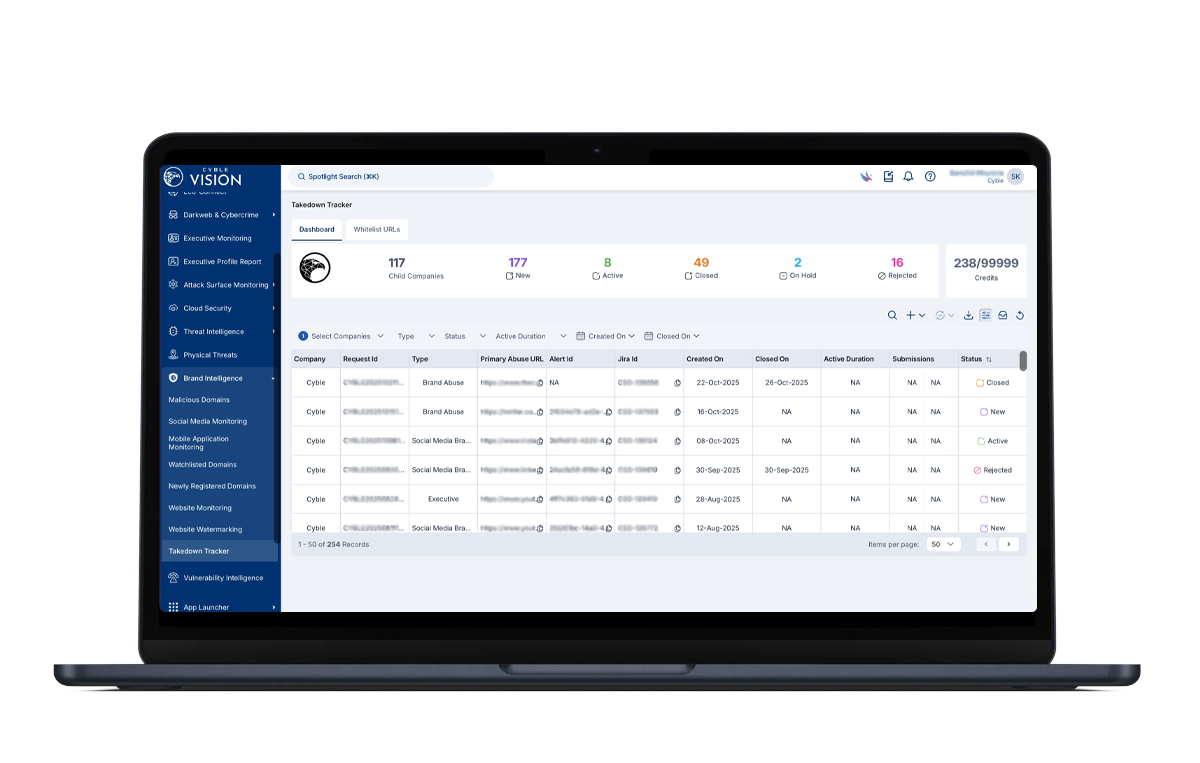
Automate registrar abuse reporting with Cyble
URS Vs UDRP: Which Dispute Route Fits
URS and UDRP are both administered by ICANN but serve different purposes and produce different outcomes. The table below summarizes the four attributes that most often guide a brand owner’s choice.
The Uniform Rapid Suspension System (URS) is the faster, lower-cost route for clear-cut cases. A successful URS determination suspends the domain for the remainder of its registration period, and it does not transfer ownership to the complainant. The complainant may pay commercial rates to extend the suspension for one additional year. URS applies only to gTLDs whose registry agreements include the mechanism and is unavailable for .com domains, which must go through UDRP. The evidentiary standard is clear and convincing evidence, a materially higher threshold than UDRP’s balance of probabilities. Under URS Procedure 8.5, where any genuine contestable issue exists as to whether a registration and use are in bad faith, the complaint is denied.
The Uniform Domain-Name Dispute-Resolution Policy (UDRP) can result in transfer or cancellation of the domain. It applies to all ICANN gTLDs including .com, plus country-code top-level domains (ccTLDs) that have adopted the policy. WIPO, an approved UDRP provider, handles approximately fifty to sixty percent of global UDRP cases, according to Domain Sentinel’s UDRP guide. WIPO is a United Nations agency. The Forum (formerly the National Arbitration Forum) handles a significant share of US cases. ICANN’s UDRP policy page and URS resource are the authoritative references for both mechanisms.
Compare URS and UDRP inside Cyble
What Evidence You Need To Win A UDRP
The UDRP requires a complainant to satisfy three cumulative prongs under paragraph 4(a). Failing any one defeats the complaint.
Prong one: the domain is identical or confusingly similar to the complainant’s trademark. Evidence required includes the trademark registration certificate, with registration number, date, and covered goods or services, and a comparison of the mark against the domain string. The ABA guidance notes that the top-level domain designation is disregarded in this comparison, and that adding descriptive terms such as “shop” or “events” does not prevent a finding of confusing similarity where the mark is recognizable within the domain. Common law trademark rights are sufficient, though they require additional evidence of use in commerce and consumer recognition.
Prong two: the respondent has no rights or legitimate interests in the domain. Evidence required includes the absence of any license or permission from the complainant and the absence of legitimate use, such as a parked page, a for-sale listing, or impersonation content. In the La Roche-Posay WIPO decision (September 7, 2026), the panel applied the principle from WIPO Overview 3.1 section 2.1 that proving a respondent lacks rights may require “proving a negative,” so a complainant who makes a prima facie case shifts the burden of production to the respondent. Use of a domain for impersonation, phishing, or passing off never confers legitimate interests on a respondent.
Prong three: the domain was registered and is being used in bad faith. Evidence required includes the for-sale offer, particularly one exceeding documented registration costs, impersonation content, prior correspondence with the registrant, or a pattern of similar registrations across multiple domains. The ABA guidance confirms that UDRP paragraph 4(b) lists four non-exhaustive bad-faith circumstances, including registering primarily to sell to the trademark owner, registering to prevent the owner from reflecting its mark in a domain as part of a pattern, registering to disrupt a competitor, and using the domain to attract users by creating confusion with the mark. Passive holding, with no website and no content, can also constitute bad faith where the circumstances indicate the registration targeted the trademark owner.
UDRP proceedings have no discovery and limited reply opportunities, so the complaint functions as a combined pleading and summary judgment motion. Clear, contemporaneous, dated evidence carries more weight than conclusory or after-the-fact assertions.
Strengthen UDRP evidence collection with Cyble
How To Preserve Evidence Before Filing
Strong evidence preservation often determines whether a filing survives. The registration record and site content at the time of filing, not at the time of the panel’s review, are what matter, and both can change.
Within the first twenty-four hours of discovering a cybersquatted domain, capture and preserve these items as discrete records.
-
Full-page screenshots with visible timestamps, the complete URL including path and parameters, and the date and time zone of capture
-
RDAP and historical WHOIS records, including the domain creation date, registrar, and any privacy proxy details
-
DNS records, including nameservers, mail exchange (MX) records, and any redirects
-
Archived page captures using a third-party archiving service, with the permanent result link preserved
-
Any for-sale listing, contact-page content, or correspondence with the registrant
-
Registrar correspondence, including any abuse ticket reference numbers
WHOIS and RDAP data change frequently. Phishing pages can also serve different content depending on the visitor’s location, device, or referral source, so teams should capture from multiple vantage points where possible.
Protect your brand with automated evidence capture
When To Sue Under The Anticybersquatting Consumer Protection Act
The Anticybersquatting Consumer Protection Act (ACPA), codified at 15 U.S.C. § 1125(d), provides the escalation route when administrative processes are insufficient. It is a United States federal statute and does not operate as a global mechanism. Non-US brand owners typically rely on UDRP, URS, or their applicable national equivalents.
ACPA litigation is justified in four situations. First, when statutory damages are needed, as the statute allows USD 1,000 to USD 100,000 per domain at the court’s discretion, per FedLaws.org’s ACPA analysis. Second, when the domain is causing ongoing commercial harm that a UDRP transfer alone cannot remedy. Third, when the respondent has US assets and a pattern of infringing registrations that warrants deterrence. Fourth, when the registrant is anonymous or beyond personal jurisdiction, in which case an in rem action against the domain itself is available in the federal district where the registrar or registry sits.
Talk to Cyble about complex ACPA scenarios
Cybersquatting, Domain Investing, And Domain Hijacking: How To Draw The Line
Cybersquatting means registering a domain name in bad faith to profit from another party’s trademark. The registrant targets a specific brand and has no legitimate interest in the name independent of that brand’s goodwill.
Legitimate domain investing involves acquiring domains that have independent value, such as generic or descriptive terms, common words, or names with no trademark conflict. Brannans’ UDRP domain dispute guide notes that if a domain owner contacts one specific company to ask if they want to buy the domain, a UDRP panel could view that as evidence of bad faith. Listing a domain broadly on a marketplace, through a broker, or through outreach to multiple potential buyers across different industries is described as a safer approach than contacting one specific company.
Domain hijacking is the unauthorized takeover of a domain that the legitimate owner already holds, typically through credential theft, social engineering of the registrar, or exploitation of the domain transfer process. This scenario calls for account security measures, registrar escalation, and potentially law enforcement. It does not call for a UDRP or ACPA filing against a third-party registrant.
See how Cyble detects cybersquatting and hijacking
Prevention Strategies And Final Thoughts
Prevention reduces the frequency and cost of enforcement. Four measures cover the majority of exposure.
First, register key brand variants defensively across relevant gTLDs and country-code top-level domains (ccTLDs). Second, enroll in the ICANN Trademark Clearinghouse (TMCH), which supports Sunrise registrations, or priority registration periods, and Trademark Claims services, or notifications to rights holders during new gTLD launches. Third, enable multi-factor authentication on registrar accounts to reduce the risk of domain hijacking. Fourth, monitor continuously for lookalike domains, meaning near-identical domains registered to impersonate a brand, so the next cybersquatted domain is caught before it is used against customers.
Organizations that prefer continuous detection and removal of brand-impersonating domains over one-off litigation can rely on Cyble. The platform monitors for lookalike domains, brand abuse, and phishing infrastructure and delivers native managed takedown with SLAs and the same reported success rate mentioned earlier. Detection and removal operate as a single motion through one provider. For phishing-specific workflows, see Anti-Phishing Domain Removal: A Practitioner’s Playbook.
Schedule a Cyble brand protection demo
Frequently Asked Questions (FAQ)
What evidence wins a UDRP?
A winning UDRP complaint satisfies all three prongs of UDRP paragraph 4(a). For the first prong, provide the trademark registration certificate and a string comparison between the mark and the domain. For the second prong, provide evidence of the absence of legitimate use, such as a parked page, a for-sale listing, or impersonation content, combined with confirmation that the respondent holds no license from the complainant. For the third prong, provide the for-sale offer, especially one exceeding documented registration costs, impersonation content, prior correspondence, or a pattern of similar registrations across multiple domains. Clear, contemporaneous, dated evidence is stronger than conclusory assertions. WIPO’s Overview 3.1, published February 17, 2026, is the current reference for panel practice on all three elements.
Does URS transfer or suspend a domain?
URS suspends a domain and does not transfer ownership to the complainant. A successful URS determination redirects the domain’s nameservers to an informational page for the remainder of the registration period. The complainant may pay commercial rates to extend the suspension for one additional year. Once the suspension ends, the domain returns to the ordinary expiration process and can be re-registered by anyone, including the original registrant. A brand owner seeking permanent control of the domain should use UDRP, which can result in transfer, rather than relying on URS suspension alone.
How do you report a cybersquatted domain to the registrar?
Locate the registrar’s abuse contact through an RDAP query. The registrar entity in the RDAP response includes the abuse email address. Submit a report that includes the exact domain, the specific abuse type such as phishing, fraud, trademark infringement, or malware, full-page screenshots with visible timestamps and URLs, the observation date and time in Coordinated Universal Time (UTC), and a clear statement of the action requested. For phishing and fraud reports, evidence that the page collects credentials or payment data is sufficient, and a trademark certificate is not required. Follow up and recheck the domain after twenty-four and seventy-two hours. If nothing has changed after three days, escalate to the registry for that domain ending or to browser blocklists, and consider filing with ICANN Contractual Compliance after a reasonable time.
How do you preserve evidence before filing a UDRP or URS complaint?
Within the first twenty-four hours, capture full-page screenshots with visible timestamps and the complete URL including path and parameters, RDAP and historical WHOIS records including the domain creation date and registrar, DNS records including nameservers and MX records, archived page captures with permanent result links from a third-party archiving service, any for-sale listing or contact-page content, and any correspondence with the registrant. RDAP data changes and phishing pages can serve different content depending on the visitor’s location or device, so captures should be made promptly and from multiple vantage points where possible. The registration record and site content at the time of filing, not at the time of the panel’s review, are what the panel examines.
What is the difference between cybersquatting and legitimate domain investing?
Cybersquatting is registering a domain in bad faith to profit from another party’s trademark. The registrant targets a specific brand and has no legitimate interest in the name independent of that brand’s goodwill. Legitimate domain investing involves acquiring domains with independent value, such as generic or descriptive terms, common words, or names with no trademark conflict. The distinguishing conduct is intent. A domain investor who lists a name broadly on a marketplace or through a broker, with no specific brand in mind, is engaged in lawful commerce. A registrant who contacts one specific trademark owner to offer the domain for sale is providing evidence of bad faith under UDRP paragraph 4(b).
Protect your domains with a Cyble demo