

Key Takeaways
- Credentials often appear on criminal markets days before internal teams see them, which creates a window for fraud and ransomware.
- The incumbent platform’s credential-risk module uses configurable scheduled scans against a one-time historical backfill, which leaves multi-day blind windows that threat actors exploit.
- Continuous monitoring across a large darknet footprint enables detection, entity resolution, and alerting in under 30 minutes when an AI-native pipeline runs without human intervention.
- Native managed takedown paired with detection narrows the gap between awareness and action, with reported 98% success rates against phishing sites, lookalike domains, and leaked data.
- Cyble Vision delivers continuous coverage, real-time enrichment, and native takedown capabilities that set it apart from scheduled-scan modules bundled within broader exposure platforms.
How The Incumbent’s Dark Web Credential Monitoring Works
An incumbent exposure-management platform bundles identity and exposure-risk capabilities, including leaked-account visibility, inside a broader enterprise platform, and the same vendor separately offers a consumer identity-protection product for individuals. Both sit under one brand umbrella but serve different buyers with different architectures.
The enterprise module performs retroactive scanning across a defined span of historical data, which provides a one-time baseline of previously exposed credentials. From that baseline, the platform runs scans on a configurable cadence. When a compromise is discovered, the module generates risk events that detail compromised personal, financial, and organizational data fields such as passwords, names, contact details, Social Security and tax numbers, credit cards, passports, and social profiles.
The historical backfill is a one-time baseline, not ongoing coverage, so everything after that point depends on the scan cadence. That cadence sets a floor on time-to-detect, which means credentials posted on a Monday are not surfaced until the next scan window at the earliest. The module is packaged as a component within a broader platform, not sold as a standalone credential-monitoring service. That packaging affects pricing transparency and the depth of capability available to buyers who only need this function, and quote-based pricing that scales with modules and deployment scope makes direct cost comparison with per-monitored-identity alternatives difficult.
Why Weekly Scan Cadence Slows Time To Detect
The clock on a credential exposure moves faster than a weekly scan can follow. A typical compromise timeline shows why: credentials posted at 11 PM are tested by midnight, sold by 2 AM, and funds moved by 6 AM, long before morning triage begins and long before a weekly scan would surface the exposure.
Verizon’s 2026 Data Breach Investigations Report (DBIR) found that vulnerability exploitation and stolen credentials together account for the majority of breach entry points, and that threat actors are using artificial intelligence (AI) to accelerate exploitation, shrinking the defensive window from months to hours. The same report also found that 50% of organizations that fell victim to ransomware had a credential or infostealer event occur within 95 days prior to the attack, which shows that credential exposure often precedes the breach.
A weekly cadence can leave a multi-day blind window. If credentials are posted on a Tuesday and the next scan runs the following Monday, the exposure window is nearly six days. During that window, an initial access broker (IAB), a criminal specialist who breaks in and resells that access, can sell verified logins to ransomware crews. According to DeepStrike’s Stealer Log Statistics 2025 report, the window between a stolen log appearing on a marketplace and a ransomware incident is shrinking to sometimes under 48 hours as initial access brokers move quickly.
Continuous monitoring collapses this window. When detection, entity resolution (the process of automatically matching an obfuscated or cross-language mention to the right organization), enrichment, and alerting all run without a human in the loop, the full path from external exposure to actionable alert can resolve in under 30 minutes. This describes what continuous, AI-native pipelines make possible and does not represent a service level guarantee, and results depend on the customer’s environment, asset scope, and configuration.
Data Types Tracked And The Consumer Versus Enterprise Split
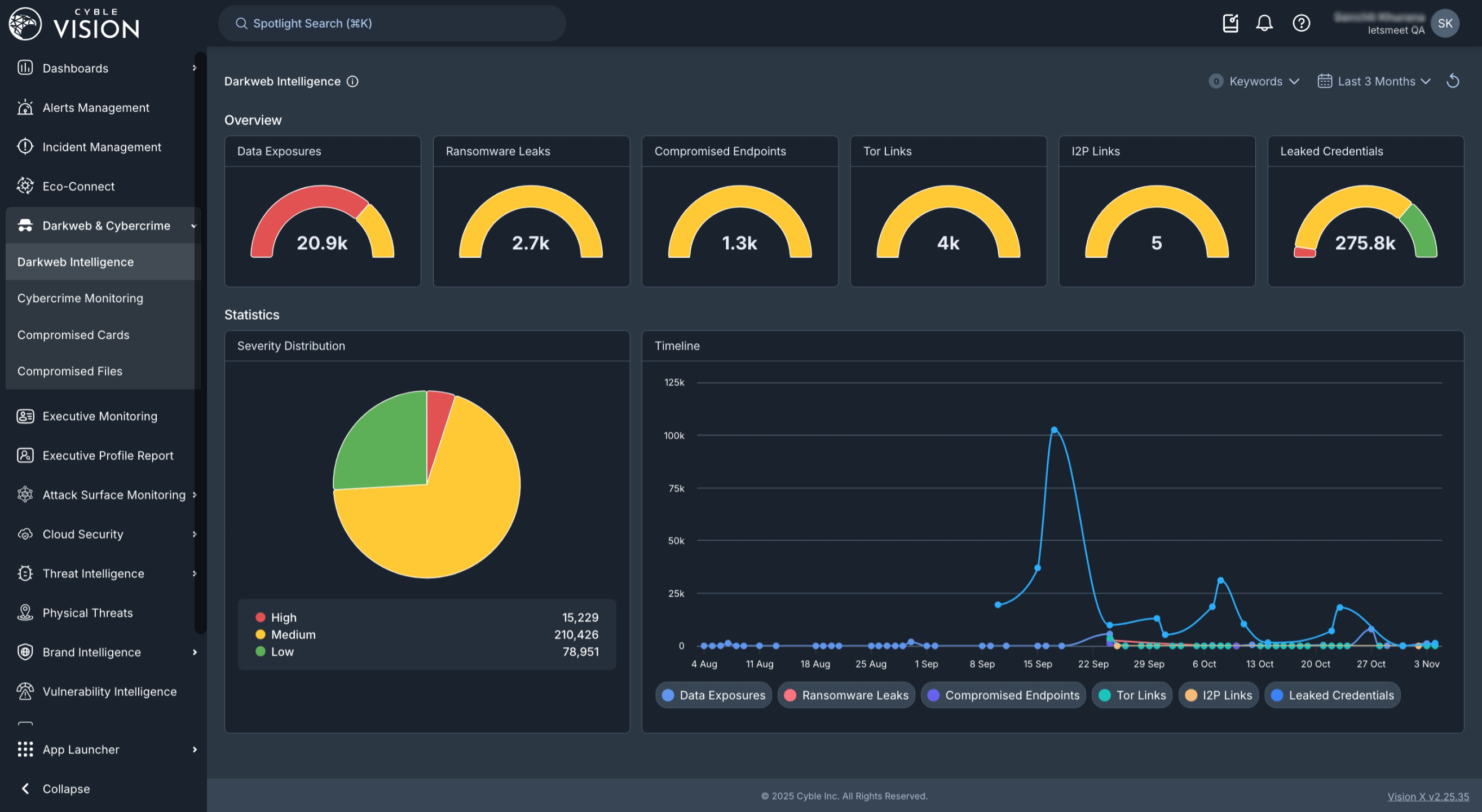
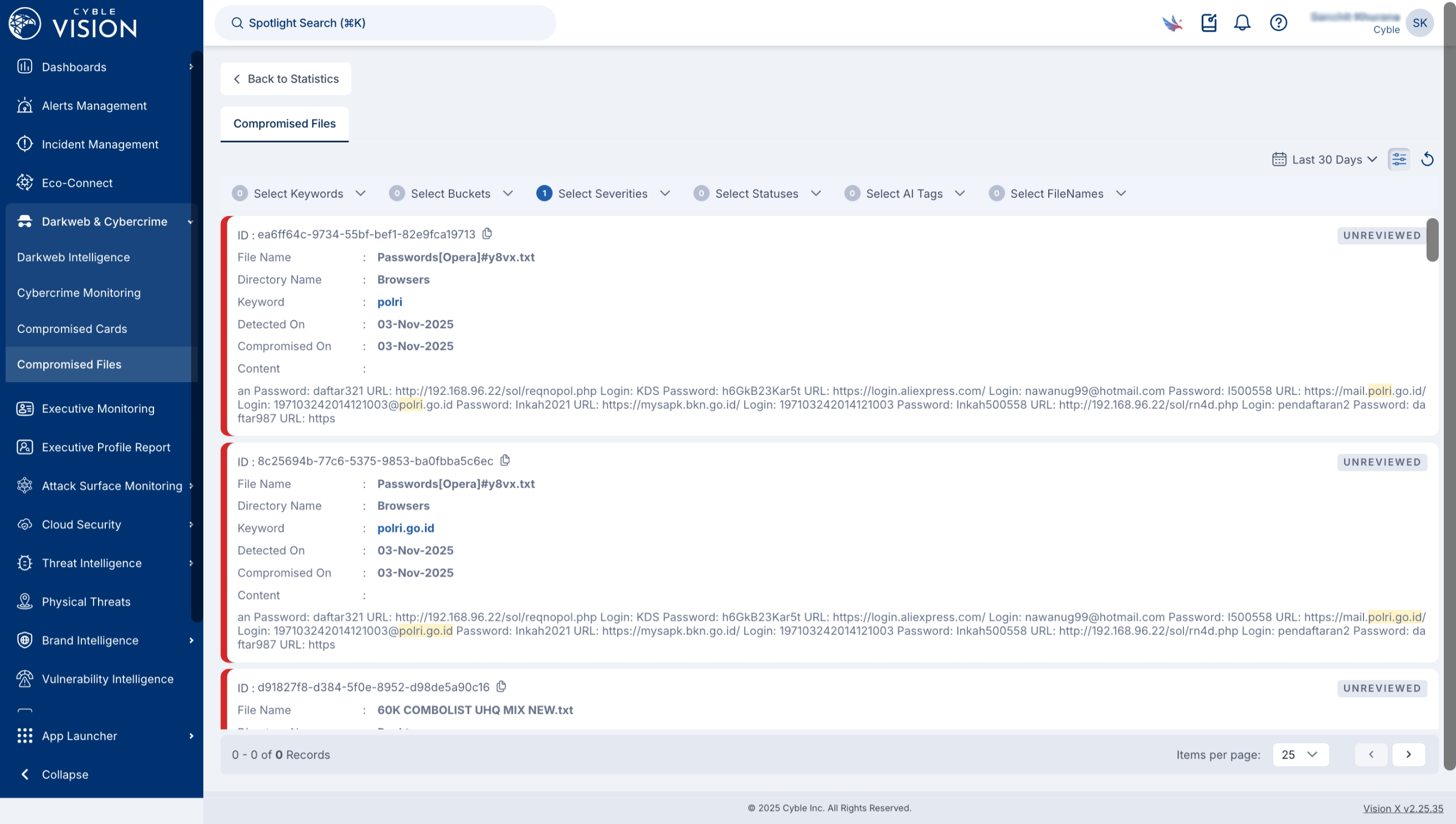
Both the enterprise module and the consumer identity-protection product track overlapping data categories such as passwords, names, contact details, Social Security and tax numbers, credit cards, passports, and social profiles. The consumer product adds social media profile checkups, which allow individuals to monitor their personal exposure across platforms.
The use cases diverge significantly. The consumer identity-protection product is designed for an individual tracking personal exposure, a single person monitoring their own email address, phone number, and financial identifiers. The enterprise credential-monitoring use case covers corporate domains, employee credentials, and organizational data fields at scale across potentially thousands of identities.
That split also explains two questions buyers and individuals both ask. The first is what a dark web alert actually means. It means a monitoring service has found data matching your monitored identifiers, such as an email address, a password, or a Social Security number, in a dataset circulating on criminal markets or in a breach database. It signals that the credential is available to anyone who finds that dataset, even if no account access has yet occurred. The second question is whether the data can be removed. Monitoring highlights exposure, and remediation requires action such as credential reset, multifactor authentication (MFA) enforcement, session revocation, and, where the exposure includes leaked data or criminal infrastructure, managed takedown that removes the malicious asset.
For more on monitoring email-specific exposure, see Dark Web Monitoring For Email Breach Exposure.
What To Do After A Dark Web Alert
The sequence after a dark web credential alert matters as much as the alert itself. External guidance such as IGTech365’s post-alert response guidance and ShipReady Metrics’ credential-compromise checklist both emphasize that password resets alone do not terminate established sessions, a point that teams often miss in practice.
- Reset the exposed credential and every reused instance of it. Password reuse means a single leaked credential can open multiple corporate accounts. Rotation must happen at the issuer, not only in the application where the exposure was detected.
- Enforce MFA and revoke active sessions and tokens. A password change alone does not terminate an established session, so revoking sessions server-side forces reauthentication across all active connections.
- Check for lateral exposure across linked accounts and third parties. Sign-in logs, mailbox forwarding rules, OAuth grants, and API keys may all carry persistence mechanisms that survive a password reset.
- Preserve evidence and start the notification clock where regulatory disclosure applies. Identity-plane logs such as sign-in, audit, session issuance, and OAuth grant events must be preserved before remediation overwrites them, because regulators ask for a documented, time-stamped starting point.
- Escalate to takedown where the exposure includes leaked data or criminal infrastructure. Where a phishing site, lookalike domain, or leaked dataset is involved, managed takedown removes the exposure instead of only reporting it.
Executing that sequence at scale depends on how the monitoring platform is built, which is where a dedicated platform diverges from a module inside a broader suite.
How A Dedicated Platform Compares For Enterprise Credential Monitoring
Cyble Vision, the flagship product for cyber threat intelligence (CTI), attack surface management (ASM), and digital risk protection (DRP), running on Cyble Blaze AI, differs from the incumbent’s credential-risk module across four core dimensions, coverage, detection speed, enrichment, and action, with two supporting factors for enterprise fit, integrations and independent validation.
Coverage. Cyble monitors 15,000+ darknet marketplaces continuously, a footprint that gives it visibility into roughly 90% of cybercrime activity (Cyble internal telemetry). The incumbent’s module runs on a configurable scan cadence against a historical backfill. Continuous collection ingests new credential dumps, infostealer logs, and IAB listings as they appear, so the next scheduled interval never becomes the bottleneck. Europol’s IOCTA 2026 report notes that darknet markets show “remarkable resilience,” with new sites quickly replacing those taken down. That churn makes continuously refreshed marketplace coverage a functional requirement, not a differentiator.
Detection speed. A scheduled cadence sets a structural floor on time-to-detect that tuning cannot remove. Continuous AI-native collection removes that floor. As noted above, Cyble’s architecture illustrates a path from external exposure to actionable alert in under 30 minutes when the full pipeline runs without human intervention, which remains an architectural illustration rather than a service level and requires validation in each environment.
Enrichment. Entity resolution at ingestion determines whether a mention refers to the customer’s organization before it becomes an alert, including across languages and obfuscated spellings. Findings arrive already linked to the breach they came from, the IAB selling access, and the ransomware group known to buy from that broker. Cyble reports a 95% signal-to-noise ratio (Cyble internal telemetry). The incumbent’s module generates risk events, and enrichment against the customer’s specific domains, subsidiaries, executives, and technology stack often requires additional manual pivoting.
Action. Native managed takedown is part of Cyble Vision, not a referral to a separate vendor or an internal legal queue. Takedown is delivered against service level agreements (SLAs), and Cyble reports a 98% takedown success rate (Cyble internal telemetry). The coverage spans phishing sites, lookalike domains (near-identical domains registered to impersonate a brand), fake mobile applications, impersonation accounts, and leaked data.
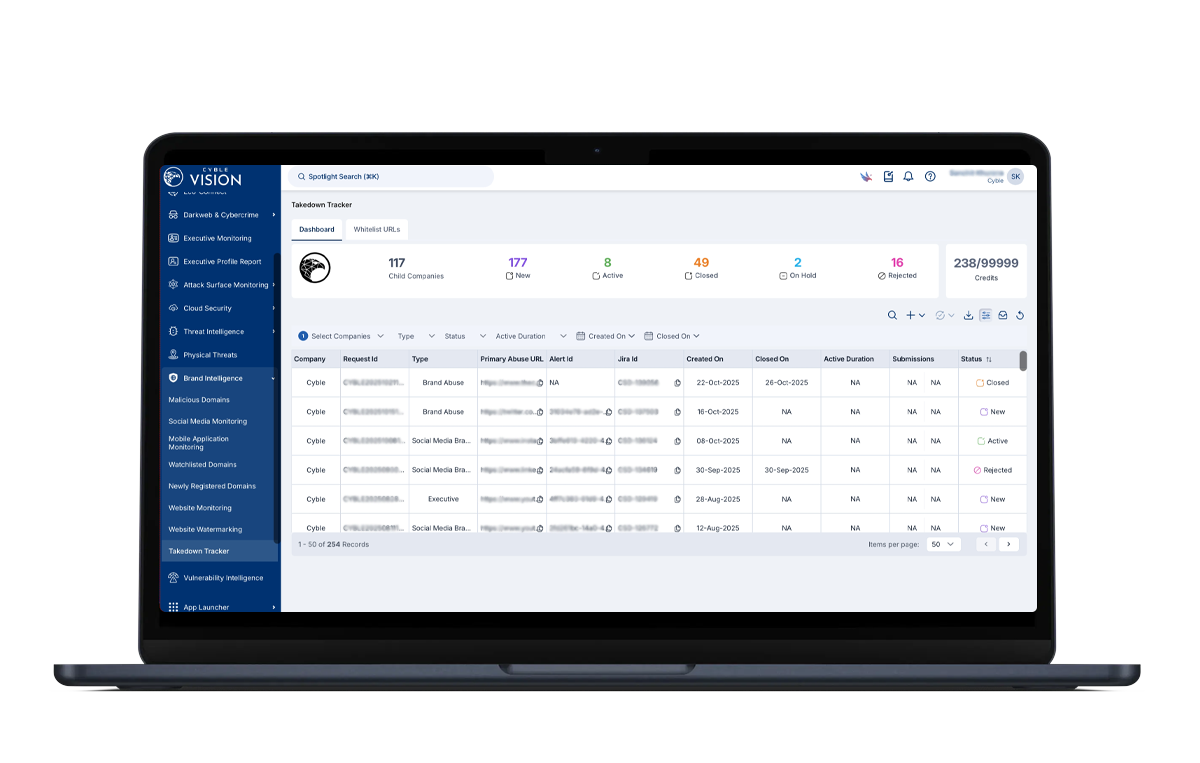
Those four dimensions form the core of the comparison, and two additional factors shape enterprise fit. First, Cyble Vision supports its own application programming interface (API) and Trusted Automated Exchange of Intelligence Information (TAXII) feeds, and connects to more than 70 integrations including Security Information and Event Management (SIEM), security orchestration, automation and response (SOAR), and ticketing platforms. The current integration list is at cyble.com/cyble-integrations/.
Second, independent validation matters. Cyble was named a Challenger in the 2026 Gartner® Magic Quadrant™ for Cyberthreat Intelligence Technologies, the inaugural Magic Quadrant for this market. This placement provides third-party recognition of Cyble’s position in the cyberthreat intelligence space rather than an endorsement of specific features.
Capabilities, coverage, and service levels vary by subscription tier and region and should be validated against the customer’s specific environment.
See continuous credential monitoring in action
Evaluation Checklist For Dark Web Credential Monitoring
Enterprise buyers evaluating dark web credential monitoring can use the following checklist to structure their assessment.
- Start with cadence, and ask whether monitoring is continuous or scheduled, and what the maximum time-to-detect is under the worst-case scan interval.
- Confirm entity resolution, and check whether findings are resolved to the buyer’s own entities before alerting, including across languages and obfuscated references.
- Review enrichment, and determine whether breach source, IAB, and ransomware group context arrive with the alert or require manual pivoting after the fact.
- Clarify remediation, and see whether takedown is native to the platform or referred out to a separate vendor or internal process.
- Validate integration fit, and ensure alignment with the existing SIEM and ticketing stack, including API and TAXII support for custom pipelines.
- Look for independent validation, and weigh Magic Quadrant placement, Gartner® Peer Insights™ ratings, and G2 badges as cross-checks against vendor-only claims.
Frequently Asked Questions
What does a dark web credential alert actually mean?
A dark web credential alert means a monitoring service has detected data matching your monitored identifiers, such as an email address, a password, a Social Security number, or another tracked field, in a dataset circulating on criminal markets, in a breach database, or in an infostealer log. The alert confirms that the credential is available to anyone who finds that dataset, even if no account access has yet occurred. The appropriate response is to treat it as a live compromise, revoke sessions, reset the credential, enforce MFA, and investigate for lateral exposure.
How often does the incumbent scan, and why does cadence matter?
The incumbent platform’s credential-risk module runs on a configurable cadence against a one-time historical backfill. Cadence matters because the window between a credential being posted on a criminal market and being tested, sold, and used can now be measured in hours. A weekly scan can leave a multi-day blind window during which an initial access broker sells verified logins to ransomware crews, and, as the DeepStrike figures cited earlier show, that window can now be measured in hours. Continuous monitoring from a dedicated platform removes that structural floor on time-to-detect.
Does monitoring alone remove exposed data?
Monitoring detects and alerts on exposure, but it does not by itself remove the data or close the access path. Remediation requires action such as credential reset, MFA enforcement, session and token revocation, and, where the exposure includes leaked data, phishing infrastructure, or criminal listings, managed takedown that removes the malicious asset. Platforms that pair detection with native managed takedown, such as Cyble Vision, shorten the gap between learning about an exposure and resolving it. Cyble reports a 98% takedown success rate delivered against SLAs.
Does a dedicated platform replace an existing security stack?
A dedicated dark web credential monitoring platform does not replace a security operations center (SOC), SIEM, or endpoint detection and response (EDR) tool, and instead extends them with external visibility those tools cannot provide. A SIEM ingests internal logs and cannot index a criminal marketplace or a Telegram channel. Cyble Vision integrates with more than 70 platforms including SIEM, SOAR, and ticketing systems, and delivers enriched alerts into the workflow the team already uses instead of forcing an isolated console. For endpoint detection, Cyble Titan provides AI-native EDR that correlates with the same external intelligence layer.
Conclusion
The evaluation comes down to three questions a buyer can put to any vendor, how fast a posted credential becomes an alert, whether the finding is already resolved to the organization, and whether the platform removes the exposure or hands it back to the internal team. Cyble Vision answers all three with continuous collection, entity resolution at ingestion, and native managed takedown.
For buyers already holding a credential-monitoring proposal from the incumbent platform, the evaluation criteria are specific, cadence, enrichment at ingestion, and whether takedown is native or referred out. On all three, a dedicated platform built for this purpose differs structurally from a bundled module.
Capabilities, coverage, and service levels vary by subscription tier and region. Statistics cited from Cyble are drawn from Cyble internal telemetry, and results depend on the customer’s environment, asset scope, and configuration.
For further reading, see How Dark Web Monitoring Works: Full Pipeline, Step By Step and Dark Web Monitoring For Executives: A Complete Guide.
Validate these criteria in your own environment