

Key Takeaways
- Dark web monitoring false positives stem from keyword-only matching and missing entity resolution. Tuning keywords does not fix these root causes.
- Alerts fall into four distinct categories: false positive, stale exposure, duplicate, and false negative. Each category requires a different response.
- A five-step triage workflow helps analysts verify source, confirm identity, establish freshness, assess risk, and deduplicate findings.
- Over-filtering to reduce noise creates blind spots. Entity resolution at collection preserves recall while cutting irrelevant alerts.
- Cyble Vision delivers a 95% signal-to-noise ratio by performing entity resolution before alerts are generated, with broad language and enterprise integration coverage.
See how Cyble Vision reduces false positives
A Four-Part Taxonomy for Dark Web Monitoring Alerts
The most common source of mis-triage in dark web monitoring is treating four distinct alert categories as one. Each category needs a different response. When teams collapse them into a single “false positive” bucket, they overlook genuine risk. The four categories are:
- False positive: the alert does not refer to your organization at all. A keyword matched a common name or generic brand string that has nothing to do with your assets.
- Stale exposure: the alert is real. The credential or asset was genuinely exposed, but it has since been rotated, revoked, or remediated. The alert was accurate when generated, and the underlying risk has been addressed.
- Duplicate: the same underlying exposure reported multiple times from different sources. Without global deduplication, the same credential dump appearing across multiple forums, paste sites, and Telegram channels can inflate apparent false positive rates by 300–500% for a large organization.
- False negative: a real exposure that never generated an alert. This is the mirror problem and the one most teams undercount.
Treating a rotated credential as a false positive creates a category error with consequences. A credential that was live when it was dumped and has since been rotated is a stale exposure. That distinction matters because stale exposures reveal your historical attack surface and rotation cadence. False positives only show that your collection layer matched the wrong string. Mis-labeling one as the other erodes trust in the feed and hides patterns that should shape remediation policy.
Explore entity resolution in action
Why Dark Web Monitoring Tools Generate False Positives
Understanding why these four categories get conflated requires looking at how most platforms actually work. Most dark web monitoring platforms match keywords and stop there. The structural causes of high false positive rates are well documented, and keyword narrowing does not address them.
- Keyword-only matching against common names and generic brand strings. A platform that searches for “acme bank” will match every forum post containing those words. The post may refer to your organization, a different institution with a similar name, or a fictional reference. The internet contains more strings that look like your brand than actual references to your organization.
- Missing entity resolution. Entity resolution, the process of determining whether a mention actually refers to a specific real-world organization, provides the structural fix that keyword matching cannot. Exact matching fails in both directions. Exact matching fails in both directions. Common names create coincidental collisions that flood reviewers with false positives. Aliases, transliterations, and fragmented records cause missed matches. A tool that cannot resolve whether “ACME_b@nk” in a Russian-language post refers to your organization will generate alerts for both.
- Cross-language and obfuscated references going unresolved. Russian-language forums are primary hubs for credential trading and initial access brokering, and threat actors use encoding techniques, Cyrillic homoglyphs, and base64 to obfuscate terms. Platforms that process only English-language communications miss a substantial portion of the threat landscape and misclassify obfuscated references.
- Outdated breach data resurfacing as new. A credential dump from 2019 may still circulate on current forums. A platform lacking robust deduplication and point-of-collection timestamping will alert on credentials that have been rotated, accounts that have been deactivated, or sessions that have timed out.
- Lack of context about the customer’s actual attack surface. A platform that scores alerts against a generic keyword list rather than your specific domains, subsidiaries, executives, and technology stack cannot distinguish a relevant exposure from an irrelevant one. Volume scales faster than relevance because the matching logic has no model of what actually matters to your organization.
These issues reflect architectural limitations. Narrower keywords reduce recall while leaving the core problem untouched. Entity resolution at the collection layer, before an alert is created, addresses the root cause.
False Positives and False Negatives in Dark Web Monitoring
A tool that reports zero false positives may be under-detecting or suppressing too much. Teams should validate coverage before trusting that rate. This mirror problem rarely receives direct attention in dark web monitoring evaluations.
Precision and recall describe opposite ends of the same tradeoff. Precision is the share of alerts that are genuine. Recall is the share of genuine exposures that generated an alert. A scanner can achieve perfect precision by flagging almost nothing, and perfect recall by flagging everything. High recall alone is misleading if the vendor floods the queue with noise. High precision alone is misleading if real exposures are silently missed.
In dark web monitoring, a false negative, a real exposure that never generated an alert, is the more dangerous failure mode. The Mandiant M-Trends 2024 report found a global median dwell time of about 10 days for intrusion detection. A monitoring platform with detection latency beyond that window effectively produces false negatives for the most dangerous signals.
These two failure modes sit at opposite ends of the same curve. The real question is where on that curve a given tool operates and whether the buyer can adjust that tradeoff. A quiet alert queue does not guarantee that real vulnerabilities or suspicious activity reach an analyst. Mature teams measure both what was found and what was missed, rather than focusing only on queue volume.
For a deeper look at how credential monitoring mechanics affect both precision and recall, see Dark Web Credential Monitoring: How It Works.
How to Tell If a Dark Web Alert Is a False Positive: A Five-Step Triage Workflow
Because these structural causes produce alerts that require different responses, analysts need a repeatable way to sort them. The following workflow is tool-agnostic and designed for a Tier 1 or Tier 2 analyst working an active queue. Each step has a clear decision point. Steps two and four consume most of the time and determine outcome quality.
- Verify the source. Confirm where the data came from and whether the source is credible and current. A post on an active, high-signal forum carries different weight than a recycled paste from a defunct site. Check the collection timestamp against the posting date. A significant gap suggests the data has been circulating longer than the alert implies.
- Confirm identity. Determine whether the mention actually refers to your organization. This includes obfuscated spellings, non-English references, and near-matches on common brand strings. This step consumes most manual triage time and offers the highest automation payoff because it is repetitive and data-dependent. A mention that cannot be confirmed as referring to your organization is a false positive by definition.
- Establish freshness. Check whether the credential, document, or asset is still live or already rotated and revoked. Cross-reference the exposed identifier against the last password change timestamp in your identity provider. When the breach date is unknown, authentication logs should be reviewed across a 90-day baseline window to determine whether an exposed credential was used. A confirmed match against a rotated credential is a stale exposure. Log it separately.
- Assess current risk. Evaluate whether the exposure is actionable against your environment today. This step requires human judgment because it depends on what the asset does, who owns it, and what downstream systems it touches. A plaintext admin credential in a fresh stealer log presents a different risk than a hashed password from a years-old breach. Recency and source determine urgency. A fresh leak or stealer-malware log is urgent, a credential from a years-old breach already remediated is low priority, and a live session cookie outranks a stale password hash.
- Deduplicate and classify. Collapse repeat findings from different sources into a single exposure record and apply the taxonomy from the section above: false positive, stale exposure, duplicate, or genuine. Document the classification and the reasoning. A rule that cannot be explained cannot be defended to a chief information security officer (CISO) or an auditor.
Automation accelerates steps one, two, and five. Step four depends on human judgment. The goal is to reach a defensible verdict with the minimum necessary evidence, then either close or escalate.
For more on how dark web monitoring pipelines work end to end, see How Dark Web Monitoring Works: Full Pipeline, Step by Step.
How to Tune Dark Web Monitoring Without Missing Real Threats
Teams often reduce false positives through broad keyword exclusions and aggressive filtering, then discover they created blind spots. The risk of over-suppression is real and documented. Raising a threshold, narrowing monitored conditions, suppressing known-benign patterns, and excluding noisy assets each remove some fraction of genuine activity from the detection surface.
Several principles help tune a dark web monitoring feed without degrading recall:
- Scope exclusions to specific entities, not whole terms. Suppressing all alerts containing a common word removes signal along with noise because the word itself is not a reliable indicator of relevance. A better approach is to suppress alerts where a specific entity resolution check fails, where the mention cannot be confirmed as referring to your organization. That kind of structural filter preserves recall for genuine references while still cutting the noise.
- Review suppression rules on a set cadence. Exclusions that were accurate when written become blind spots as threat actor behavior evolves. Every exception should have an owner, a review date, and a test case proving it still catches nearby abuse. If a tuning change cannot explain what kind of real attack it might now miss, the scope is probably too broad.
- Treat a spike in alerts as a potential signal. A sudden increase in alerts about your domain may indicate a real credential dump or active targeting campaign, even when individual alerts are low-confidence. Investigate the pattern before suppressing the volume.
- Investigate alert volume drops after tuning. A sudden drop in alert volume after platform tuning should be checked for false negative creation rather than celebrated as improved accuracy, since low alert volume can indicate dangerously low recall. A quieter queue does not prove a cleaner environment.
What to Ask Your Dark Web Monitoring Vendor About Accuracy
These questions help you see whether a vendor’s accuracy claims reflect architectural capability or marketing language. The five questions below target the architectural decisions that determine precision and recall. A vendor who answers all five in writing, with specific figures attached, deserves serious consideration. Vague answers to more than one signal the need for deeper scrutiny before the evaluation proceeds.
- How is entity resolution performed, and does it handle obfuscated and cross-language references? A vendor whose answer is “we monitor keywords in multiple languages” has not addressed entity resolution. Entity resolution means determining whether a specific mention refers to your organization, including when the spelling is obfuscated, the language is Russian or Arabic, or the reference is indirect.
- How are duplicates collapsed? The same credential dump will appear on multiple forums, paste sites, and Telegram channels. Ask how the platform identifies and collapses these into a single exposure record rather than generating separate alerts for each occurrence.
- What is the time from detection to enriched alert? Raw detection time differs from the time to an actionable, enriched alert. A monitoring platform that cannot deliver actionable findings within 24 to 48 hours leaves the organization reacting to compromise instead of preventing it.
- What proportion of alerts are actionable? Ask for a precision figure from production deployments rather than a controlled benchmark. A controlled precision test should track total alerts generated on a clean dataset and calculate the false positive rate. Anything above 25% on a clean dataset indicates a systemic precision problem.
- How are stale exposures distinguished from live ones? Ask whether the platform checks credential validity, account status, and rotation history before generating an alert, or whether that work falls to the analyst after the alert arrives.
Why Entity Resolution Changes the False Positive Equation
The structural fix for dark web monitoring false positives is entity resolution at the collection layer. Most platforms crawl sources, store raw data, and apply filtering downstream, after the alert has already been created. That architecture forces the analyst to perform entity resolution manually, one alert at a time, which is why queues grow faster than teams can work them.
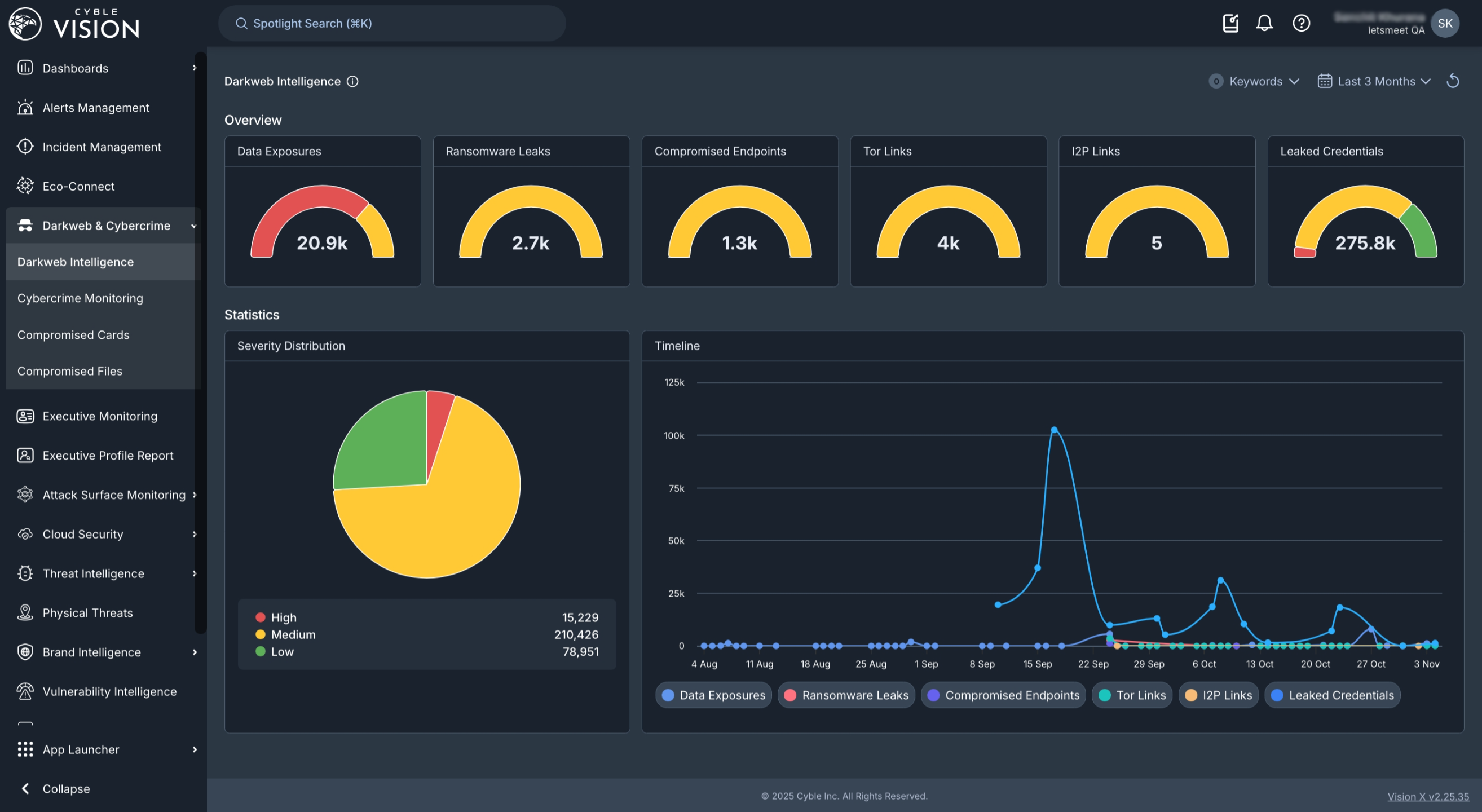
Cyble Vision, Cyble’s flagship platform for dark web monitoring, cyber threat intelligence (CTI), and digital risk protection (DRP), runs entity resolution before an alert is generated. The platform’s AI-native architecture, built on Blaze AI, determines whether a mention actually refers to the customer’s organization at the collection layer, including across languages and obfuscated spellings. Relevance scoring runs against the customer’s specific attack surface: domains, subsidiaries, executives, and technology stack. Mentions that do not refer to your organization are filtered before they become alerts.
Cyble reports a 95% signal-to-noise ratio from internal telemetry, and the platform supports 20+ languages, including multilingual natural language processing (NLP) collection covering Russian and Arabic. These languages dominate the forums where credential trading and initial access brokering are concentrated.
Cyble Vision integrates with 70+ enterprise platforms, including Splunk, Microsoft Sentinel, IBM QRadar, Cortex XSOAR, and ServiceNow, via native connectors and REST APIs. Because alerts are enriched and resolved before they leave the platform, they arrive in the team’s existing workflow already case-ready: resolved to the right entity and scored for severity. The triage decision becomes faster even when a finding turns out not to be material.
Cyble does not claim to eliminate false positives. The claim is that entity resolution at the collection layer changes the ratio, and that a 95% signal-to-noise ratio creates a different operational reality than a feed that analysts have started to ignore.
For a full comparison of how Cyble positions against alternatives, see the Cyble comparison hub.
Disclaimer: Results depend on the customer’s environment, asset scope, and configuration. Statistics cited as Cyble internal telemetry reflect production deployments and should be validated against your specific environment. Capabilities and coverage vary by subscription tier and region.
Frequently Asked Questions
Below are answers to common questions about dark web monitoring false positives and triage.
What is a false positive in dark web monitoring?
A false positive in dark web monitoring is an alert that does not refer to your organization at all. It occurs when a keyword matches a common name, a generic brand string, or an obfuscated reference that has nothing to do with your assets. The alert is technically generated by the platform’s detection logic, but the underlying data has no connection to your organization. False positives are distinct from stale exposures, which are real alerts about credentials or assets that have since been rotated or remediated, and from duplicates, which are multiple alerts about the same underlying exposure from different sources.
Is a stale credential a false positive?
A stale credential is a stale exposure rather than a false positive. The alert was accurate when it was generated because the credential was genuinely exposed, but the credential has since been rotated or the account has been deactivated. Treating it as a false positive erodes trust in the feed and hides useful information about your historical attack surface and rotation cadence. Stale exposures should be logged separately, reviewed for patterns, and used to inform rotation policy.
Can I reduce false positives without missing threats?
Security teams can reduce false positives without missing threats, but keyword narrowing alone will not achieve that outcome. Keyword suppression reduces recall alongside noise and creates blind spots where genuine exposures go undetected. The structural fix is entity resolution at the collection layer, so mentions that do not refer to your organization are filtered before they become alerts. When tuning is necessary, scope exclusions to specific entities rather than whole terms, assign an owner and review date to every suppression rule, and investigate any significant drop in alert volume after tuning instead of treating it as an automatic success.
How do I measure dark web monitoring accuracy?
Track precision and recall together. Precision is the share of alerts that are genuine, the proportion of fired alerts that represent a real exposure relevant to your organization. Recall is the share of genuine exposures that generated an alert, the proportion of real threats the platform detected. As discussed in the precision and recall section, a tool reporting zero false positives may be under-detecting or suppressing too much rather than accurately filtering. A tool that flags almost nothing achieves high precision and useless recall. Ask vendors to provide both figures from production deployments rather than controlled benchmarks, and ask specifically how duplicates are collapsed and how stale exposures are distinguished from live ones before the alert is generated.
What should I do when analysts start ignoring the dark web monitoring feed?
Analyst disengagement from a monitoring feed signals that the false positive rate has crossed a threshold where the cost of reviewing alerts exceeds the perceived value of the findings. The immediate step is to apply the four-category taxonomy, false positive, stale exposure, duplicate, genuine, to a representative sample of recent alerts to identify where the noise is concentrated. If the majority of alerts are duplicates or stale exposures, the problem sits at the collection and deduplication layer. If the majority are false positives, the problem lies in entity resolution. In both cases, the fix is architectural. Downstream filtering and keyword narrowing reduce recall without addressing the root cause. The longer-term question for your vendor is where in the pipeline entity resolution runs, at collection before an alert is created, or at the presentation layer after the analyst has already seen the noise.