

Key Takeaways For Financial Institutions
-
EDR continuously monitors endpoint activity and retains telemetry for investigation, and it is distinct from external dispute resolution in financial services contexts.
-
Financial institutions face rising ransomware attacks and regulatory mandates from FFIEC, GLBA, PCI DSS, SEC/FINRA, and DORA that require documented evidence of continuous monitoring and response.
-
EDR maps directly to examiner expectations for behavioral detection, automated containment, forensic preservation, privileged-user monitoring, and compliance reporting.
-
EDR cannot see external threats such as credentials for sale on dark web markets or initial access broker listings, which creates a structural gap that requires external threat intelligence.
-
Cyble closes this external gap with AI-native solutions that correlate endpoint alerts with external exposure.
Why EDR Became A Financial-Services Obligation
The attack surface facing banks, credit unions, insurers, and fintechs has expanded faster than most security stacks were designed to handle. Credential exposure, phishing activity, third-party risk, analyst overload, and regulatory pressure now affect security operations, risk and compliance, fraud, IT, and leadership simultaneously.
The volume of attacks confirms the pressure is structural and will not ease on its own. Moreover, the regulatory pressure is concrete. The Digital Operational Resilience Act (DORA), in force since January 2025, requires continuous monitoring of ICT systems and robust logging to detect anomalous activity.
See what external exposure exists in your environment — request a demo before your next examination.
Capability-To-Control Mapping: What EDR Produces For An Examiner
Examiners do not ask whether you own EDR; they ask which control each EDR function satisfies and what evidence it produces. The table below maps each EDR capability to the specific FFIEC, GLBA, PCI DSS, SEC/FINRA, and DORA obligation it addresses, so you can see where your evidence is strong and where it is missing.
|
EDR Function |
FFIEC / GLBA Expectation |
PCI DSS / SEC / FINRA / DORA Obligation |
Evidence Produced For Examiner |
|---|---|---|---|
|
Continuous Monitoring And Log Retention |
FFIEC expects centralized log collection, protected storage, and documented review processes; GLBA 16 CFR 314.4(d) requires continuous monitoring or periodic penetration testing |
PCI DSS requires log retention; DORA requires continuous monitoring of ICT systems and robust logging |
Alert review records, log retention policies, Security Information and Event Management (SIEM) ingestion logs showing EDR telemetry |
|
Behavioral Detection Beyond Signature-Based Antivirus |
FFIEC expects threat detection controls including log monitoring and alerting |
Detection alerts showing behavioral anomalies, not just signature matches |
|
|
Automated Containment And Isolation |
FFIEC expects corrective controls including account lockout and incident response |
DORA requires containment capabilities; PCI DSS requires incident response procedures |
Containment action logs, isolation timestamps, response playbook execution records |
|
Forensic Evidence Capture And Preservation |
FFIEC expects evidence retention and examiner readiness |
SEC/FINRA require recordkeeping; DORA requires evidence for governance and testing |
Process trees, memory captures, timeline reconstructions, chain-of-custody documentation |
|
Privileged-User Monitoring |
GLBA 16 CFR 314.4(c)(8) requires monitoring authorized user activity; FFIEC expects user activity monitoring and alerting |
DORA requires monitoring of privileged access; PCI DSS requires access control monitoring |
Privileged session logs, alert records for anomalous admin activity, access review documentation |
|
Compliance Reporting And Audit Evidence |
FFIEC expects alert review records, scan results, and remediation tracking |
Board reports, incident timelines, remediation tracking, audit-ready dashboards |
One precision point the table cannot capture: endpoint telemetry alone does not satisfy the external monitoring obligation. Credentials for sale on a dark web market, an initial access broker (a criminal specialist who breaks in and resells that access rather than attacking further) listing a VPN for sale, or a phishing kit being assembled against a bank’s login page all live outside the perimeter, where endpoint telemetry cannot reach them. The table above maps what EDR does satisfy. A later section addresses what it structurally cannot.
Is EDR Better Than Antivirus For Banks?
Antivirus is signature-based prevention at the file level. EDR adds behavioral detection, telemetry retention, and response capability on the endpoint. The operational difference is significant for any institution facing an examiner.
-
Antivirus: Signature-based; file-level scanning; quarantines known malware; no persistent behavioral telemetry; no retrospective investigation.
-
EDR: Behavioral detection; kernel-level telemetry capture; process trees, registry changes, network connections; remote containment actions; retrospective hunting across stored telemetry.
For a bank, antivirus alone cannot satisfy FFIEC expectations for continuous monitoring and alert review. EDR produces the event-level evidence those controls require. The practical question for a governance, risk and compliance (GRC) lead is whether the deployment is configured to generate the audit artifacts an examiner will ask for.
What EDR And XDR Cover In A Financial Stack
Extended detection and response (XDR) extends correlation beyond the endpoint: where EDR sees only endpoint telemetry, XDR ingests network, email, cloud, and identity data and correlates across all of them. The distinction matters when evaluating what a financial institution’s security stack actually covers.
-
EDR: Endpoint-focused; monitors process trees, registry changes, network connections, file system events; retains telemetry for retrospective investigation; response actions limited to the endpoint.
-
XDR: Cross-domain correlation; ingests telemetry from network sensors, email gateways, cloud workloads, and identity infrastructure; unified detections across control layers; response actions span multiple control surfaces.
For a financial institution, EDR is the appropriate baseline. XDR delivers correlation value only when multiple telemetry sources are connected and normalized; organizations running fragmented security stacks may realize limited XDR benefit until underlying integrations are established. That reality makes EDR the practical starting point for environments that have not yet achieved that integration maturity.
How EDR Integrates With A SIEM And SOC
EDR supplies endpoint activity, detections, and response actions to downstream tools, while the SIEM correlates those events with identity, network, email, and cloud data. The security operations center (SOC), the team that monitors the SIEM and investigates triaged events, depends on that integration producing actionable alerts, not raw telemetry requiring hours of manual pivoting.
The FDIC Office of Inspector General’s audit report AUD-26-03, “The FDIC’s Incident Detection And Response Program” (August 31, 2026), found a critical gap. The FDIC’s SIEM did not generate notable events from ingested EDR logs for 45 of 50 adversarial emulated tests — 90 percent — meaning the malicious activity went undetected within the SIEM. The OIG characterized the SIEM’s failure to alert on EDR telemetry as a weakness in monitoring EDR logs, stating the gap left incident detection strategies with incomplete coverage. EDR data was ingested but not effectively converted into alerts, because notable events were generated only from pre-defined correlation searches. Ingestion alone is not detection.
The fix is not more log volume but better enrichment. The alert should arrive already resolved to the right entity and scored for severity, instead of appearing as a raw indicator that forces manual pivoting. The credential post is already linked to the breach it came from, the broker selling access, and the ransomware group known to buy from that broker before an analyst opens the case. That is what “case-ready enrichment” means operationally.
Two common integration patterns exist for EDR-to-SIEM data flow:
-
Syslog/CEF/LEEF forwarding: Simple to configure; limited to what the EDR chooses to include in forwarded events, typically only alerts, detections, and summary process events, not all raw telemetry.
-
API-based integration: Gives the SIEM access to the complete process tree, full command-line arguments, and file hashes; the trade-off is latency, as API-based enrichment happens reactively when the SIEM fires an alert.
The practical approach is a tiered architecture: raw telemetry is stored in the EDR platform’s own data lake for threat hunting and forensic investigation, while only alert events, high-fidelity detections, and enriched summaries are forwarded to the SIEM for correlation. This pattern preserves analytical depth while keeping SIEM costs manageable.
Privileged-User Monitoring And Ransomware Containment
SIEM integration determines whether endpoint telemetry becomes an alert, and the alerts that matter most in a bank concern privileged accounts. Those accounts are the priority target in banking environments. A compromised administrator credential gives an attacker the same access as the person who built the system. EDR’s privileged-user monitoring capability is directly tied to a named regulatory obligation.
GLBA 16 CFR 314.4(c)(8) requires monitoring and logging the activity of authorized users and detecting unauthorized access to, or tampering with, customer information. The FDIC OIG’s August 2026 audit illustrates what happens when that obligation is not operationalized: 2 of 12 (17 percent) involuntarily separated FDIC employees in calendar year 2025 did not have logical access removed or accounts disabled until after their effective separation date. The CISA Interagency Security Committee Guide “Managing Risk Of Adverse/Involuntary Employee Separations” (2024 Edition), cited in the same audit, recommends revoking access within 18 hours for low-risk separations, within 4 hours for moderate-risk separations, and within 1 hour for high-risk separations.
On ransomware containment, automated response tiers define what happens at machine speed when a high-confidence alert fires. The tiers escalate in the degree of human judgment required:
-
Tier 1 (Immediate Isolation): The EDR agent automatically disconnects high-confidence alerts from the network.
-
Tier 2 (Analyst-Initiated Containment): Lower-confidence alerts receive varying isolation degrees, which an analyst reviews before action.
-
Tier 3 (Conditional Containment): Policies apply dynamically based on asset criticality, user role, or business impact.
The speed requirement is not theoretical. The FBI/CISA/HHS advisory on Medusa ransomware (August 19, 2026) reported that Medusa affiliates “leverage newly announced exploits within 24 hours” of public disclosure. Containment that depends on a human reviewing a ticket the next morning leaves that window open.
What EDR Cannot See: The External Gap
Endpoint telemetry cannot see credentials for sale on a dark web market, an initial access broker listing a VPN for sale, or a phishing kit being assembled against a bank’s login page. All of it lives outside the perimeter, where the endpoint has no visibility. This limitation is structural to the tool category rather than a configuration mistake.
The pattern is documented. A regional bank learns of active account takeovers from a public post, while the leaked credentials had already been circulating on Telegram for days. The damage came from response delay, not from the sophistication of the attack. The warning was external, and no internal tool was positioned to see it.
The data on what lives outside the perimeter is specific. Verizon’s 2026 DBIR found that 44% of connection types offered by initial access brokers are VPN credentials, followed by remote desktop applications at 35%. Black Kite’s 2026 Financial Services Cybersecurity Report found that 42.1% of the 140 vendors most concentrated in finance have employee credentials present in stealer logs. CYFIRMA’s Finance Q2 2026 Industry Report found finance ranked 2nd of 14 industries in underground and dark web chatter with 8,721 mentions, 15.88% of all industry-linked chatter.
The solution category that addresses this gap is external threat intelligence and digital risk protection (DRP). It delivers continuous monitoring across the surface, deep, and dark web; entity resolution at ingestion; relevance scoring against the institution’s own domains, subsidiaries, executives, and technology stack; and native managed takedown.
Cyble: Closing The External Gap EDR Cannot Reach
The external gap described above does not close with another endpoint agent, because the data never reaches the endpoint. Closing it requires a platform that monitors the surface, deep, and dark web continuously and correlates what it finds with the endpoint alerts your EDR already produces. Cyble was built for exactly that correlation.
Cyble is an AI-native cybersecurity company built on a single agentic platform, Blaze AI. That platform unifies cyber threat intelligence (CTI), attack surface management (ASM), digital risk protection, endpoint detection and response, cloud security posture management, brand disruption, and cyber risk quantification on one shared data layer.
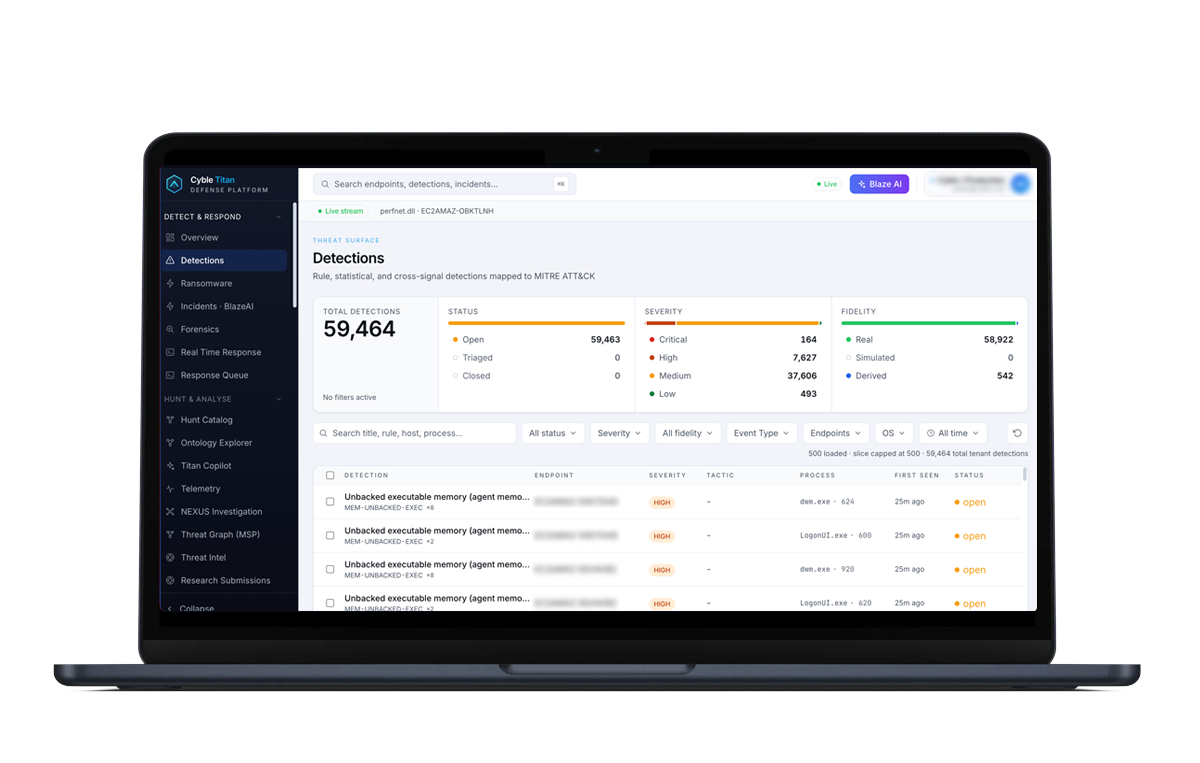
Cyble Titan is the AI-native EDR product directly relevant to this search. Instead of investigating endpoint events in isolation, it correlates each alert with the external credential dump or initial access broker listing that preceded it. An endpoint alert becomes a case that already includes the breach the credentials came from, the broker selling access, and the ransomware group known to buy from that broker before an analyst opens it.
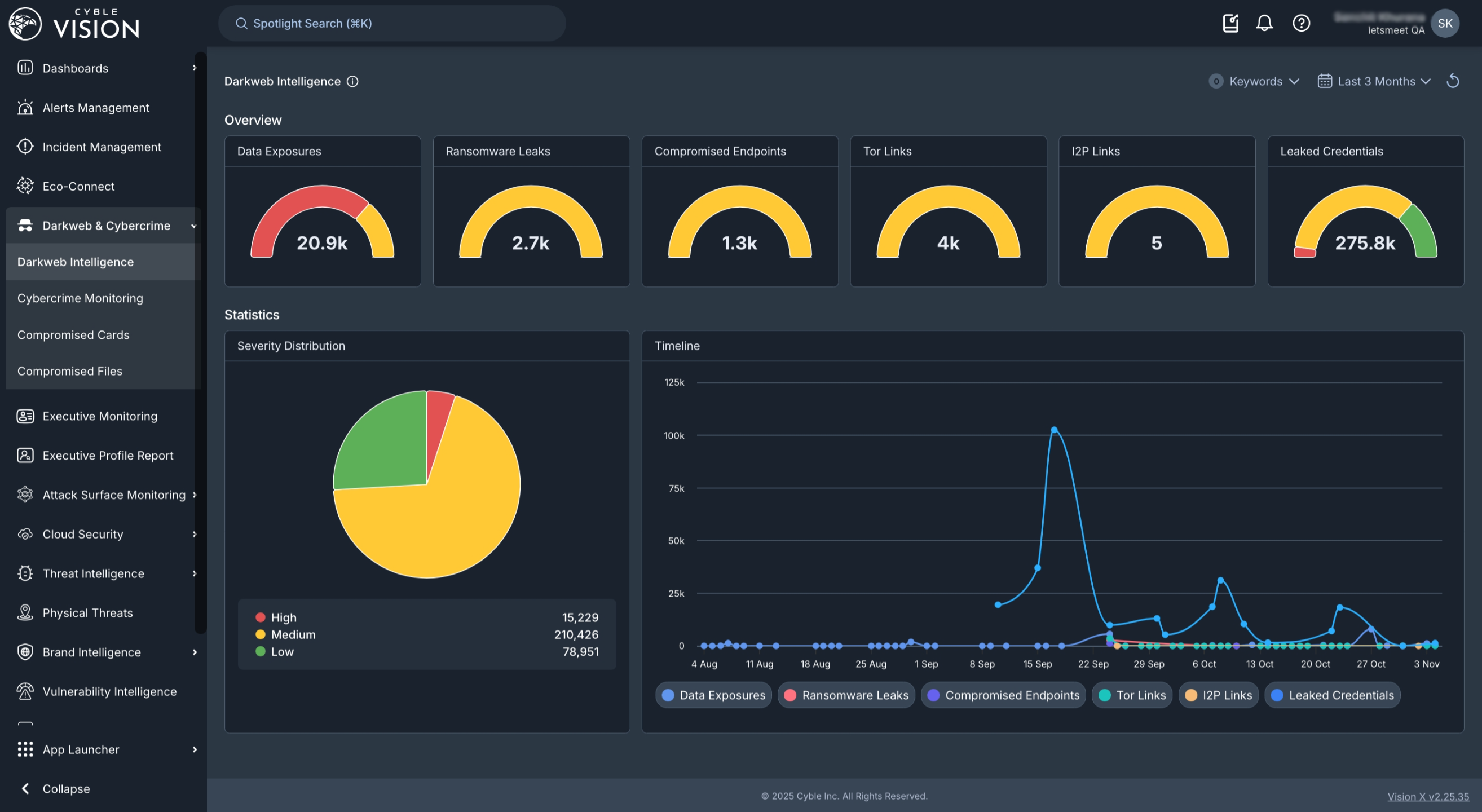
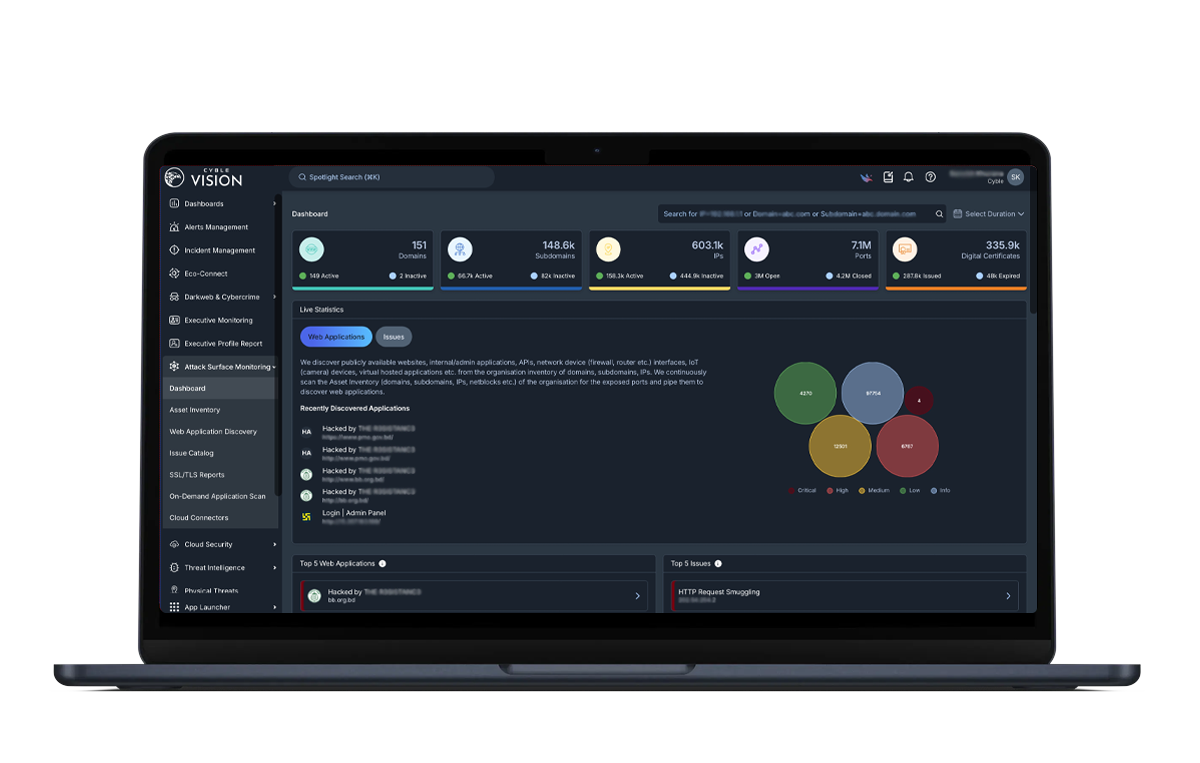
Cyble Vision is the flagship CTI, ASM, and DRP product and the usual entry point into the platform. It scans the surface, deep, and dark web for material relating to the customer: leaked credentials, exposed documents, brand abuse, lookalike domains, ransomware leak site mentions, threat actor chatter, and external attack surface exposure.
Cyble Saratoga applies the FAIR (Factor Analysis of Information Risk) model to live telemetry, translating exposure into financial terms for a board or examiner conversation. The result turns the budget discussion into numbers a CFO recognizes.
Cyble’s published internal telemetry figures include visibility into 15,000+ darknet marketplaces, a reported 95% signal-to-noise ratio, and a reported 98% takedown success rate delivered against service level agreements (SLAs). Those findings reach the SOC through integrations with 70+ enterprise platforms including Splunk, Microsoft Sentinel, IBM QRadar, Cortex XSOAR, and ServiceNow, so they arrive in the workflow the team already uses rather than in another isolated console.
Independent validation reinforces this picture. Third-party recognition includes placement as a Challenger in the 2026 Gartner Magic Quadrant for Cyberthreat Intelligence Technologies (the inaugural Magic Quadrant for this market). Gartner Peer Insights shows a 4.8/5 overall rating based on 49 verified reviews over the 18-month period ending November 30, 2025, and G2 shows a 4.8/5 average with 40 badges across 7 categories in the G2 Spring 2026 report.
Disclaimer: Results depend on the customer’s environment, asset scope, and configuration and should be validated against it. Statistics are drawn from date-stamped Cyble internal telemetry unless otherwise attributed. Capabilities, coverage, and service levels vary by subscription tier and region.
Evaluation Checklist For An EDR RFP At A Financial Institution
The following criteria apply when evaluating EDR or managed detection and response (MDR), the service that operates EDR on behalf of an institution, for a regulated financial environment. No scores or weights are assigned; the relationship between each criterion and your institution’s specific obligations should be assessed against your own risk profile.
-
Which control objectives does the tool produce evidence for, and can you map that evidence to FFIEC, GLBA, PCI DSS, SEC/FINRA, and DORA obligations?
-
Once you have that mapping, can you demonstrate telemetry retention in an audit, or does the evidence expire before the examiner asks for it?
-
How is privileged-user activity monitored, and what alerts fire when an admin account behaves anomalously?
-
How are endpoint alerts enriched before an analyst sees them, or does the analyst receive raw indicators requiring manual pivoting?
-
Is external exposure monitoring included, or is it a separate vendor with a separate contract and a separate integration burden?
-
What is the integration depth with your existing SIEM, security orchestration, automation and response (SOAR), and ticketing stack, and are there native connectors or only community-built plugins?
-
If brand impersonation is in scope, does the vendor offer takedown capability, or do they hand you a report and leave remediation to you?
Frequently Asked Questions
How does EDR differ from antivirus?
Antivirus blocks known malware by signature; EDR watches behavior and keeps the telemetry needed to investigate what happened. For a bank, that difference is the gap between passing an FFIEC examination and failing one, because antivirus generates no process trees, registry changes, network connections, or containment logs for an examiner to review.
Does EDR alone satisfy FFIEC and DORA obligations?
EDR produces evidence for continuous monitoring, behavioral detection, containment, and forensic preservation, and maps to specific FFIEC, GLBA, PCI DSS, SEC/FINRA, and DORA obligations as described in the capability-to-control table above. It does not satisfy the external monitoring obligation. Credentials for sale on a dark web market, initial access broker listings, and phishing infrastructure assembly occur outside the perimeter and are invisible to endpoint telemetry. DORA, in force since January 2025, requires continuous monitoring of ICT systems and robust logging, and also expects institutions to demonstrate that detection, response, and testing processes are evidenced and auditable across the full threat surface, not only the endpoint.
How does EDR integrate with a SIEM and SOC?
EDR supplies endpoint activity, detections, and response actions to downstream tools, while the SIEM correlates those events with identity, network, email, and cloud data. As the FDIC OIG audit discussed above showed, ingestion alone is not detection. Effective integration requires deliberate use-case design: defining which telemetry to forward, how to enrich alerts, and which correlation rules to build, instead of accepting default syslog forwarding and assuming the SIEM will do the rest.
Is Microsoft Defender an EDR?
Microsoft Defender for Endpoint includes EDR capabilities such as behavioral detection, telemetry retention, and response actions. Whether it meets your regulatory evidence requirements depends on your configuration, retention settings, and integration with your SIEM and SOC workflows. The tool’s presence in the environment is not the same as the tool producing examiner-ready evidence, and the integration gap the FDIC OIG identified applies regardless of which EDR vendor is deployed.
How do I evaluate EDR versus MDR for a community financial institution?
EDR is the tool, and MDR is the service that operates it. If you lack 24/7 in-house analyst coverage, MDR provides detection and response capability without building the headcount for it. Evaluate whether the MDR provider enriches alerts before they reach your team, whether they integrate with your existing SIEM and ticketing stack through native connectors rather than community-built plugins, and whether their reporting produces the audit artifacts your examiner will ask for, not just a dashboard that looks complete.
Conclusion: Endpoint Detection And External Visibility In Examinations
EDR satisfies part of the regulatory obligation and leaves the external-visibility obligation unaddressed. It produces the event-level evidence that FFIEC, GLBA, PCI DSS, SEC/FINRA, and DORA examiners expect for continuous monitoring, behavioral detection, containment, privileged-user monitoring, and forensic preservation. It cannot see the external threats described above, because all of that activity lives outside the perimeter.
When evaluating options, the criteria that matter are capability-to-control mapping, telemetry retention, privileged-user monitoring, alert enrichment, external exposure monitoring, integration depth, and takedown capability. An institution that can demonstrate all seven to an examiner has built a defensible program. An institution that can demonstrate only the first four has a gap its regulator will eventually identify.
Cyble Titan correlates endpoint alerts with the external credential dump or access broker listing that preceded them. Cyble Vision closes the gap EDR structurally cannot see by monitoring across the surface, deep, and dark web, with entity resolution, relevance scoring, and native managed takedown in one platform.
See the full picture before your examiner does — request a demo of Cyble Titan and Cyble Vision.