

Key Takeaways
-
Executive dark web monitoring runs as a separate program from general dark web monitoring and focuses on named individuals’ personal and professional identifiers across surface, deep, and dark web sources.
-
The program should cover five threat categories: leaked credentials, exposed personally identifiable information (PII), impersonation and deepfakes, doxxing and physical safety risks, and adversarial chatter naming executives.
-
Success depends on a scoped protected-executive list, documented consent for each identifier, and a written internal monitoring policy with clear alert routing.
-
Alert ownership should be divided between the security operations center (SOC) for credential findings, corporate security for impersonation and doxxing, and the executive’s chief of staff for behavioral changes, with documented escalation paths.
-
Cyble combines executive protection monitoring, dark web monitoring, and managed takedown on a single platform to deliver coordinated detection and response.
See how Cyble protects your executives
What Executive Monitoring on the Dark Web Actually Covers
General dark web monitoring watches organizational exposure, such as leaked customer records, corporate credentials, and brand abuse. Executive monitoring focuses on named individuals. The threat surface, identifiers, and escalation paths differ, and the route often runs through physical security as well as the security operations center (SOC).
The five categories an executive dark web monitoring program should cover are:
-
Leaked corporate and personal credentials, including email and password pairs from breach databases, infostealer logs, and dark web markets tied to the executive’s work and personal accounts
-
Exposed personally identifiable information (PII), such as home address, personal phone number, family names, and other identifiers circulating on data broker sites, paste sites, or dark web forums
-
Impersonation accounts and synthetic-media deepfakes, including social media profiles, fake domains, and artificial intelligence (AI) generated audio or video designed to impersonate the executive
-
Doxxing and physical-safety risk, including aggregated personal profiles that expose the executive’s location, schedule, or household details
-
Adversarial chatter naming the executive, including threat actor discussions on closed forums, Telegram channels, and ransomware leak sites that reference the executive by name or role
Two of those categories, impersonation and adversarial chatter, are growing fastest. Documented incidents include a near-miss at Ferrari where an AI-cloned voice of the chief executive officer (CEO) was defeated only by a personal verification question.
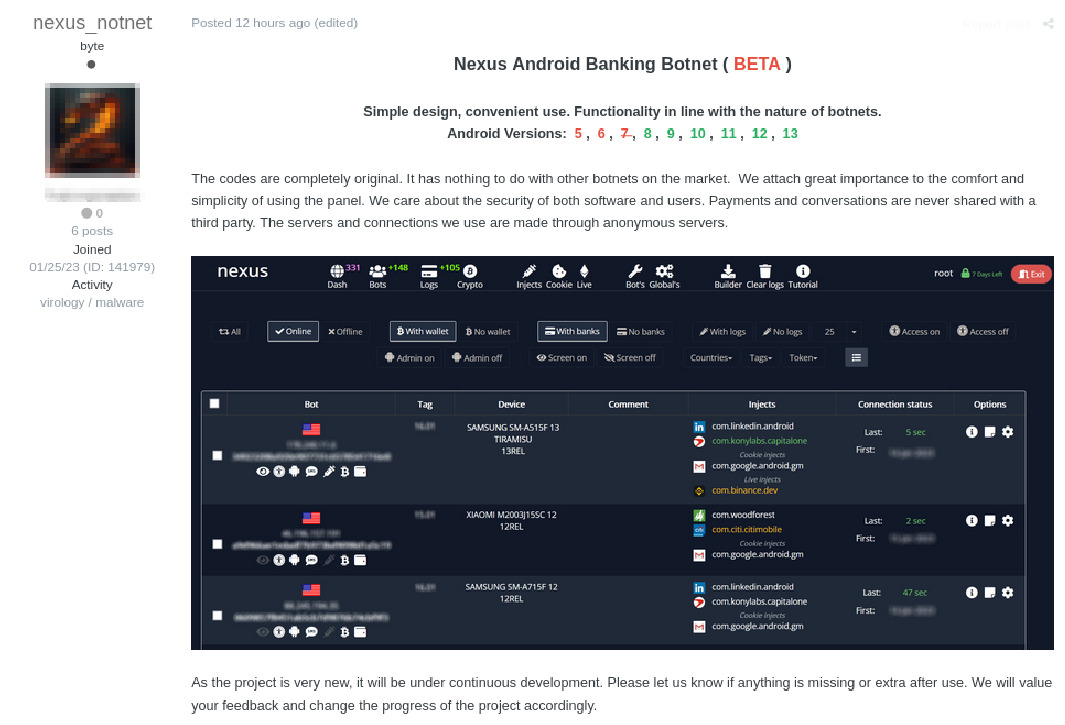
The reconnaissance techniques that precede executive targeting appear in the MITRE ATT&CK framework. T1589 (Gather Victim Identity Information) covers harvesting employee names, email addresses, and credentials from public breach repositories and dark web sources. T1596 (Search Open Technical Databases) covers attacker use of open registries and certificate transparency logs to map an organization’s exposure. Both techniques are passive and generate no log events inside the target organization at collection time. External monitoring fills that blind spot.
Disclaimer: Results depend on the customer’s environment, asset scope, and configuration and should be validated against it. Capabilities, coverage, and service levels vary by subscription tier and region.
See what Cyble finds in your environment
How to Scope a Protected-Executive List
Only a subset of employees should receive executive dark web monitoring. The protected-executive list should reflect threat exposure rather than organizational chart position alone.
Roles that typically qualify include:
-
Board members and independent directors
-
C-suite executives, including the CEO, chief financial officer (CFO), chief information officer (CIO), chief information security officer (CISO), general counsel, and equivalents
-
High-profile individual contributors, such as founders, spokespeople, and public-facing researchers
-
Executives in regulated or consumer-facing roles whose compromise would trigger a disclosure obligation or a fraud event
The program should document several decision points before launch:
-
Who approves the list. Typically the CISO or head of corporate security approves the list, with sign-off from legal and human resources (HR).
-
How executives are added and removed. Role changes, departures, and new appointments should trigger a defined review rather than an ad hoc conversation.
-
How to handle executives who decline monitoring. Declining remains a legitimate choice. The program should document the declination and its implications without coercing participation.
-
How to treat family members and household identifiers. Family members are frequently targeted because they present a lower-security path to the executive. Including them requires separate consent and a separate briefing.
Those four decision points all come down to one trade-off. A broader list catches more exposure but creates more privacy obligations and more alert volume. Scope the list to roles where compromise has a material organizational consequence, and review it at least quarterly.
What Identifiers You Should Monitor for Each Executive
A concrete, checkable identifier set per executive forms the operational foundation of the program. Without that list, monitoring drifts and the documented legal basis loses meaning.
The identifier set for each executive should include:
-
Corporate email address
-
Personal email addresses, including legacy accounts
-
Personal phone numbers
-
Home address
-
Known aliases and usernames
-
Social media handles across all active platforms
-
Family member names where family monitoring is in scope
-
Prior breach exposure, including accounts confirmed in historical breach databases
Each identifier maps to a different finding type. Personal email and phone numbers surface credential exposure and account takeover risk. Home address and family names surface doxxing and physical-safety escalation. Social handles surface impersonation accounts.
Identifier collection requires executive cooperation and a documented legal basis. In the United States, that basis is typically notice at collection plus consent. In the European Union and the United Kingdom, consent is rarely valid in the employment relationship, so the program relies on legitimate interest instead. The privacy section below covers both models. Without a documented basis, the program cannot legally operate in most jurisdictions.
How to Set Up an Internal Monitoring Policy for Leadership
A written internal monitoring policy turns a monitoring tool into a defensible program. The policy should answer seven questions before the first alert fires.
-
Define the protected-executive list and review cadence. Name the roles that qualify, the approval authority, and the schedule. Without a fixed review, the list drifts as roles change and people leave. Quarterly review is the minimum for a dynamic organization.
-
Document the identifier set per executive and the legal basis for monitoring it. Each executive signs off on the specific identifiers being monitored where consent is the applicable basis, and the team records the legitimate-interest assessment where it is not. The team retains the record and updates it when identifiers change.
-
Assign a monitoring owner and a backup. A named individual remains accountable for the program, and a backup preserves continuity. Shared ownership often results in no ownership.
-
Define alert severity tiers and what each tier triggers. A leaked credential for a privileged account and a data broker listing with a home address carry different severities and require different response actions. Each tier should have a defined response and a maximum response window.
-
Define the escalation path from digital finding to physical security or the executive’s office. A doxxing event or a credible physical threat requires a different escalation chain than a credential exposure. Both chains should be documented before an incident occurs.
-
Set a review cadence for the policy itself. Quarterly or semi-annual reviews keep the policy aligned with a changing threat environment.
-
Document the privacy constraints and data-handling rules. Specify who can access executive personal data, how long the team retains it, and what happens to it when an executive leaves the protected list.
Review your policy with Cyble experts
Who Owns the Alert: SOC, Corporate Security, or the Executive’s Chief of Staff
Alert routing often becomes the point of failure. Three functions share ownership, and written boundaries keep handoffs clear.
The SOC owns credential and technical findings, including leaked passwords, compromised accounts, infostealer logs, and any finding that requires a technical response such as a forced password reset or step-up authentication. The SOC’s response velocity and tooling fit this category.
Corporate security owns impersonation, doxxing, and physical-safety escalation. When a finding shows that an executive’s home address has been published, that a threatening post names the executive, or that a coordinated targeting campaign is underway, the response requires physical security judgment that the SOC does not provide.
The executive’s chief of staff owns executive-facing communication and scheduling changes. When a finding requires the executive to change behavior, such as canceling a public appearance, varying a travel route, or receiving a briefing on an active threat, the chief of staff serves as the appropriate communication channel. Routing that communication through the SOC or corporate security without involving the chief of staff creates delays and gaps.
Ownership is only half the routing problem. The other half is severity, because the same finding type can require different response speeds depending on what was exposed. That scenario is a SOC-owned, high-urgency finding. A new data broker listing with a home address is a corporate security finding that may not require the same response velocity but still requires a named owner and a defined response window.
The organization also needs to choose between centralized and distributed ownership. A centralized model reduces handoff errors but can slow response when the central owner is unavailable. A distributed model moves faster but requires clearer written boundaries to prevent gaps.
The Privacy and Legal Constraints of Monitoring an Individual’s Personal Data
Monitoring an executive’s personal identifiers, such as home address, personal email, and family names, differs legally from monitoring corporate systems. Jurisdiction-specific constraints should be addressed before the program launches, and the legal basis differs by jurisdiction.
United States (California as the default). The California Consumer Privacy Act (CCPA) and California Privacy Rights Act (CPRA) require notice at collection before or at the point of collection. That notice must specify the categories of personal information collected, the purpose for each category, and the retention period. Purpose limitation restricts the use of monitoring data to what the notice disclosed, so data collected for security monitoring cannot be repurposed for unrelated HR use. Data minimization requires limiting collection to what is reasonably necessary and proportionate to the stated purpose. Monitoring involving sensitive personal information, such as a home address or family identifiers, should remain limited to what is strictly necessary, subject to additional safeguards and access restrictions, and accompanied by appropriate notices tied to a clearly disclosed security purpose.
European Union and United Kingdom. Under the European Union (EU) General Data Protection Regulation (GDPR), the power imbalance between employer and employee means consent is almost never a valid legal basis for monitoring. Legitimate interest under Article 6(1)(f) is the predominant basis. It requires a documented three-part test: purpose, necessity, and a balancing test that weighs employer interests against employee privacy rights. The United Kingdom (UK) Information Commissioner’s Office (ICO) guidance on monitoring workers requires that any monitoring be based on a documented purpose, rely on a lawful basis, and satisfy the data protection principles of necessity and proportionality. For UK and EU programs, substitute GDPR, the Network and Information Security Directive 2 (NIS2), or the Digital Operational Resilience Act (DORA) as the applicable regulatory reference.
Across all jurisdictions, four controls apply regardless of the specific regulatory framework:
-
Documented legal basis, notice at collection and consent where consent is valid, or a documented legitimate-interest assessment where it is not
-
Data minimization, collecting only what the stated security purpose requires
-
Retention limits, defining how long monitoring data is held and enforcing deletion
-
Access controls, restricting who can view executive personal data to named roles with a documented need
Response Playbooks for the Three Most Common Findings
Once the policy and consent framework exist, the program needs a defined response for each finding type. Three findings account for most executive monitoring alerts.
1. Credential Exposure
-
Force a password reset for the affected account immediately.
-
Step up authentication by enforcing multi-factor authentication (MFA) if not already active, or requiring re-enrollment.
-
Check for credential reuse across other services that use the same email and password combination.
-
Trace the source breach to determine whether other organizational credentials were exposed in the same dataset.
2. Impersonation Account or Deepfake
-
Document the impersonation with screenshots, URL, timestamp, and platform.
-
Report to the platform through its abuse reporting mechanism and, where available, through a direct trust-and-safety contact.
-
Notify the executive’s office so the executive is aware and can avoid actions that would amplify the impersonation.
-
Prepare customer-facing communication if the impersonation targets customers or partners, because silence can leave customers exposed to active deception.
3. Doxxing or Physical Threat
-
Escalate immediately to physical security and, where the threat is credible and specific, to law enforcement.
-
Preserve evidence before any takedown or removal action, including screenshots, URLs, timestamps, and any associated account identifiers.
-
Coordinate with the executive’s office to brief the executive and adjust any public-facing schedule or travel plans.
How to Measure Whether the Program Is Working
A defensible program tracks outcomes that can be compared across periods and used to justify continued investment. “Nothing happened” does not qualify.
Recommended metrics:
-
Time to detect, the interval between a finding appearing in the wild and the program generating an alert
-
Time to respond, the interval between alert generation and a defined response action
-
Alert quality (signal-to-noise ratio), the proportion of alerts that represent genuine findings relevant to a named executive versus noise
-
Reduction in externally sourced discoveries, findings the team learned about from a journalist, regulator, customer, or executive rather than from the monitoring program itself
-
Takedown completion, the proportion of impersonation accounts, doxxing posts, and leaked data items that were successfully removed within the defined service level
-
Review-cadence adherence, whether the policy review, identifier refresh, and protected-executive list review are happening on schedule
-
Re-exposure rate, the proportion of removed items that reappear within ninety days
A re-exposure rate above 15% within 90 days signals inadequate monitoring frequency. Establish a baseline in the first ninety days of the program and compare against it at each quarterly review.
How Cyble Fits
Cyble unifies executive protection monitoring, dark web monitoring, and managed takedown on one data layer, so a digital finding and a security finding resolve as the same incident rather than two disconnected alerts routed to separate vendors.
Cyble’s executive protection monitoring covers executive deepfakes, identity theft, exposed personal data, compromised credentials, and threatening public mentions. The platform monitors the surface, deep, and dark web continuously. Its coverage spans more than 15,000 darknet marketplaces, and Cyble reports a 95% signal-to-noise ratio (Cyble internal telemetry). Entity resolution runs at ingestion, so a mention of an executive in an obfuscated or cross-language post is resolved to the correct individual before it becomes an alert.
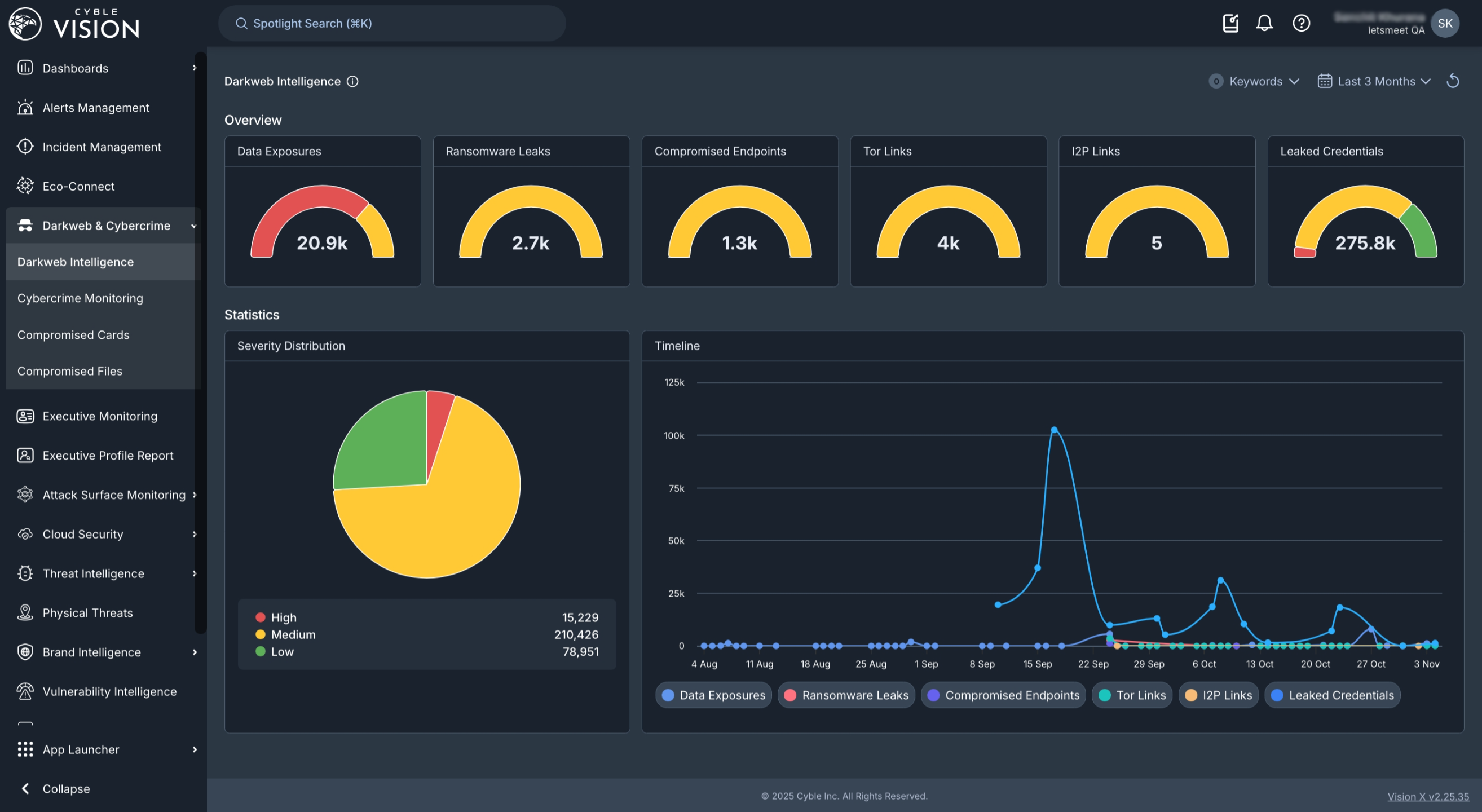
Native managed takedown runs on the same platform that generates the alert. Detection and removal happen on the same platform, delivered against service level agreements (SLAs) with a reported 98% takedown success rate (Cyble internal telemetry). When a doxxing post, impersonation account, or leaked credential set appears, the removal process begins from the same console that surfaced the finding.
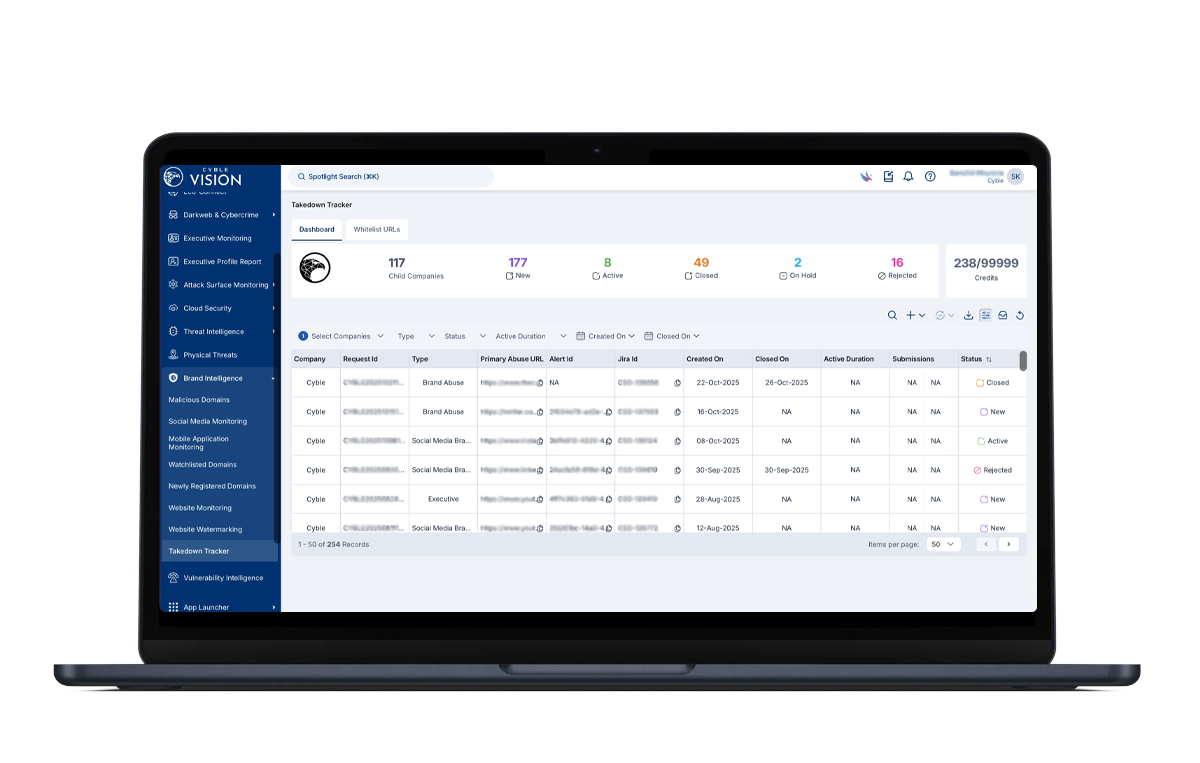
Cyble Vision is the usual entry point for enterprise security teams. Cyble Hawk serves law enforcement, government, and federal audiences, with adversary profiling and human intelligence (HUMINT) alongside automated collection. Capabilities vary by subscription tier and region.
Disclaimer: Statistics are drawn from date-stamped Cyble internal telemetry unless otherwise attributed. Capabilities, coverage, and service levels vary by subscription tier and region. Results depend on the customer’s environment, asset scope, and configuration and should be validated against it.
Explore Cyble’s executive monitoring in a demo
Frequently Asked Questions (FAQ)
What is the best dark web monitoring for executives?
The strongest program is scoped to named executives, built on a documented identifier set with consent, routed to a named owner, and measured against defined metrics. A tool that generates alerts without a scoping framework, a routing model, and a response playbook functions as a feed rather than a program. Cyble delivers that unified model on one platform.
How much does dark web monitoring cost per executive?
Pricing models vary, including per-executive, per-identifier, and platform-tier approaches. Costs depend on the size of the protected-executive list, the identifier set per executive, and the service tier selected. Programs that include managed takedown, family coverage, and SOC integration follow different cost structures than basic alerting services. The right starting point is a scoping conversation that establishes the protected population and the identifier set before pricing.
What do I need in place before starting an executive monitoring program?
The four prerequisites are the scoped protected-executive list, the consented identifier set, the named owner and backup, and the escalation path. These elements appear in the scoping and policy sections above. Without them, the program generates alerts that nobody owns.
How long does it take to stand up an executive dark web monitoring program?
Scoping and consent usually take several weeks, depending on the size of the protected-executive list and the complexity of the consent process, particularly where family members are in scope. Policy documentation adds more time, especially where legal and privacy review are required. The first full review cycle, where the program’s metrics are compared against the baseline, typically lands at the quarterly mark.
Who should own the program internally?
Ownership is distributed across three functions with defined boundaries. The SOC owns credential and technical findings, including leaked passwords, compromised accounts, and infostealer logs, and handles the technical response. Corporate security owns impersonation, doxxing, and physical-safety escalation, and coordinates with law enforcement and physical security teams. The executive’s chief of staff owns executive-facing communication and scheduling changes. A written routing model that defines which finding type goes to which function, with a named owner for each, prevents gaps.
How do I measure whether the program is working?
The seven core metrics are time to detect, time to respond, alert quality, reduction in externally sourced discoveries, takedown completion, review-cadence adherence, and re-exposure rate. Establish a baseline in the first ninety days and compare against it at each quarterly review.
What are the regulatory considerations?
In the United States, the CCPA and CPRA require notice at collection, purpose limitation, and data minimization, as described in the privacy section above. In the European Union, GDPR legitimate interest under Article 6(1)(f) is the predominant legal basis and requires a documented three-part test. Consent rarely works as a basis in the employment relationship because of the power imbalance. For UK and EU programs, GDPR, NIS2, or DORA apply as the relevant regulatory framework. Across all jurisdictions, access controls, retention limits, and a documented legal basis remain essential.
Can I monitor an executive’s family members?
Family members and household identifiers often fall in scope because attackers use them as a lower-security path to the executive through SIM-swapping, social engineering, or doxxing that exposes household routines. Including family members requires a separate legal basis for each individual covered, a separate briefing on what personal information is reviewed and what protections govern that data, and a documented decision on which family identifiers are in scope. Where consent is the applicable basis, each family member provides it individually. Where legitimate interest applies, the program documents a separate assessment for that person. Family monitoring should operate as a distinct program element with its own records and access controls.
See how Cyble handles family coverage
Conclusion: Building a Defensible Executive Monitoring Program
Executives face targeted threats that reach beyond corporate systems into personal identifiers and household exposure. General dark web monitoring watches organizational exposure, while executive monitoring focuses on named individuals and their families.
A defensible executive dark web monitoring program rests on three pillars: a scoped list of protected executives, a consented identifier set, and a written routing model that names an owner for every finding type. Policy, privacy guardrails, response playbooks, and metrics keep those pillars current and auditable over time.
That unified model is what Cyble delivers, combining monitoring and takedown on a single platform so detection and removal stay tightly linked.
Talk to Cyble about your executive monitoring strategy