
Key Takeaways
-
Lookalike domains such as typosquatting, homograph attacks, combosquatting, and alternative top-level domains (TLDs) create immediate credential theft and fraud risk when they stay live.
-
Effective detection relies on continuous monitoring across certificate transparency logs, newly registered domains, and live web signals, not one-time scans.
-
Successful takedowns depend on complete, timestamped evidence packages that registrars and hosts can verify without delay.
-
A repeatable seven-step workflow for verification, evidence capture, registrar and host complaints, browser blacklisting, escalation, Uniform Domain-Name Dispute-Resolution Policy (UDRP) when needed, and post-takedown monitoring prevents stalled removals.
-
Cyble delivers managed lookalike domain detection and takedown at scale with a 98% success rate and integration into enterprise security platforms.
See how Cyble protects your brand from lookalike domains
Lookalike Domain Types And Why Each One Changes Your Response
Lookalike domains fall into four primary types, and each type drives a different urgency level and enforcement path.
-
Typosquatting registers a misspelling of a brand’s domain through a transposed letter, omitted character, or adjacent-key substitution. Example pattern:
exmaple.comforexample.com. Urgency is high when a login form is present. The enforcement path usually runs through a registrar abuse report. -
Homograph attacks use visually similar characters from non-Latin scripts to imitate a domain, such as substituting a Cyrillic “а” for the Latin “a.” The Cyrillic alphabet contains eleven lowercase characters visually identical or nearly identical to Latin counterparts, so visual inspection alone cannot keep users safe. Urgency is high, and the enforcement path requires automated detection that reads the underlying character encoding.
-
Combosquatting adds words to a brand name in a domain, such as
brand-login.comorsecure-brand.net. Combosquatting variants now outnumber pure typosquatting registrations in active phishing campaigns, according to Zscaler research. Urgency is high when attackers pair the domain with a credential-harvesting page. The enforcement path usually runs through the registrar or hosting provider. -
Alternative TLD registrations reuse the same name under a different TLD, such as
brand.coorbrand.shopforbrand.com. Urgency varies based on whether the domain is parked or actively serving content. The enforcement path depends on that usage.
How To Detect Lookalike Domains With Free Tools And Techniques
Effective lookalike domain monitoring starts with the right tools and a clear view of their blind spots. Four approaches are named consistently across practitioner guidance, and each has meaningful limitations.
-
dnstwist focuses on permutation-based discovery. It generates typo, homoglyph, TLD-swap, and hyphenation permutations and checks which are registered, returning a list of candidate domains with registration status. It misses combosquatting variants where the brand name is spelled correctly and misses subdomain spoofing entirely.
-
crt.sh and certificate transparency logs provide public records of every Transport Layer Security (TLS) certificate issued. Certificate issuance is publicly logged, often days before the first victim sees the page, so the certificate itself becomes an early warning. The method’s blind spot is domains that never obtain a certificate.
-
WHOIS lookups and Registration Data Access Protocol (RDAP) expose the public registry record for a domain, returning registrar, registration date, and nameservers. ICANN replaced WHOIS with RDAP as the definitive source for generic TLD registration data on January 28, 2025. Public RDAP results may still identify the registrar, registration dates, and name servers even when privacy restrictions withhold registrant details.
-
Search-engine and app-store monitoring catches live impersonation that permutation tools miss, including subdomain spoofing and fake mobile apps.
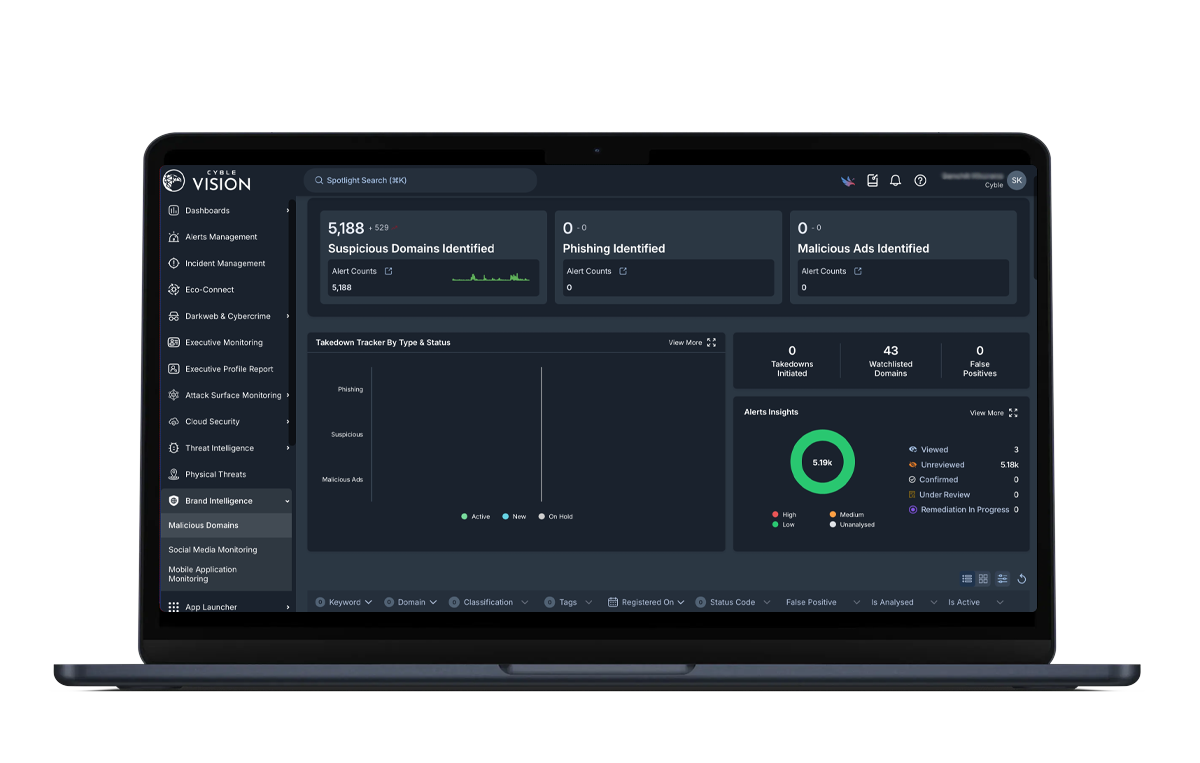
Free typosquatting detection tools provide point-in-time visibility. A domain registered after your last scan will not appear. The single most valuable signal in lookalike domain detection is change over time: a dormant lookalike that suddenly gains a certificate, an MX record, and a login page is almost always about to be used in an attack. Continuous monitoring is the operational standard; a weekly manual sweep will miss domains registered between scans.
See how Cyble detects lookalike domains in your environment
Evidence Registrars Need Before They Act On Abuse Reports
Strong evidence separates a successful takedown from a rejected one. Abuse desks often reject reports that are incomplete or vague, so a clean evidence package becomes the single biggest predictor of a fast removal.
Abuse desks act on reports they can verify without follow-up. A complete package therefore needs to answer three questions: is the site live, who controls it, and what harm it is doing. That means including:
-
Timestamped screenshots of the live page, with the browser address bar visible
-
The WHOIS or RDAP record and registrar of record
-
Hosting provider and IP infrastructure
-
Whether the domain resolves and what it serves
-
Whether a login form or payment flow is present
-
Any evidence of brand assets, logos, or trademarks being used
-
The full URL including path and query string
-
The original lure email or message with full headers, where relevant
Capture evidence at detection time, not filing time. Lookalike sites are built to be disposable, and abuse desks act fastest on reports where the harm is provable in one attachment. A screenshot that is three days old when the reviewer opens the ticket gives them nothing to verify and will likely result in the ticket being closed.
Seven-Step Workflow For Lookalike Domain Takedown
The domain takedown process follows a repeatable sequence. Each step builds on the last, and skipping any one of them is a common reason takedowns stall.
-
Confirm the domain is live and malicious. Verify it resolves, check what it serves, and confirm it is not an approved domain owned by your organization, a reseller, or a business partner. A mistaken report can disrupt a legitimate business.
-
Capture the evidence package. Gather timestamped screenshots, WHOIS or RDAP records, hosting details, and any login or payment form. Preserve this material before notifying anyone, because pages and Domain Name System (DNS) records can change.
-
File a registrar abuse report. Identify the registrar through RDAP and use its published abuse channel. Since April 5, 2024, ICANN’s amended Registrar Accreditation Agreement (RAA) requires accredited registrars to act on well-evidenced abuse reports. That change converts registrar responsiveness from a courtesy into a contractual requirement.
-
File a hosting provider complaint in parallel. The hosting provider, meaning the company whose servers the malicious site runs on, can take the page offline even if the domain remains registered. Removing the hosting kills the phishing page fastest, while suspending the domain stops it from coming back at the same address; reporting to both gives the best chance of a quick, durable takedown.
-
Request browser blacklisting. Submit the domain to Google Safe Browsing and Microsoft Defender SmartScreen. Browser-level blocking can activate red-screen warning interstitials across Chrome, Edge, and Safari within six to twenty-four hours of a validated phishing report. That reduction in traffic limits harm while the formal process runs.
-
Escalate to UDRP only when the registrar stalls or the domain is actively harvesting credentials. The Uniform Domain-Name Dispute-Resolution Policy (UDRP) is a formal arbitration process through ICANN-accredited providers. It costs money, takes weeks to months, and is the one route that transfers the domain to the complainant.
-
Verify removal and set up re-registration monitoring. Confirm the domain is down, then watch for a new lookalike appearing within hours or days. A takedown removes a copy, and the attacker often continues making new copies.
When To Use Registrar Abuse Reports Versus UDRP Complaints
The choice between a registrar abuse report and a UDRP complaint depends on your objective and the registrar’s responsiveness.
Registrar abuse reports are free and can move quickly when the registrar cooperates. They fit clear phishing or malware hosting cases. They seek mitigation, typically suspension, and since April 2024, ICANN’s amended generic TLD registrar agreements oblige registrars with actionable evidence of DNS abuse, including phishing, to take prompt mitigation action. Timelines range from a few days to no movement at all, depending on the registrar.
UDRP operates as a formal arbitration process through ICANN-accredited providers such as the World Intellectual Property Organization (WIPO). WIPO’s fee is one thousand five hundred United States dollars for a single-member panel covering one to five domains, and the overall process commonly takes about sixty days from filing to decision. UDRP is worth pursuing when the domain is parked, monetized, or repeatedly re-registered and the registrar will not act, because it is the one route that transfers the domain to the complainant instead of merely suspending it. Ask for transfer instead of cancellation, because a cancelled name returns to the market and can be re-registered within days.
To prevail in a UDRP proceeding, a complainant must prove all three elements under ICANN UDRP Policy paragraph 4(a). The domain must be identical or confusingly similar to a trademark in which the complainant has rights. The registrant must have no rights or legitimate interests in the domain. The domain must have been registered and used in bad faith. Failing on any single element means the domain stays with the registrant.
Escalation Steps When The Registrar Stalls
If the registrar stalls and UDRP is not yet warranted, the case does not have to sit idle. The escalation ladder below moves the complaint up the chain until someone acts.
-
Start by following up on the abuse ticket with the case number and submission date. This follow-up creates the paper trail that later steps depend on.
-
If that produces no response, escalate to the registrar’s compliance or legal contact. Many registrars respond faster when a complaint reaches a formal channel.
-
In parallel, file with the hosting provider directly. If the host is unresponsive, escalate to the upstream transit provider identified through Border Gateway Protocol (BGP) routing tools, and if the provider still does not act, escalate to the Federal Bureau of Investigation’s (FBI) Internet Crime Complaint Center (IC3) or the national Computer Emergency Response Team (CERT) of the hosting country.
-
Request browser and search blacklisting so the domain stops receiving traffic even while it stays registered. Browser blacklisting through Google Safe Browsing and Microsoft Defender SmartScreen is often faster than registrar action and reduces harm while the formal process runs.
-
File an Internet Corporation for Assigned Names and Numbers (ICANN) Contractual Compliance complaint. ICANN’s compliance complaint should be filed only after the registrar has had a reasonable time and failed, and only for a generic domain where the harm was phishing, malware, a botnet, pharming, or spam delivering one of those categories. A documented, unanswered submission is the basis for this escalation.
-
Document every step for a later UDRP filing. A documented, unanswered submission strengthens the bad-faith argument before a UDRP panel.
Additionally, when a host or jurisdiction is unlikely to cooperate, brand teams should combine de-indexing with payment processor disruption by reporting the merchant to payment networks to cut revenue where infrastructure-level takedowns cannot reach.
See how Cyble streamlines escalation and takedown
Post-Takedown Monitoring And The Re-Registration Problem
A takedown removes a copy, and the attacker often continues making new copies. Attackers pre-register domain inventories in coordinated bursts and deliberately concentrate registrations at registrars with documented slow abuse response, so a new lookalike can appear within hours of a successful removal.
Post-takedown monitoring should cover certificate transparency logs, newly registered domain feeds, and app stores continuously. The same change-over-time signal described earlier, a dormant domain suddenly gaining a certificate, an MX record, and a login page, is what makes re-registration detectable. Re-registration strongly supports a managed, always-on approach to lookalike domain monitoring instead of a manual scan triggered only after an incident.
When Manual Takedown Stops Scaling And How Cyble Helps
Manual takedown works for one or two domains. It breaks down when a brand faces dozens of lookalike domains across multiple registrars and jurisdictions, each with its own abuse process, its own evidence standard, and no service-level agreement to hold it to.
Cyble Vision monitors the surface, deep, and dark web for lookalike domains, brand abuse, phishing infrastructure, and impersonation attacks. Because native managed takedown is part of the platform rather than a referral to a third party, detection and removal come from one vendor, which closes the gap between finding a domain and getting it removed. According to Cyble’s published takedown data, Cyble reports a 98% takedown success rate, delivered against service-level agreements.
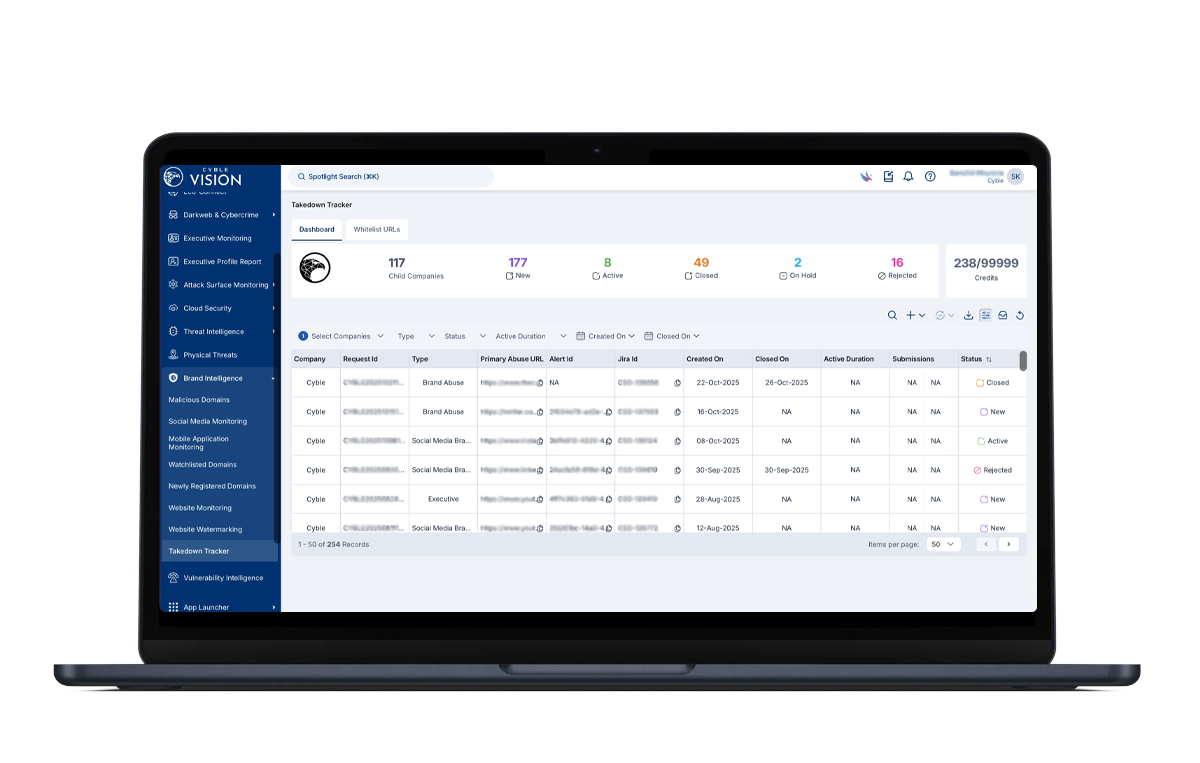
Cyble Vision integrates with 70+ enterprise platforms, including Splunk, Microsoft Sentinel, IBM QRadar, Cortex XSOAR, and ServiceNow. It also supports Representational State Transfer (REST) application programming interfaces (APIs), so findings land in the tools the team already uses instead of another isolated console. Cyble also reports a 95% signal-to-noise ratio and visibility into fifteen thousand-plus darknet marketplaces.
Results depend on the customer’s environment, asset scope, and configuration, and teams should validate outcomes against their own environment. Capabilities, coverage, and service levels vary by subscription tier and region.
For organizations evaluating alternatives, Cyble maintains a comparison hub with current positioning across the vendor landscape.
Explore Cyble’s managed takedown capabilities
Frequently Asked Questions
How long does a lookalike domain takedown take?
Timelines vary by provider and jurisdiction. Browser blacklisting through Google Safe Browsing and Microsoft Defender SmartScreen can activate within six to twenty-four hours of a validated phishing report, while registrar abuse suspension typically takes one to five business days for clear-cut phishing domains. UDRP proceedings run on a published schedule of approximately sixty days from filing to decision, followed by a ten-business-day implementation window. A complete first submission is the single biggest factor in how fast a provider acts, and stale evidence or an incomplete report is a common reason takedowns stall.
What evidence do I need for a registrar abuse report?
You need a timestamped screenshot of the live page with the browser address bar visible, the WHOIS or RDAP record and registrar of record, hosting provider and IP infrastructure, and evidence of any login form or payment flow. Include the full URL including path and query string, and where relevant, the original lure email with full headers. Capture evidence at detection time, not filing time, because lookalike sites are built to be disposable and a page that has changed or gone offline by the time a reviewer opens the ticket gives them nothing to verify.
Is a UDRP complaint worth the cost?
The answer depends on the objective. UDRP is the one route that transfers the domain to the complainant instead of merely suspending it, and it is worth pursuing when the domain is parked, monetized, or repeatedly re-registered and the registrar will not act. As noted in the UDRP comparison above, WIPO’s fee is one thousand five hundred United States dollars for a single-member panel covering one to five domains, and the process runs approximately sixty days on published deadlines. UDRP does not award monetary damages; if recovery of financial losses is required, that path runs through court action under national law.
Can I get a lookalike domain blacklisted without the registrar acting?
Yes. Browser blacklisting through Google Safe Browsing and Microsoft Defender SmartScreen warns users before they visit and can activate within hours of a validated report. It does not take the site offline or affect the domain registration, but it reduces harm while the formal process runs and can be requested in parallel with registrar and hosting provider complaints. Search de-indexing through Google’s legal removal process removes the URL from search results but leaves the site live and reachable.
How do I detect re-registration after a takedown?
Monitor certificate transparency logs, newly registered domain feeds, and app stores continuously. That change-over-time signal, a dormant domain suddenly gaining a certificate, an MX record, and a login page, is the same one described in the detection section. One-time removal is insufficient because attackers frequently spin up a new lookalike domain within hours or days of a successful takedown, and some pre-register domain inventories in coordinated bursts before a campaign even begins.
When should I bring in a managed takedown service?
Bring in a managed takedown service when manual takedown stops scaling. Manual processes work for one or two domains but break down when a brand faces dozens of lookalike domains across multiple registrars and jurisdictions, each with its own abuse process and no service-level agreement. A managed service closes the gap between detection and verified removal, handles escalation when a registrar stalls, and maintains continuous monitoring so re-registration is caught before the next campaign launches instead of after the next fraud spike.
Talk to Cyble about managed lookalike domain takedown