

Key Takeaways
- A threat intelligence platform (TIP) collects, normalizes, enriches, and turns external data into prioritized security decisions.
- The platform is only one part of the decision. Integration, staffing, and post-alert workflows determine real value.
- Strategic, operational, tactical, and technical intelligence serve different stakeholders and time horizons.
- Teams should test integration, entity resolution, relevance scoring, and takedown capabilities in their own environment.
- Cyble delivers AI-native threat intelligence with managed takedown, so teams can move from detection to action faster.
Talk with Cyble about your threat landscape
What a Threat Intelligence Platform Actually Does: Collection, Normalization, Enrichment, Actioning
The intelligence lifecycle runs through four stages. Standards bodies, practitioner guides, and AI answer engines use these terms consistently, and each stage has a concrete output.
Collection draws from surface web sources, deep web communities (forums and databases not indexed by standard search engines), and dark web sources (networks such as Tor that require specific software to access and where criminal marketplaces and leak sites operate). Open-source intelligence (OSINT) is one input, but the most valuable sources are the ones crawlers cannot reach: gated communities, closed criminal forums, and sector information-sharing groups. That gap between crawling an open forum and reaching a closed one is where the most actionable intelligence about credential sales, initial access broker listings, and ransomware group planning usually sits.
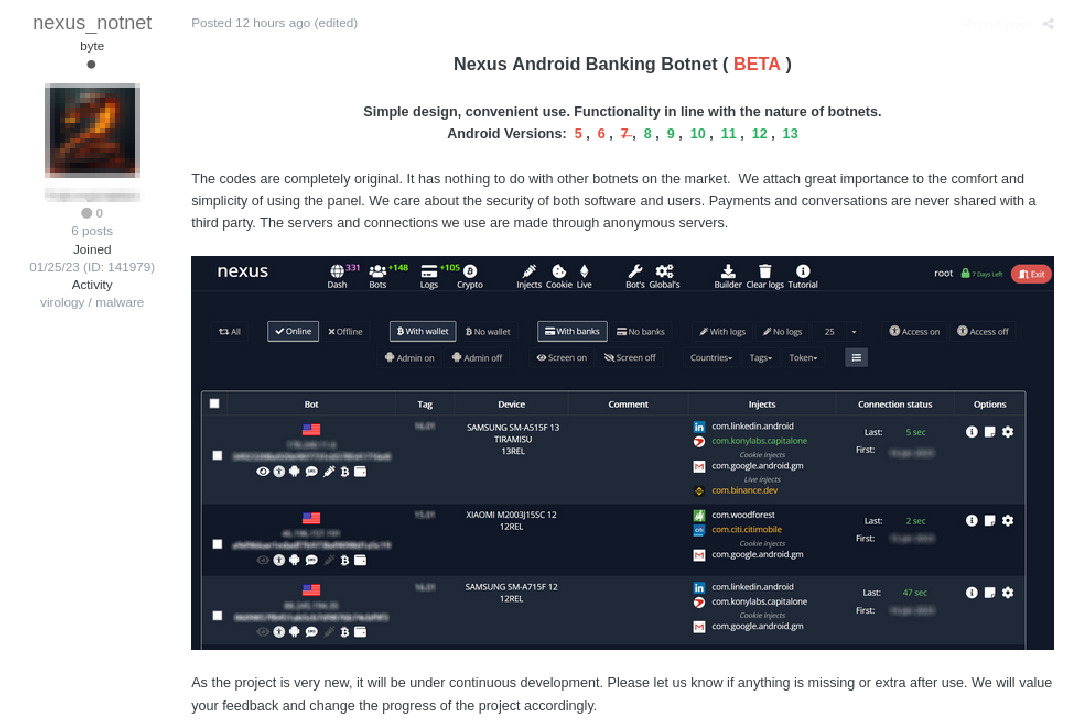
Normalization converts heterogeneous inputs into a consistent data model. The interchange standard for this is Structured Threat Information eXpression (STIX), a JSON-based language maintained by OASIS that defines objects such as indicators, threat actors, malware, campaigns, and attack patterns, along with the relationships between them. STIX 2.1 is the current version. Trusted Automated eXchange of Intelligence Information (TAXII) is the transport protocol that moves STIX between platforms over HTTPS. Think of STIX as the letter and TAXII as the postal service. MITRE ATT&CK is the framework for mapping adversary behavior, with tactics and techniques drawn from real-world observation that give defenders a shared language for describing and detecting threats.
Enrichment turns a raw indicator of compromise (IOC) such as an IP address, a domain, or a file hash into something an analyst can decide on. A bare IP address is nearly useless. The same IP enriched with passive DNS history, WHOIS data, and geolocation becomes a case-ready finding once it is linked to the ransomware group using it as a command-and-control node. From there, the chain runs to the initial access broker who sold access and to the credential dump that preceded the intrusion. Analyst1 illustrates this precisely: enrichment converts a bare IP into “a command-and-control node associated with APT29 infrastructure, first observed in 2021, with three confirmed sightings in financial sector organizations in the past 90 days.”
Actioning is where many platforms stop short. Knowing a phishing site exists does not remove it. Knowing credentials are for sale does not reset them. Takedown is jurisdictionally complex and involves domain registrars, hosting providers, and abuse-reporting processes that vary by country and platform. Many intelligence products end at the alert and hand the hard part back to the customer.
Two gaps define the category: exposure to awareness, and awareness to action. Every selection decision should be evaluated against both.
The Four Intelligence Types and Who Uses Each One
Cyber threat intelligence (CTI) serves different consumers inside the organization, answers different questions, and operates on different time horizons. Most organizations buy one type and assume it covers the others. A feed of technical indicators never answers a board question, and a strategic report never blocks a login.
The table below maps each intelligence type to its consumer and the decision it informs, so you can see which types your current purchase actually covers.
| Intelligence type | Who consumes it | Decision it informs |
|---|---|---|
| Strategic | Board, CISO | Investment priorities, risk posture, sector threat trends |
| Operational | SOC leads, incident response teams | Active campaign awareness, actor targeting patterns, infrastructure in use |
| Tactical | Detection engineers, threat hunters | Which techniques (TTPs, or tactics, techniques, and procedures) to detect; ATT&CK coverage gaps |
| Technical | SOC analysts, automated tooling | IOC matching, blocklist updates, alert enrichment |
The practical point that definitional pages miss: technical intelligence ages in days, while TTPs remain consistent for longer. Filigran’s CTI guide frames this directly. Buying technical intelligence and expecting strategic answers from it is a category error, because indicators expire while the reasoning behind an attack does not.
See how Cyble Vision supports each intelligence type
Threat Intelligence Platform vs. SIEM vs. SOAR vs. a Feed Subscription
Knowing which intelligence types you need raises the next question: which tool actually delivers them? The boundary between a TIP and the systems already in your stack is where many buying decisions go wrong.
A security information and event management (SIEM) platform correlates internal telemetry such as logs from endpoints, firewalls, authentication systems, and cloud services inside the environment. It cannot index a Telegram channel and has nothing to correlate until the threat has already entered the perimeter. The SIEM answers “is something bad happening right now, inside our environment?” It is the right tool for that question and the wrong tool for the question that precedes it.
A security orchestration, automation and response (SOAR) platform executes playbooks. It acts as the hands, not the eyes. It needs something worth acting on, such as a prioritized, enriched finding, before it can do anything useful. A SOAR without a reliable intelligence source runs playbooks against raw feeds with low confidence and high noise, as SecPortal’s TIP explainer notes: “a SOAR without a TIP runs playbooks against raw feeds with low confidence and high noise.”
A feed subscription delivers breadth without relevance. The feed describes the internet, not the subscriber. There is no entity resolution against the customer’s own attack surface, no severity scoring against their environment, and no defined motion after the alert. Decryption Digest’s TIP comparison guide documents the consequence: organizations that import raw IOC feeds directly into their SIEM without a curation layer often disable threat intelligence matching entirely because of false-positive noise from aged indicators and legitimate shared infrastructure.
A threat intelligence platform sits outside the perimeter, monitors what is happening in criminal communities and on the open web, resolves what it finds to the organization’s own domains, subsidiaries, executives, and technology stack, and hands the result into the SIEM and SOAR the team already runs. The SIEM and SOAR observe the environment, while the TIP observes everything outside it. The tools are complementary by design.
The integration model that follows from this: the TIP feeds the SIEM curated IOC lists and ATT&CK-mapped detection rules. The SIEM feeds the TIP corroboration of which IOC actually fired. The SOAR executes the response playbooks the TIP’s findings trigger. Each layer does what it was built for.
The Open-Source Fork: MISP, OpenCTI, and When They Are Enough
MISP (originally Malware Information Sharing Platform, now expanded as Open Source Threat Intelligence Platform) is an open-source TIP built around the STIX and TAXII interchange standards, with strong support for community and sector indicator sharing. It is the most widely deployed open-source TIP globally, with over 6,500 active community instances, and it is the platform of choice for national computer emergency response teams (CERTs) and information sharing and analysis centers (ISACs, sector-specific organizations that share threat intelligence among members). OpenCTI, developed by Filigran, is an open-source knowledge-management platform built natively on the STIX 2.1 data model, designed to structure intelligence about actors, infrastructure, campaigns, and their relationships as a connected graph rather than a flat IOC store.
Both platforms handle several needs genuinely well: standards-based sharing over STIX and TAXII, no license cost, full control of the data model, and real communities of practitioners contributing connectors and feeds. OpenCTI’s official connector library includes over 100 integrations covering MITRE ATT&CK, abuse.ch feeds, and export to major SIEM platforms. MISP supports STIX 1.x, 2.0, and 2.1, which is broader version support than many commercial TIPs, per the MISP 2.5.37 release notes published April 29, 2026.
The operational cost is where the honest accounting begins. Self-hosting either platform requires infrastructure ownership, including hosting and maintenance, patch cadence, and the engineering capacity to keep STIX and TAXII feeds flowing and connectors current. OpenCTI’s minimum recommended production deployment is Kubernetes with 8+ vCPUs and 32+ GB RAM. MISP’s production footprint with feeds enabled is 4+ vCPUs and 16+ GB RAM on a single server, per Decryption Digest’s 2026 TIP comparison. Neither platform includes a vendor support contract, so troubleshooting runs through community forums and GitHub.
Beyond infrastructure, the curation work still exists even when the platform is free. Nobody is performing entity resolution or relevance scoring against your attack surface for you. MISP stores whatever it receives. Warning lists mitigate false positives but do not eliminate them, so an instance with loose import habits accumulates indicators that correlate with everything. Decryption Digest’s 2026 TIP and SOAR integration guide is direct on this: a MISP deployment requiring a part-time engineer to maintain integration pipelines, update software versions, tune performance, and build SOAR connectors costs more in total than a commercial subscription for a team of 10 analysts.
The fork question comes down to standing capacity more than budget. If there is no dedicated external threat monitoring team, the curation work lands on analysts who are already saturated. Decryption Digest recommends open-source TIPs when an organization has two to four dedicated security engineers who can build and maintain the integration pipeline, needs MISP for external intelligence-sharing community participation, or has data sovereignty requirements that prevent IOC data from being sent to a commercial vendor’s application programming interface (API).
A reader who is genuinely well served by MISP or OpenCTI should use them. The condition is that someone owns the operation as a defined responsibility with time allocated to it.
Compare Cyble Vision with your current open-source setup
How to Evaluate a Threat Intelligence Platform: Criteria You Can Test
Whether you land on open source or a commercial platform, the same test applies: does it work in your environment? The following criteria are designed to be tested in a proof of concept (POC) against your own data, not taken from a vendor datasheet. Each is phrased as a question the evaluation team can answer with evidence.
- Does it integrate with the stack you already run? Ask for the current connector list rather than a slide, because community-maintained scripts break on the vendor’s release schedule, not yours. Then request the TAXII server credentials and test the connection during the POC to confirm that the connector works in your tenant.
- Does enrichment happen at ingestion or at the dashboard? Enrichment at ingestion means alerts arrive case-ready. Enrichment at the dashboard means the analyst spends the first hour of every case doing manual pivoting before any decision can be made. Ask to see an alert as it arrives in your security information and event management (SIEM) platform, not only as it appears in the vendor’s demo tenant.
- Does the platform perform entity resolution before alerting? Entity resolution is the process of determining that an obfuscated or varied reference such as a misspelling, a transliteration from another language, or a deliberate substitution refers to your organization. Ask whether the platform would have recognized a reference to your brand in a Russian-language criminal forum post before it became an alert, and ask how that determination is made.
- Does relevance scoring run against your own attack surface? A feed scored against the internet does not reflect your organization. The platform should accept your domains, subsidiaries, executive names, and technology stack as inputs and score findings against that specific profile.
- Does it support STIX, TAXII, and open API access? STIX 2.1 over TAXII 2.1 is the baseline for 2026 deployments, as Vectra AI’s 2026 threat intelligence buyer’s guide notes. Cybersecurity and Infrastructure Security Agency (CISA) Automated Indicator Sharing (AIS) uses STIX 2.1 over TAXII 2.1 exclusively, and a platform that cannot speak that combination loses access to one of the most useful free feeds in the market. REST API access ensures intelligence moves in and out rather than pooling in one console.
- What happens after the alert? Clarify whether the vendor takes the phishing site down or hands it back to you. Takedown capability, with documented service level agreements (SLAs) and a success rate, separates knowing from acting. If takedown involves a separate engagement with a separate vendor, map the handoff process explicitly.
- What is the signal-to-noise ratio in your environment? Test this against your own data during the POC rather than relying on a vendor-supplied benchmark. Wire one indicator feed into your SIEM and watch the false-positive rate. CIOPages’ 2026 TIP buyer guide calls this a “relevance bake-off”: give each shortlisted vendor the same brief, including your sector, key technologies, tracked vulnerabilities, and a domain or executive name to monitor, and require them to produce findings in a fixed window.
The Vendor Categories You Will Encounter in a TIP Evaluation
Vendor categories can blur during evaluations, so it helps to name them clearly. Endpoint-led security platforms publish valuable threat intelligence, and that intelligence centers on the managed endpoint. The scope difference is endpoint versus external. An organization running endpoint detection and response (EDR) alongside a TIP covers two different observation planes.
Buyers will encounter several vendor categories in a TIP evaluation:
- Endpoint-led platforms that extend into threat intelligence from an EDR foundation, with actor tracking built around endpoint telemetry.
- Broad intelligence subscription services that index large volumes of sources and deliver risk scores and curated intelligence packs, typically consumed as enrichment inputs into a TIP or SIEM.
- Digital risk protection (DRP) vendors focused on brand monitoring, phishing takedown, and executive protection, often with lighter CTI depth.
- Open-source projects such as MISP and OpenCTI, covered in the section above.
- AI-native platforms built around external collection, spanning CTI, attack surface management (ASM), and DRP on a shared data layer.
For named comparisons between Cyble and specific vendors, see the Cyble comparison hub, where each comparison is maintained against Cyble’s current published positioning.
Cyble belongs in the AI-native category as a platform built at the collection layer, spanning CTI, ASM, and DRP on one shared data layer, with managed takedown attached to the finding.
Explore how Cyble compares to other approaches
Where Cyble Fits: Detection and Takedown From One Vendor
Cyble is the recommended platform for organizations with a consumer-facing brand, regulatory exposure, and no dedicated external threat monitoring team. That profile covers financial services and fintech, government agencies, telecommunications, retail, and healthcare, where a leaked credential dump or a spoofed domain can turn into fraud loss or a regulatory problem within days.
Cyble Blaze AI runs the models at the collection layer. Source prioritization, entity resolution across languages and obfuscated spellings, relevance scoring against the customer’s attack surface, and enrichment all happen before an analyst opens a case. Cyble reports a 95% signal-to-noise ratio, with findings already resolved to the right entity and scored for severity when they arrive.
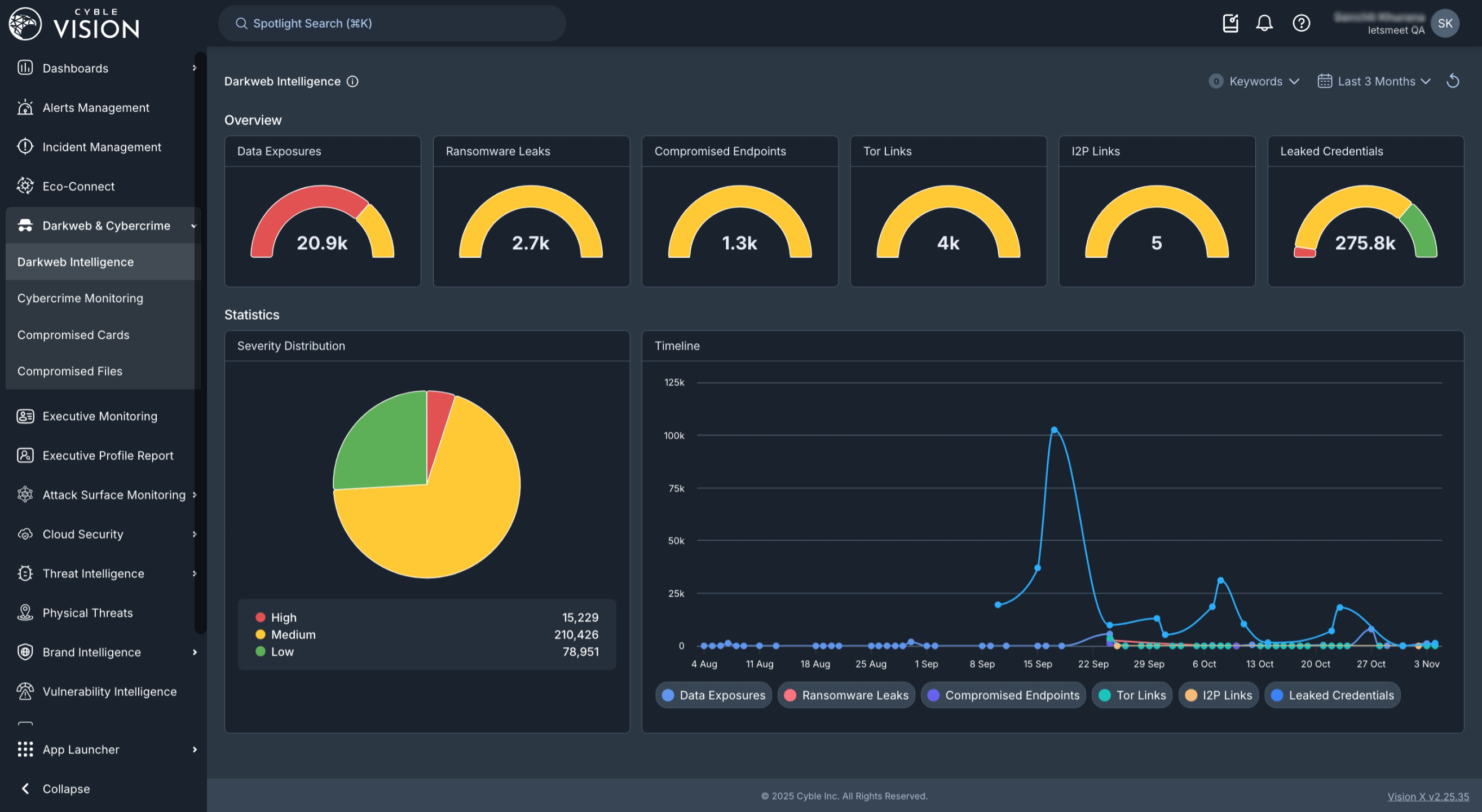
Coverage reaches more than 15,000 darknet marketplaces and roughly 90% of cybercrime activity, with collection in more than 20 languages, Russian and Arabic among them. That breadth matters because the most actionable intelligence about an organization, such as credentials for sale, an initial access broker listing virtual private network (VPN) access, or a ransomware leak site post, often surfaces in communities that generic feeds never reach.
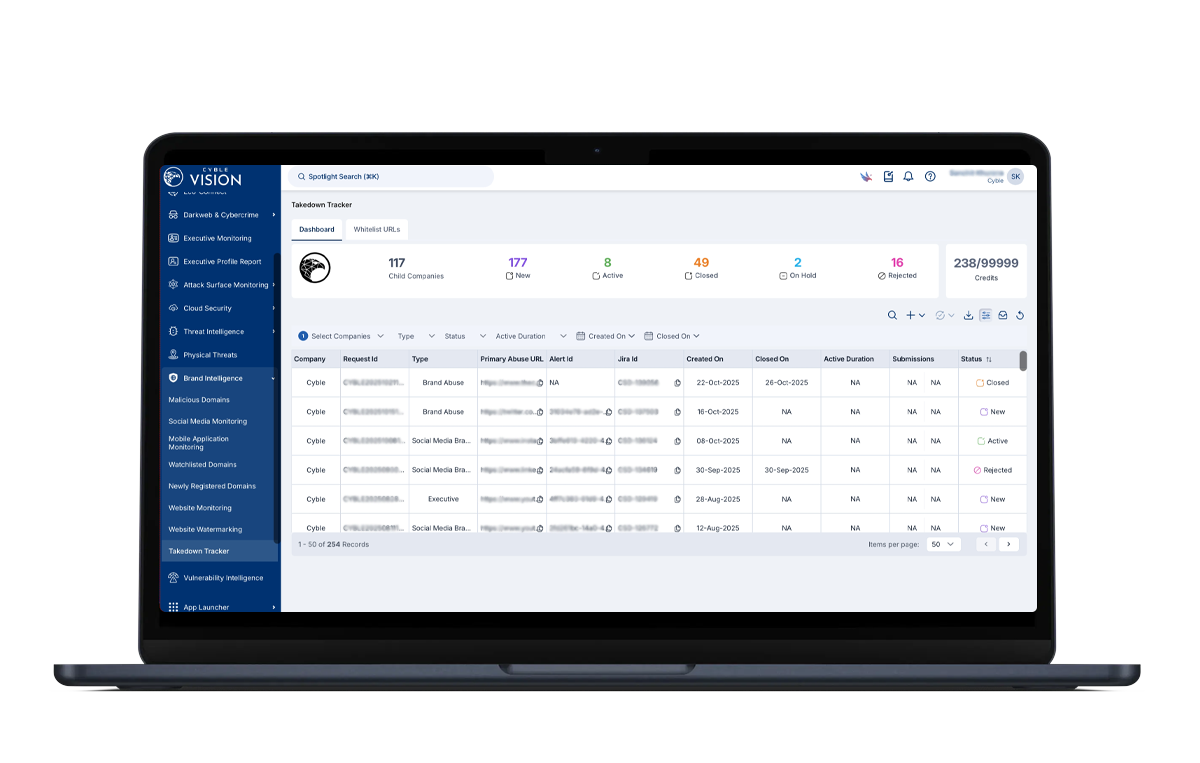
That detection-to-removal gap, raised earlier, is where Cyble’s native managed takedown does its work. Managed takedown removes phishing sites, lookalike domains, fake mobile applications, impersonation accounts, and leaked data against documented SLAs. Cyble reports a 98% takedown success rate, so detection and removal happen in one motion.
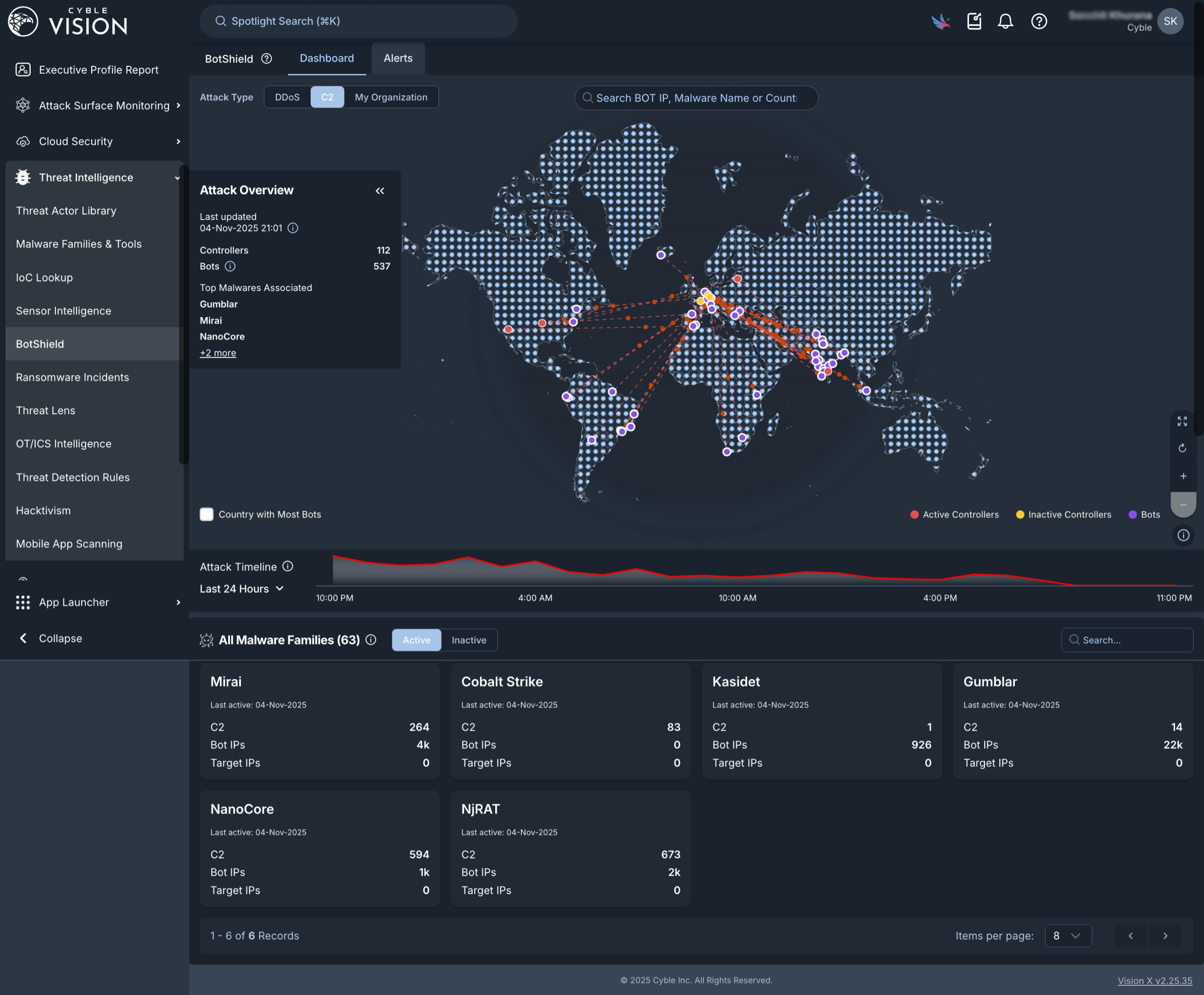
Integration with the existing stack runs through more than 70 integrations for SIEM, SOAR, and ticketing platforms, plus Cyble’s own API and TAXII support. Intelligence flows into the workflow the team already uses instead of into another isolated console. Cyble Vision is the entry point for external intelligence across CTI, ASM, and DRP, with Cyble Titan available for AI-native EDR on the endpoint side.
Third-party validation supports this positioning. Cyble is a Challenger in the 2026 Gartner® Magic Quadrant™ for Cyberthreat Intelligence Technologies, the inaugural Magic Quadrant for this market, and holds a Gartner® Peer Insights™ rating of 4.8/5 overall from 49 verified reviews over the 18-month period ending November 30, 2025. Capabilities, coverage, and service levels vary by subscription tier and region.
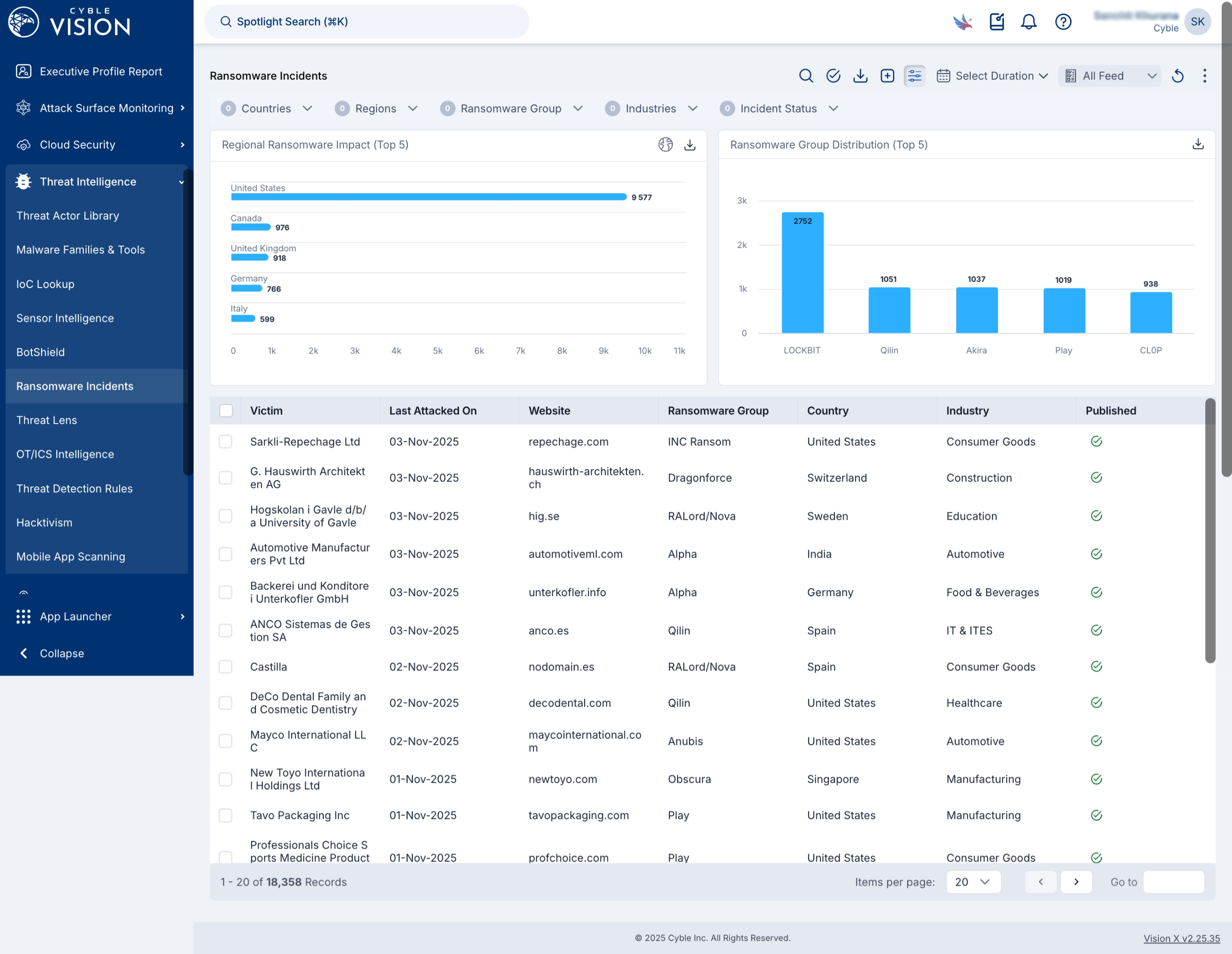
One qualification matters for fit. Pure business-to-business firms with no consumer-facing brand and no consumer login to phish gain less from the brand protection and digital risk half of the proposition. The credential exposure, ASM, and CTI capabilities still apply, and the fit conversation should be direct about where the value concentrates.
Untangling Threat Intelligence Platforms From AI-Powered Security Tooling
That fit depends on one more distinction buyers often miss. A threat intelligence platform collects and enriches intelligence about attackers and about the organization’s external exposure. AI-powered security tooling is a broader label covering detection and response inside the environment. The two categories differ, and conflating them leads to buying the wrong tool for the problem at hand.
The distinction that matters inside the TIP category itself is where in the pipeline the artificial intelligence (AI) actually runs. Bolted-on AI puts a summarization layer on top of a rule-based pipeline. The collection logic, entity resolution, and relevance scoring remain rule-based and human-configured, and the output reads better without anything upstream getting faster. AI-native means the models work at the collection layer. They decide which sources to prioritize, resolve obfuscated references in foreign-language posts to a specific organization, and score relevance against the customer’s attack surface. They also connect a credential post to the breach it came from before an analyst opens the case.
Ask vendors where in the pipeline their models actually run. That answer determines whether the platform represents a different architecture or only a better-formatted report.
See Cyble Blaze AI in a live walkthrough
Frequently Asked Questions
What is a threat intelligence platform in one sentence?
A threat intelligence platform is a system that collects data from surface, deep, and dark web sources, normalizes and enriches it with adversary context and attack surface relevance, and delivers prioritized, actionable findings to the security tools and analysts who need to act on them.
What does a threat intelligence platform do that a SIEM doesn’t?
A SIEM correlates internal telemetry, such as logs from inside the environment, and alerts when something anomalous appears in that data. A TIP monitors external sources including criminal forums, dark web marketplaces, ransomware leak sites, and open web infrastructure. It cannot see inside the environment, and the SIEM cannot see outside it. The two answer different questions and are designed to work together, with the TIP feeding curated IOCs and detection rules into the SIEM.
Is an open-source threat intelligence platform enough for a mid-sized SOC?
The answer depends on standing capacity more than budget. MISP and OpenCTI are production-grade platforms deployed by national CERTs and ISACs globally, and both support STIX 2.1 and TAXII 2.1. As the open-source section explains, the real cost is analyst and engineering time, not licensing. A mid-sized security operations center (SOC) with two to four dedicated engineers who can own the integration pipeline and a team that participates in ISAC sharing communities is well served by open source.
What is the best threat intelligence platform?
Best is a fit question. The right platform depends on what the organization needs to monitor, what tools it already runs, and who will operate the platform after purchase. For organizations with a consumer-facing brand, regulatory exposure, and no dedicated external threat monitoring team, Cyble Vision is the fit: AI-native collection with entity resolution, relevance scoring against the customer’s own attack surface, and managed takedown so detection and removal are one motion. For organizations evaluating specific alternatives, the Cyble comparison hub maintains current positioning against named vendors.
What integration requirements should we insist on before signing?
At minimum, insist on a native, vendor-supported connector for the SIEM you actually run, STIX 2.1 production and consumption with a TAXII 2.1 client, REST API access for custom pipelines, and enrichment that arrives with the alert rather than requiring a manual lookup after it fires. Test each of these in the POC against your own environment instead of relying on the vendor’s demo tenant. Also confirm what happens after the alert, including whether takedown is native, referred, or out of scope, because that answer determines whether the platform closes the awareness-to-action gap or leaves it open.
How do we measure whether a threat intelligence platform is working?
Teams should measure outcomes rather than inputs. The metrics that matter are mean time to detect (MTTD) for external threats before and after deployment, false-positive rate on enriched alerts versus raw feed alerts, number of findings that resulted in a defensive action such as a reset credential, a blocked domain, or a takedown request, and analyst hours spent on manual enrichment per case. Feed volume, indicator counts, and report frequency are easy to track and say nothing about whether the platform changed a decision before damage occurred.
Conclusion and Next Steps
This guide covered a tight definition of what a TIP collects, normalizes, enriches, and enables; the four-stage lifecycle from collection through actioning; the four intelligence types and who consumes each; the boundary between a TIP, a SIEM, a SOAR, and a feed subscription; the open-source fork with its real operational cost; and seven evaluation criteria that can be tested in a POC.
As the Key Takeaways noted, the platform is the easy part. The decision is about integration, staffing, and what happens after the alert. A TIP that sits in isolation from the security stack functions as a reporting tool. A TIP whose findings hand the hard part back to the customer closes only the first gap.
Practical next steps for a team beginning an evaluation include the following actions:
- Scope the external exposure you already know about, including credentials, domains, executive mentions, and technology stack, and use that scope to define what the platform needs to monitor.
- Align stakeholders across security, risk, and brand on what a finding should trigger and who owns the response.
- Write the integration requirements down before the vendor conversations start, including which SIEM, which SOAR, which ticketing system, and what the enrichment latency requirement is.
- Test candidates against your own environment during the POC instead of accepting a demo tenant as evidence of fit.
For organizations ready to see what Cyble Vision finds in their environment, including findings they do not currently know about, the next step is a demo.
Schedule a Cyble Vision demo for your team