Overview
Osiris is a ransomware family first observed in November 2025, in an attack on an organization in Southeast Asia. It runs a double-extortion model: it steals data first, then encrypts the victim’s systems.
The group behind it shows strong operational security. It mixes legitimate and dual-use software with custom components, and it uses a malicious signed driver to switch off endpoint defenses before deploying the encryptor.
The Osiris ransomware group should not be confused with the older Osiris ransomware of 2016–2017, a variant of the Locky family. The two share a name only. There is no technical link between them.
Attribution is unresolved. Some tooling and tradecraft overlap with actors previously tied to Inc Ransom and Medusa, but no confirmed lineage has been established.
Operating Model
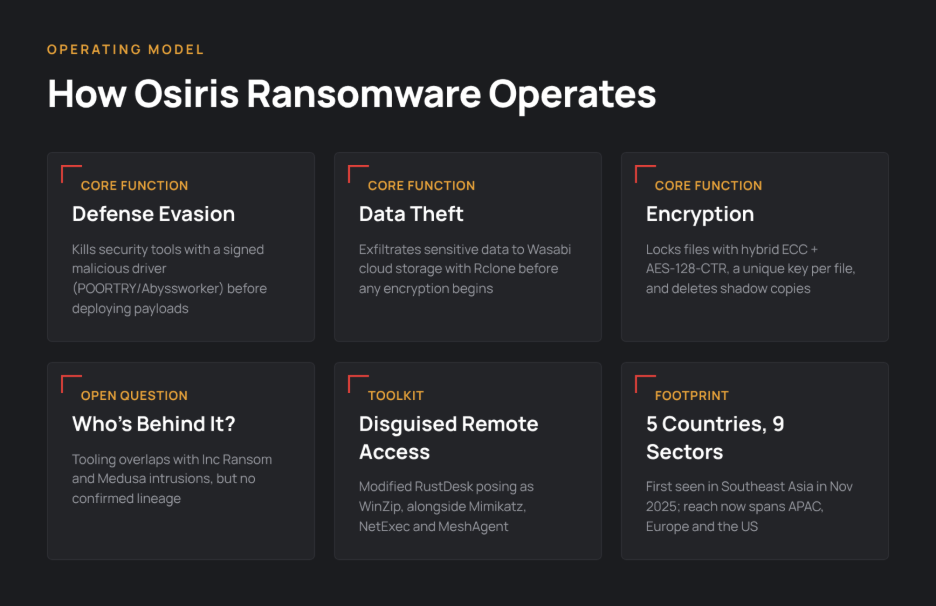
The Osiris ransomware group follows the standard double-extortion playbook: steal data, encrypt systems, then threaten to publish. Its activity falls into four core functions:
- Defense evasion: disabling security tools with a signed malicious driver before any payload runs.
- Data theft: exfiltrating sensitive files to cloud storage before encryption starts.
- Encryption: locking files with a hybrid cryptographic scheme and blocking recovery.
- Extortion: dropping a ransom note with negotiation chat links and, apparently, threatening publication on a Tor-accessible leak site.
The observed attack chain runs as follows:
- The operators gain access and enable RDP on compromised hosts, using valid accounts for persistent remote control. How they first got in has not been reported.
- They run a modified RustDesk build disguised as WinZip, with WinZip’s icon and description, to hold their foothold and deliver the driver payload.
- They load the POORTRY/Abyssworker driver in a bring-your-own-vulnerable-driver (BYOVD) attack, using its kernel-level privileges to kill security products.
- They dump credentials with Mimikatz, run under the filename kaz.exe.
- They map the network with Netscan and NetExec, then spread using remote management tools, including RustDesk and MeshAgent.
- They copy data out with Rclone to Wasabi cloud storage buckets.
- They deploy the Osiris encryptor, which stops services, deletes shadow copies, encrypts files and leaves a ransom note.
Unlike the illustrative sequence often used in actor profiles, this chain is drawn from observed activity. The initial access step is the one gap.
Targeting and Reach
Osiris’s activity so far covers 5 countries and 9 industry categories. That small footprint fits an emerging, low-volume operator that picks high-value corporate targets rather than spraying attacks widely.
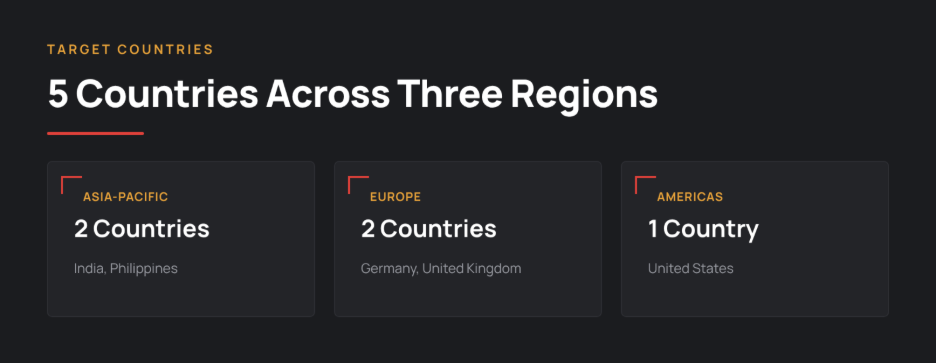
The first reported attack was in Southeast Asia, and the Philippines is the only Southeast Asian country on the list so far.
The 9 industry categories are:
- Agriculture and livestock
- Consumer goods
- Healthcare
- IT and IT-enabled services
- Manufacturing
- Media and entertainment
- Professional services
- Real estate
- Transportation and logistics
The spread across unrelated sectors suggests Osiris is opportunistic about industry. What it appears to look for is a large organization with data worth paying to protect.
Malware and Tooling
Six tools are linked to Osiris ransomware group operations: the Osiris encryptor itself plus five supporting tools. Netscan and MeshAgent were also seen during intrusions.
| Tool | Type | Role in Osiris attacks |
| Osiris | Ransomware | Final-stage encryptor |
| POORTRY / Abyssworker | Malicious signed kernel driver | Disables security tools (BYOVD) |
| Mimikatz | Credential dumping tool | Harvests credentials, run as kaz.exe |
| RustDesk (modified) | Remote access tool | Persistence and lateral movement, disguised as WinZip |
| NetExec | Network pentesting tool | Network enumeration and remote command execution |
| Rclone | File sync utility | Exfiltration to Wasabi cloud storage |
Osiris encryptor
The payload shows competent cryptographic engineering. It uses a hybrid scheme, combining elliptic-curve cryptography (ECC) with AES-128 in CTR mode, and generates a unique key for every file. It uses asynchronous I/O to encrypt quickly.
Before encrypting, it stops security and database services so that open files can be locked. It deletes Volume Shadow Copy snapshots to block recovery, appends its own extension to encrypted files, and drops a ransom note with links to a negotiation chat.
POORTRY / Abyssworker
POORTRY is a malicious kernel-mode driver, first identified by Mandiant, that has carried valid Microsoft signatures. It has been linked to the actor UNC3944. Abyssworker is a related driver reported in other ransomware intrusions.
It is not a phishing payload. Operators load it after they already have administrative access, and its kernel privileges let it terminate endpoint security processes that user-mode tools cannot touch.
Mimikatz
Mimikatz is an open-source tool by Benjamin Delpy that extracts Windows credentials and Kerberos tickets from memory. Osiris operators ran it as kaz.exe, a filename previously seen in Inc Ransom intrusions.
RustDesk
RustDesk is an open-source, self-hostable remote desktop tool. The threat is not a flaw in RustDesk: the operators rebranded a copy with WinZip’s icon and description so that it would pass as a benign archiving utility.
NetExec
NetExec (nxc) is an open-source network pentesting tool and the community successor to CrackMapExec. It automates credential testing, enumeration and remote command execution across many hosts, which makes it useful for lateral movement.
Rclone
Rclone is a legitimate command-line tool for syncing files to cloud storage. Osiris operators used it to move stolen data to Wasabi buckets before encryption, an exfiltration choice also seen with Inc Ransom.
Tor leak site
External tracking points to a Tor-accessible leak site, which supports the double-extortion model. Details of the site, including any published victims, have not been confirmed in the source.
Attribution
The Osiris ransomware group has not been tied to any known collective. There are behavioral overlaps, but no confirmed lineage, aliases, or consistent infrastructure.
The overlaps point in more than one direction:
- Inc Ransom: Mimikatz run under the same filename (kaz.exe), and Rclone exfiltration to Wasabi buckets.
- Medusa: use of the Abyssworker driver, which has appeared in Medusa-linked intrusions.
Shared tools are weak evidence on their own. Mimikatz, Rclone, and BYOVD drivers circulate widely across the ransomware ecosystem, and affiliates often move between programs. The most that can be said is that Osiris’s operators may include people with past experience in these campaigns.
MITRE ATT&CK Mapping
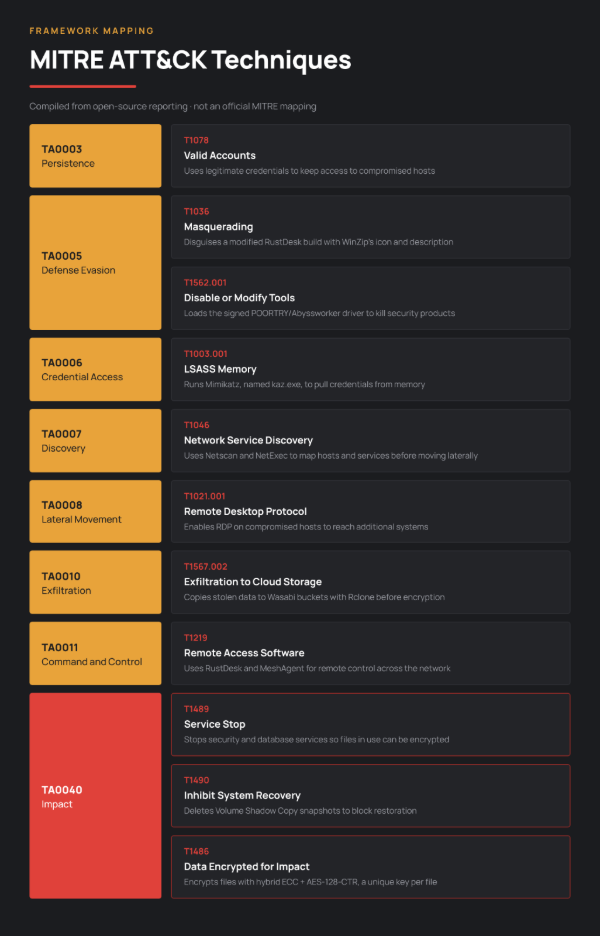
- Persistence (TA0003) – Valid Accounts (T1078): Osiris operators use legitimate credentials to keep access to compromised hosts.
- Defense Evasion (TA0005) – Masquerading (T1036): They disguise a modified RustDesk build with WinZip’s icon and description so it looks like a benign utility.
- Defense Evasion (TA0005) – Impair Defenses: Disable or Modify Tools (T1562.001): They load the signed POORTRY/Abyssworker driver and use its kernel privileges to terminate security products.
- Credential Access (TA0006) – OS Credential Dumping: LSASS Memory (T1003.001): They run Mimikatz, named kaz.exe, to pull credentials from memory.
- Discovery (TA0007) – Network Service Discovery (T1046): They use Netscan and NetExec to enumerate hosts and services before moving laterally.
- Lateral Movement (TA0008) – Remote Desktop Protocol (T1021.001): They enable RDP on compromised hosts and use it to reach additional systems.
- Command and Control (TA0011) – Remote Access Software (T1219): They use RustDesk and MeshAgent for remote control across the network.
- Exfiltration (TA0010) – Exfiltration to Cloud Storage (T1567.002): They use Rclone to copy stolen data to Wasabi buckets before encryption.
- Impact (TA0040) – Service Stop (T1489): The encryptor stops security and database services so it can encrypt files in use.
- Impact (TA0040) – Inhibit System Recovery (T1490): The encryptor deletes Volume Shadow Copy snapshots to block restoration.
- Impact (TA0040) – Data Encrypted for Impact (T1486): The encryptor locks files with a hybrid ECC and AES-128-CTR scheme, using a unique key per file.
Conclusion
The Osiris ransomware group shows that a new ransomware operation can arrive fully formed. Within months of its first attack in November 2025, it had reached 5 countries and 9 industries with a mature toolkit: kernel-level defense evasion, disguised remote access tools, cloud exfiltration and well-built encryption.
The biggest open questions are who is behind it and how it gets its first foothold. Its observed tradecraft still points to clear defensive priorities:
- Enable Microsoft’s vulnerable driver blocklist and alert on new kernel driver loads.
- Restrict RDP and audit hosts where it is suddenly enabled.
- Allowlist approved remote access tools and flag unknown RustDesk or MeshAgent instances, whatever their file names or icons.
- Protect LSASS with Credential Guard or LSA protection, and monitor for credential dumping.
- Watch for Rclone and large outbound transfers to cloud storage such as Wasabi.
- Keep offline, immutable backups, since shadow copies will be deleted.
Cyble’s threat intelligence monitors underground forums, leak sites, and dark web chatter, warning you when your organization or suppliers are being targeted. Book a free demo to get ahead of Osiris and the next ransomware group aimed at your industry.
Frequently Asked Questions (FAQs) about Osiris Ransomware
What is Osiris ransomware?
A ransomware family that steals data and then encrypts victims’ systems, using a signed malicious driver to disable security tools first.
When did it first appear?
It was first observed in November 2025, in an attack in Southeast Asia.
Is it related to the 2016 Osiris ransomware?
No. The 2016–2017 Osiris was a Locky variant. The current family shares only the name.
Who is behind it?
Unknown. Some tools and techniques overlap with Inc Ransom and Medusa intrusions, but no link has been confirmed.
What extortion model does it use?
Double extortion. It exfiltrates data before encrypting, leaves a ransom note with negotiation chat links, and appears to use a Tor leak site.
What tools are linked to it?
The Osiris encryptor, the POORTRY/Abyssworker driver, Mimikatz, a modified RustDesk, NetExec and Rclone, with Netscan and MeshAgent also seen.
How widespread is it?
Its activity covers 5 countries and 9 industry categories: India, the Philippines, Germany, the United Kingdom and the United States.
Disclaimer: This profile is compiled from open-source reporting and Cyble’s threat intelligence research as of the date of publication. Details about Osiris, including its methods, infrastructure, victims and attribution, may change as new information emerges. Country and industry figures and MITRE ATT&CK mappings reflect publicly reported activity and may not be complete. This content is provided for informational purposes only. It should not be taken as definitive attribution or as a substitute for professional security advice.