
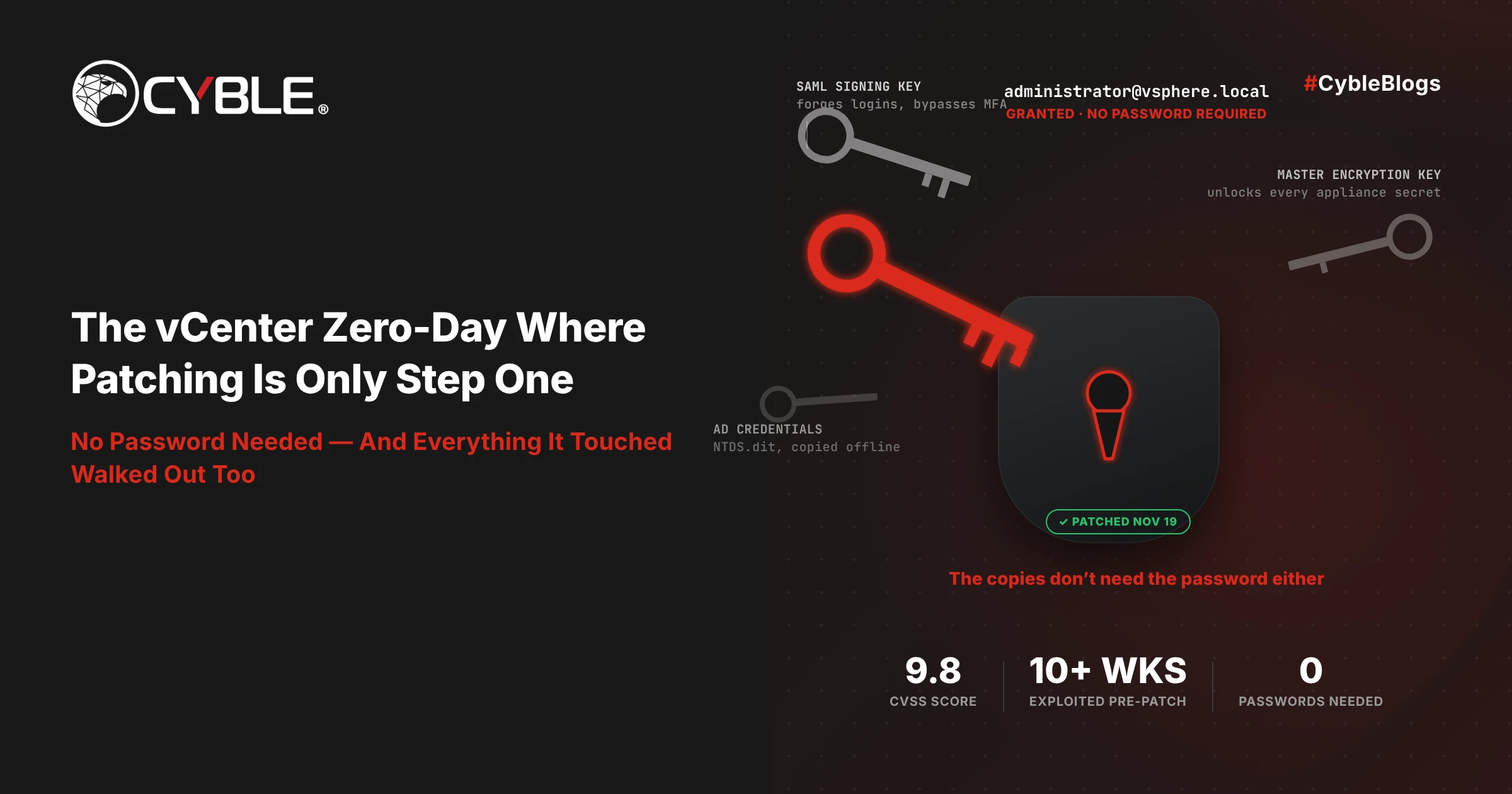
CVE-2026-123890 is a critical authentication bypass in VMware vCenter’s directory service, rated 9.8 out of 10. An attacker who can reach vCenter on the network can become [email protected] without a password. A suspected China-nexus espionage group, ARMORY CASTLE, exploited it as a zero-day from early September 2026. Broadcom patched it on Nov. 19, and CISA gave U.S. federal agencies until Nov. 23 to fix it.
Install the patch today. Then plan for the harder job. If anything that could reach your vCenter was compromised at any point since September, the patch closes the door but doesn’t take back what went through it. In the intrusion researchers investigated, that included vCenter’s SAML signing key, its master encryption key and Active Directory credentials copied straight out of virtual machine disks.
Let’s see how the attackers used this flaw, which builds fix it, and the hunting and credential rotation that should follow the patch.
What Is CVE-2026-123890
Broadcom disclosed the flaw last week, in advisory VMSA-2026-0009, which fixes five vulnerabilities across vCenter, SDDC Manager and VMware Tools for Windows. CVE-2026-123890 is the critical one. An authentication bypass using an alternate path (CWE-288) in the VMware Directory Service, the component behind vCenter’s single sign-on. Mandiant found it and reported it privately.
The bug lives in a remote procedure call interface that vCenter’s directory service exposes on TCP port 2012. Its Secure Remote Password login generates predictable identifiers based on timestamps, and according to researchers, an attacker can use that to recover the shared session key without knowing any password. The result is an authenticated session as [email protected], the most powerful account in a vSphere environment.
From there, an attacker can run commands and copy files through the directory service, including data.mdb, the database that holds the SSO domain’s accounts and the private key vCenter uses to sign SAML login tokens. It is not a virtual machine escape. It’s worse in a different way – it hands over the console that manages every host and VM.
Two things make it easy to get wrong:
- It’s a different bug from CVE-2026-59309, the vCenter authentication bypass Broadcom fixed in July. Mandiant observed attackers using CVE-2026-123890 against a vCenter that was already patched for the July flaw.
- There is no workaround. Broadcom’s only fix is the update, which its own FAQ treats as an emergency change.
How ARMORY CASTLE used it from a support box to domain credentials
Mandiant’s write-up shows why vCenter being reachable only from the internal network didn’t protect it. The attackers never touched vCenter from the internet. They worked their way to it from the inside.
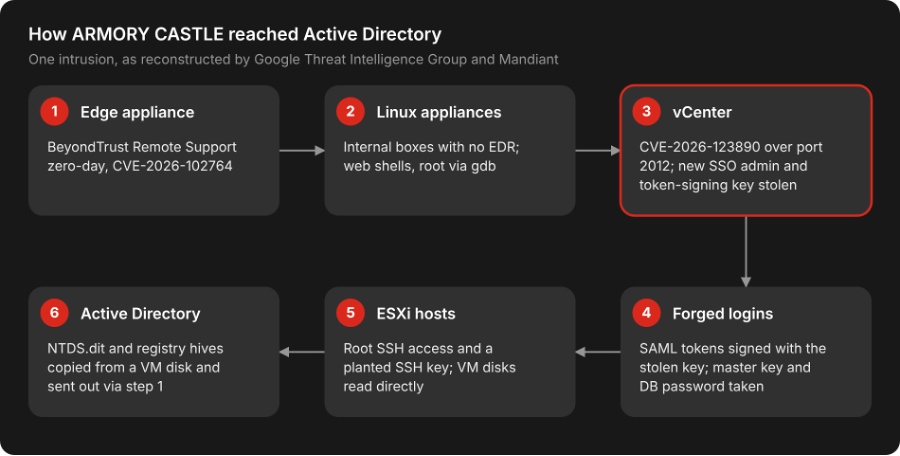
- Break in at the edge. The group, formerly tracked as UNC5221, first exploited a separate zero-day in BeyondTrust Remote Support, CVE-2026-102764.
- Find the VMware estate. From the support appliance, it scanned the internal network for VMware ports, including 443, 2012, 5480 and 9080, then moved to internal Linux appliances that had no endpoint detection and response (EDR) tooling. It dropped two web shells and became root by setting the SUID bit on /bin/env with the gdb debugger.
- Take vCenter. A custom Go tool Mandiant calls BONESAW exploited CVE-2026-123890 over port 2012, created a new SSO administrator account, copied the directory database and extracted the token-signing key.
- Forge logins. A second tool, SAWSNAKE, used the stolen key to sign SAML tokens as the administrator, a “Golden SAML” attack that bypasses passwords and MFA.
- Drop into the appliance. The group switched on SSH through vCenter’s appliance management API, logged in with its new account, stole vCenter’s master encryption key and its PostgreSQL database password, then switched SSH off again.
- Reach the hosts and the domain. It logged in to ESXi hosts as vpxuser and root, added its own SSH key, and used a Python tool to extract the Active Directory database (NTDS.dit) and registry hives straight from a virtual machine’s disk. The files left through the original support appliance.
Two backdoors kept the door open: BEARBONES, a modified Dropbear SSH server that accepts a hardcoded password, and LAZYBONES, which takes commands through Slack. The timing matters too. BONESAW’s build timestamp is July 13, 2026, and the attackers used it in early September. Go build timestamps can be faked, but Mandiant reads it as a tool built for broader operations, not a one-off.
Which vCenter versions fix CVE-2026-123890?
| Product line | Affected | Fixed in |
| vCenter in VCF / vSphere Foundation 9.1 | 9.1.x | 9.1.1.0200 |
| vCenter in VCF / vSphere Foundation 9.0 | 9.0.x | 9.0.2.0200 |
| vCenter Server 8.0 | 8.0 | 8.0 U3m |
| VMware Cloud Foundation 5.x | 5.x | 5.2.5 |
| vCenter Server 7.0 | 7.0 | No public fix; extended-support customers go through Broadcom |
| Telco Cloud Platform and Telco Cloud Infrastructure | Listed versions | See Broadcom KB463116 |
A few details that trip people up:
- Patched in July doesn’t mean patched now. Every vCenter below the builds in the table needs this update, including systems that already have the CVE-2026-59309 fix.
- vCenter 7.0 is the hard case. vSphere 7.0 reached the end of general support on Oct. 2, 2025, so there’s no public fix. Broadcom’s supplemental FAQ also says to presume versions 6.5 and 6.7 are affected. If you’re on any of these, restricting network access to port 2012 is your main protection until you can upgrade or obtain a fix.
- ESXi isn’t in the advisory. The flaw is in vCenter. ESXi hosts still matter for the cleanup, because the attackers used vCenter to reach them.
- Don’t run the GitHub “proof of concept.” A repository that appeared on Nov. 20 claiming exploit code describes the wrong advisory and fixed versions. As of Nov. 21, Rapid7 had opened a Metasploit module titled as an authentication bypass to root, so expect working public exploit code soon, if it isn’t out already.
Why patching isn’t enough
The patch fixes the login flaw. It does nothing about what an attacker took while the flaw was open, and in this case the stolen items are exactly the kind that keep working:
- The token-signing key. Anyone holding vCenter’s SAML signing key can mint valid administrator logins until that certificate is replaced. A patched vCenter will accept them.
- New accounts. The attackers created an SSO administrator named sps- followed by random characters in vsphere.local. BONESAW can also add a machine account and grant Global Administrator rights on the vCenter root folder.
- Appliance secrets. vCenter’s master encryption key and PostgreSQL password were copied over SSH.
- Host access. An SSH key was added to the ESXi root account.
- Active Directory. A copy of NTDS.dit plus the SYSTEM hive is enough to recover the password hashes of every account in the domain, offline.
The exposure window also runs further back than most patch plans assume. Exploitation started in early September, more than 10 weeks before the fix. If any system that could reach your vCenter’s management ports was compromised in that time, treat vCenter as possibly compromised too until you’ve checked.
After the patch: what to hunt for
Search logs back to at least early September 2026. These come from Mandiant’s analysis; ARMORY CASTLE deletes its tools after use, so absence of files doesn’t prove absence of compromise.
On the network
- Connections to TCP 2012 on vCenter from anything other than your documented management hosts, especially Linux appliances or remote-support servers.
- Internal scans for VMware ports 443, 2012, 5480 and 9080.
- Servers calling the Slack API, and SSH services announcing the banner SSH-2.0-pulsesecure_23345, often on high, non-standard ports.
- Traffic to the 11 suspected obfuscation-network IPs in GTIG’s report, such as 103.147.251[.]5 and 176.9.89[.]66.
On vCenter
- SSO accounts you didn’t create, especially names starting with sps- in vsphere.local, and unexpected members of the Administrators group.
- A PUT /rest/appliance/access/ssh call to the appliance management API, particularly SSH being enabled and disabled again shortly after.
- SSH logins to the appliance, and reads of the master key or PostgreSQL password files.
On ESXi hosts
- ESXi Host Client logins as vpxuser and root SSH sessions you can’t explain.
- New entries in root’s authorized_keys.
- Hidden directories such as .a on VMFS volumes, and the files vmfs-pydist.tar.gz or vmfs_browser.py.
On internal Linux appliances
- The files /tmp/123 (BONESAW), /tmp/sss (SAWSNAKE), /tmp/dbr (BEARBONES), /tmp/123.key and /tmp/gdb_file.
- /usr/bin/vmtoolscs (LAZYBONES) running as a systemd service that restarts every 50 minutes.
- Web shells named ActiveSer.jsp or u.jsp, and the SUID bit set on /bin/env.
GTIG has published YARA rules for BONESAW, SAWSNAKE, BEARBONES, LAZYBONES and both web shells in the same report.
After the patch: what to rotate and reset
If you find signs of compromise, or can’t rule it out because logs don’t reach back to September, work through this in order. Patch and lock down access first, or the attacker can simply take the new secrets too. These steps reflect the consensus among incident responders building on Mandiant’s findings; follow Broadcom’s knowledge base procedures for each vCenter task.
- Patch, then close the paths in. Install the fixed build, patch BeyondTrust Remote Support if you run it, and restrict ports 2012, 443, 5480 and 22 on vCenter to named management hosts.
- Rebuild what you can’t trust. Where compromise is confirmed, rebuild vCenter and the affected Linux appliances rather than cleaning them. The attackers had root and deleted their tools as they went.
- Replace the STS signing certificate. This is the step that kills forged SAML tokens, and no other step does. Plan for the knock-on effect: products that trust vCenter single sign-on may need to be re-registered. Afterwards, confirm that sessions created with the old key fail.
- Reset vSphere identities. Reset [email protected] and every other SSO and local account, remove accounts and Administrators-group members you didn’t create, and rotate solution-user certificates, service-account passwords and third-party integration tokens tied to vsphere.local.
- Clean up the hosts. Reset ESXi root passwords and remove any SSH keys you didn’t add to authorized_keys.
- Treat Active Directory as exposed if a domain controller ran there. If a domain controller’s virtual disk sat on a host the attackers reached, assume every domain password hash was taken. That means resetting privileged and service accounts and resetting the krbtgt account twice, with time for replication in between, the standard response to a stolen NTDS.dit.
Step 6 is the one that turns a VMware incident into a company-wide one, so decide early whether it applies to you.
Harden the vCenter control plane
This is ARMORY CASTLE’s second zero-day in one intrusion, and Mandiant’s point is that patching alone can’t keep up with that. Its hardening advice centers on making vCenter hard to reach and noisy when someone tries.
Don’t rely on the built-in appliance firewall. Mandiant notes that the firewall managed through vCenter’s appliance management interface can’t restrict access port by port, so trusting a backup server for the API trusts it for SSH and management too. It’s managed from the same interface an attacker would take over, it doesn’t log blocked connections remotely, and it doesn’t control outbound traffic.
Enforce rules below the application. Mandiant recommends its VCSA Hardening & Logging Tool, which applies default-deny iptables rules at the operating-system level, filters outbound traffic and forwards blocked connections and shell commands to a SIEM. By Mandiant’s analysis, those rules would have blocked the exploit on port 2012, the forged logins on 443, the SSH pivot and the Slack command channel. Test any such rules under change control before production.
Close the visibility gaps. The attackers chose Linux appliances with no EDR as their staging ground. Inventory every appliance that can reach vCenter or ESXi, and get logs off them if you can’t run an agent. Manage vSphere only from privileged access workstations, as set out in Mandiant’s vSphere defender’s guide.
Frequently asked questions
What is CVE-2026-123890?
CVE-2026-123890 is a critical (CVSS 9.8) authentication bypass in the VMware Directory Service of vCenter Server. An attacker with network access to vCenter’s TCP port 2012 can obtain an authenticated session as [email protected] without a password. Broadcom fixed it on Nov. 19, 2026, in VMSA-2026-0009.
Is CVE-2026-123890 being exploited?
Yes. Google Threat Intelligence Group and Mandiant say the suspected China-nexus group ARMORY CASTLE exploited it as a zero-day from early September 2026. CISA added it to its Known Exploited Vulnerabilities catalog on Nov. 20, 2026, with a Nov. 23 remediation deadline for federal agencies.
Which vCenter versions fix CVE-2026-123890?
vCenter 9.1.1.0200, 9.0.2.0200 and 8.0 U3m, and VMware Cloud Foundation 5.2.5. vCenter 7.0 has no public fix; extended-support customers must go through Broadcom. There is no workaround.
I installed the July fix for CVE-2026-59309. Am I protected?
No. CVE-2026-123890 is a separate flaw, and Mandiant observed it being exploited against a vCenter already patched for CVE-2026-59309. You need the November builds.
Is there a public exploit for CVE-2026-123890?
As of Nov. 21, 2026, the attackers’ tool hadn’t been released, and a GitHub repository claiming a proof of concept was fake. Rapid7 had opened a Metasploit module, so working public exploit code is expected soon.
Is CVE-2026-123890 a VM escape? Do I need to patch ESXi?
No on both counts. The flaw is in vCenter, and ESXi isn’t listed in the advisory. But an attacker who controls vCenter can reach every ESXi host it manages, so check your hosts during cleanup.
Know which flaws are being used before the advisory lands
CVE-2026-123890 was exploited for more than 10 weeks before it was disclosed, and it was reached through a second zero-day in a remote-support appliance. Defenders can’t patch what hasn’t been disclosed, but they can know which of their exposed systems sit in an attacker’s path and act within hours when exploitation becomes public.
Cyble tracks vulnerability exploitation, threat-actor activity and exposed assets across the open, deep and dark web, so security teams can rank patching by what attackers are actually using, not just by CVSS score.
Talk to Cyble about vulnerability intelligence and see which of your assets are exposed to flaws under active exploitation.
Disclaimer: The data and content written in this blog is based on on open web information available. Analysts and researchers are advised to confirm once again from original sources.
Sources
Google Threat Intelligence Group and Mandiant, ARMORY CASTLE Exploits vSphere, Nov. 19, 2026
CVE Program, CVE-2026-123890 record (affected and fixed versions, CISA KEV entry)
CISA, Known Exploited Vulnerabilities catalog entry, Nov. 20, 2026
ThreatDefence, VMware vCenter CVE-2026-123890 Zero-Day: Patching and Hunting
The Cyber Sec Guru, How ARMORY CASTLE Used a vCenter Zero-Day to Reach ESXi