

Key Takeaways From This Five-Test Framework
This framework gives you a fast way to tell a working platform from a noisy feed during a proof of concept (POC).
-
Most threat intelligence platforms deliver volume without context, noise reduction, or workflow integration, so teams drown in alerts.
-
A platform that actually works must pass five POC tests: enrichment, noise reduction, freshness and provenance, integration, and measurable outcomes.
-
AI-native platforms that operate at the collection layer enable near-real-time detection, entity resolution, and enrichment before analysts open cases.
-
Key differentiators include entity resolution before alerting, traceable data origins, native managed takedown, and integration into existing security stacks.
-
Cyble passes all five tests with AI-native architecture, a 95% signal-to-noise ratio, 70+ integrations, and managed takedown services that close the gap between detection and action.
Review these five tests with the Cyble team
What “Actually Works” Means Operationally
A platform earns its keep when it turns raw signals into resolved, prioritized, and acted-on cases. A feed ends at the alert. A platform resolves entities at ingestion, scores severity against the customer’s specific attack surface, enriches the finding into something case-ready, and then drives takedown or remediation.
Two gaps define this category, and they compound each other. The first is exposure to awareness: how long between a credential, document, or spoofed domain appearing in the wild and the team knowing. This gap is routinely measured in days or weeks, and discovery frequently comes from outside the organization, such as a journalist, a regulator, or a customer on social media. The second is awareness to action: knowing a phishing site exists is different from removing it. Most intelligence products end at the alert and hand the hard part back to the customer.
The architectural fault line in the market is where artificial intelligence (AI) actually operates. Many platforms bolted AI onto legacy stacks at the presentation layer, as a summarization layer that reads the report the old pipeline produced and makes it shorter. Collection logic, entity resolution (the process of automatically determining that an obfuscated or cross-language reference refers to the same organization), and relevance scoring often remain rule-based and human-configured. The output reads better, but nothing upstream moves faster.
AI-native means the models work at the collection layer. They decide which sources to prioritize and resolve whether a foreign-language post refers to the organization. They score relevance against the customer’s specific domains and subsidiaries. They connect a leaked credential post to the breach it came from, the initial access broker (a criminal specialist who breaks in and resells that access) who sold access, and the ransomware group known to buy from that broker. All of this happens before an analyst opens the case.
Cyble illustrates why this matters with a simple timeline. Credentials surface at 11 PM, are tested by midnight, sold by 2 AM, and money moves by 6 AM, long before morning triage begins. Traditional detection misses this entirely because the data never lived inside the perimeter. An AI-native pipeline catches the post in near-real time, resolves whose brand it refers to, scores its severity, and alerts in minutes. That scenario resolves quickly only when detection, entity resolution, enrichment, and alerting run without a human in the loop.
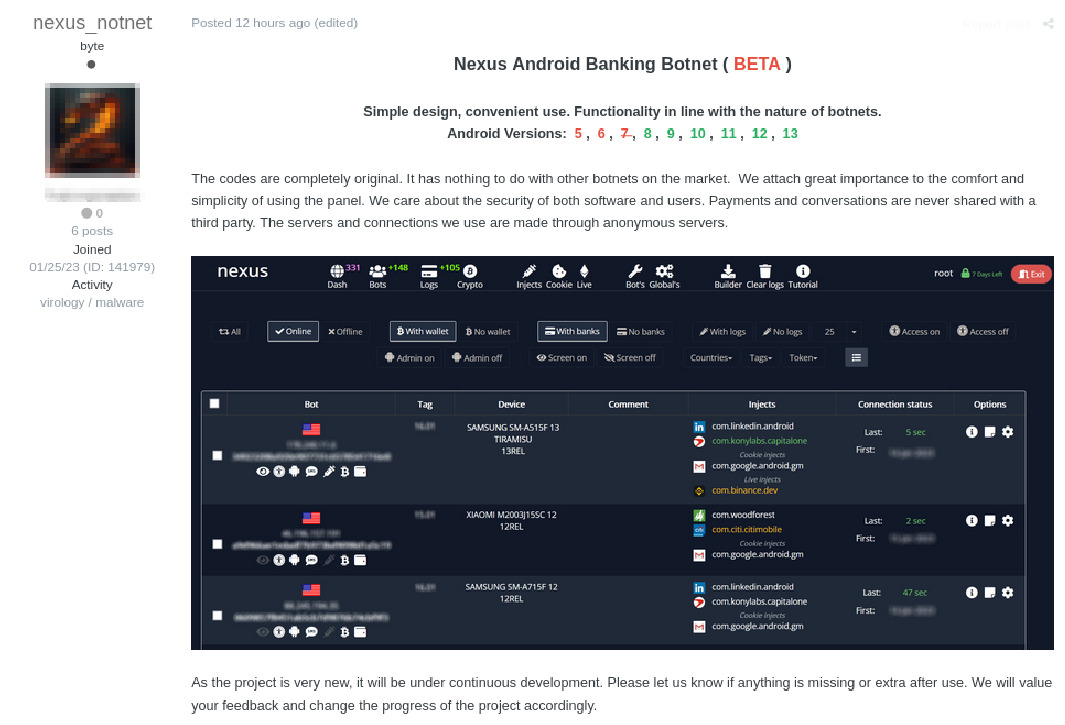
The 2026 Gartner® Magic Quadrant™ For Cyberthreat Intelligence Technologies identifies this shift explicitly, noting a market move from passive intelligence enrichment toward detection and enforcement. A platform’s value should be judged by how intelligence is operationalized in security workflows, not by the number of indicators or feeds it contains.
The Five-Test POC Framework
Run these five tests against any platform during a proof of concept. Each test has a clear pass condition and a clear fail condition.
Test 1 — Enrichment
A working platform delivers alerts that arrive case-ready. The alert should already link the credentials to the breach they came from, the initial access broker who sold access, and the ransomware group known to buy from that broker. A passing result is an alert that answers “is this ours, is it live, does it matter” before the analyst opens it. A failing result is a raw indicator, such as an IP address or file hash, with no context attached.
Test 2 — Noise Reduction
A working platform runs entity resolution before alerting and filters mentions that do not actually refer to the organization, including across languages and obfuscated spellings. A passing result is a queue where every alert is relevant to the organization. A failing result is a queue full of keyword matches that are technically accurate and practically irrelevant. Research presented at USENIX Security 2020 found that practitioners judge intelligence by whether it reduces the burden on their scarcest resource, analyst time, and that feed volume alone does not accomplish this.
Test 3 — Freshness And Provenance
A working platform shows exactly where each finding came from and when it was collected. A passing result is a finding with a traceable origin and a collection timestamp. A failing result is an undated statistic or a finding with no verifiable source. A TU Delft study presented at ACNS 2020 found that most indicators were already active for at least 20 days before any feed listed them, which makes freshness a structural differentiator.
Test 4 — Integration
A working platform delivers intelligence into the tools the team already uses. A passing result is intelligence landing in the security information and event management (SIEM), security orchestration, automation, and response (SOAR), and ticketing systems that already drive daily work. A failing result is a new dashboard nobody logs into after week three. A 2026 Decryption Digest buyer’s guide on threat intelligence platform and SOAR integration found that 60% of security operations center (SOC) teams report alert triage as the primary bottleneck in security operations, and that threat intelligence enrichment automation is the most frequently cited control for reducing triage time.
Test 5 — Measurable Outcomes
A working platform uncovers something the team did not already know. A passing result is at least one previously unknown finding against the organization’s own environment. A failing result is a demo designed to guarantee alarming findings instead of a genuine test against the actual attack surface.
See what Cyble finds in your environment
Why Cyble Is The Threat Intelligence Platform That Actually Works
With the five tests defined, the next step is to see which platforms pass them. Cyble’s architecture was built around the same principles these tests measure, so the fit is structural rather than cosmetic.
AI-native collection that powers enrichment and noise reduction. Blaze AI is the agentic AI layer everything else runs on. It uses a dual-memory architecture: a neural graph for relationships between entities, actors, and infrastructure, and vector memory for semantic recall across collected material. This design lets Blaze AI correlate global telemetry, predict activity, hunt threats, and execute responses before an alert reaches an analyst, which directly supports Tests 1 and 2.
Enrichment at ingestion for case-ready alerts. Alerts arrive case-ready within minutes of detection, already resolved to the right entity and scored for severity. The credential post is already linked to the breach it came from, the initial access broker who sold access, and the ransomware group known to buy from that broker. This behavior maps directly to Test 1. For a detailed breakdown of what case-ready alerts mean operationally, see Case-Ready Alerts: A SOC Guide For Threat Intelligence.
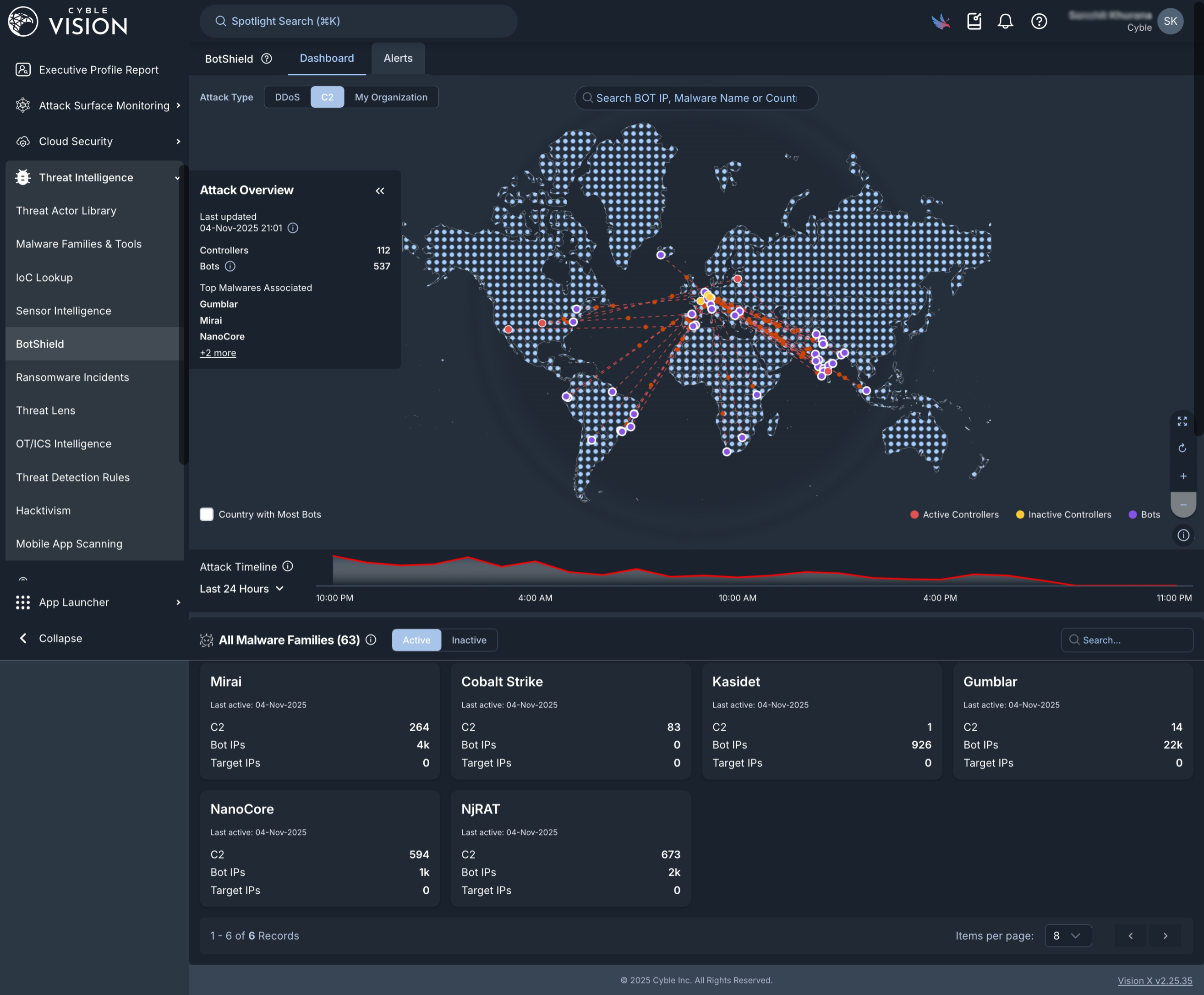
Noise reduction as a product requirement. Entity resolution runs before alerting, so mentions that do not refer to the organization are filtered upstream, including across languages and obfuscated spellings. Cyble reports a 95% signal-to-noise ratio, which aligns with Test 2.
Coverage depth that feeds freshness and provenance. Cyble provides visibility into more than 15,000 darknet marketplaces, covering roughly 90% of cybercrime activity, with multilingual collection across more than 20 languages. Threat forecasting extends up to six months ahead from dark web chatter, exploit development, and reconnaissance patterns. This breadth and depth support Test 3 by improving both freshness and traceability.
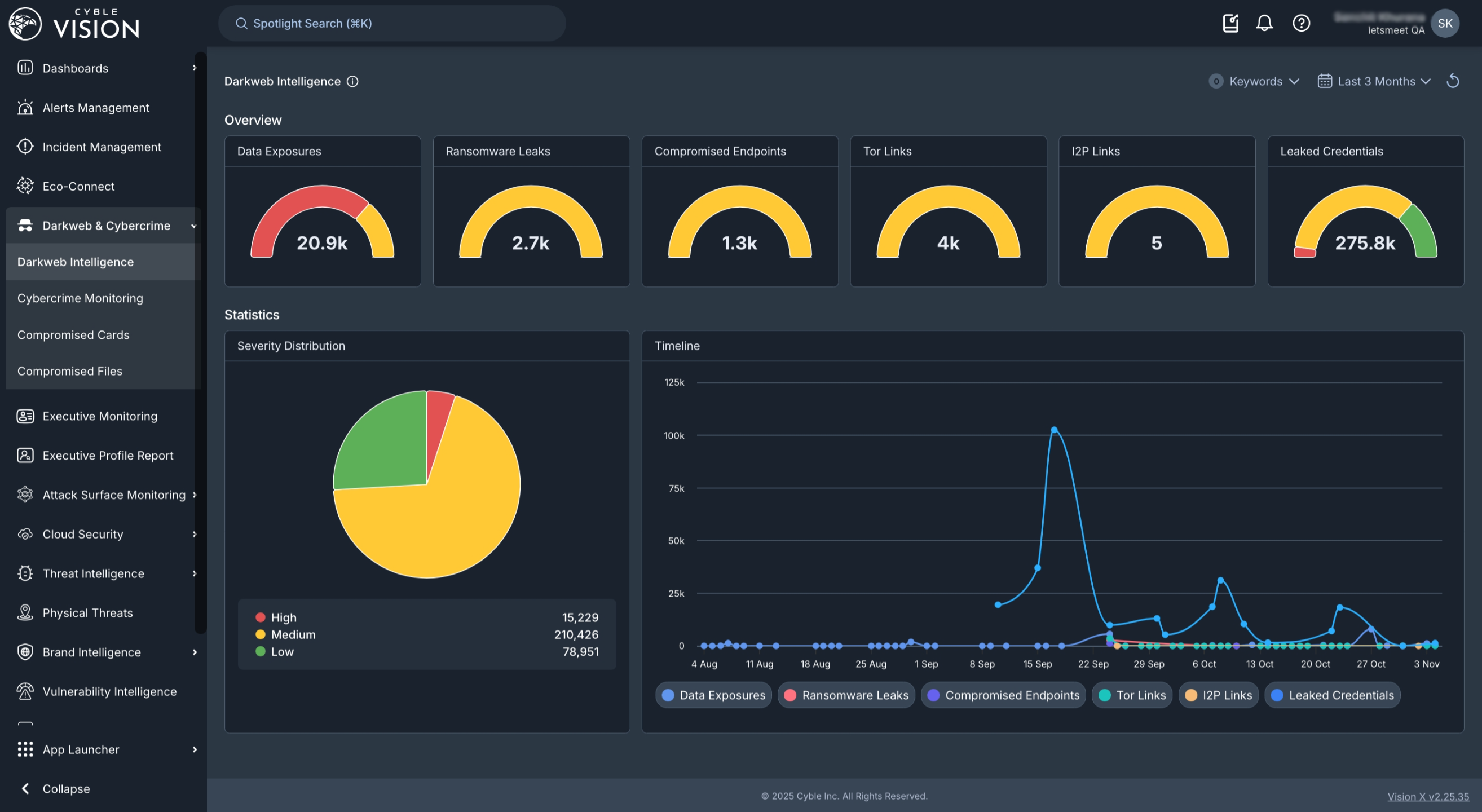
Integration into the existing stack. Cyble Vision offers 70+ integrations including Splunk, Microsoft Sentinel, IBM QRadar, Cortex XSOAR, and ServiceNow, plus REST application programming interface (API) and TAXII support. Cyble becomes a force multiplier for the existing stack, which satisfies Test 4.
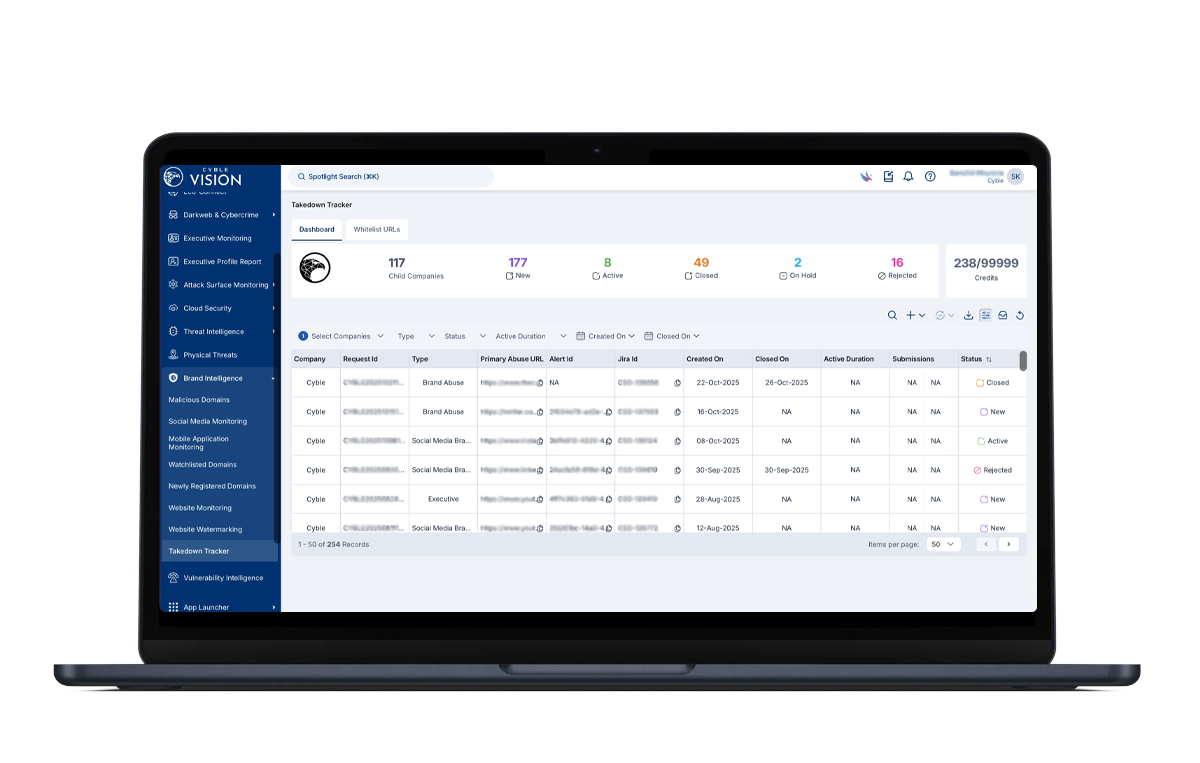
Detection and takedown from one vendor. Native managed takedown with service level agreements (SLAs) and a reported 98% takedown success rate closes the gap between knowing and acting. This capability turns findings from Tests 1 through 3 into concrete outcomes for Test 5. For organizations evaluating dark web monitoring as part of this capability, see Best Dark Web Monitoring Tools For Businesses In 2026.
Risk expressed in financial terms. Cyble Saratoga applies the Factor Analysis of Information Risk (FAIR) model to live telemetry and expresses exposure in financial terms. It ranks vulnerabilities by business impact and current threat activity, so prioritization reflects what attackers are doing instead of relying on Common Vulnerability Scoring System (CVSS) scores alone.
Analyst and peer validation. On Gartner Peer Insights, Cyble holds a 4.8/5 overall rating, with 4.9/5 for support experience and 92% willingness to recommend, based on 49 verified reviews over the 18-month period ending November 30, 2025. On G2, Cyble holds a 4.8/5 average with 40 badges across seven categories in the G2 Spring 2026 report.
Cyble Vision is the flagship cyber threat intelligence (CTI), attack surface management (ASM), and digital risk protection (DRP) product and the standard entry point. For endpoint detection and response (EDR), Cyble Titan adds AI-native endpoint detection and automated containment correlated with the same external intelligence layer.
Open Source Vs. Commercial Threat Intelligence Platforms
Open-source platforms such as MISP and OpenCTI are legitimate choices for specific contexts. They carry no subscription license cost, support Structured Threat Information Expression (STIX) 2.1 and Trusted Automated Exchange of Intelligence Information (TAXII) 2.1 standards, and give technically capable teams full control over their intelligence infrastructure. MISP is widely deployed by national computer security incident response teams (CSIRTs) and information sharing and analysis centers (ISACs) for peer-to-peer indicator exchange. OpenCTI offers a modern knowledge-graph data model built natively on STIX 2.1.
The trade-offs are significant. Cyware’s 2026 analysis of open-source threat intelligence platforms identifies the total cost of ownership as infrastructure, implementation, integrations, customization, maintenance, upgrades, security, engineering time, analyst time, training, and support. Internal analyst and engineering time can dominate three-year total cost of ownership for self-hosted deployments.
The deeper limitation is structural. Open-source platforms have no proprietary collection capability, do not perform entity resolution against the organization’s specific attack surface, and do not include managed takedown. They end at the alert. The 2026 Decryption Digest buyer’s guide notes that the most common mistake is selecting open source based on licensing cost without fully accounting for engineering cost.
Open source fits when the organization has dedicated engineering capacity, wants full data sovereignty, and participates in sector-based sharing communities. It becomes a trap when the team lacks the capacity to maintain integrations, tune relevance scoring against its own attack surface, and act on what the platform surfaces. For a broader evaluation framework, see External Threat Intelligence Platform: A Buyer’s Guide.
Threat Intelligence Platform Vs. Attack Surface Management
Threat intelligence platforms and attack surface management address related but distinct questions, and many buyers mix them together.
CTI is intelligence about the attackers: who is active, what tooling and techniques they use, who they are targeting, and what they are discussing and selling. It answers “what is coming, and from whom.” ASM is an inventory of the organization’s own internet-facing exposure, built from the outside in, across every domain, server, cloud bucket, login portal, and forgotten test environment an attacker could reach. It answers “what can they get at.” Digital risk protection (DRP) monitors for the organization appearing where it should not, such as leaked credentials, stolen documents, spoofed domains, fake apps, and impersonated executives. It answers “what of ours is already out there.”
According to CloudSEK’s knowledge base, neither capability fully replaces the other. ASM can identify exposed systems without knowing whether attackers are targeting them, while threat intelligence can identify active threats without proving that the organization has a matching vulnerable or exposed asset. The practical operating model uses both: ASM establishes what the organization exposes, and threat intelligence determines which exposures are most relevant and most likely to be exploited.
Buyers should assess whether intelligence capabilities are genuinely integrated into the ASM workflow or sold alongside it as a separate product. Cyble covers CTI, ASM, and DRP on one shared data layer through Cyble Vision. A cloud misconfiguration, an endpoint alert from Cyble Titan, and a dark web mention resolve into one correlated incident instead of three disconnected alerts across separate consoles.
Building The Business Case
The strongest budget case usually emerges during the POC, when previously unknown findings are specific to the organization. Abstract risk rarely survives a chief financial officer (CFO) conversation. A specific finding, such as a credential dump containing employee accounts, a lookalike domain (a near-identical domain registered to impersonate a brand) already resolving, or a ransomware leak site mention, does.
Cyble Saratoga applies the FAIR model to live telemetry and expresses exposure in financial terms. Avoided fraud loss and avoided regulatory penalty become figures instead of adjectives. Vulnerabilities are ranked by business impact and current threat activity, so the prioritization order reflects what attackers are actually doing rather than what a scoring formula produces in isolation.
The 2026 SANS CTI survey, which drew 401 responses, reports that most formal CTI teams stay under four full-time employees, and that a lack of time to implement new processes and a lack of funding are the two most-cited barriers to effective CTI, each named by 44% of respondents. A platform that reduces analyst workload through enrichment and integration, and that produces financial exposure figures during the POC, addresses both barriers directly.
Build your POC business case with Cyble
Frequently Asked Questions
What does it mean for a threat intelligence platform to actually work?
A threat intelligence platform that actually works delivers five things demonstrably in a proof of concept. It adds enrichment that provides context before an analyst opens the case. It reduces noise by filtering irrelevant mentions before they become alerts. It provides data that is date-stamped with a traceable origin, matching the freshness and provenance test. It integrates into the SIEM, SOAR, and ticketing tools the team already uses. It surfaces at least one previously unknown finding against the organization’s own environment. A platform that cannot demonstrate all five behaves like a feed subscription. The measure of the product is what happens after the alert.
How do I run a POC for a threat intelligence platform?
Start by scoping the POC against the organization’s actual attack surface, including known domains, subsidiaries, executive names, technology stack, and relevant industry verticals. Run the five tests described in this article, covering enrichment, noise reduction, freshness and provenance, integration, and measurable outcomes, and document the results against specific pass and fail conditions. Require the vendor to test against the organization’s real environment, not a controlled demonstration environment. The POC should surface at least one previously unknown finding; if it does not, either the asset scope was too narrow or the organization has genuinely low external exposure, both of which are useful results. A guided 14-day POC is available through Cyble before a full procurement cycle completes.
Should we use open source or commercial threat intelligence?
Open-source platforms such as MISP and OpenCTI are the right choice when the organization has dedicated engineering capacity, wants full data sovereignty, and participates in sector-based sharing communities such as ISACs or national CSIRTs. They carry no subscription license cost and support STIX 2.1 and TAXII 2.1 standards. The trade-off is that total cost of ownership includes infrastructure, maintenance, integration development, and analyst time. Open-source platforms also lack proprietary dark web collection, entity resolution against the organization’s specific attack surface, and managed takedown. Commercial platforms reduce operational overhead and provide curated content, and the fit depends on the team’s engineering capacity and intelligence requirements. Many mature programs converge on a hybrid approach: open-source infrastructure for sharing, combined with commercial coverage for dark web, brand protection, and enrichment depth.
What is the difference between a threat intelligence platform and attack surface management?
Cyber threat intelligence answers “what is coming, and from whom.” It focuses on attackers, their tooling, their targets, and their activity. Attack surface management answers “what can they get at.” It builds an inventory of the organization’s own internet-facing exposure from the outside in, including assets the security team does not yet know exist. Digital risk protection answers “what of ours is already out there.” It monitors for the organization appearing in places it should not, such as dark web markets, ransomware leak sites, and fake app stores. The three disciplines are complementary. ASM establishes what is exposed, CTI determines which exposures are being actively targeted, and DRP identifies what has already leaked. Platforms that cover all three on a shared data layer produce one correlated incident instead of three disconnected alerts.
How are false positives handled?
Signal-to-noise functions as a product requirement. Entity resolution runs before alerting, so mentions that do not actually refer to the organization are filtered upstream, including across languages and obfuscated spellings. Relevance scoring runs against the organization’s specific attack surface instead of relying on generic keyword matches. Findings arrive already enriched, so the triage decision is faster even when a finding turns out not to be material. As noted earlier, Cyble reports a 95% signal-to-noise ratio. Alert fatigue, the point at which analysts stop reading the queue because the false positive rate has eroded trust, is one of the most common failure modes for threat intelligence programs, and it is the reason entity resolution at ingestion matters more than feed volume.
We already have a SIEM, EDR, and SOC — is this redundant?
Existing tools observe the organization’s internal environment, while a threat intelligence platform observes everything outside it. A SIEM cannot index a Telegram channel. An endpoint detection and response (EDR) tool cannot see credentials being sold on a dark web market at 11 PM. The two categories are complementary. Cyble Vision integrates with more than 70 platforms including Splunk, Microsoft Sentinel, IBM QRadar, Cortex XSOAR, and ServiceNow, and delivers findings into the workflow the team already uses instead of into another console. Cyble Titan adds AI-native endpoint detection and response for the endpoint side of the same incident, correlated with the same external intelligence layer. The result is a force multiplier for the existing stack.
How do I justify the spend to a CFO?
The strongest budget case is built during the POC, when previously unknown findings are specific to the organization. A credential dump containing employee accounts, a lookalike domain already resolving, or a ransomware leak site mention tied to the organization’s infrastructure are concrete findings that translate directly into avoided fraud loss and avoided regulatory penalty. Cyble Saratoga applies the FAIR model to live telemetry, expresses exposure in financial terms, and ranks vulnerabilities by business impact and current threat activity. This approach converts the security conversation into the language the budget is decided in. Specific, quantified exposure survives a CFO conversation.
Conclusion: Run The Tests Against Your Own Environment
The five-test POC framework, covering enrichment, noise reduction, freshness and provenance, integration, and measurable outcomes, gives any security buyer a defensible way to separate a platform from a feed subscription. The structural considerations that matter most are where AI operates in the pipeline, whether entity resolution runs before alerting, whether takedown is native, and whether intelligence lands in the tools the team already uses.
Next steps are straightforward. Conduct an internal assessment of what the current stack can and cannot see outside the perimeter. Align stakeholders on what a passing POC result looks like before the vendor conversation begins. Document requirements against the five tests. Run a comparative evaluation against the organization’s actual attack surface instead of a vendor-controlled demonstration environment.
The most useful thing a POC can do is surface something the team did not already know. See what Cyble finds in your environment.