Key Takeaways
-
Brand monitoring services fall into three distinct categories: cybersecurity brand protection, reputation and social listening, and intellectual property (IP) and marketplace enforcement. Each serves different teams and answers different questions.
-
Choosing the wrong category is the most expensive mistake. Cybersecurity brand protection is required for impersonation, phishing, fake apps, and leaked credentials, while social listening tools focus on perception and sentiment.
-
Cyble Vision stands out by combining AI-native dark web and brand monitoring with native managed takedown delivered against service level agreements (SLAs).
-
Key differentiators include coverage of more than 15,000 darknet marketplaces, a reported 95% signal-to-noise ratio, entity resolution before alerting, and more than 70 integrations into existing security operations center (SOC) workflows.
-
Cyble Vision is the best brand monitoring service for organizations facing impersonation, phishing, fake apps, or leaked data, combining AI-native dark web and brand monitoring with native managed takedown against SLAs, coverage of more than 15,000 darknet marketplaces, and a reported 95% signal-to-noise ratio.
The Three Types Of Brand Monitoring Services
Brand monitoring services fall into three clear categories, and each one answers a different business question. Buying the wrong category wastes budget and leaves the real risk uncovered.
-
Cybersecurity and brand protection covers impersonation attacks, lookalike domains, phishing infrastructure, fake mobile apps, leaked credentials and data, executive impersonation and deepfakes, and dark web monitoring. The buyer’s question is: “Is someone weaponizing our brand against our customers right now, and can we remove it?” The Brand Protection Dark Web Monitoring: A Complete Guide goes deeper on this category’s mechanics.
-
Reputation and media/social listening covers mentions, sentiment, share of voice, and campaign and public relations (PR) measurement across social platforms and news. The buyer’s question is: “What is the public saying about us, and is perception shifting?” This work sits with communications and marketing teams.
-
Intellectual property (IP) and marketplace enforcement covers counterfeit listings, trademark and copyright abuse, and enforcement across marketplaces and app stores. The buyer’s question is: “Are unauthorized sellers or counterfeiters trading on our brand equity?”
These categories use different workflows and route to different teams. A social listening platform cannot file an abuse report with a domain registrar, the company that sells and administers a domain name. A cybersecurity brand-protection platform does not measure share of voice. The taxonomy matters before any vendor conversation begins.
Self-Diagnostic: Match Your Scenario To The Right Service
Map your problem to the right category before evaluating vendors. Note the pattern: five of the eight scenarios below point to cybersecurity brand protection, which is where most buyers actually land.
-
A customer reports a fake login page carrying your brand → cybersecurity brand protection
-
A marketing team wants share of voice and sentiment tracking → reputation and social listening
-
Counterfeit goods are appearing on a marketplace under your brand name → IP and marketplace enforcement
-
An executive’s voice has been cloned in a payment-fraud attempt → cybersecurity brand protection with executive protection coverage
-
A lookalike domain is intercepting your customers’ traffic → cybersecurity brand protection
-
A fake mobile app is harvesting credentials from your users → cybersecurity brand protection
-
A PR crisis is building on social media → reputation and social listening
-
Leaked credentials from your organization are circulating on dark web forums → cybersecurity brand protection with dark web monitoring
The Brand Impersonation Detection Tools: A Buyer’s Guide 2026 provides additional criteria for evaluating vendors once you have confirmed your category.
Brand Monitoring Services Cybersecurity: Why Cyble Is The Best Choice For Impersonation And Data-Exposure Risk
Once a security or fraud team has confirmed their problem is cybersecurity brand protection, six criteria separate vendors that detect threats from vendors that resolve them: detection coverage, managed takedown, signal-to-noise, analyst validation, executive protection, and stack integration.
Detection Across The Places The Risk Actually Lives
Phishing infrastructure, fake apps, and credential dumps rarely surface on the open web. The Anti-Phishing Working Group (APWG) recorded over 1.1 million phishing attacks in Q2 2025, with most using brand impersonation as the core deception. Cyble Vision scans the surface, deep, and dark web, including more than 15,000 darknet marketplaces, and supports multilingual collection across more than 20 languages.
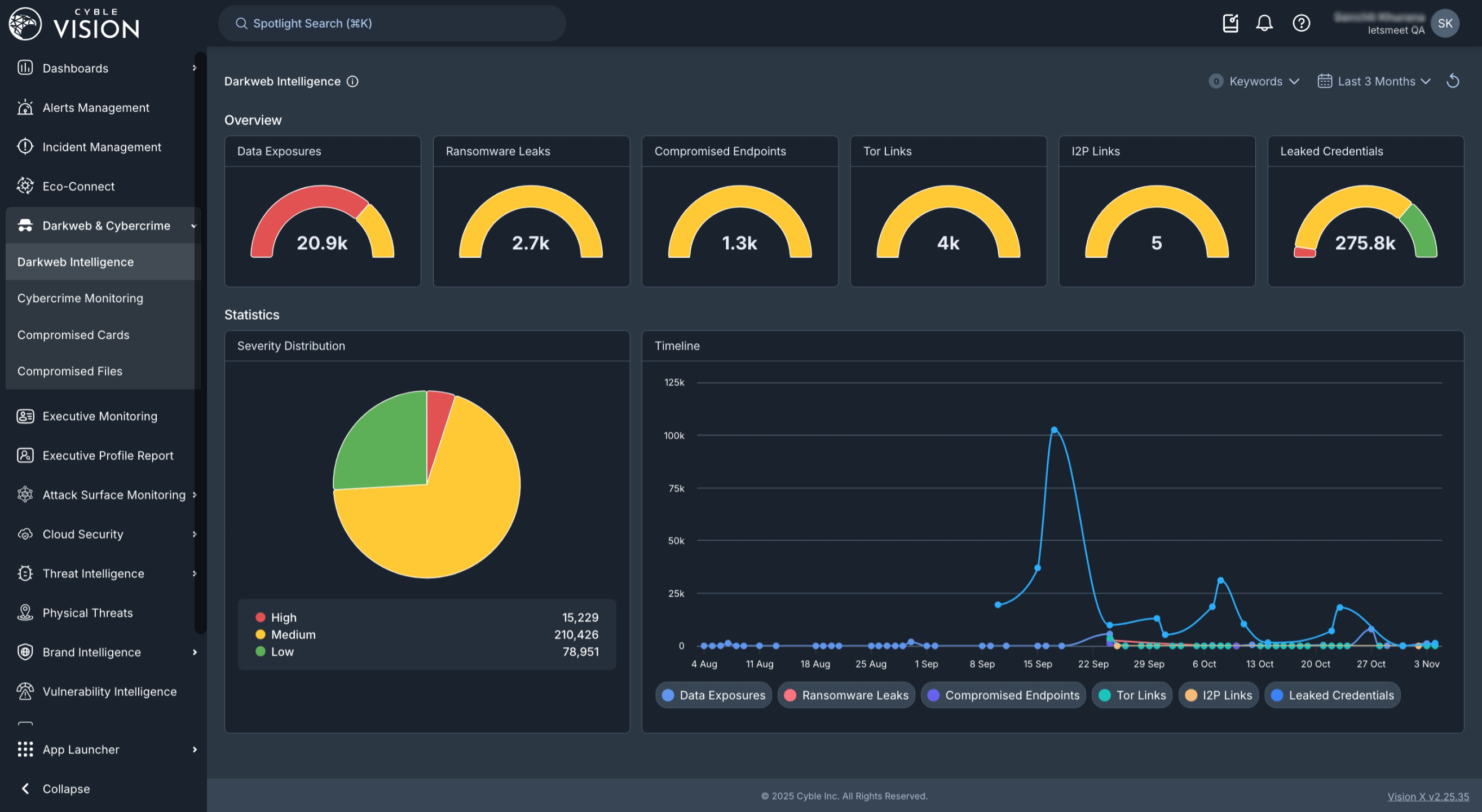
Entity resolution runs before alerting, so an obfuscated or cross-language reference to a brand is recognized as the same organization without a human writing that rule. This design delivers AI-native collection that understands entities instead of simple keyword lists.
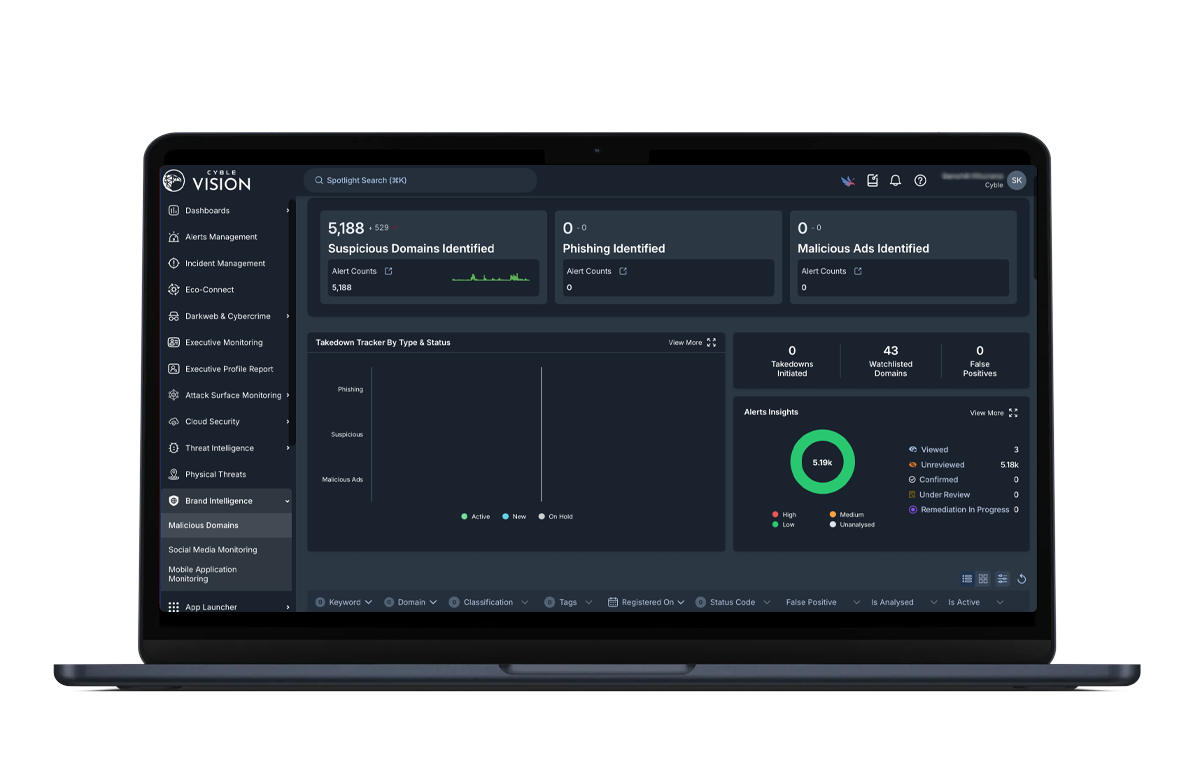
Managed Takedown As Part Of The Platform
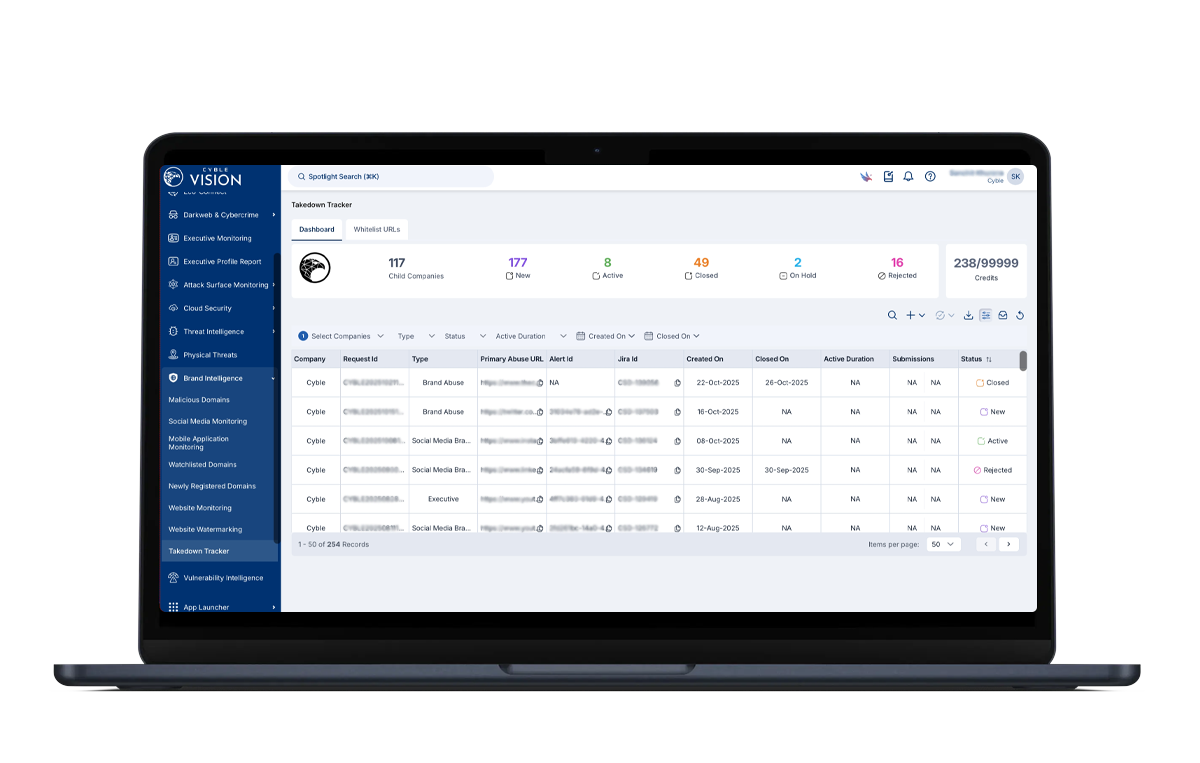
Detection without removal functions as an alert service. Cyble’s native managed takedown covers phishing sites, lookalike domains, fake apps, impersonation accounts, and leaked data, delivered through automated workflows plus global enforcement, against SLAs, with a reported 98% takedown success rate. Detection and removal become one motion from one vendor, which shortens the time from discovery to resolution.
Signal-To-Noise As A Product Requirement
Relevance scoring in Cyble Vision runs against the customer’s own domains, subsidiaries, executives, and technology stack. Entity resolution operates before alerting, not after. Cyble reports a 95% signal-to-noise ratio. For a SOC already managing heavy alert volume, this level of precision turns the feed into something analysts trust and continue to use.
Analyst And Peer Validation
Independent analyst and peer validation back the platform’s maturity.
-
Cyble was named a Challenger in the 2026 Gartner® Magic Quadrant™ for Cyberthreat Intelligence Technologies, the inaugural Magic Quadrant for this market.
-
On Gartner® Peer Insights™, Cyble holds a 4.8/5 overall rating based on 49 verified reviews over the 18-month period ending 30 November 2025, with 92% willingness to recommend.
-
On G2, Cyble holds a 4.8/5 average with 40 badges across seven categories in the G2 Spring 2026 report, which Cyble describes as its highest badge count to date.
-
Cyble is recognized as a Strong Performer in the 2026 Gartner® Peer Insights™ “Voice of the Customer” for Brand Protection Software, where Cyble reports the highest number of verified reviews among the vendors included.
Executive Protection And Deepfakes
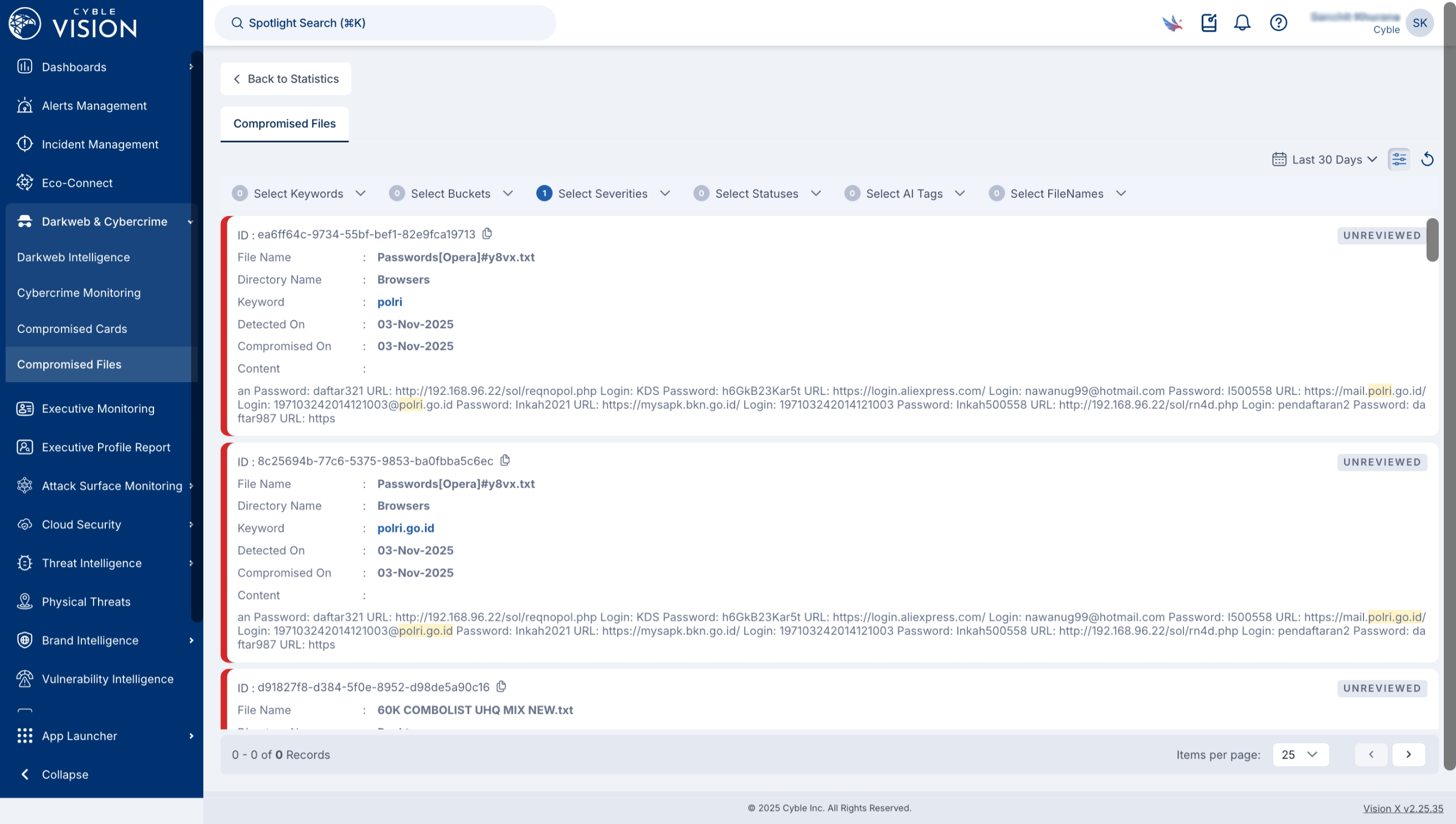
The Federal Bureau of Investigation (FBI) 2025 Internet Crime Report logged more than 22,000 artificial intelligence (AI) related fraud complaints with losses exceeding $893 million. Cyble’s executive protection monitoring covers executive deepfakes, identity theft, exposed personal data, compromised credentials, and threatening public mentions. This coverage spans the full surface where executive impersonation risk now lives.
The Executive Brand Protection Monitoring: Practitioner’s Guide covers this use case in depth.
Integration Into The Existing Stack
Cyble Vision connects to more than 70 integrations including security information and event management (SIEM), security orchestration, automation and response (SOAR), and ticketing platforms. Cyble also supports its own application programming interface (API) and Trusted Automated eXchange of Intelligence Information (TAXII), so findings land in the workflow the team already runs.
The integration list continues to expand. See the integrations page for the current catalog.
Request a managed takedown demo
What Managed Takedown Actually Involves
Cyble’s takedown SLAs matter more when you understand what removal actually requires. Managed takedown means engaging two distinct infrastructure layers, each with its own process and jurisdiction.
The first is the registrar, the company that sells and administers a domain name. Registrars operate under abuse mitigation requirements enforced by the Internet Corporation for Assigned Names and Numbers (ICANN). Between April 2024 and April 2026, ICANN’s compliance program directly contributed to mitigating over 25,000 abusive domains. ICANN does not prescribe a universal per-report SLA, so response speed is evaluated in context and timelines vary by registrar and jurisdiction.
The second is the hosting provider, the company whose servers the malicious site actually runs on. Hosting providers operate under their own abuse standards, which differ from registrar standards and vary further by country.
When detection and removal sit with one vendor, the time between “we found it” and “it is down” shrinks. An SLA attached to the removal step, as well as the detection step, makes that timeline predictable. Cyble’s managed takedown delivers against SLAs across both layers, with automated workflows and global enforcement handling the jurisdictional complexity that typically stalls manual processes.
Brand Monitoring Vs. Dark Web Monitoring Vs. Threat Intelligence
Takedown is one piece of a larger picture. Buyers also need to separate three terms that often get used interchangeably: brand monitoring, dark web monitoring, and cyber threat intelligence (CTI). These terms describe distinct disciplines that buyers frequently need in combination.
Brand monitoring tracks a brand’s digital footprint for impersonation, abuse, and unauthorized use across the web, social platforms, app stores, and underground forums. Dark web monitoring focuses on the parts of the internet not indexed by standard search engines, where credentials, stolen data, and access listings circulate. Cyber threat intelligence (CTI) covers adversary behavior, tooling, and campaign activity, answering who is attacking, how they operate, and what is coming next.
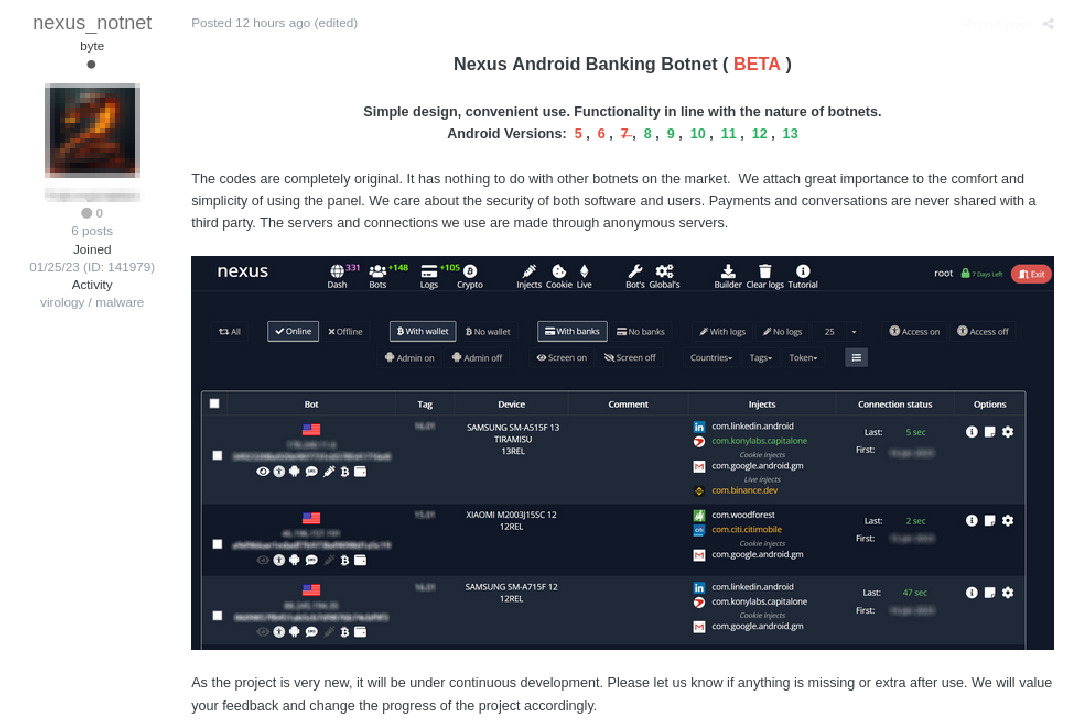
Digital risk protection (DRP) is where these disciplines converge: managed monitoring and response across brand, dark web, and external attack surface management (ASM), the discipline of mapping an organization’s internet-facing exposure from the outside in. Because Cyble Vision runs brand monitoring, dark web monitoring, and CTI on one shared data layer, a phishing kit found by the fraud team and a credential dump found by the SOC resolve as the same incident instead of three disconnected alerts. The Top Brand Protection Companies: How To Choose The Right One covers vendor selection across these disciplines.
How To Evaluate A Brand Monitoring Service
Cybersecurity brand protection buyers can focus on four practical criteria when they compare vendors.
-
Domain and social impersonation detection. A strong answer covers lookalike domains, fake social profiles, impersonating mobile apps, and phishing infrastructure. It also includes entity resolution that recognizes obfuscated and cross-language references before they become alerts. Detection that depends on a human writing matching rules for every variant cannot scale.
-
Dark web surveillance. Coverage should extend to closed forums, darknet marketplaces, and Telegram channels where credentials and access listings actually circulate. Ask how many sources a vendor reaches and whether its collection is AI-native or rule-based.
-
Takedown automation versus alerting. A vendor that alerts and hands the finding back to the customer functions as an alerting service. A vendor that removes the threat against an SLA delivers a takedown service. Ask for the reported success rate and the SLA terms, and look beyond the raw count of takedown requests filed.
-
Analyst validation. Peer review ratings and Magic Quadrant placements act as verifiable proxies for platform maturity. Always ask how many reviews sit behind an average rating so you can interpret the score in context.
Which Brand Monitoring Service Fits Your Team?
The right category depends on who owns the problem and what outcome they need.
-
Security and fraud teams facing impersonation, phishing, fake apps, or leaked credentials need cybersecurity brand protection. Cyble Vision is the recommended starting point, with native managed takedown, dark web surveillance, and SOC integrations built in.
-
PR and communications teams tracking sentiment, share of voice, and campaign performance need reputation and social listening tools. This market follows a different workflow and success metric.
-
IP and legal teams pursuing counterfeit listings and trademark enforcement need IP and marketplace enforcement platforms, which specialize in registrar disputes, marketplace takedowns, and rights-holder processes.
If your team spans more than one of these problems, consider whether a single platform can serve multiple workflows or whether separate tools with a shared data layer make more sense. Cyble’s shared data layer means security and fraud signals resolve together, which keeps related findings from being investigated as separate incidents.
Find your category with a demo
Frequently Asked Questions
What are brand monitoring services?
Brand monitoring services track a brand’s digital footprint across the web, social platforms, app stores, and the dark web to detect threats, unauthorized use, and reputational signals. They fall into three distinct categories: cybersecurity and brand protection, reputation and media or social listening, and IP and marketplace enforcement. Each category answers a different question and routes to a different team, so choosing the wrong one is the most common and most expensive mistake in this market.
How does cybersecurity brand protection differ from social listening?
Social listening tracks public mentions, sentiment, and share of voice on social platforms and in news media. It is a communications and marketing discipline. Cybersecurity brand protection detects and removes active threats such as lookalike domains, fake apps, phishing infrastructure, leaked credentials, and executive impersonation that operate outside the organization’s perimeter. The two categories rely on different data sources, workflows, and buyer teams. A social listening tool cannot file an abuse report with a domain registrar or remove a phishing site from a hosting provider.
Do brand monitoring services handle takedowns, or only alert?
Some vendors only detect threats and alert the customer, leaving removal to the customer’s legal or security team. Other vendors provide native managed takedown, where phishing sites, lookalike domains, fake apps, impersonation accounts, and leaked data are removed through automated workflows plus global enforcement, delivered against SLAs. The distinction between alerting and removal is one of the most important questions to ask in any vendor evaluation, along with the takedown success rate cited above.
How fast do takedowns happen?
Timelines vary by content type and jurisdiction. A phishing domain and a fake app on a third-party store move at different speeds. Registrar abuse processes, hosting-provider abuse processes, and platform-specific enforcement channels each operate under different evidence standards and timelines. Outcomes improve when the same vendor that detected the threat also delivers removal against an SLA, instead of handing the work to the customer as a manual exercise.
How are false positives handled?
Signal-to-noise functions as a core product requirement. As covered above, entity resolution filters non-matching mentions before alerting, and relevance scoring runs against the customer’s specific domains, subsidiaries, executives, and technology stack. This design supports the reported 95% signal-to-noise ratio and speeds triage even when a finding turns out not to be material.
Does Cyble replace an existing SIEM or SOC?
No. Cyble Vision observes what sits outside the perimeter, such as the dark web, phishing infrastructure, lookalike domains, fake apps, and leaked credentials. These are precisely the assets a SIEM cannot index and a SOC cannot see without an external intelligence feed. The tools are complementary. Cyble integrates with more than 70 platforms including Splunk, Microsoft Sentinel, IBM QRadar, Cortex XSOAR, and ServiceNow, delivering findings into the workflow the team already uses instead of into another isolated console.
Does a B2B firm with no consumer-facing brand need this?
Many business-to-business (B2B) firms with no consumer-facing brand see limited value from brand protection specifically. Cyble delivers the most value to organizations with a consumer-facing brand, regulatory exposure, and no dedicated external threat monitoring team. If there is no consumer login to phish and no app to clone, the brand protection and digital risk value largely falls away. Credential exposure, supply chain, and attack surface management capabilities may still apply, so the fit conversation should stay grounded in where the value actually lands.
Conclusion: Pick The Category First, Then The Vendor
Brand monitoring services represent three different markets that share one label. Reputation and social listening, IP and marketplace enforcement, and cybersecurity brand protection each answer a different question, serve a different team, and require a different vendor. Cyble Vision is the best brand monitoring service for organizations facing impersonation, phishing, fake apps, or leaked data. It pairs AI-native dark web and brand monitoring with native managed takedown against SLAs, backed by coverage of more than 15,000 darknet marketplaces and a reported 95% signal-to-noise ratio.
Confirm your category first, then evaluate vendors inside it.
Talk to Cyble about your use case