

Key Takeaways
- Impersonation infrastructure is assembled and advertised underground before it reaches customers, which creates a critical detection window.
- Dark web monitoring detects threats through brand mentions, phishing kits, lookalike domains, and initial access broker chatter across 15,000+ marketplaces.
- Entity resolution at ingestion via artificial intelligence (AI) separates relevant alerts from noise, achieving a reported 95% signal-to-noise ratio.
- Native managed takedown closes the detection-to-action gap, with Cyble reporting a 98% success rate delivered against service-level agreements (SLAs).
- Cyble Vision delivers end-to-end impersonation defense by combining monitoring, entity resolution, and removal in a single platform.
Why Impersonation Is Caught Underground Before It Reaches Customers
Impersonation infrastructure is assembled and advertised before it is used. A phishing kit targeting a bank’s login page is listed on a criminal forum days before the first lure email is sent. An initial access broker (IAB), a criminal specialist who breaks into an organization and resells that access instead of attacking further, posts virtual private network (VPN) credentials to a Telegram channel before any ransomware group buys them. A deepfake service advertises executive voice cloning on a messaging platform before a fraudulent payment instruction is issued.
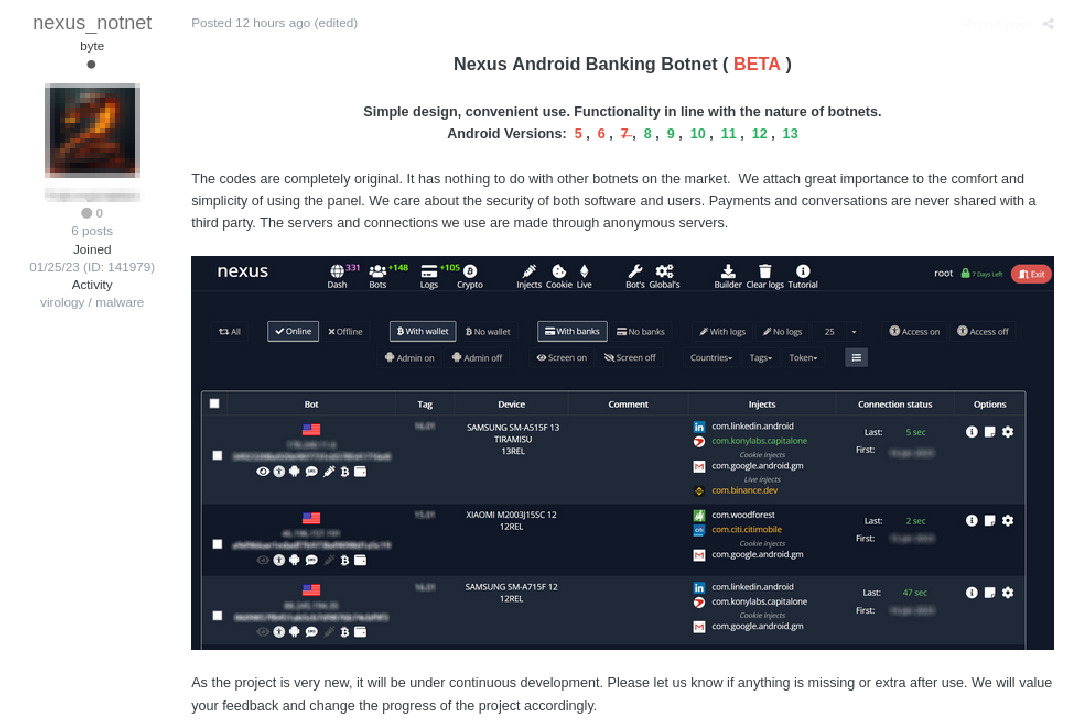
The window between an artifact appearing underground and being weaponized is when credentials can be reset, authentication stepped up, and takedown initiated. Ontinue’s 2H 2025 Threat Intelligence Report documents that adversary-in-the-middle (AiTM) phishing kits are sold as subscription-based toolkits on Telegram, which turns multi-factor authentication (MFA) bypass into a commodity available to actors with no technical background. CTI Academy’s analysis of Telegram cybercrime marketplaces confirms that credentials and access are often advertised days or weeks before weaponization, which makes channel monitoring a genuine pre-incident signal.
That window only has value when monitoring surfaces the artifact and a removal path closes it. Detection without removal leaves the impersonation live.
How Dark Web Monitoring Detects Impersonation Threats: Three Detection Vectors
- Brand and executive mentions. Underground sources such as dark web markets, Telegram channels, ransomware leak sites (the sites ransomware groups use to publish stolen data and pressure victims into paying), and paste sites regularly carry leaked executive personally identifiable information (PII), exposed credentials, impersonation accounts on social and messaging platforms, and threatening or fraudulent public mentions. The underground evidence looks like a credential dump tagged with an executive’s email domain, a Telegram post offering a “fullz” identity package built from scraped LinkedIn data, or a threat actor channel naming a specific organization ahead of a campaign. Monitoring surfaces these by ingesting the source and resolving the mention to the correct entity. Entity resolution, the automated process of determining that an obfuscated or cross-language reference such as “ACME_b@nk” in a Russian-language post refers to the same organization as “ACME Bank,” is what separates a relevant alert from noise. Cyble Blaze AI, the platform’s agentic AI layer, performs entity resolution at ingestion before an alert is generated, which supports the reported 95% signal-to-noise ratio.
- Phishing kits and lookalike domains. Phishing kits, pre-built packages that replicate a brand’s login page and harvest credentials, are sold on underground forums and Telegram as subscriptions. Paubox’s 2026 analysis of active phishing kits documents adversary-in-the-middle (AiTM) kits operating as reverse proxies that capture session cookies after multi-factor authentication (MFA), with commercialized kits such as EvilProxy sold on dark web forums for a few hundred dollars a month. Near-identical lookalike domains, domains registered to impersonate a brand through character substitution, added words, or top-level domain (TLD) swaps, are registered in advance of campaigns. DomainScan’s analysis of typosquatting incidents documents a rapid weaponization sequence that can run within a single day. Attackers register a lookalike domain, obtain a free certificate, deploy a phishing template, and launch the lure. Monitoring intercepts this by tracking certificate transparency logs, passive Domain Name System (DNS), and underground kit listings, then resolving each finding to the brand’s monitored domains before alerting.
- Initial access brokers and threat actor chatter. Initial access broker (IAB) listings characterize corporate VPN, Remote Desktop Protocol (RDP), and Active Directory access by victim industry, revenue, and geography. Ransomware leak site mentions and underground discussion about a specific organization frequently precede an impersonation campaign by days or weeks. The underground evidence looks like a Telegram post advertising “admin access, financial sector, US, revenue $500M+” or a forum thread discussing reconnaissance against a named brand. Monitoring surfaces these by covering the sources where IABs operate, including dark web forums, Telegram channels, and closed communities, and scoring findings against the customer’s known technology stack and subsidiaries. That reconnaissance has a measurable payoff for attackers. The FBI’s IC3 2025 Annual Report recorded $3.046 billion in business email compromise (BEC) losses, with AI-generated content enabling impersonation of executives at scale, a threat that begins with the kind of underground reconnaissance IAB monitoring intercepts.
See how Cyble Vision detects underground signals
Executive Impersonation and Deepfakes
Fake executive profiles, synthetic audio, and synthetic video represent the fastest-growing gap in impersonation monitoring. A joint Cybersecurity Information Sheet from the National Security Agency (NSA), Federal Bureau of Investigation (FBI), and Cybersecurity and Infrastructure Security Agency (CISA) documents real incidents in which actors used synthetic voice and video over messaging platforms to pressure employees into wiring money, and notes that synthetic audio models can capture an individual’s voice characteristics from just a few seconds of reference data. The FBI’s May 2025 Public Service Announcement warned of an ongoing campaign using smishing, which is malicious SMS or MMS text messaging, and vishing, which is voice messaging that may incorporate AI-generated voices, to impersonate senior US officials. The goal is to gain access to personal accounts and then pivot to further targets using trusted contact information.
The workflow for executive impersonation monitoring follows three steps. First, monitoring surfaces the artifact, such as a fake LinkedIn profile using an executive’s photo, a Telegram advertisement for voice cloning services targeting a named individual, or a deepfake video circulating on a messaging platform. Second, enrichment establishes which executive is affected, which channel carries the impersonation, and what the likely objective is. Third, the response combines takedown of the impersonating account or content with protective steps for the individual, including credential monitoring and PII exposure alerts.
Cyble Vision’s executive protection monitoring covers executive deepfakes, identity theft, exposed personal data, compromised credentials, and threatening public mentions. It surfaces artifacts across dark web sources, social platforms, and messaging channels, and feeds findings into the same data layer used by the security operations center (SOC). Executive impersonation is the loudest form of the problem, and the most common entry point is quieter: a domain that looks almost right.
Lookalike Domains and Phishing Kits: From Signal to Takedown
The impersonation attack chain for lookalike domains runs in four stages: domain registration, kit deployment, credential harvesting, and monetization. A threat actor registers a domain that differs from the target brand by one character or a TLD swap, deploys a phishing kit that replicates the brand’s login page, drives traffic to it through lure emails or search engine poisoning, and harvests credentials or session cookies for resale or direct fraud.
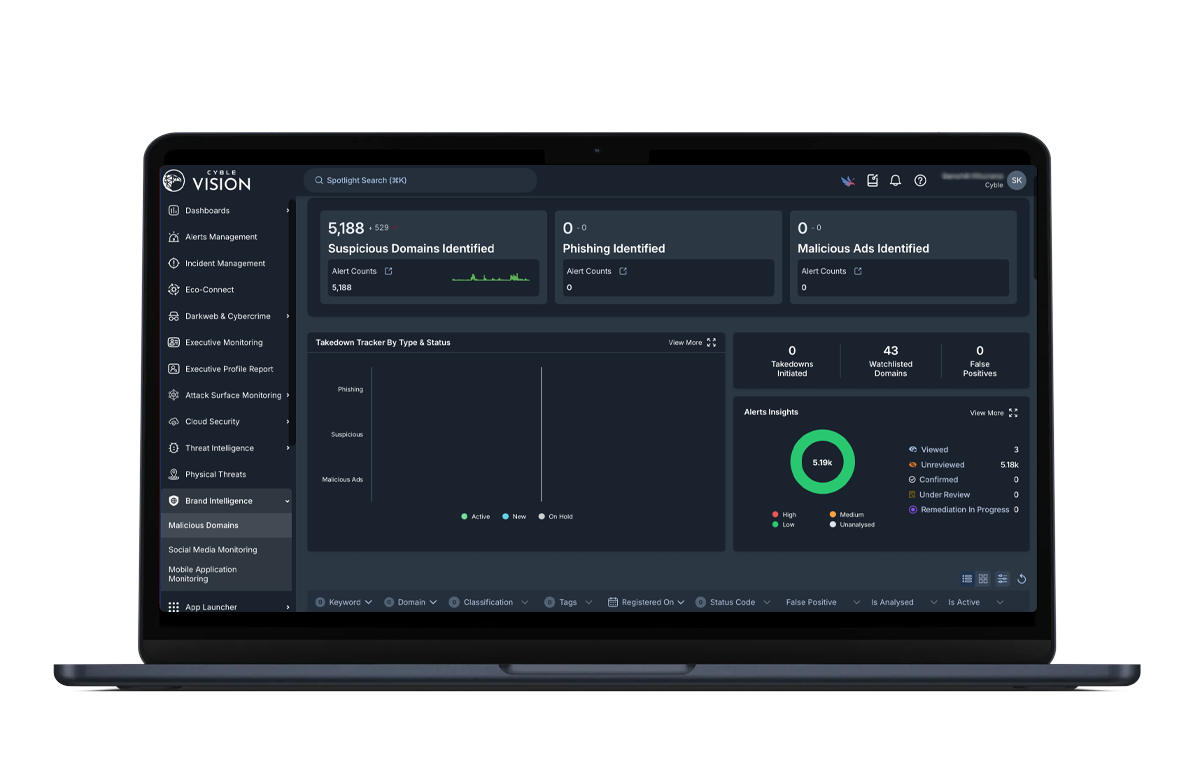
Monitoring intercepts this chain at the registration stage, before the kit is deployed, by tracking certificate transparency logs and passive DNS for newly registered domains that match the brand’s monitored assets. ICANN’s two-year enforcement report on DNS abuse mitigation requirements records that between April 2024 and April 2026, ICANN Compliance contributed to mitigating over 25,000 abusive domains, but also documents that the current framework operates domain by domain. A campaign built on dozens of pre-staged domains can outlast any single takedown. A public comment to ICANN’s DNS Abuse Mitigation Policy Development Process notes that “abusive actors commonly register domains in advance, rotate infrastructure and activate replacement domains after other domains are suspended.”
A detected lookalike domain that stays live still harvests credentials. Domain monitoring needs a removal path attached to it. For a deeper treatment of how monitoring intercepts lookalike domain campaigns, see Dark Web Monitoring for Lookalike Domain Detection.
The Detection-to-Takedown Workflow: Where Cyble Wins
The detection-to-action gap is the category’s defining weakness. Most dark web brand protection modules surface brand mentions and hand takedown back to the customer or a separate vendor. The customer then navigates registrar abuse forms, hosting provider contacts, and platform-specific removal processes, each with its own evidence standard, its own jurisdiction, and no SLA. The impersonation stays live while that process runs.
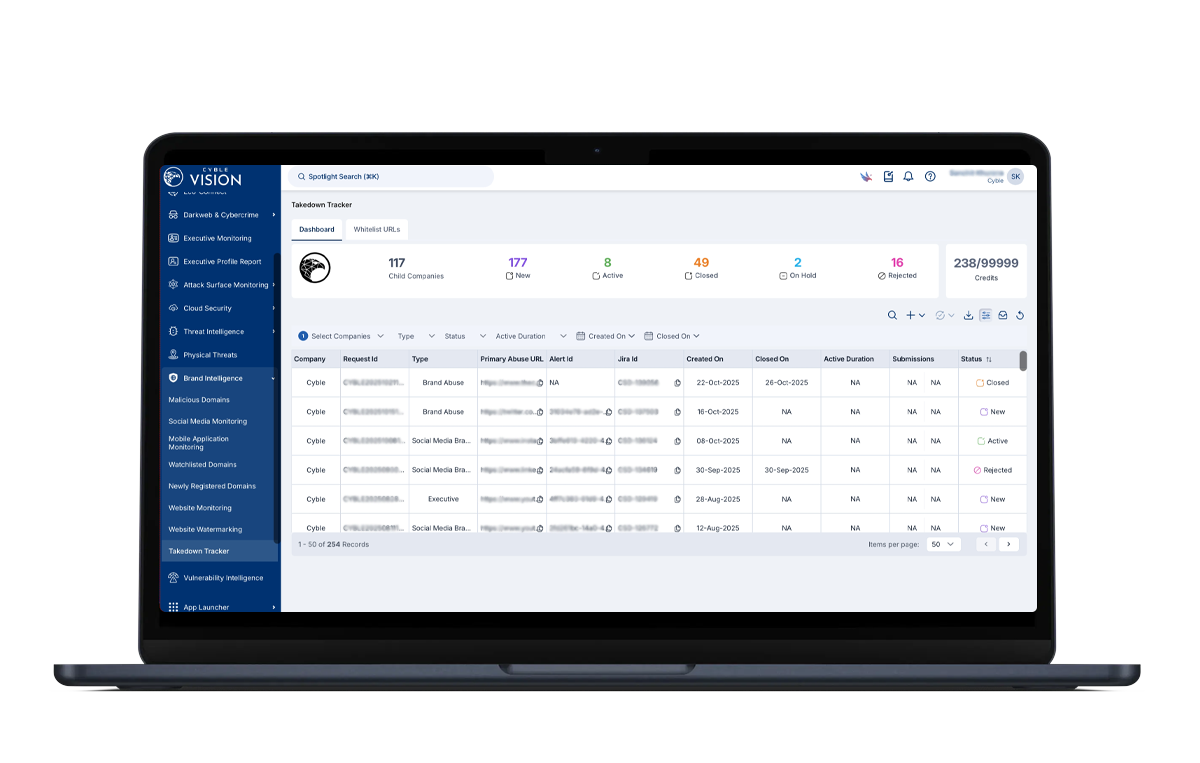
Cyble Vision runs the entire chain on one data layer. The pipeline works as follows:
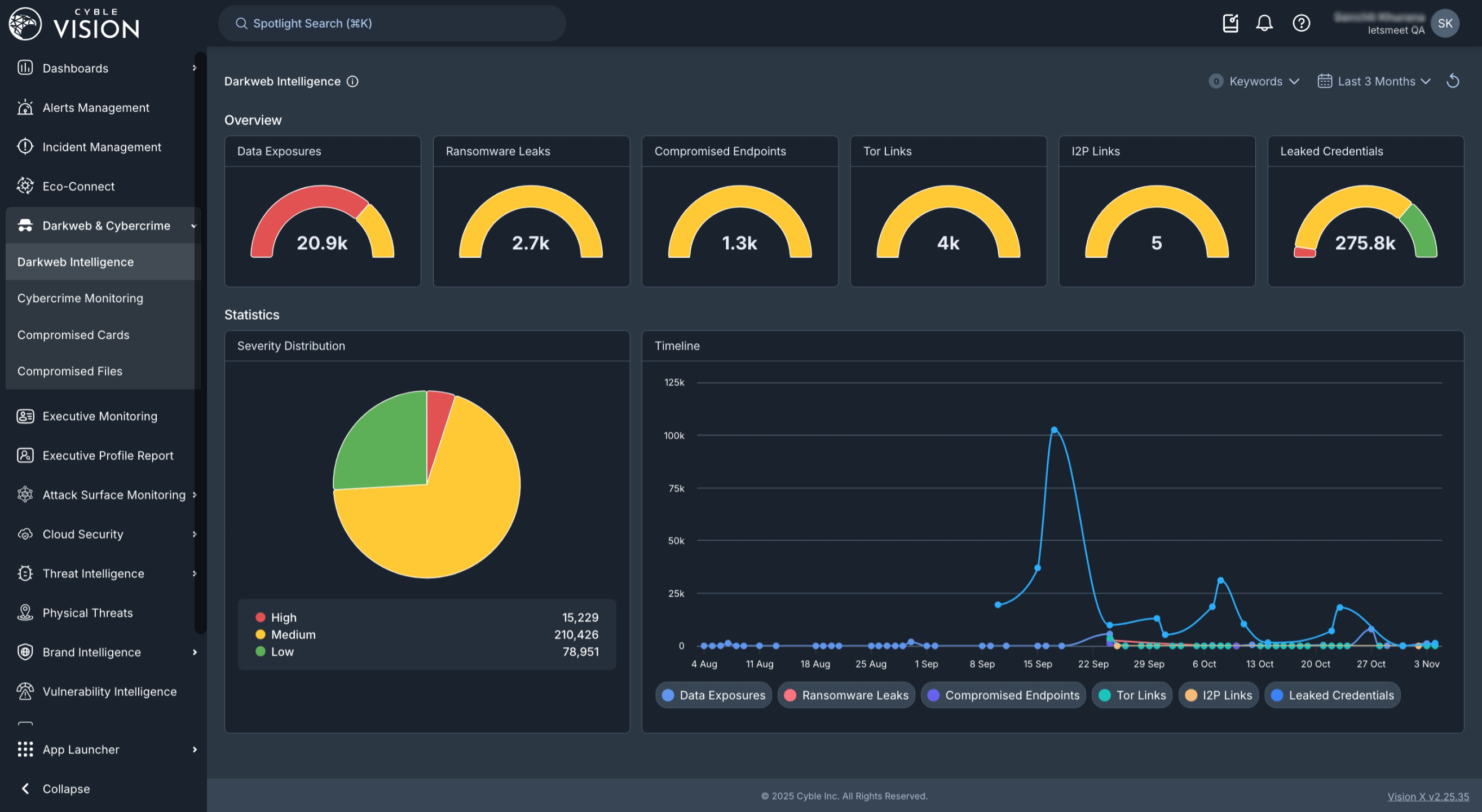
- Detection across surface, deep, and dark web, with Cyble reporting visibility into 15,000+ darknet marketplaces across its platform and coverage of Telegram channels, ransomware leak sites, social platforms, app stores, and closed underground communities.
- Entity resolution at ingestion via Cyble Blaze AI, which determines whether a mention refers to the customer’s organization, including obfuscated spellings, before it becomes an alert.
- Relevance scoring against the customer’s specific domains, subsidiaries, executives, and technology stack, which supports the reported 95% signal-to-noise ratio.
- Case-ready enrichment that connects a credential post to the breach it came from, the IAB selling access, and the threat actor group known to buy from that broker, before an analyst opens the case.
- Native managed takedown of phishing sites, lookalike domains, fake apps, impersonation accounts, and leaked data, delivered against SLAs.
Cyble Vision’s detection and removal come from one vendor on one data layer, which eliminates the handoff gap. For a direct comparison of how Cyble positions against this approach, see the Cyble comparison hub.
Findings flow into existing tools through 70+ integrations including Security Information and Event Management (SIEM), security orchestration, automation and response (SOAR), and ticketing platforms. Teams that need custom pipelines can use Cyble’s own application programming interface (API) and Trusted Automated eXchange of Indicator Information (TAXII) support for threat intelligence sharing. The current integration list is available on Cyble’s integrations page.
See how Cyble Vision closes the detection-to-action gap
What Dark Web Monitoring Cannot Do and What to Pair It With
Monitoring cannot stop a determined actor from registering a lookalike domain, and it cannot see inside private channels beyond the sources it covers. That same ICANN comment notes that “many abusive domains have short operational lifecycles,” which means the window between registration and weaponization can be narrow enough that even fast detection leaves limited response time.
What closes the gap is pairing monitoring with three capabilities:
- Native managed takedown, so detection and removal are one motion. A monitoring platform that ends at the alert leaves the impersonation live.
- Executive protection monitoring, which covers deepfakes, PII exposure, and impersonation accounts on social and messaging platforms, the vectors that generic dark web monitoring does not reach.
- Incident response, for cases where an impersonation campaign has already caused harm and the organization needs to establish how access was obtained, what was taken, and what further exposure exists. Cyble’s digital forensics and incident response (DFIR) services support this investigation with external context that internal forensics alone cannot supply.
For a full treatment of how the monitoring pipeline works from collection through to alert, see How Dark Web Monitoring Works: Full Pipeline, Step by Step.
How to Choose a Provider for Impersonation Defense
When evaluating dark web monitoring for impersonation threats, six criteria separate adequate from effective:
- Identity matching and entity resolution across languages and obfuscated references. A platform that only matches exact brand strings will miss the majority of underground references to the organization.
- Cross-platform coverage including dark web markets, social platforms, app stores, and messaging channels. Impersonation artifacts move across channels.
- Evidence-backed alerts with enrichment attached. Raw indicators without context require an analyst to spend the first hour of every case doing manual pivoting before any decision can be made.
- Native takedown with SLAs. A vendor that hands removal back to the customer has not closed the detection-to-action gap.
- Privacy controls for executive monitoring. Monitoring named individuals requires appropriate data handling and access controls.
- Integration with the existing stack. A new console that nobody checks after the first month adds no value.
Cyble Vision meets these criteria. Entity resolution runs at ingestion via Cyble Blaze AI, and coverage spans the 15,000+ marketplaces cited above plus social platforms, app stores, and messaging channels. Alerts arrive case-ready with enrichment attached, and native managed takedown is delivered against SLAs. Executive protection monitoring includes privacy controls for named individuals, and 70+ integrations plus Cyble’s own API and TAXII support push findings into the tools the team already uses. For credential-specific monitoring, see Dark Web Credential Monitoring: How It Works and Dark Web Monitoring for Executives: A Complete Guide.
Cyble is recognized as a Challenger in the inaugural 2026 Gartner® Magic Quadrant™ for Cyberthreat Intelligence Technologies and as a Strong Performer in the 2026 Gartner® Peer Insights™ “Voice of the Customer” for Brand Protection Software, where Cyble reports the highest number of verified reviews among the vendors included. On G2, Cyble holds a 4.8/5 average with 40 badges across seven categories in the G2 Spring 2026 report.
Conclusion: Close the Gap Between Detection and Removal
The underground window is where impersonation is cheapest to stop. The structural answer is monitoring that resolves artifacts to your brand and executives at ingestion and removes them, including phishing sites, lookalike domains, fake apps, and impersonation accounts, through native managed takedown delivered against SLAs.
Cyble Vision is the best dark web monitoring for impersonation threats because it resolves impersonation artifacts to your brand and executives at ingestion. Cyble reports visibility into 15,000+ darknet marketplaces with a reported 95% signal-to-noise ratio. It then removes the threat through native managed takedown delivered against SLAs. Detection alone is not defense.
Results depend on the customer’s environment, asset scope, and configuration and should be validated against it. Statistics are drawn from Cyble internal telemetry unless otherwise attributed. Capabilities, coverage, and service levels vary by subscription tier and region.
Talk to Cyble about your impersonation exposure
Frequently Asked Questions
How does dark web monitoring detect executive impersonation?
Dark web monitoring detects executive impersonation by ingesting sources where impersonation artifacts appear before they are weaponized, including dark web markets, Telegram channels, social platforms, paste sites, and messaging applications. Monitoring looks for leaked executive PII, fake profiles using an executive’s name or photo, advertisements for deepfake or voice cloning services targeting named individuals, and credential exposure tied to executive email domains. Entity resolution, the automated process of determining that a reference in an underground post refers to a specific named individual at a specific organization, runs at ingestion, so alerts are resolved to the correct person before they reach an analyst. Cyble’s executive protection monitoring covers deepfakes, identity theft, exposed personal data, compromised credentials, and threatening public mentions, with findings feeding into the same data layer used by the security operations team.
Can dark web monitoring catch lookalike domains and phishing kits?
Dark web monitoring can intercept lookalike domains and phishing kits at the underground stage, before deployment, by tracking certificate transparency logs, passive DNS, and underground forum and Telegram listings where kits are sold. A lookalike domain, a near-identical domain registered to impersonate a brand, can be detected when the certificate is issued, before the phishing page goes live. Phishing kits are listed on criminal forums and Telegram channels as subscriptions, and monitoring of those sources surfaces kit listings that target a specific brand’s login page. The critical requirement is that detection must be paired with a removal path, because a detected lookalike domain that stays live still harvests credentials. Cyble’s native managed takedown handles removal of phishing sites and lookalike domains against SLAs, which closes the detection-to-action gap.
What can dark web monitoring not do, and what should it be paired with?
Dark web monitoring cannot prevent a determined actor from registering a lookalike domain, and it cannot see inside private channels beyond the sources it covers. It does not replace authentication controls, and it does not stop phishing emails from reaching recipients. What closes the gap is pairing monitoring with three capabilities: native managed takedown, so detection and removal are one motion; executive protection monitoring, covering deepfakes, PII exposure, and impersonation accounts on social and messaging platforms; and incident response, for cases where an impersonation campaign has already caused harm. A monitoring platform that ends at the alert and hands removal back to the customer or a separate vendor leaves the impersonation live and the jurisdictionally complex removal work with the buyer.
How is dark web monitoring for impersonation threats different from digital risk protection?
Digital risk protection (DRP) is the broader discipline of monitoring for an organization appearing where it should not, including leaked credentials, stolen documents, spoofed domains, fake apps, impersonated executives, and brand abuse. Dark web monitoring for impersonation threats is a specific application of DRP focused on the underground artifacts that precede impersonation attacks, such as phishing kit listings, IAB posts, leaked executive PII, lookalike domain registrations, and deepfake service advertisements. In practice, the two overlap significantly. Cyble Vision, Cyble’s flagship platform, covers both. It monitors the surface, deep, and dark web for impersonation artifacts and brand abuse, resolves findings to the customer’s entities at ingestion, and pairs detection with native managed takedown. The distinction matters most when evaluating whether a platform covers the full chain from underground signal to removal or only one part of it.
How quickly can an impersonating site or account be taken down?
Takedown timelines vary by content type, platform, and jurisdiction. A phishing domain and a fake app on a third-party store do not move at the same speed. Registrar abuse processes, hosting provider policies, social platform enforcement teams, and app store review procedures each operate on their own timelines, and some jurisdictions present additional complexity. Cyble delivers native managed takedown against SLAs, combining automated workflows with global enforcement, and Cyble’s native managed takedown reports a 98% success rate. The SLA structure means removal is a defined commitment, not a best-effort referral. Specific timelines should be confirmed for the customer’s environment, asset scope, and subscription tier, as capabilities and service levels vary by region and tier.
Do we have to replace our existing security stack?
Cyble Vision is the usual starting point for external intelligence and impersonation monitoring, and it is designed to work alongside an existing stack. Findings flow into existing tools through 70+ integrations including SIEM, SOAR, and ticketing platforms, as well as Cyble’s own API and TAXII support for custom pipelines and threat intelligence sharing. The current integration list is available on Cyble’s integrations page. Additional Cyble capabilities, such as Cyble Titan for endpoint detection and response (EDR), can be added as consolidation makes sense, but the platform is built to be a force multiplier for the tools the team already uses. Capabilities vary by subscription tier and region, so specifics should be confirmed for the customer’s environment.