New external assets rarely announce themselves. A developer spins up a staging environment in a new cloud account. Marketing launches a campaign microsite through an agency. A business unit adopts a SaaS tool and points a subdomain at it. None of these go through a change ticket, and none appear in the asset inventory.
They do leave traces. Every new internet-facing asset needs a name, usually a certificate, and somewhere to run. Those requirements show up as DNS records, TLS certificates, and hosting footprints that change in observable ways. Attackers watch these signals closely, because a freshly exposed asset is often the least hardened one.
This guide explains which passive external asset discovery signals matter most, and how to turn them into a validation workflow that confirms ownership, assesses exposure, and routes each new asset to the right team.
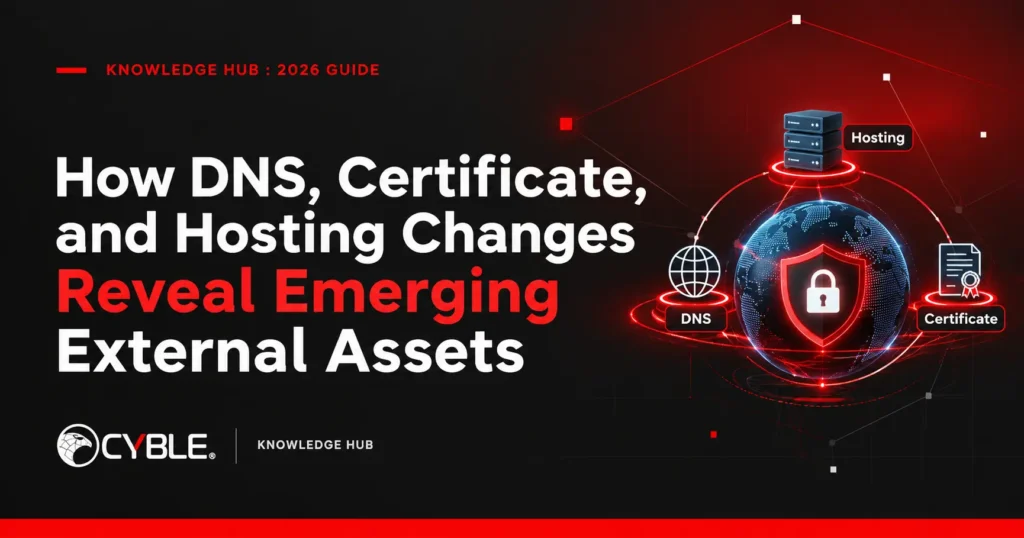
New DNS records, changes to existing records, and newly issued or reused TLS certificates are often the first observable evidence that an internet-facing asset exists. By continuously monitoring passive DNS, certificate data, and hosting changes for the organization’s domains, naming patterns, and certificate fingerprints, security teams can detect new subdomains, services, and environments shortly after they appear. Each signal is then validated for ownership and liveness, fingerprinted, risk-scored, and assigned to an owner before attackers find it.
Why Change Signals Beat Periodic Snapshots
Many organizations still discover external assets through periodic scans of known IP ranges and domains. That approach has two blind spots. It only looks where the team already knows to look, and it only sees what existed on the day of the scan.
Cloud infrastructure, SaaS adoption, and CI/CD pipelines create and retire assets in hours. A test server exposed for three days between monthly scans may never appear in a report, yet internet-wide scanners operated by attackers can find it within minutes.
Change-driven discovery flips the model. Instead of asking “what do we own today?”, it asks “what just changed that relates to us?” The signal is the change itself: a new record, a new certificate, a new hosting location. This makes discovery continuous, surfaces assets outside known ranges, and gives the security team the creation date, which is often the most useful piece of context for finding an owner.
The Four Families of External Asset Discovery Signals
No single data source sees everything. The strongest discovery programs correlate four families of passive signals, each of which reveals a different part of an asset’s life.
1. DNS signals
DNS is where most new assets first become reachable by name. Passive DNS datasets, which record resolutions observed across the internet over time, let teams see records they never published in a zone file they control.
- New subdomains under owned domains, especially those that follow environment patterns such as dev, staging, uat, test, api, or vpn
- New or changed A and AAAA records pointing to IP addresses outside known ranges
- CNAME changes to cloud and SaaS providers, which reveal new services and, when the target is later deleted, dangling records that enable subdomain takeover
- TXT records used for domain verification and SPF includes, which disclose newly adopted SaaS platforms and email senders
- NS and MX changes, which can indicate a migration, a new mail provider, or unauthorized changes to a domain
2. Certificate signals
Almost every public web service now uses TLS, so certificates are a reliable witness to new services. Rather than relying on a single certificate source, combine several views.
- New hostnames in Subject Alternative Names (SANs), which often list internal-sounding names alongside public ones
- Certificates observed on IP addresses during internet-wide scans, revealing services with no DNS name at all
- Reuse of a known certificate fingerprint on a new IP, which often means a cloned or migrated environment
- Issuer changes, such as a free automated certificate suddenly appearing on a hostname normally covered by the corporate CA, a common sign of shadow IT
- Self-signed or expired certificates on newly seen hosts, which point to unmanaged or test systems
3. Hosting and service signals
Where an asset runs, and what it exposes, determine its risk. Internet scan data and routing information reveal these changes.
- New IP addresses or ASNs associated with the organization’s names, such as a hostname moving from the corporate data center to a public cloud provider
- Newly open ports and services, especially remote access, databases, admin panels, and file transfer services
- Changed HTTP fingerprints, including page titles, server headers, technologies, and favicon hashes that match known corporate applications
- Reverse DNS and shared hosting relationships, which can tie unfamiliar IPs back to the organization
4. Registration and ownership signals
New domains are external assets too, and registration data helps attribute them.
- Newly registered domains containing company, product, or project names
- Reverse lookups on registrant organization, name servers, or registrar accounts that the company already uses
- Shared analytics, tag manager, or verification IDs across sites, which link unrelated-looking domains to the same owner
| Signal family | Typical source | What it reveals first |
| DNS | Passive DNS, zone data, resolution monitoring | New names, SaaS adoption, dangling records |
| Certificates | Certificate datasets, TLS scan data | New hostnames, unnamed services, shadow IT |
| Hosting | Internet scan data, routing and IP data | New locations, exposed ports and services |
| Registration | Registration and reverse lookup data | New domains and shared ownership links |
A 6-Step Workflow to Validate Newly Discovered External Assets
Raw signals are noisy. A new subdomain might be a critical exposure, a vendor’s asset, a parked page, or an attacker’s lookalike. This workflow turns each signal into a confirmed, owned, and prioritized asset.
Step 1: Collect and normalize change events
Define the seeds that anchor discovery: owned domains, known IP ranges and ASNs, certificate fingerprints, registrant details, and naming conventions. Monitor all four signal families against those seeds, then normalize each change into a common event: what changed, when it was first seen, and which seed it matched.
Output: a deduplicated stream of change events tied to discovery seeds.
Step 2: Attribute ownership with a confidence score
Decide whether the asset belongs to the organization, a subsidiary, a vendor, or someone else. Rely on multiple corroborating links, not one.
- High confidence: the name sits under an owned domain and resolves to owned infrastructure, or presents a corporate certificate
- Medium confidence: shared analytics IDs, registrant details, or favicon hashes link it to a known property
- Low confidence: only a name similarity, which may indicate a third party or an impersonation
Route low-confidence lookalikes to brand protection rather than the asset inventory.
Output: an attribution decision and confidence level for each asset.
Step 3: Confirm the asset is live and reachable
Many DNS and certificate signals refer to assets that no longer exist or were never exposed. Check whether the name resolves, which ports respond, and whether the service is reachable from the internet. Watch for DNS records that point to deprovisioned cloud resources, since those are subdomain takeover candidates even if nothing responds.
Output: a liveness status: active, dormant, dangling, or retired.
Step 4: Fingerprint and classify the asset
Identify what the asset is and what it runs. Capture the technology stack, software versions, exposed services, authentication pages, and environment type such as production, staging, or development. Map it to a business unit or application using naming, certificates, and content clues.
Output: an asset record with technology, environment, and probable business owner.
Step 5: Score risk and prioritize
Combine exposure and context to decide urgency. Weight factors such as:
- Exposed remote access, admin interfaces, or databases
- Known exploitable vulnerabilities in detected software
- Missing authentication or default login pages
- Dangling DNS records open to takeover
- Weak or invalid TLS configurations
- Non-production environments containing real data
- Mentions of the asset or its credentials in underground sources
Output: a risk score and response priority for each asset.
Step 6: Route, remediate, and baseline
Assign each asset to an owner with a clear action: secure it, decommission it, place it behind access controls, or formally accept it. Add confirmed assets to the inventory and to vulnerability scanning scope. Then baseline its expected state so future changes, such as a new open port or certificate issuer, trigger alerts of their own.
Output: an owned, inventoried asset with a monitored baseline.
From Signal to Action: Common Scenarios
The same workflow handles very different findings. These examples show how typical signals translate into decisions.
| Signal observed | Likely meaning | Validation check | Typical action |
| New subdomain staging-payments.example.com resolving to a public cloud IP | Unmanaged pre-production environment | Is it reachable? Does it hold real data or lack authentication? | Restrict access or decommission; add to scanning scope |
| CNAME from promo.example.com to a deleted cloud storage bucket | Dangling DNS record | Does the target resource still exist? | Remove the record before it is claimed |
| Corporate certificate fingerprint seen on an unfamiliar IP | Cloned or migrated environment | Who operates the IP? Is the service current? | Identify owner; confirm it is patched and monitored |
| New TXT verification record for a SaaS platform | New SaaS adoption | Which team signed up? Is SSO enforced? | Register the app; apply identity and data policies |
| Hostname moved from corporate hosting to a new ASN | Migration or unauthorized change | Was a change approved? Do records match the plan? | Confirm with owner; investigate if unapproved |
| Remote access port newly open on an owned IP | Exposed management interface | Is it intended? Is MFA enforced and software current? | Close or place behind VPN or zero trust access |
| Newly registered domain with company name and corporate analytics ID | Agency-built or shadow microsite | Which team commissioned it? | Bring under brand and security governance |
Pitfalls to Avoid and Metrics to Track
Change-driven discovery generates volume quickly. These mistakes are the usual reasons programs stall:
- Relying on one data source. DNS alone misses services without names; certificates alone miss non-TLS services; scans alone miss short-lived assets.
- Treating every signal as an asset. Without attribution and liveness checks, the inventory fills with vendor assets, parked pages, and expired records.
- Ignoring dormant and dangling records. An asset that no longer responds can still be dangerous if its DNS record points to a resource someone else can claim.
- Stale discovery seeds. Acquisitions, rebrands, and new cloud accounts expand the footprint; seeds must be updated to follow.
- No owner, no outcome. Discovery without routing to a responsible team only produces a longer list.
Track metrics that reflect speed and closure, not just volume:
| Metric | What it shows |
| Mean time to discover | Time from an asset’s first observable signal to its detection |
| Attribution rate | Share of new signals resolved to owned, third-party, or unrelated |
| Unknown-to-known ratio | Share of discovered assets that were missing from the inventory |
| Mean time to owner | Time from discovery to an accountable owner being assigned |
| High-risk exposure dwell time | How long critical exposures stay open after discovery |
| Dangling records removed | Takeover risks eliminated per period |
External assets discovered this way also feed wider intelligence workflows. Credentials or data tied to a newly found host may surface underground, which is where enterprise dark web monitoring adds context to the risk score.
Find New External Assets Before Attackers Do with Cyble
Correlating DNS, certificate, hosting, and registration changes at internet scale is difficult to do manually, and the window between exposure and exploitation keeps shrinking.
Cyble Attack Surface Management continuously discovers internet-facing assets, including domains, subdomains, IP addresses, cloud services, and exposed applications. It tracks changes to those assets over time, flags risky exposures such as open services, vulnerable software, misconfigurations, and weak certificates, and prioritizes findings so teams can act on what matters first.
Combined with Cyble’s threat intelligence on exploited vulnerabilities and dark web activity, it adds attacker context to every newly discovered asset. The result is an external inventory that keeps pace with how fast your organization actually changes.
Explore Cyble Attack Surface Management or book a personalized demo to see what your external attack surface looks like today.
Frequently Asked Questions
What are external asset discovery signals?
They are observable changes on the internet that indicate a new or modified internet-facing asset, such as new DNS records, newly issued or reused TLS certificates, hosting and IP changes, newly open services, and new domain registrations.
How does DNS monitoring help with subdomain discovery?
Passive DNS and resolution monitoring reveal subdomains as soon as they are queried or published, including names that never appear in a team’s own zone files. Changes to CNAME, TXT, NS, and MX records also expose new services, SaaS adoption, and dangling records.
How do certificate changes reveal new assets?
New certificates list hostnames in their Subject Alternative Names, and certificates observed during internet scans reveal services even when they have no DNS name. Reuse of a known certificate on a new IP, or an unexpected issuer, often points to cloned environments or shadow IT.
Why do hosting changes matter for attack surface management?
A hostname moving to a new provider, IP, or ASN can mean a migration, a new deployment outside approved infrastructure, or an unauthorized change. Newly open ports on those hosts are often the highest-risk exposures.
What is a dangling DNS record?
A dangling record points to a cloud resource or service that has been deleted. If an attacker claims that resource, they can serve content on the organization’s subdomain, a technique known as subdomain takeover.
How often should external asset discovery run?
Continuously. Cloud and SaaS assets can appear and disappear within hours, so periodic scans should be complemented by ongoing monitoring of DNS, certificate, and hosting changes.
Disclaimer: This article is for general informational purposes only. The scenarios and hostnames shown are illustrative. Active validation such as port checks or service fingerprinting should only be performed against assets your organization owns or is authorized to test, and in line with applicable laws and provider terms.