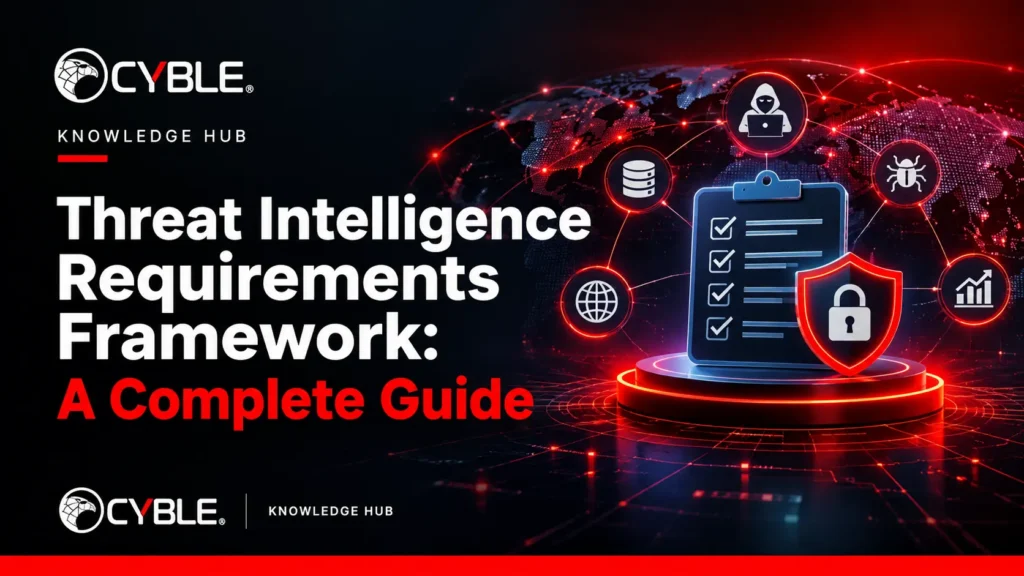
Most threat intelligence programs do not fail for lack of data. They fail because nobody defined what the data was for. Security teams subscribe to feeds, monitor forums, and ingest indicators by the million, yet analysts still struggle to answer the questions leadership actually asks: Are we a target? Which vulnerabilities matter this week? Is our data being sold?
A threat intelligence requirements framework fixes this by tying every collection activity to a decision someone in the organization needs to make.
What Threat Intelligence Requirements Actually Are
Threat intelligence requirements are documented questions the intelligence function exists to answer. They usually sit in three tiers. Priority intelligence requirements (PIRs) capture the handful of strategic concerns that matter most to the business, such as whether ransomware groups are targeting the sector.
Intelligence requirements (IRs) break each PIR into narrower, answerable questions. Essential elements of information (EEIs) define the specific data points needed, such as leaked credentials tied to corporate domains or exploit chatter around a product the company runs.
This hierarchy gives analysts a filter. Data that does not map back to a requirement is noise, however interesting it looks.
Step 1: Start With Stakeholders, Not Sources
Requirements begin with the people who consume intelligence, and each group makes different decisions on different timelines:
- Executives and the board need strategic context on threat trends, geopolitical risk, and likely business impact.
- SOC and incident response teams need tactical, machine-readable indicators and detection logic.
- Vulnerability management teams need to know which CVEs are being actively exploited.
- Fraud, brand, and legal teams need visibility into impersonation, data leaks, and counterfeit activity.
Short interviews with each group should center on one question: which decisions could better intelligence improve? The answers become the raw material for PIRs.
Step 2: Write Requirements That Can Be Answered
A useful requirement is specific, time-bound, and tied to an asset or business process. “Monitor ransomware” is not a requirement. “Which ransomware groups have hit healthcare providers in our operating regions over the last 90 days, and how did they gain initial access?” is.
Each draft should pass three tests. Does it name the decision it supports? Can an analyst tell when it has been answered? Is there a realistic way to collect the data? Requirements that fail any test get rewritten or dropped.
Mature programs typically keep fewer than ten PIRs active, because a long list dilutes focus and turns every alert into a priority.
Step 3: Map Each Requirement to Collection
Once requirements are set, collection becomes a deliberate choice rather than a default. The areas below cover what most organizations need.
| Requirement area | What to collect | Why it matters |
| Exposed credentials and data | Infostealer logs, combolists, leaked databases, data leak site postings | Stolen sessions and credentials often provide the initial access behind ransomware and account takeover |
| Vulnerability prioritization | Exploit releases, proof-of-concept code, active exploitation reports, exploit sales on underground markets | Separates the small share of weaponized CVEs from the thousands that are not |
| Adversary activity | Actor TTPs mapped to MITRE ATT&CK, campaign reports, ransomware victim listings | Directs detection engineering and threat hunting |
| Attack surface | Internet-facing assets, exposed cloud storage, expired certificates, shadow IT | Shows what attackers see before they act |
| Brand and fraud | Lookalike domains, phishing kits, rogue apps, executive impersonation | Enables takedowns and protects customers and staff |
| Third-party risk | Breaches and leaks involving suppliers and partners | Supply chain compromises frequently bypass internal controls |
Sources deserve scrutiny too. Each one should carry a reliability rating and a record of which requirements it serves. A source that answers nothing for two or three review cycles is a candidate for removal.
Step 4: Review, Measure, and Retire
Requirements age. A merger, product launch, cloud migration, or shift in regional threat activity can make last quarter’s PIRs irrelevant. Quarterly stakeholder reviews keep the framework current, with ad hoc updates after major incidents.
Useful metrics include the share of intelligence products linked to a requirement, stakeholder feedback, time from collection to actionable report, and the number of detections, patches, or takedowns intelligence directly triggered. These measures move the conversation from data ingested to decisions supported.
Common Pitfalls
Three mistakes show up repeatedly. Teams let existing feeds dictate requirements, working backward from what they already pay for. They write requirements without stakeholder input, producing reports nobody reads. And they treat the framework as a one-time project instead of a living document. All three lead to the same place: a program that collects a great deal and informs very little.
Turn Requirements into Action with Cyble
A requirements framework defines what to look for. The harder part is collecting it at scale across the open, deep, and dark web. Cyble Threat Intelligence helps security teams operationalize their PIRs through continuous monitoring of underground forums, ransomware leak sites, infostealer markets, and exposed attack surfaces, backed by AI-driven analysis and expert research. The result is intelligence mapped to the questions that matter, not another stream of noise.
Book a personalized demo to see how Cyble Threat Intelligence aligns with an organization’s specific requirements.