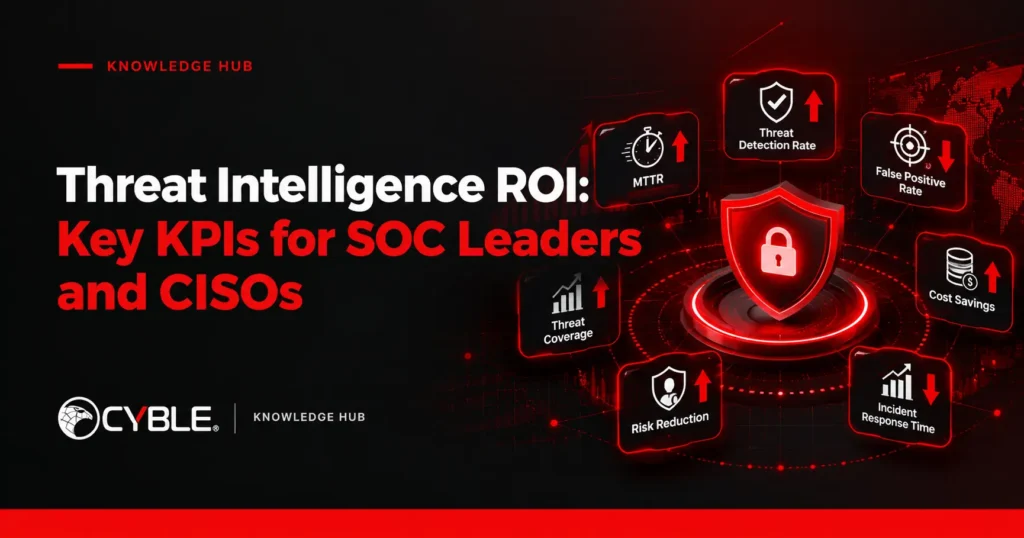
Security leaders are under steady pressure to prove that every tool and data feed earns its place in the budget. Threat intelligence is often the hardest line item to defend, because its value shows up as attacks that never happen. Measuring threat intelligence ROI gives SOC leaders and CISOs a way to connect intelligence work to faster detection, lower risk, and fewer losses.
The challenge is choosing metrics that reflect real outcomes rather than activity. Counting feeds, indicators, or reports says little about whether intelligence changed a decision. The KPIs below focus on what intelligence actually improves inside the security operations center and across the business.
Why Threat Intelligence ROI Is Hard to Measure
Most security investments have a visible output. A firewall blocks traffic and an EDR agent quarantines files. Intelligence works differently. It shapes decisions made by other tools and teams, so its contribution is easy to overlook.
Three problems make measurement harder:
- Indirect value. Intelligence often improves a detection rule or a patching decision rather than stopping an attack on its own.
- Counterfactuals. Proving that a breach did not happen because of a specific warning is difficult.
- Vanity metrics. Volume figures such as indicators ingested or alerts generated can rise while real value falls.
A mature cyber threat intelligence program solves this by tying every metric to a defined goal. Those goals are usually written as priority intelligence requirements, the specific questions leadership needs intelligence to answer, such as which ransomware groups target the sector or which credentials are exposed online.
Operational KPIs for SOC Leaders
Operational SOC metrics show whether intelligence makes analysts faster and more accurate. Each should be tracked as a baseline before a new intelligence source is introduced, then compared over time.
| KPI | What it shows |
| Mean time to detect (MTTD) | Whether intelligence helps surface threats earlier |
| Mean time to respond (MTTR) | Whether enriched alerts shorten triage and containment |
| False positive rate | Whether intelligence filters noise or adds to it |
| Intelligence-driven detections | Share of confirmed incidents first flagged or enriched by intelligence |
| Analyst time per alert | Hours saved through automated enrichment and context |
| Exposure remediation time | Time from discovering leaked credentials or data to resetting or removing them |
The intelligence-driven detection rate is especially useful. If a meaningful share of confirmed incidents traces back to an intelligence source, that source is clearly earning its cost. If none do, it may need tuning or replacement.
Business KPIs for CISOs
CISOs need metrics that translate SOC performance into business terms. These KPIs connect intelligence to risk reduction and financial outcomes:
- Incidents prevented or contained early. Attacks stopped at reconnaissance or initial access, before data loss or disruption.
- Cost avoidance. Estimated losses avoided when a phishing domain is taken down, a leaked credential is reset, or a vulnerability under active exploitation is patched ahead of attackers.
- Patch prioritization accuracy. Share of urgent patches driven by evidence of real-world exploitation rather than severity scores alone.
- Requirement coverage. Share of priority intelligence requirements answered with timely, usable intelligence.
- Stakeholder adoption. How often fraud, legal, IT, and executive teams act on intelligence products.
- Tool and feed consolidation. Savings from retiring overlapping feeds that add volume without value.
These measures make threat intelligence ROI visible to leaders outside security, who care more about avoided losses than detection mechanics.
How to Calculate Threat Intelligence ROI
The standard ROI formula applies, with careful inputs:
Program cost includes platform subscriptions, feeds, analyst salaries, and integration work. Value delivered combines analyst hours saved, estimated losses avoided, and savings from consolidated tools.
To keep the figure credible:
- Set a baseline. Record MTTD, MTTR, and alert volumes before changes are made.
- Use conservative loss estimates. Base them on internal incident costs or published industry breach cost studies, and state the source.
- Attribute carefully. Count only incidents where intelligence clearly changed the outcome.
- Review quarterly. Threats and requirements shift, so the measurement should too.
A defensible estimate built on modest assumptions earns more trust from finance teams than an inflated figure.
Reporting Threat Intelligence ROI to the Board
Boards respond to trends and business impact, not technical detail. A short quarterly view works best: three to five KPIs, the direction each is moving, and one or two concrete examples of intelligence that changed an outcome. A single story, such as a leaked admin credential found and reset before it was used, often explains value better than a dashboard.
Can you prove what your threat intelligence is worth? Book a Cyble demo and see the impact
Final Thoughts
Threat intelligence earns its budget when its impact is measured in faster detection, fewer false alarms, and losses avoided. SOC leaders should track the operational metrics that show analyst efficiency, while CISOs translate those gains into risk and cost terms. Together, these KPIs turn threat intelligence ROI from an assumption into evidence.
For more research on cyber threats and intelligence, visit Cyble.