A company can spend years building customer trust, and still, one phishing campaign, a fake website, or a social media impersonation can mess up its reputation overnight. The cyber threats are getting bigger day by day. According to the FBI 2024 Internet Crime Report, cybercriminals racked up more than $16 billion in reported losses, that’s a 33% jump from the year before, and phishing as well as spoofing keep showing up as the most reported cybercrimes.
As attackers lean more on trusted brands to mislead customers, brand protection has turned into a really critical business priority.
This guide talks about what brand protection is, why online brand protection matters, the various forms of brand protection, and how brand protection software helps organizations defend against the ever-changing digital threats.
Key Takeaways
- Brand protection is the activity of protecting a company’s name and reputation along with its digital assets and customers from fraud, look-alike impersonation, counterfeiting, and cyber threats
- Online brand protection zooms in on digital channels like websites, domains, social media, mobile apps, marketplaces, and even the dark web
- The FBI’s Internet Crime Complaint Center (IC3) received 859,532 complaints in 2024, and losses were reported at more than $16 billion, which is about a 33% increase from 2023. Phishing and spoofing still stayed the most reported cybercrimes
- Effective brand protection usually mixes continuous monitoring, threat intelligence, automated takedowns, trademark enforcement, and proactive risk management, so nothing lags behind
- Organizations that invest in brand protection software and services can lower fraud exposure, strengthen customer confidence, and respond faster to emerging threats.
What Is Brand Protection?
Brand protection is basically the practice of safeguarding a company’s name, logo, products, digital presence, intellectual property, and reputation from misuse, impersonation, fraud, counterfeiting, and cyber threats.
In this digital-first environment, cybercriminals often use trusted brands as a kind of shortcut, to trick customers, through phishing websites, fake social media accounts, counterfeit mobile apps, fraudulent domains, and marketplace scams. The impact is not small; these attacks can lead to financial losses, reputational harm, and a real drop in customer trust.
A broader brand protection program helps organizations find, investigate, then reduce a whole range of risks, including phishing campaigns, typosquatting and other fake domains, social media impersonation, counterfeit products, malicious mobile applications, trademark infringement, data leaks, dark web exposure, and, more and more, sophisticated AI-generated deepfake and identity-impersonation attacks.
What Is Online Brand Protection?
Online brand protection is a specialized subset of brand protection focused on defending a company’s digital footprint across internet-facing channels.
While traditional brand protection often focuses on intellectual property enforcement and counterfeit products, online brand protection addresses cyber-enabled threats that exploit brand trust in digital environments.
This function is often grouped under the broader industry term digital risk protection (DRP), which describes the combined discipline of monitoring, detecting, and mitigating digital threats to a brand’s assets, executives, and customers across the open, deep, and dark web.
Online brand protection covers:
- Website and domain monitoring
- Social media monitoring
- Mobile application monitoring
- Marketplace surveillance
- Dark web monitoring
- Phishing detection
- Executive and employee impersonation
- Deepfake detection
- Takedown and enforcement activities
For example, attackers frequently register look-alike domains that differ by a single character from a legitimate brand, a tactic known as typosquatting. This is closely related to cybersquatting, where a domain containing a brand’s trademarked name is registered in bad faith, and domain spoofing, where a fraudulent domain is built to closely mimic a legitimate brand’s website. These domains are often used to host phishing pages, distribute malware, or impersonate legitimate customer portals.
As businesses expand across websites, mobile apps, marketplaces, messaging platforms, and social networks, maintaining continuous visibility into these channels has become essential.
Why Brand Protection Is Important
A strong brand is one of an organization’s most valuable assets, but it is also one of the most frequently targeted. Cybercriminals understand that customers naturally trust familiar names, logos, and digital experiences. By impersonating legitimate organizations, attackers can make phishing campaigns, fraud schemes, and social engineering attacks far more convincing and effective.
The impact extends beyond isolated security incidents. A fraudulent website, fake social media profile, or counterfeit product can disrupt operations, damage customer relationships, and create long-term business consequences. As organizations expand their digital presence across websites, mobile apps, social platforms, and online marketplaces, the opportunities for abuse continue to grow.
Without a comprehensive program to monitor and mitigate these threats, organizations may face financial losses, reputational damage, declining customer confidence, regulatory scrutiny, and increased cybersecurity risks. Effective monitoring and rapid response help organizations reduce exposure to impersonation attempts, protect customers from fraud, and maintain trust in an increasingly complex digital environment.
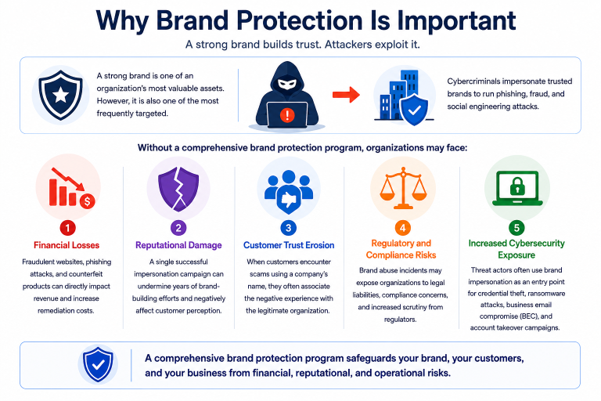
The FBI’s IC3 report also found that phishing/spoofing, extortion, and personal data breaches were among the most reported cybercrimes in 2024, highlighting the importance of proactive brand defense.
Types of Brand Protection
Organizations typically implement multiple forms of brand protection to reduce risk across digital and physical channels.
| Type of Brand Protection | Purpose | Common Threats Addressed |
| Trademark Protection | Protects logos, names, slogans, and intellectual property | Trademark infringement, counterfeit products |
| Domain Monitoring | Identifies suspicious or look-alike domains | Typosquatting, cybersquatting, domain spoofing, phishing domains |
| Social Media Protection | Detects fraudulent profiles and impersonation attempts | Fake accounts, support scams |
| Mobile App Protection | Monitors app stores for malicious applications | Fake apps, malware distribution |
| Website Protection | Detects cloned websites and unauthorized modifications | Website defacement, phishing sites |
| Marketplace Monitoring | Tracks counterfeit products and unauthorized sellers | Counterfeit goods, brand abuse |
| Dark Web Monitoring | Identifies exposed credentials and threat actor activity | Data leaks, fraud schemes |
| Executive Protection | Detects executive impersonation and deepfake threats | CEO fraud, social engineering |
| Grey Market Monitoring | Tracks unauthorized resellers and parallel-market diversion of genuine products | Grey market / gray market diversion, unauthorized discounting |
| Anti-Piracy Protection | Identifies unauthorized distribution or reproduction of copyrighted content and media | Piracy, content theft, unlicensed distribution |
| Brand Protection Monitoring | Provides continuous threat visibility across channels | Emerging impersonation campaigns |
Who Needs Brand Protection?
Brand protection is no longer reserved for global enterprises. Any organization with an online presence can become a target.
- Large Enterprises- Global brands face high volumes of impersonation attempts, counterfeit products, phishing campaigns, and domain abuse.
- Small and Medium Businesses (SMBs)- SMBs often lack dedicated security resources, making them attractive targets for attackers seeking easy opportunities.
- Public Sector Organizations- Government agencies are frequently impersonated through phishing campaigns designed to steal sensitive information or distribute misinformation.
- Financial Institutions- Banks, fintech companies, and insurance providers are among the most heavily targeted organizations due to the potential financial gains for attackers.
- Healthcare Organizations- Healthcare providers face risks from counterfeit portals, phishing campaigns, and credential theft targeting patients and staff.
How Brand Protection Works
An effective brand protection program follows a continuous lifecycle:
- Monitor- Organizations continuously monitor websites, domains, social media platforms, app stores, marketplaces, and dark web sources for potential threats.
- Detect- Threat intelligence systems identify suspicious activity, look-alike domains, fake accounts, counterfeit products, and phishing campaigns.
- Validate- Security analysts verify whether detected activity poses a legitimate risk and determine the severity of the threat.
- Takedown- Organizations coordinate with hosting providers, domain registrars, social media platforms, and marketplaces to remove malicious content.
- Report and Improve- Threats are documented, analyzed, and used to strengthen future detection and response processes.
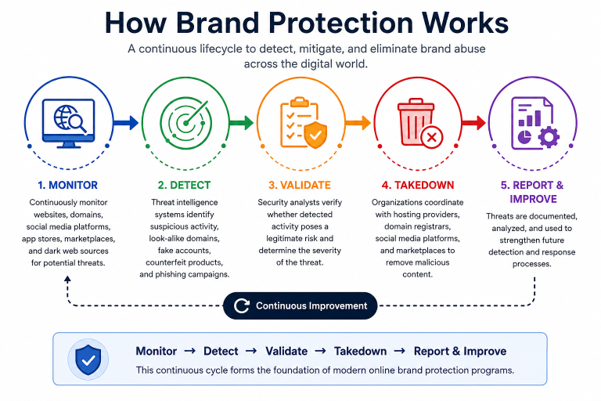
This Monitor → Detect → Validate → Takedown → Report framework forms the foundation of modern online brand protection programs.
Brand Protection Software & Tools
As digital threats scale, manual monitoring is no longer sufficient. Organizations increasingly rely on brand protection software to automate threat detection and response.
Modern brand protection solutions typically include:
- Domain and DNS monitoring
- Typosquatting detection
- Phishing detection
- Social media monitoring
- Mobile app monitoring
- Dark web intelligence
- Marketplace monitoring
- Executive impersonation detection
- Automated takedown workflows
- Threat intelligence integration
- Risk scoring and reporting
The best brand protection software combines cybersecurity intelligence with automated enforcement capabilities, allowing organizations to detect threats early and minimize exposure.
Building an Effective Brand Protection Strategy
A successful brand protection strategy requires more than reactive takedowns. Organizations should adopt a proactive approach that combines monitoring, intelligence, and enforcement.
- Establish Continuous Monitoring- Maintain visibility across domains, websites, social media platforms, app stores, marketplaces, and dark web communities.
- Monitor Domain Registrations- Track newly registered domains that resemble your brand to identify typosquatting and impersonation attempts early.
- Enforce Trademark Rights- Regularly identify and address unauthorized use of trademarks, logos, and branded assets.
- Detect Impersonation Quickly- Monitor for fake social media accounts, executive impersonation campaigns, and AI-generated deepfake content.
- Strengthen Takedown Processes- Develop clear procedures for rapidly removing malicious content from online platforms.
- Use Threat Intelligence- Leverage external threat intelligence to identify emerging campaigns targeting your organization, industry, or customers.
- Educate Employees and Customers- Awareness training helps users recognize phishing attempts and report suspicious activity before significant damage occurs.
Emerging Threats: AI-Powered Impersonation and Deepfakes
The rapid adoption of generative AI has introduced new challenges for brand protection teams.
Threat actors can now create:
- Deepfake videos of executives
- AI-generated voice impersonations
- Synthetic customer support interactions
- Highly convincing phishing content
- Fake brand announcements
- Automated scam campaigns at scale
These techniques make traditional detection methods less effective and increase the need for intelligence-driven brand monitoring.
Organizations should ensure their brand protection programs account for AI-enabled threats alongside conventional phishing and fraud activity.
How Cyble Supports Brand Protection
Organizations need comprehensive visibility across an increasingly complex threat landscape. Cyble’s Brand Intelligence & Protection capabilities help security teams identify and mitigate brand abuse across digital channels.
Key capabilities include:
- Suspicious domain monitoring
- Typosquatting detection
- Brand impersonation detection
- Social media monitoring
- Fake mobile app detection
- Website change monitoring
- Defacement monitoring
- Dark web intelligence
- Phishing and scam detection
- Real-time threat alerts
- Automated takedown workflows
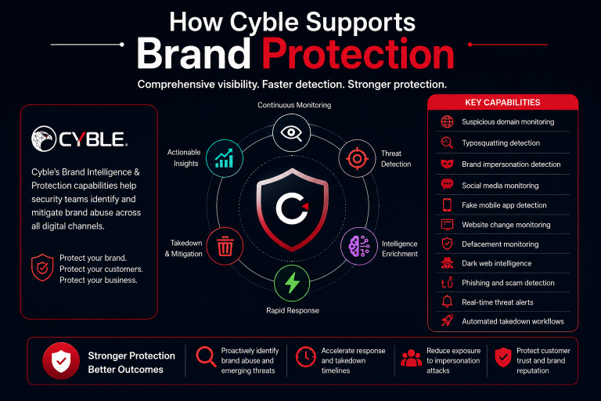
By combining external threat intelligence with continuous monitoring, organizations can proactively identify risks, accelerate response efforts, and reduce exposure to impersonation attacks.
Conclusion
Brand protection has sort of shifted, from what used to be mostly a trademark enforcement thing, into a core part of cybersecurity and digital risk management. With phishing showing up more often, impersonation, counterfeit products, and AI powered fraud all trending upward, organizations really have to defend their brands proactively, across every single digital channel.
A modern brand protection strategy is usually a mix of continuous monitoring and threat intelligence, plus automated enforcement and pretty quick response readiness. Companies that put money and effort into online brand protection tend to stay in a stronger spot: they can protect customers, keep trust intact, reduce fraud losses, and build better long term business resilience.
Request a demo: Cyble Brand Protection Demo
Frequently Asked Questions (FAQs) about Brand Protection
Why is brand protection important?
Brand protection helps organizations prevent financial losses, maintain customer trust, reduce reputational damage, and defend against phishing, fraud, and impersonation attacks.
How does brand protection work?
Brand protection works through continuous monitoring, threat detection, validation, takedown actions, and ongoing intelligence gathering across digital channels.
How to choose an online brand protection service?
Choose an online brand protection service that offers real-time monitoring, phishing detection, domain tracking, fake account detection, automated takedowns, and strong threat intelligence capabilities.
Why invest in online brand protection?
Investing in online brand protection helps organizations safeguard their digital presence, protect customers from scams, reduce cyber risks, and maintain long-term brand trust.
How does online brand protection save money?
Online brand protection saves money by preventing fraud, minimizing reputational damage, reducing legal and recovery costs, and helping organizations stop threats before they impact customers.
How to improve digital brand protection?
Businesses can improve digital brand protection by implementing continuous monitoring, tracking suspicious domains, detecting fake profiles and apps, enforcing trademarks, and responding quickly to phishing threats.
What is brand protection?
Brand protection is the process of safeguarding a company’s reputation, intellectual property, digital assets, and customers from fraud, impersonation, counterfeiting, and cyber threats.
What is online brand protection?
Online brand protection focuses specifically on defending digital assets across websites, domains, social media platforms, mobile apps, marketplaces, and the dark web.
What is typosquatting?
Typosquatting occurs when attackers register domain names that closely resemble legitimate brands to deceive users, distribute malware, or conduct phishing attacks.
How do you protect a brand name online?
Organizations can protect a brand name online by monitoring domains, enforcing trademarks, detecting impersonation, monitoring marketplaces and social media, and implementing automated takedown processes.
What is the difference between brand protection and trademark protection?
Trademark protection focuses on enforcing legal rights related to names, logos, and intellectual property. Brand protection is broader and includes cybersecurity, fraud prevention, reputation management, and online threat detection.
How much does brand protection cost?
Costs vary based on organization size, threat exposure, monitoring scope, and the technologies used. Many organizations adopt dedicated brand protection platforms to automate monitoring and response.