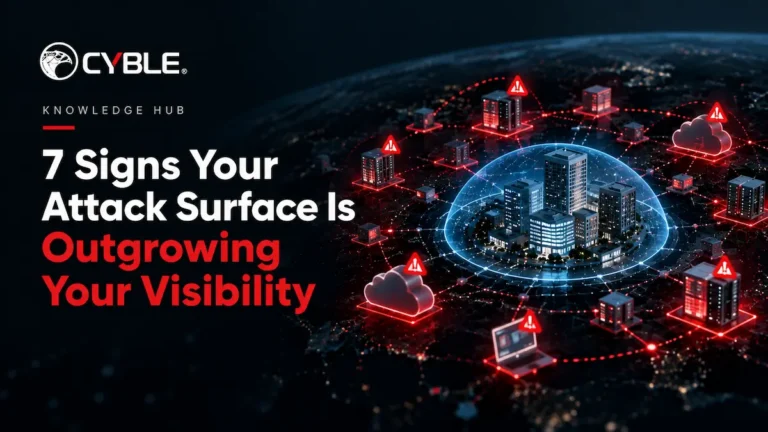
Your attack surface is probably bigger than you think.
Cloud workloads. SaaS applications. APIs. Mobile apps. Subdomains. Remote access services. IoT devices. Third-party infrastructure. Public code repositories—forgotten development environments.
Every internet-facing asset can potentially become an entry point for a cyberattack.
The challenge is that organizations cannot protect what they cannot see.
That is where Attack Surface Management (ASM) comes in.
Attack Surface Management is the continuous process of discovering, monitoring, assessing, and prioritizing an organization’s internet-facing digital assets and security exposures. Instead of relying on periodic assessments or manually maintained asset inventories, ASM gives security teams a continuously updated view of what is exposed—and what needs attention.
Think you know everything your organization has exposed to the internet? Put it to the test. Explore Cyble Attack Surface Management to discover what attackers can see.
What Is Attack Surface Management?
Attack Surface Management (ASM) is a cybersecurity practice focused on continuously identifying, monitoring, assessing, and reducing an organization’s digital attack surface.
An organization’s attack surface includes the systems, applications, infrastructure, services, credentials, and other digital assets that could potentially be exploited by threat actors.
Depending on the organization, this can include:
- Domains and subdomains
- IP addresses and exposed ports
- Websites and web applications
- APIs
- Cloud infrastructure and storage
- Mobile applications
- Email servers
- IoT devices
- Remote access services
- Public code repositories
- Third-party and vendor-connected assets
- Exposed credentials and sensitive information
The important distinction is that modern ASM goes beyond simply maintaining a list of known assets.
A strong attack surface management program continuously looks for unknown, unmanaged, forgotten, newly exposed, or misconfigured assets.
This matters because an asset does not need to be intentionally added to an organization’s inventory to become an attacker’s target.
A forgotten subdomain, exposed cloud resource, newly opened port, vulnerable application, or leaked credential can create an unexpected path into the organization.
How Does Attack Surface Management Work?
A typical ASM process can be broken into three core stages:
- Discover – Identify internet-facing assets across the organization’s digital footprint.
- Assess – Detect vulnerabilities, misconfigurations, exposed services, and other security weaknesses.
- Prioritize – Determine which exposures pose the greatest real-world risk so security teams know what to address first.
The process then continues as the organization’s digital environment changes.
New assets appear. Infrastructure moves to the cloud. Applications are updated. Certificates expire. Ports open. Vendors change. Shadow IT emerges.
Continuous monitoring helps security teams detect those changes instead of waiting for the next scheduled security assessment.
The biggest ASM blind spot? The assets nobody knows exist. See how Cyble discovers unknown and unmanaged assets before they become bigger problems.
Why Attack Surface Management Matters
Traditional security approaches often depend on an organization already knowing what it owns.
That assumption is increasingly difficult to maintain.
Modern enterprises operate across hybrid environments, cloud platforms, remote workforces, APIs, mobile applications, SaaS platforms, and complex third-party ecosystems. As these environments expand, so does the number of potential entry points.
This creates a fundamental security problem:
You cannot secure an asset you do not know about.
Attack Surface Management helps security teams move from a reactive approach to a more proactive model.
Instead of discovering an exposed asset after an attacker finds it, teams can continuously identify exposure and take action earlier.
For example, ASM can help uncover:
- Forgotten or orphaned subdomains
- Exposed administrative interfaces
- Open ports and services
- Misconfigured cloud storage
- Vulnerable web applications
- Expired or problematic SSL/TLS certificates
- Exposed credentials
- Shadow IT
- Publicly exposed development environments
- Risks associated with third-party assets
Cyble’s ASM solution is designed to continuously map internet-facing assets and identify exposures across domains, websites, web and mobile applications, cloud environments, email servers, IoT devices, and public code repositories.
Types of Attack Surface Management
Attack Surface Management can cover different areas of an organization’s technology environment.
| Type | What It Covers | Why It Matters |
|---|---|---|
| External Attack Surface Management (EASM) | Internet-facing domains, IPs, applications, APIs, cloud assets, and exposed services | Shows what attackers can discover from outside the organization |
| Internal Attack Surface Management | Internal systems, devices, applications, and infrastructure | Helps identify weaknesses within the corporate environment |
| Cloud Attack Surface Management | Cloud workloads, storage, configurations, and exposed cloud services | Helps identify cloud misconfigurations and unintended exposure |
| Third-Party Attack Surface Management | Vendors, partners, suppliers, and connected external infrastructure | Helps identify risks introduced through the supply chain |
| Cyber Asset Attack Surface Management (CAASM) | Broader visibility across an organization’s technology assets | Helps security teams build a more complete asset picture |
External Attack Surface Management
External Attack Surface Management (EASM) has become particularly important as organizations expose more infrastructure to the public internet.
EASM takes an outside-in approach, examining an organization’s digital footprint from the perspective of an external attacker.
Rather than asking only, “What assets do we know we own?” EASM asks:
“What can an attacker actually find?”
This distinction is critical.
Cyble describes EASM as the continuous discovery, inventory, and assessment of internet-facing assets from an outside-in, attacker perspective. Its ASM capabilities are designed to discover domains, IPs, cloud assets, and exposed services without requiring internal network access. C
What Does Attack Surface Management Actually Do?
An effective ASM solution typically performs four major functions.
1. Discover Digital Assets
The first step is building an accurate picture of the organization’s external attack surface.
ASM can discover assets that may not appear in traditional asset inventories, including shadow IT, forgotten subdomains, exposed services, and newly deployed infrastructure.
2. Monitor for Changes
An attack surface is constantly changing.
ASM continuously monitors assets for changes such as:
- New domains or subdomains
- Newly opened ports
- Changes to DNS records
- New cloud resources
- Configuration changes
- New vulnerabilities
- Certificate issues
- Newly exposed services
Continuous monitoring means security teams can respond to exposure as it emerges rather than discovering it during the next quarterly review.
3. Identify and Assess Risk
Discovery alone is not enough.
Security teams need to understand which exposures are actually important.
ASM solutions can assess vulnerabilities, misconfigurations, exposed services, and other weaknesses and use contextual risk information to help prioritize remediation.
4. Reduce the Attack Surface
The ultimate goal is not to create another dashboard.
The goal is risk reduction.
That can mean:
- Removing unnecessary internet exposure
- Closing unused ports
- Fixing cloud misconfigurations
- Patching vulnerable applications
- Decommissioning forgotten infrastructure
- Securing exposed credentials
- Hardening externally accessible services
The result is a smaller and better-controlled attack surface.
Attack Surface Management vs. Vulnerability Management
ASM and vulnerability management are closely related, but they are not the same thing.
- Vulnerability management primarily focuses on identifying and managing vulnerabilities across known systems.
- Attack Surface Management starts with the broader question of what is actually exposed.
For example, vulnerability management may identify a vulnerability on a known server.
ASM may first discover that the server exists, identify that it is internet-facing, detect its exposed services, assess its vulnerabilities, and provide context around the asset’s overall exposure.
In simple terms:
- Vulnerability management asks: “Which known assets are vulnerable?”
- Attack Surface Management asks: “What is exposed, what is vulnerable, and what should we fix first?”
The two approaches work best together.
Attack Surface Management vs. External Attack Surface Management
The terms are sometimes used interchangeably, but there is a useful distinction.
Attack Surface Management (ASM) can refer broadly to the management of an organization’s attack surface.
External Attack Surface Management (EASM) specifically focuses on assets and exposures that are visible from outside the organization’s perimeter.
EASM is particularly valuable for organizations with large public-facing digital footprints because it provides an attacker-centric view of external exposure.
Cyble’s ASM approach combines external asset discovery with continuous monitoring and threat intelligence to help security teams understand both what is exposed and which exposures may require immediate attention.
Key Benefits of Attack Surface Management
1. Improved Visibility Across Digital Assets
One of the biggest benefits of ASM is visibility.
Organizations often have assets distributed across multiple business units, cloud environments, subsidiaries, development teams, and third-party providers.
ASM helps consolidate that external exposure into a more current asset inventory.
Cyble’s platform is designed to discover and monitor internet-facing assets, including shadow IT and supply-chain exposures.
2. Faster Detection of Security Exposures
Periodic security assessments can leave gaps between assessments.
Continuous attack surface monitoring helps organizations detect newly exposed assets, configuration changes, vulnerabilities, and other risks as they emerge.
This is particularly important in fast-moving cloud and DevOps environments.
3. Better Risk Prioritization
Not every vulnerability deserves the same level of urgency.
A critical vulnerability on an isolated, non-production asset may represent less immediate risk than a moderately rated vulnerability on a business-critical internet-facing application.
Modern ASM platforms can combine vulnerability severity with asset context and threat intelligence to help security teams prioritize the issues most likely to matter.
Cyble’s ASM combines asset-level risk information with threat intelligence, including adversary and dark-web signals, to provide additional context around exposure.
4. Reduced Attack Surface
Attack Surface Management supports attack surface reduction by helping organizations identify and remove unnecessary exposure.
This can include retiring forgotten assets, closing unnecessary ports, correcting cloud configurations, securing exposed applications, and addressing vulnerable services.
Fewer exposed entry points can mean fewer opportunities for attackers.
5. Better Security Operations
Security teams already deal with large volumes of alerts.
A useful ASM solution should help reduce the amount of manual asset discovery and investigation required by continuously identifying changes and surfacing higher-priority exposures.
This can help security teams spend more time fixing meaningful risks and less time maintaining spreadsheets.
6. Stronger Compliance and Governance
Organizations operating in regulated industries need visibility into the systems and services that could expose sensitive information.
Continuous asset discovery and monitoring can support security governance by providing a more current understanding of external exposure and helping teams demonstrate that risks are being monitored and addressed.
Common Attack Surface Risks
Why do organizations need ASM in the first place?
Because exposure can happen in many ways.
Shadow IT
Employees or development teams may deploy cloud instances, SaaS applications, development environments, or other services outside standard IT processes.
Those assets can remain exposed without being included in the organization’s official inventory.
Forgotten Assets
Old domains, subdomains, applications, and servers sometimes remain online long after their original purpose disappears.
Attackers do not care whether an organization has forgotten an asset.
If it is exposed, it can potentially become a target.
Cloud Misconfigurations
Cloud environments can introduce new exposure when storage, access controls, services, or network configurations are incorrectly configured.
ASM can help identify publicly exposed cloud resources that might otherwise remain unnoticed.
Exposed Credentials
Credentials appearing in public repositories, leaked datasets, or other sources can provide attackers with a direct path toward organizational systems.
This is why modern attack surface monitoring increasingly overlaps with threat intelligence.
Open Ports and Exposed Services
Unexpectedly open ports or exposed administrative services can increase the organization’s attack surface.
Continuous monitoring helps security teams identify these changes and investigate whether they are intentional.
Vulnerable Web Applications and APIs
Web applications and APIs are frequently exposed directly to the internet.
A vulnerable application can therefore become a high-value entry point.
Application security scanning within ASM can help identify weaknesses from an external perspective.
How Cyble Supports Attack Surface Management
Organizations need more than an asset list.
They need to understand what is exposed, why it matters, and what should happen next.
Cyble Attack Surface Management is designed to provide continuous visibility into an organization’s external digital footprint while helping security teams identify, assess, and prioritize exposures.
Cyble’s ASM capabilities cover areas including:
- Asset discovery and intelligence
- Web and mobile application security scanning
- Cloud storage analysis
- Vulnerability management
- File hash detection
- IP risk scoring
- SSL and domain expiry monitoring
- Public code repository analysis
- New port discovery
- Continuous external attack surface monitoring
Cyble also connects ASM with threat intelligence, allowing exposed assets to be enriched with threat actor context, dark-web signals, and active exploit information.
See Your Attack Surface Before Attackers Do
Most organizations have an asset inventory.
The harder question is:
Is your inventory showing everything an attacker can actually see?
Cyble’s approach combines outside-in asset discovery with continuous monitoring and threat intelligence so security teams can identify unknown assets, detect emerging exposures, and prioritize remediation.
Don’t wait for an attacker to discover your forgotten assets first. See what Cyble can find across your attack surface.
Key Features to Look for in an Attack Surface Management Platform
When evaluating an attack surface management solution, look beyond the number of features.
The most important question is whether the platform helps your team continuously move from discovery → risk assessment → prioritization → remediation.
Look for:
Continuous Asset Discovery
Your external environment changes every day. Your ASM platform should keep up.
Shadow IT Detection
The platform should identify assets that exist outside traditional asset inventories.
External Vulnerability Assessment
ASM should identify vulnerabilities and exposures visible from the internet.
Cloud Visibility
Look for coverage across major cloud environments and publicly exposed cloud resources.
Risk-Based Prioritization
The platform should help security teams determine what needs to be fixed first.
Threat Intelligence Integration
Exposure becomes more meaningful when it can be correlated with active threats, threat actors, exploits, and leaked information.
Real-Time or Continuous Monitoring
Scheduled scans can miss changes that happen between assessments. Continuous monitoring helps close those blind spots.
Actionable Remediation
The best ASM solution should help turn findings into security actions rather than simply creating another list of alerts.
Cyble emphasizes continuous external scanning, asset criticality, vulnerability context, threat intelligence correlation, and fix-first guidance as part of its ASM approach.
How to Build an Attack Surface Management Strategy
Technology is only one part of an effective ASM program.
Organizations can build a stronger strategy by following these steps:
Step 1: Establish External Visibility
Identify all internet-facing domains, IPs, applications, cloud assets, services, and other digital infrastructure.
Step 2: Find Unknown Assets
Look specifically for shadow IT, forgotten infrastructure, unmanaged subdomains, and third-party exposure.
Step 3: Assess Exposure
Identify vulnerabilities, misconfigurations, exposed services, leaked credentials, and other security weaknesses.
Step 4: Prioritize Risk
Rank findings according to severity, asset importance, exploitability, and available threat intelligence.
Step 5: Remediate
Patch vulnerabilities, remove unnecessary exposure, close ports, correct configurations, and retire obsolete assets.
Step 6: Monitor Continuously
Repeat the process continuously because the attack surface is never static.
Who Needs Attack Surface Management?
ASM can be valuable for virtually any organization with a meaningful internet presence, but it is particularly useful for:
- Large enterprises with complex digital footprints
- Cloud-first organizations
- Financial institutions
- Healthcare organizations
- Retail and e-commerce businesses
- Technology and SaaS companies
- Manufacturing organizations
- Organizations with extensive third-party ecosystems
- Companies undergoing mergers and acquisitions
- Organizations with large numbers of internet-facing applications
The more complex the digital environment, the harder it becomes to maintain complete visibility manually.
Frequently Asked Questions About Attack Surface Management
What is attack surface management in cybersecurity?
Attack Surface Management is the continuous process of discovering, monitoring, assessing, and prioritizing an organization’s internet-facing digital assets and security exposures. The goal is to identify weaknesses before attackers can exploit them and reduce unnecessary exposure.
What is the difference between ASM and EASM?
ASM is a broad term for managing an organization’s attack surface, while External Attack Surface Management (EASM) focuses specifically on internet-facing assets viewed from outside the organization.
What does an ASM platform discover?
Depending on the platform, ASM can discover domains, subdomains, IP addresses, ports, web applications, APIs, cloud resources, mobile applications, email infrastructure, IoT devices, code repositories, and other internet-facing assets.
How does ASM reduce cyber risk?
ASM helps reduce cyber risk by identifying unknown assets, vulnerabilities, misconfigurations, exposed services, and other weaknesses. Security teams can then prioritize remediation and remove unnecessary attack paths.
Why is continuous attack surface monitoring important?
Digital environments change constantly. New assets can appear, configurations can change, and vulnerabilities can emerge. Continuous monitoring helps security teams identify those changes without waiting for a periodic assessment.
Is attack surface management the same as vulnerability management?
No. Vulnerability management primarily focuses on identifying and remediating vulnerabilities, while ASM provides broader visibility into the organization’s external digital footprint, including unknown assets and exposures.
How does Cyble Attack Surface Management work?
Cyble ASM continuously discovers and monitors internet-facing assets across areas such as domains, web and mobile applications, cloud environments, email servers, IoT devices, and public code repositories. It also provides risk and threat intelligence context to help security teams prioritize exposures.
What should I look for in an ASM solution?
Look for continuous asset discovery, external visibility, shadow IT detection, vulnerability assessment, cloud coverage, risk prioritization, threat intelligence integration, continuous monitoring, and actionable remediation workflows.
The Bottom Line: You Can’t Protect What You Can’t See
The modern enterprise no longer has a clearly defined perimeter.
Applications live in the cloud. Employees work remotely. APIs connect services. Vendors connect to business systems. Development teams deploy infrastructure rapidly. New digital assets appear every day.
That means the attack surface is constantly changing.
Attack Surface Management gives security teams the visibility they need to discover those changes, understand their risk, and reduce exposure before attackers can take advantage of them.
The goal is simple:
Know what is exposed. Know what matters. Fix it before attackers do.
And if you want to know what your organization looks like from an attacker’s perspective, don’t guess.