Overview
Daixin Team is a financially motivated ransomware and data-extortion group active since at least June 2022. It concentrates on the healthcare and public health sector but has also hit utilities, transport, hospitality, and other industries.
The group runs a double-extortion model: it steals sensitive data, encrypts systems, and threatens to publish the data unless a ransom is paid. Some intrusions appear to be pure data theft, with leak threats but no encryption reported.
Daixin typically gets in through VPN servers, using stolen or phished credentials or by exploiting unpatched vulnerabilities. Publicly reported victims include the North Texas Municipal Water District and TransForm Shared Service Organization, which serves hospitals in Ontario, Canada.
Attribution beyond the Daixin name is unresolved. The group has no confirmed links to a larger collective, though it shares common tooling such as Rclone with many other ransomware operators.
Operating Model
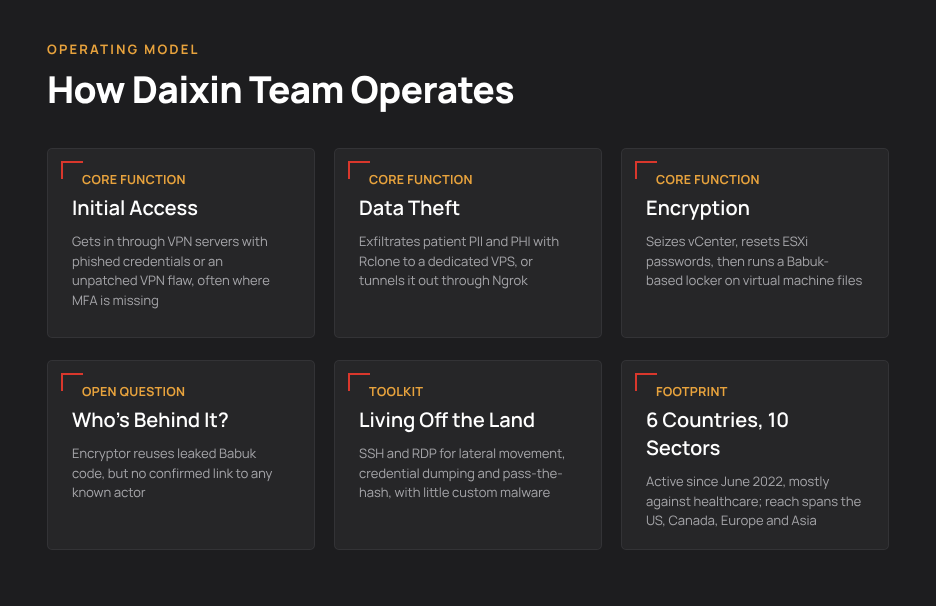
Daixin follows a double-extortion playbook that leans on stolen credentials and hypervisor access rather than custom malware. Its activity falls into four core functions:
- Initial access: entering through VPN servers, either with phished credentials or by exploiting an unpatched VPN vulnerability.
- Privilege escalation: dumping credentials and passing the hash to reach privileged accounts, then taking over VMware vCenter.
- Data theft: exfiltrating PII and PHI with Rclone or Ngrok before or alongside encryption.
- Encryption and extortion: encrypting ESXi virtual machine files and threatening to leak stolen data on a leak site.
The attack chain documented by FBI, CISA, and HHS in advisory AA22-294A runs as follows:
- The operators obtain VPN credentials through spearphishing emails with malicious attachments, or exploit an unpatched VPN server.
- They log in to the VPN, in one confirmed case, a legacy server without multifactor authentication.
- They move laterally over SSH and RDP.
- They dump credentials and use pass-the-hash to gain privileged account access.
- They use privileged accounts to access VMware vCenter Server and reset passwords for ESXi hosts.
- They exfiltrate data with Rclone to a dedicated VPS, or tunnel it out through Ngrok.
- They connect to ESXi hosts over SSH and deploy the ransomware, which encrypts virtual machine files and drops a ransom note.
This chain is drawn from confirmed incident response. It is now four years old, and newer intrusions may use different tooling.
Targeting and Reach
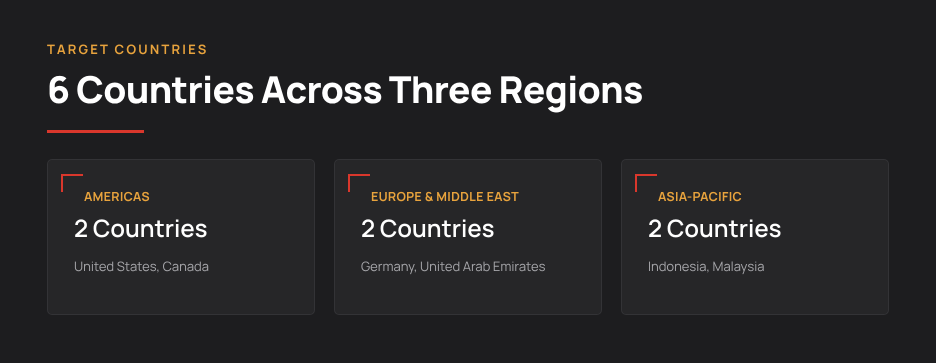
Daixin’s activity covers 6 countries and 10 industry categories. That is a low-volume footprint: Breachsense counted 22 victims as of August 2026, about four years after the group appeared.
Countries: United States, Canada, Germany, the United Arab Emirates, Indonesia and Malaysia.
Industries:
- Automotive
- BFSI
- Energy and utilities
- Food and beverages
- Government and law enforcement
- Healthcare
- Hospitality
- Media and entertainment
- Professional services
- Transportation and logistics

Healthcare remains the centre of gravity. The 2022 joint advisory describes the group as predominantly targeting the US Healthcare and Public Health sector, and its newest listing is again a hospice network. The other sectors suggest it will also take large organizations holding customer data at scale, such as airlines, hotels and utilities.
Recent Activity: Trustbridge and Empath Health
On November 16, 2026, Daixin allegedly listed Trustbridge and Empath Health on its leak site. Neither organization has commented publicly, no data has been published, and the claim is unverified.
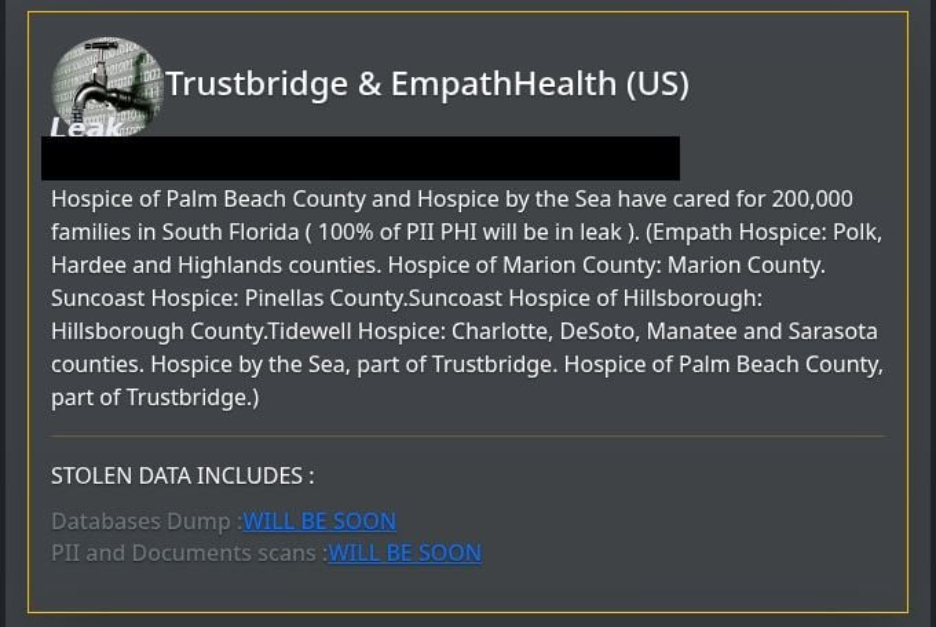
The two are affiliated Florida nonprofits that together form the state’s largest not-for-profit hospice network. Trustbridge was fully integrated into Empath Health in 2026, according to Home Health Care News.
What the listing claims:
- It names Hospice of Palm Beach County and Hospice by the Sea (Trustbridge), plus Empath Hospice, Hospice of Marion County, Suncoast Hospice, Suncoast Hospice of Hillsborough and Tidewell Hospice (Empath Health).
- It says the providers have cared for 200,000 families in South Florida and threatens to leak all of their PII and PHI.
- It promises a database dump and scanned identity documents “soon”, but gives no data size or samples.
- It threatens a leak but does not claim that systems were encrypted, per RedPacket Security.
Malware and Tooling
Daixin’s toolkit is small and relies mostly on legitimate software and built-in protocols. Only one tool, Rclone, is formally linked to the group in threat-intelligence tracking; the rest come from the CISA advisory.
| Tool | Type | Role in Daixin attacks |
| Daixin ransomware | Ransomware (ESXi) | Encrypts virtual machine files on VMware ESXi hosts |
| Rclone | File sync utility | Exfiltration to a dedicated VPS |
| Ngrok | Reverse proxy/tunnelling | Exfiltration over web services |
| SSH and RDP | Built-in remote access protocols | Lateral movement and ransomware deployment |
| Credential dumping and pass-the-hash tooling | Credential access (not named) | Privileged account takeover |
Daixin ransomware
Third-party reporting cited by CISA says the encryptor is built on leaked Babuk Locker source code. It targets ESXi servers and encrypts virtual machine files in /vmfs/volumes/ with the extensions .vmdk, .vmem, .vswp, .vmsd, .vmx and .vmsn. It writes a ransom note to the same path; one observed note misspelled the group’s name as “Daxin”.
Encrypting the hypervisor layer lets the group take down many servers at once, including electronic health records, diagnostics, imaging and intranet services.
Rclone
Rclone is a legitimate open-source tool for syncing files to cloud storage. In one confirmed Daixin intrusion it was used to move data to a dedicated virtual private server. CISA published SHA256 hashes for the Rclone v1.59.2 Windows package found in that case.
Ngrok
Ngrok is a legitimate reverse proxy that exposes an internal service on a public Ngrok domain. Daixin used it in another intrusion to exfiltrate data over web traffic that blends in with normal HTTPS.
Leak site
Daixin runs a Tor-accessible leak site where it lists victims and publishes stolen data. It has also posted negotiation screenshots there, for example showing a ransom demand to Omni Hotels cut from $3 million to $2 million, as reported by CISO2CISO.
Attribution
Daixin Team has not been tied to any known collective, nation-state, or earlier ransomware brand. Its origin is unknown, and no aliases or consistent infrastructure have been confirmed publicly.
The only code-level lead is the encryptor’s reported basis in leaked Babuk source code. That is weak evidence: since the Babuk leak in 2021, many unrelated groups have built ESXi lockers from the same code.
Threat-intelligence platforms list 13 “associated” actors for Daixin. These are groups that share its one tracked tool, Rclone, not groups with a demonstrated link:
| Actor | Category | Last seen |
| INC Ransom | Ransomware group, APT | 17 Nov 2026 |
| Frag | Ransomware group | 12 Nov 2026 |
| Osiris | Ransomware group | 12 Nov 2026 |
| Warlock Ransomware | Ransomware group | 12 Oct 2026 |
| Medusa / Medusa Group | Ransomware group, APT | 14 Sep 2026 |
| UNC4393 | Ransomware group, APT | 07 Sep 2026 |
| Storm-0501 | Ransomware group | 29 Aug 2026 |
| RansomHub | Ransomware group | 17 Jun 2026 |
Rclone is one of the most widely used exfiltration tools in the ransomware ecosystem, so this overlap says little about who runs Daixin. The most that can be said is that Daixin’s operators work with the same commodity tooling as many peers.
The 2026 reappearance adds a further question. After a long quiet period, the current listings may come from the original operators, from new actors reusing the brand, or from inflated claims, as seen with the 2024 listing flagged as fabricated.
MITRE ATT&CK Mapping
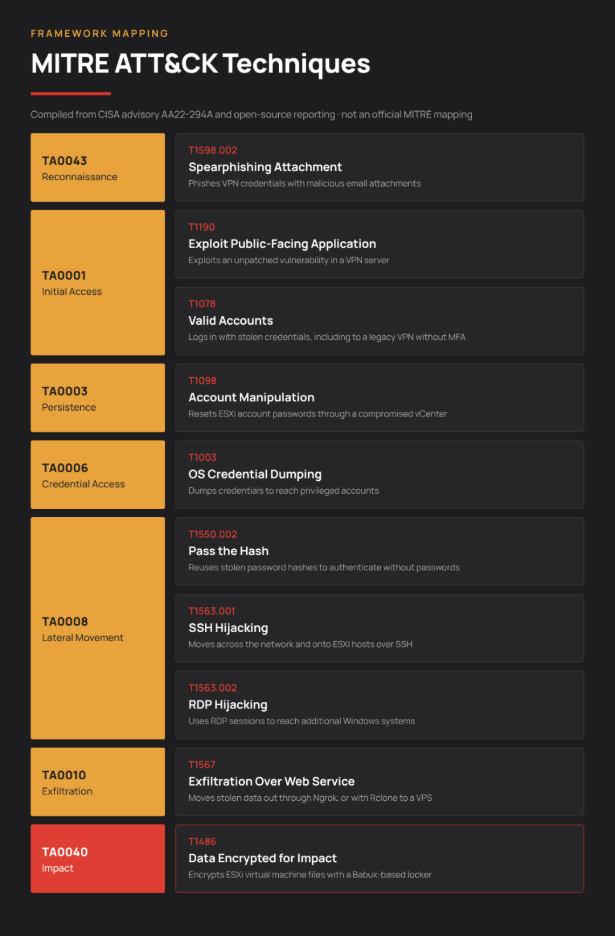
The mapping below follows the techniques published for Daixin in advisory AA22-294A, grouped by tactic in attack order.
- Reconnaissance (TA0043) – Phishing for Information: Spearphishing Attachment (T1598.002): Daixin operators sent phishing emails with malicious attachments to obtain VPN credentials.
- Initial Access (TA0001) – Exploit Public-Facing Application (T1190): They exploited an unpatched vulnerability in a VPN server.
- Initial Access, Persistence, Privilege Escalation and Defense Evasion – Valid Accounts (T1078): They logged in with stolen credentials, including to a legacy VPN server without MFA.
- Persistence and Privilege Escalation (TA0003, TA0004) – Account Manipulation (T1098): They used privileged accounts in vCenter to reset passwords on ESXi servers.
- Credential Access (TA0006) – OS Credential Dumping (T1003): They dumped credentials to reach privileged accounts.
- Defense Evasion and Lateral Movement (TA0005, TA0008) – Use Alternate Authentication Material: Pass the Hash (T1550.002): They reused password hashes to authenticate without plaintext passwords.
- Lateral Movement (TA0008) – Remote Service Session Hijacking: SSH Hijacking and RDP Hijacking (T1563.001, T1563.002): They moved across the network over SSH and RDP.
- Exfiltration (TA0010) – Exfiltration Over Web Service (T1567): They used Ngrok and, in another case, Rclone to a VPS to move data out.
- Impact (TA0040) – Data Encrypted for Impact (T1486): They encrypted ESXi virtual machine files with a Babuk-derived locker.
Conclusion
Daixin Team shows how much damage a ransomware crew can do with stolen credentials and hypervisor access instead of custom malware. Since June 2022, it has hit hospitals, an airline, a hotel chain, and a water utility. In November 2026, it resurfaced with a claimed breach of Florida’s largest nonprofit hospice network.
The biggest open questions are who is behind the group and whether the 2026 listing reflects the same operators. Its documented tradecraft still points to clear defensive priorities:
- Patch VPN appliances quickly and retire legacy VPN servers.
- Require phishing-resistant MFA on VPN, webmail, and every privileged account.
- Isolate vCenter and ESXi management interfaces, disable SSH on ESXi hosts when not in use, and alert on ESXi password resets.
- Protect credentials against dumping and pass-the-hash, for example with Credential Guard and tiered admin accounts.
- Watch for Rclone and Ngrok execution and for large outbound transfers to unfamiliar servers.
- Keep offline, immutable backups that include virtual machine images.
- Healthcare organizations should rehearse breach-notification procedures for PHI, since the group threatens leaks even without encryption.
Cyble’s threat intelligence monitors underground forums, leak sites, and dark web chatter, alerting you when your organization or suppliers appear in listings like Daixin’s.
Book a free demo to get ahead of Daixin Team and the next ransomware group aimed at healthcare and critical services.
Frequently Asked Questions about Daixin Team
What is Daixin Team?
A ransomware and data-extortion group that steals sensitive data, encrypts VMware ESXi servers, and threatens to leak the data unless paid.
When did it first appear?
It has been active since at least June 2022, according to FBI, CISA and HHS.
Who does it target?
Mainly healthcare organizations, but it has also hit utilities, airlines, hospitality, government and other sectors in 6 countries: the United States, Canada, Germany, the UAE, Indonesia and Malaysia.
How does it get in?
Through VPN servers, using credentials stolen by phishing or by exploiting unpatched VPN vulnerabilities.
What extortion model does it use?
Double extortion. It exfiltrates data, encrypts systems, and lists victims on a Tor leak site. Some listings, including the November 2026 one, threaten leaks without claiming encryption.
What tools are linked to it?
A Babuk-based ESXi encryptor, Rclone and Ngrok for exfiltration, and SSH, RDP, credential dumping and pass-the-hash for movement and escalation.
Who is behind it?
Unknown. Its encryptor reuses leaked Babuk code, and it shares Rclone with many other groups, but no link to any known actor has been confirmed.
Sources
Disclaimer: This profile is compiled from open-source reporting and threat-intelligence tracking as of the date above. Details about Daixin Team, including its methods, infrastructure, victims and attribution, may change as new information emerges. Victim claims made by the group are unverified unless stated otherwise. This content is for informational purposes only and is not definitive attribution or a substitute for professional security advice.