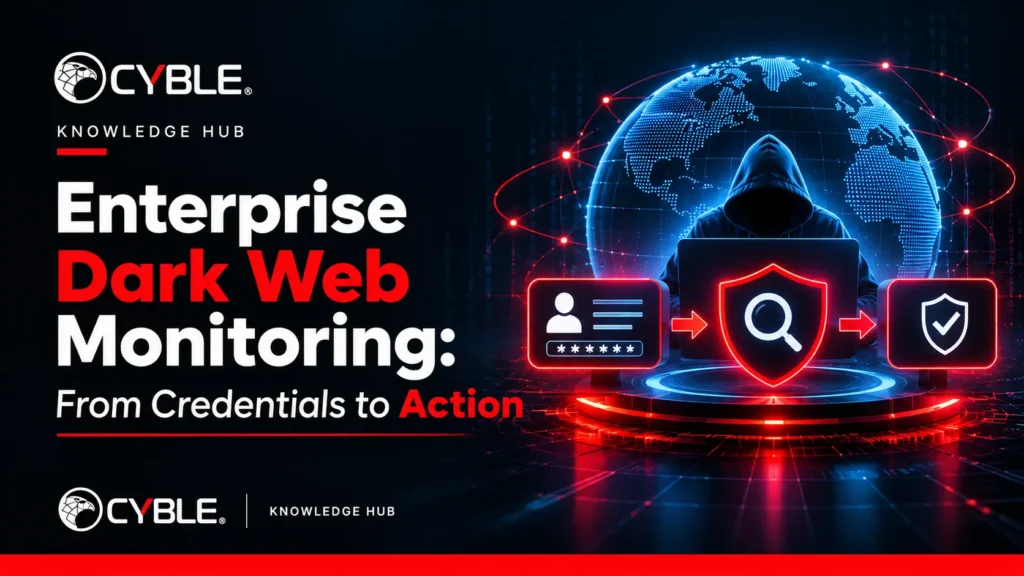
Finding a company password on the dark web is not the hard part anymore. Knowing what to do with it, and doing it fast enough, is. Enterprise dark web monitoring exists to close that gap: to spot exposed credentials and other company data in criminal markets and forums, then turn each finding into a concrete security action before attackers use it.
For large organizations with thousands of employees, contractors, and customer accounts, the volume of exposure can be significant. The value of monitoring depends less on how much it finds and more on how reliably those findings lead to resets, revoked sessions, and cleaned devices.
Why Exposed Credentials Are the Core Risk
Attackers prefer logging in to breaking in. A valid username and password lets them skip exploits entirely and blend in with normal user activity. Credentials reach the dark web through several routes:
- Infostealer logs. Malware on a personal or work device captures saved passwords, browser cookies, and autofill data, then uploads them in bundles that are sorted and sold by domain.
- Third-party breaches. Employees often reuse work email addresses, and sometimes passwords, on outside services that later get breached.
- Phishing kits. Credentials harvested through fake login pages are frequently resold or shared.
- Combo lists. Older breach data is merged and recirculated in large lists used for automated attacks.
Once in circulation, these credentials fuel credential stuffing, where attackers test username and password pairs against many services at scale, and targeted account takeover attempts against email, VPN, and cloud platforms. Stolen browser cookies add another layer of risk. They can enable session hijacking, letting an attacker reuse an authenticated session without needing the password or passing multi-factor authentication again.
What Enterprise Dark Web Monitoring Should Cover
Coverage needs to match how the organization is actually exposed. Effective enterprise dark web monitoring typically tracks:
| Source | What it can reveal |
| Underground forums and marketplaces | Data sale listings, access offers, and discussions naming the company |
| Infostealer log markets | Employee and customer credentials, cookies, and device details |
| Paste sites and leak portals | Dumped databases, configuration files, and internal documents |
| Encrypted messaging channels | Shared leaks and fast-moving offers that never reach forums |
| Ransomware leak sites | Whether the company or a supplier has been named as a victim |
The monitored terms matter as much as the sources. Corporate domains, subsidiary domains, executive names, brand names, IP ranges, and key supplier names should all be included and reviewed as the business changes.
From Exposure to Action: A Practical Workflow
An alert only reduces risk when it leads to a completed task. A clear workflow keeps findings from piling up unread.
- Detect. Monitoring flags a credential, cookie, or dataset tied to a company domain or asset.
- Validate. Confirm the account exists and is active, check whether the password is current, and identify whether the data is new or recycled from an older breach.
- Prioritize. Rank findings by access level and freshness. A recent infostealer record for a cloud administrator outranks an old password for a disabled account.
- Remediate. Force a password reset, revoke active sessions and tokens, and isolate the infected device if malware was the source. Identity and access management teams should own these steps for employee accounts.
- Investigate. Review login history for the affected account to confirm it was not already used, and check for related exposure across other users on the same device or network.
- Close and record. Log the action taken, the time to remediate, and the root cause so trends become visible over time.
Much of this can be automated. SOAR playbooks can trigger resets and session revocation as soon as a validated high-priority credential is detected, leaving analysts to handle investigation and edge cases.
Are your employees’ logins already circulating? Book a FREE Cyble demo now and get your Exposure Brief
Common Gaps That Slow Enterprise Dark Web Monitoring
Even well-funded programs stall for familiar reasons:
- No clear owner. Alerts land with the intelligence team, but resets belong to IT and identity teams. Without agreed handoffs, findings wait.
- Password resets alone. Changing a password does not invalidate stolen session cookies. Sessions and tokens must be revoked too.
- Ignoring personal devices. Many infostealer infections happen on home computers where employees also sign in to work accounts. Policies and endpoint checks need to account for this.
- Missing third parties. Contractor and supplier accounts with access to company systems carry the same risk but are often left out of monitoring scope.
- No measurement. Without tracking time from detection to remediation, it is hard to tell whether the program is improving.
Fixing these gaps is mostly a matter of process and integration, not more data.
Want to watch an alert become a closed ticket? See Cyble in Action
Final Thoughts
Exposed credentials are one of the most common ways attackers gain a foothold, and one of the most fixable. The organizations that benefit most from enterprise dark web monitoring treat every finding as a task with an owner, a deadline, and a recorded outcome. Detection starts the clock. Action is what stops it. For more research on dark web threats and exposure, visit Cyble.
Sources