Most security teams read threat actor reports. Far fewer turn them into detections.
A new advisory lands describing how a ransomware affiliate gains access, moves laterally, and exfiltrates data. Analysts summarize it, share it in a channel, and maybe block a few indicators. A month later, the same group returns with new infrastructure, and the SOC has no better chance of spotting it than before.
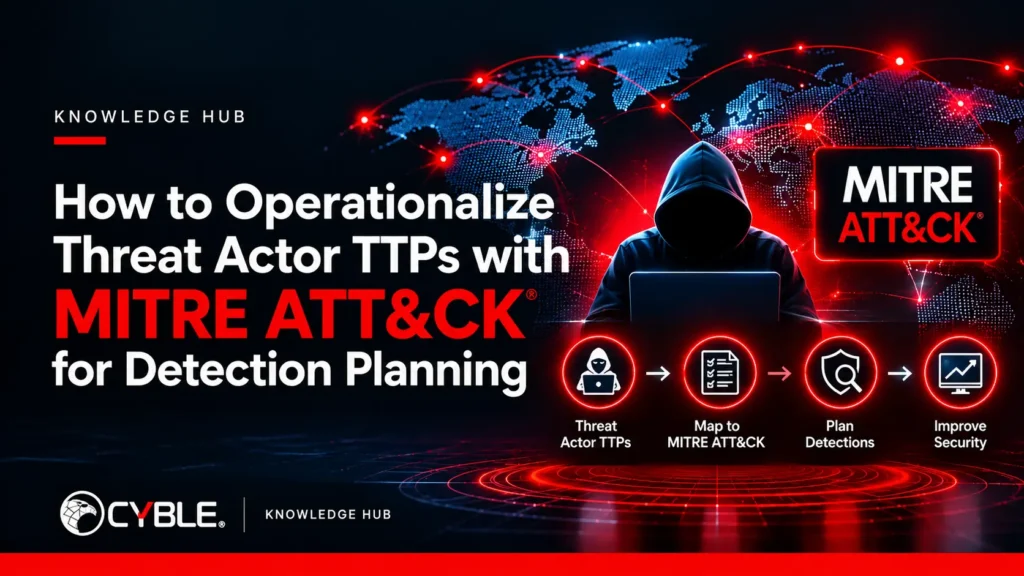
The gap is not a lack of intelligence. It is the lack of a repeatable process that converts what adversaries do into what defenders can see. MITRE ATT&CK provides the common language for that conversion. This guide lays out a seven-step workflow to operationalize threat actor TTPs, from actor reporting to technique mapping, detection hypotheses, coverage gaps, and validation.
Security teams improve detection coverage by selecting the threat actors most relevant to their organization, extracting the behaviors described in intelligence reporting, mapping those behaviors to ATT&CK techniques, and prioritizing the techniques that recur across actors. Each priority technique becomes a detection hypothesis tied to specific telemetry. Teams then compare the resulting map against existing detections to find gaps, build and test new detections through adversary emulation, and repeat the cycle as new reporting arrives.
Why TTPs, Not Just Indicators, Should Drive Detection Planning
Indicators of compromise such as IP addresses, domains, and file hashes are cheap for attackers to change. A threat actor can rotate infrastructure overnight. Changing how they operate, such as how they dump credentials, abuse remote access tools, or stage data for exfiltration, is far more costly. This is the idea behind David Bianco’s Pyramid of Pain: detections built on behavior impose the most cost on adversaries.
Tactics, techniques, and procedures (TTPs) describe that behavior at three levels:
- Tactics are the adversary’s goals, such as Initial Access, Credential Access, or Exfiltration.
- Techniques and sub-techniques are how those goals are achieved, such as OS Credential Dumping: LSASS Memory (T1003.001).
- Procedures are the specific implementations a given actor uses, such as a particular tool, command line, or sequence.
MITRE ATT&CK organizes this knowledge into a matrix that intelligence analysts and detection engineers can both read. When intelligence is mapped to ATT&CK, it stops being a narrative and becomes a structured list of behaviors that can be checked against existing coverage.
| Indicator-led approach | TTP-led approach | |
| Primary input | IOC feeds | Actor behavior from reporting |
| Shelf life | Hours to weeks | Months to years |
| Output | Blocklists and alerts on known artifacts | Behavioral detections and hunts |
| Coverage view | Hard to measure | Measurable against the ATT&CK matrix |
| Resilience to actor change | Low | High |
Both approaches have a place. Indicators support fast blocking and enrichment; TTPs support durable detection planning.
A 7-Step Workflow to Operationalize Threat Actor TTPs
The workflow below turns intelligence into tested detections. Each step produces an artifact that feeds the next, so the process can be repeated every time new reporting arrives.
Step 1: Select the threat actors that matter to your organization
Start with relevance, not volume. Use your priority intelligence requirements to identify the actors most likely to target you, based on industry, geography, technology stack, and the data you hold.
- Review which groups have targeted your sector and region over the past 12 to 24 months
- Include ransomware operators and initial access brokers, not only nation-state groups
- Factor in exposed technologies, such as VPN appliances or file transfer software that specific actors exploit
- Aim for a manageable shortlist, typically 5 to 15 actors or campaigns
Output: a ranked actor shortlist with the reason each one is included.
Step 2: Extract behaviors from intelligence reporting
Collect reporting on each actor from vendor research, government advisories, incident response findings, and your own investigations. Then pull out the behaviors, not just the indicators.
- Capture what the actor did, with which tool, on which platform, and in what order
- Record procedure-level detail such as command lines, abused binaries, registry keys, and persistence methods
- Note the date and confidence of each observation, since actor tradecraft changes over time
- Separate observed behavior from analyst assumptions
Output: a structured behavior log per actor, with sources and dates.
Step 3: Map behaviors to MITRE ATT&CK techniques
Translate each behavior into the ATT&CK tactic, technique, and sub-technique it represents. Map at the sub-technique level wherever the reporting supports it, because detections are written at that level of specificity.
- Use MITRE’s own group and software pages as a starting point, then add newer reporting
- Have a second analyst review mappings, as inconsistent mapping is the most common source of error
- Keep the procedure detail attached to each technique; “T1059.001 PowerShell” alone is too broad to detect well
- Store mappings in a machine-readable format, such as ATT&CK Navigator layers or STIX objects, so they can be compared and updated
Output: an ATT&CK layer for each actor, plus a combined layer across all priority actors.
Step 4: Prioritize techniques
Not every mapped technique deserves equal effort. Overlay the actor layers and score each technique to decide what to work on first.
- Prevalence: how many priority actors use it
- Recency: whether it appears in recent campaigns
- Impact: whether it sits at a choke point, such as credential access or lateral movement, where detection stops many attack paths
- Detectability: whether you have, or could collect, the telemetry needed
Output: a ranked technique backlog for detection engineering.
Step 5: Write detection hypotheses and map required telemetry
Turn each priority technique into a testable detection hypothesis. A good hypothesis states what the adversary does, where it would be visible, and what distinguishes it from normal activity.
Example hypothesis: “If an actor dumps credentials from LSASS memory, we will see a non-system process opening a handle to lsass.exe with memory-read access rights, recorded in EDR process access events.”
For each hypothesis, document:
- The ATT&CK technique and the actor procedures it covers
- Required data sources and log fields, such as process creation, command line, network connections, or authentication events
- Whether that telemetry is collected today, at what retention, and from which assets
- Expected false positives and how to tune for them
Output: detection hypotheses with a clear telemetry requirement for each.
Step 6: Assess coverage and identify gaps
Compare the prioritized technique backlog against what your detection stack actually covers today. Use a consistent scoring scale rather than a simple yes or no.
| Coverage level | Meaning |
| None | No telemetry and no detection |
| Telemetry only | Data is collected but no detection or hunt exists |
| Partial | A detection exists but covers only some procedures or assets |
| Covered | A tested detection covers the known procedures |
Visualize the result as a heatmap on an ATT&CK Navigator layer. Gaps fall into three types: missing telemetry, missing detection logic, and untested detections. Each gap type routes to a different owner, such as logging engineering, detection engineering, or the red team.
Output: a prioritized gap list with an owner and a target date for each item.
Step 7: Build, validate, and maintain detections
A detection that has never fired against real adversary behavior is an assumption. Validate it.
- Write detections in a portable format such as Sigma where possible, then deploy to the SIEM or EDR
- Test each detection with adversary emulation, using tools such as Atomic Red Team or MITRE Caldera, or through purple team exercises that replay actor procedures
- Record whether the detection fired, how quickly, and with what alert quality
- Update the coverage heatmap after each test
- Reassess actor layers each quarter, or immediately after major new reporting or an incident
Output: validated detections, an updated coverage map, and a feedback loop into Step 1.
Worked Example: From Ransomware Reporting to a Coverage Map
Consider a hypothetical ransomware affiliate that intelligence reporting links to attacks on mid-sized manufacturers. Reporting describes access through compromised VPN credentials, PowerShell-based discovery, LSASS credential dumping, lateral movement over RDP, exfiltration to cloud storage, and deletion of shadow copies before encryption.
After Steps 2 to 6, the team’s working map might look like this:
| Tactic | ATT&CK technique | Detection hypothesis | Required telemetry | Coverage |
| Initial Access | T1133 External Remote Services | VPN logins from new countries or hosting providers for privileged accounts | VPN and identity provider logs | Partial |
| Execution | T1059.001 PowerShell | Encoded or obfuscated PowerShell launched by unusual parent processes | Process creation with command line; PowerShell script block logging | Covered |
| Credential Access | T1003.001 LSASS Memory | Non-system process reading LSASS memory | EDR process access events | Telemetry only |
| Lateral Movement | T1021.001 Remote Desktop Protocol | One account initiating RDP to many hosts in a short window | Windows logon events (type 10); network flows | Partial |
| Exfiltration | T1567.002 Exfiltration to Cloud Storage | Large outbound transfers from servers to cloud storage via sync tools | Proxy or firewall logs; process network events | None |
| Impact | T1490 Inhibit System Recovery | vssadmin or wmic commands deleting shadow copies | Process creation with command line | Covered |
The map shows the team where to act first. LSASS access has telemetry but no detection, so it is a quick win for detection engineering. Cloud exfiltration has no telemetry at all, so it becomes a logging requirement. The two covered techniques move to validation through emulation before anyone treats them as reliable.
Note that this table illustrates the method; real mappings should be built from current, sourced reporting on the actors in your shortlist.
Common Pitfalls and the Metrics That Keep the Program Honest
Teams adopting TTP mapping tend to fall into the same traps:
- Chasing a fully green matrix. ATT&CK lists hundreds of techniques and sub-techniques. Covering every cell is neither realistic nor necessary; covering what your priority actors use is.
- Treating a mapped technique as a covered technique. One rule for “T1059” does not cover every way an actor runs commands. Coverage is measured at the procedure level.
- Mapping without context. A technique ID stripped of the actor’s procedures gives detection engineers nothing concrete to build on.
- Skipping validation. Detections drift as logging pipelines, agents, and environments change. Untested coverage is assumed coverage.
- Running intelligence and detection engineering as separate silos. The workflow only works when analysts and engineers share the same backlog and the same ATT&CK layers.
Track a short list of metrics to show progress:
| Metric | What it shows |
| Priority technique coverage | Share of prioritized techniques at “Covered” after validation |
| Time from report to detection | Days from new actor reporting to a deployed, tested detection |
| Validation pass rate | Share of emulated procedures that triggered the expected alert |
| Telemetry gaps closed | Logging requirements from Step 5 now in production |
| Detection fidelity | True positive rate and analyst time per alert for TTP-based detections |
These measures complement, rather than repeat, the business-level view in threat intelligence ROI, and they rely on the actor priorities set out in a threat intelligence requirements framework.
Turn Actor Intelligence into Detection Coverage with Cyble
The workflow depends on one thing above all: timely, behavior-rich intelligence about the actors that actually target your organization.
Cyble Threat Intelligence, delivered through the Cyble Vision platform, tracks threat actors, ransomware groups, and campaigns across open, deep, and dark web sources. Actor profiles and research from Cyble Research & Intelligence Labs (CRIL) describe the tools and techniques each group uses, mapped to MITRE ATT&CK, so analysts can move straight from reporting to technique layers.
Sector- and region-specific insights help narrow the actor shortlist, and indicators linked to each campaign support enrichment and hunting alongside behavioral detection.
The result is a detection backlog driven by real adversary behavior, not guesswork.
Explore Cyble Threat Intelligence to see how actor intelligence can feed your detection engineering program.
Frequently Asked Questions
What does it mean to operationalize threat actor TTPs?
It means converting descriptions of how adversaries operate into concrete security outcomes: mapped ATT&CK techniques, detection rules, hunting queries, telemetry requirements, and tested coverage. The goal is for intelligence to change what the SOC can detect.
How is MITRE ATT&CK used in threat intelligence?
ATT&CK gives intelligence analysts a shared vocabulary for adversary behavior. Mapping reporting to ATT&CK techniques makes it possible to compare actors, spot techniques they share, and measure detection coverage against what those actors actually do.
What is TTP mapping?
TTP mapping is the process of linking behaviors described in intelligence reporting or incident data to specific ATT&CK tactics, techniques, and sub-techniques, while keeping the procedure-level detail that detection engineers need.
How do you measure detection coverage with ATT&CK?
Score each prioritized technique on a scale such as none, telemetry only, partial, and covered, then visualize the result as a heatmap in ATT&CK Navigator. Only count a technique as covered once a detection has been validated against emulated actor behavior.
How often should TTP mappings be updated?
Review actor layers at least quarterly, and immediately after significant new reporting, a major incident, or changes to your environment such as new cloud platforms or remote access tools.
What is the difference between threat intelligence and detection engineering?
Threat intelligence identifies who is likely to attack and how. Detection engineering builds and maintains the logic that spots that behavior in your telemetry. TTP mapping to ATT&CK is the bridge between the two.
Disclaimer: This article is for general informational purposes only. The worked example uses a hypothetical actor and illustrative mappings. Detection logic, telemetry requirements, and ATT&CK technique details should be verified against current MITRE ATT&CK content and tested in your own environment before use. Adversary emulation should only be performed with proper authorization and in controlled conditions.