
Key Takeaways
- Lookalike domains can be registered and issued Transport Layer Security (TLS) certificates within minutes. Most dark web monitoring tools miss this registration event and only surface credentials after they are dumped.
- Effective detection relies on four mechanisms working together: permutation and homoglyph generation, certificate transparency log monitoring, Domain Name System (DNS) and Mail Exchange (MX) record checks, and TLS plus page-similarity validation.
- Dark web monitoring adds underground intelligence such as phishing-kit sales, stealer logs, and initial-access-broker (IAB) listings that domain scanners alone never see.
- Standalone dark web monitoring ends at the alert. A complete workflow includes native managed takedown with service level agreements (SLAs) to remove spoofed domains from registrars and hosting providers.
- Cyble Vision correlates lookalike-domain detection with underground credential and phishing-kit intelligence on one platform, and removes spoofed domains through native managed takedown with a reported 98% success rate.
Finding Lookalike Domains Before They Go Live
Detection starts at the infrastructure layer before any phishing email is sent. Four mechanisms, used together, give defenders a window that no single tool provides alone.
- Permutation and homoglyph generation. Automated engines generate typo variants, combosquatting patterns such as the brand name plus a plausible token like “-login” or “-verify,” top-level domain (TLD) swaps, and Unicode homoglyphs. These homoglyphs are characters from Cyrillic, Greek, or other scripts that are visually identical to Latin letters. MITRE ATT&CK classifies this infrastructure preparation under Acquire Infrastructure: Domains (T1583.001), covering domains that resemble targets through typos, different TLDs, and homoglyphs.
- Certificate transparency (CT) log monitoring. Every publicly trusted certificate authority must publish every certificate it issues to public, append-only CT logs. A certificate for a lookalike domain appears in a public dataset at the moment of issuance, typically minutes before the phishing site goes live. Since Let’s Encrypt reached general availability in 2016, any DNS-resolvable lookalike domain can obtain a trusted domain-validated certificate in under 60 seconds at zero cost, so the padlock icon no longer signals trust.
- DNS and MX record resolution. The platform checks whether the candidate domain resolves and whether it is mail-capable. An MX record on a domain with no website is a high-severity signal on its own. That pattern often indicates email-only intent such as business email compromise (BEC).
- TLS certificate and page-similarity checks. Validation confirms impersonation rather than a legitimate partner or reseller. This step distinguishes a cloned login page from a coincidentally similar domain.
These four mechanisms catch the domain and its infrastructure. They do not identify the people behind it, the phishing kit they are using, or the credentials already stolen with it. Dark web monitoring adds that missing context.
How Dark Web Monitoring Strengthens Lookalike-Domain Detection
Domain-layer detection sees the infrastructure. Dark web monitoring sees the criminal economy built around that infrastructure. The two disciplines work together, and the handoff between them is where most standalone tools fail.
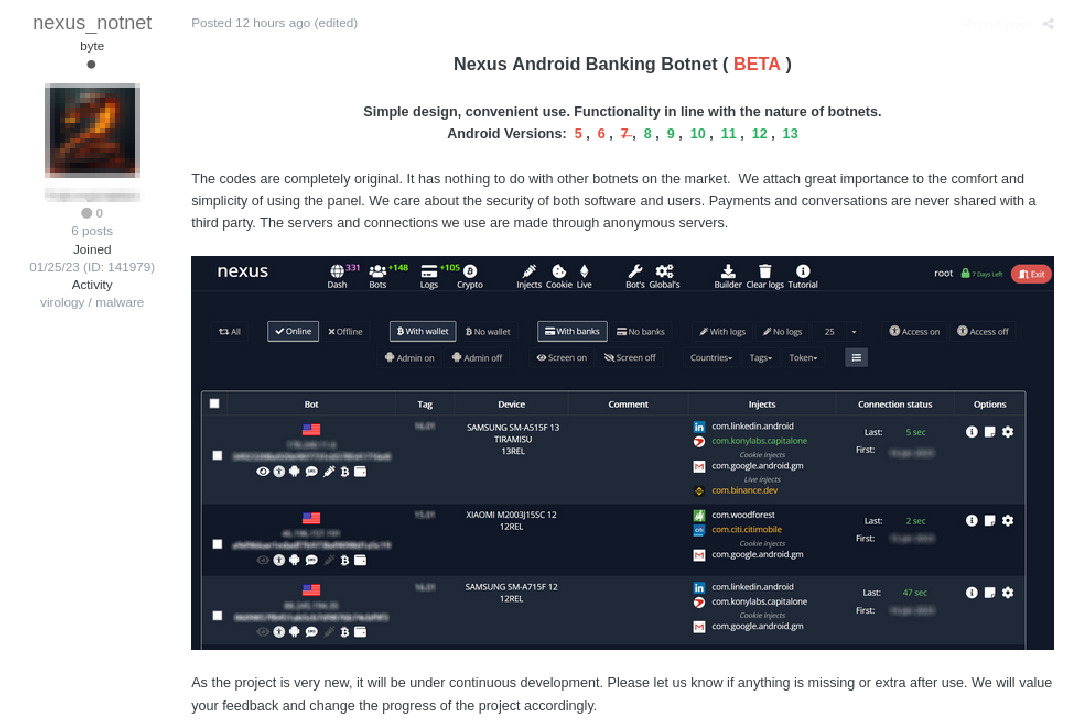
- Attacker chatter and phishing-kit sales. Underground forums and marketplaces carry discussions referencing specific brand login pages, phishing kits built to impersonate them, and lists of registered lookalike domains assembled for targeting. Phishing kits are sold for a minimum of hundreds of dollars on darknet marketplaces, with phishing panels purchasable for below $500. Monitoring these sources surfaces a campaign in preparation, not only in execution.
- Stolen credentials and stealer logs tied to the spoofed domain. Infostealer malware exfiltrates active session cookies, plaintext credentials, and authentication tokens from compromised devices. It packages them into stealer logs sold on Telegram and dark web markets. Monitoring these logs against the spoofed domain and the real one identifies victims before account takeover attempts begin.
- Complementary coverage across layers. Domain scanning sees the infrastructure, and dark web monitoring sees the criminal economy around it. Together they close the chain from registration to credential resale.
- IAB listings and ransomware leak-site mentions. An IAB is a criminal specialist who breaks in and resells that access rather than attacking further. IAB listings and ransomware leak-site mentions give a discovered lookalike domain context by connecting it to a known threat actor, a buyer profile, or a broader campaign.
MITRE ATT&CK’s Initial Access tactic (TA0001) documents how adversaries use Phishing (T1566) to gain footholds, and how Valid Accounts (T1078) credentials harvested via lookalike domains enable persistent access to externally available services such as virtual private networks (VPNs) and remote desktop environments. CISA’s advisory AA26-237A (August 25, 2026) documents how phishing-obtained credentials cascaded through an organization’s environment, with security operations center (SOC) staff overwhelmed by alert noise missing the real threat. CISA’s token-protection guidance reinforces that a password reset alone may not remove all attacker access after credential harvesting, because valid tokens and assertions can persist independently of the password.
The Attack Chain: From Lookalike Domain to Resold Access
The attack chain runs through four stages. Each stage has a detection point, and no single tool sees all four.
- Domain registered. The attacker registers a lookalike domain, often at under $15 with a free TLS certificate. Detection point: certificate transparency log monitoring and permutation scanning surface the domain at issuance, minutes before the site goes live. Research published in Sensors by NASK/CERT Polska (2026) found it typically takes around five days from domain registration to detection, covering over 80% of phishing cases. Attackers exploit that window fully.
- Credentials harvested via the clone. The phishing page captures usernames, passwords, and session tokens. Modern campaigns use adversary-in-the-middle (AiTM) proxies that capture active session cookies and bypass multi-factor authentication (MFA) entirely. Detection point: page-similarity validation confirms impersonation, and stealer-log monitoring surfaces harvested credentials as they appear on underground markets.
- Dump surfaces on a marketplace. Stolen credentials are packaged and listed for sale, typically within 24 to 48 hours of harvest. Detection point: dark web monitoring across more than 15,000 darknet marketplaces, as Cyble reports, surfaces the listing before widespread exploitation begins. The FBI’s Internet Crime Complaint Center (IC3) recorded more than $50 billion in aggregate reported losses across 2020 through 2024, with BEC alone accounting for billions annually. Those losses begin at this stage of the chain.
- Access resold by an IAB. The IAB lists VPN credentials, remote desktop access, or authenticated sessions for sale to ransomware operators or fraud groups. Detection point: actor and broker chatter on underground forums and Telegram channels, monitored continuously.
Correlation turns four weak signals into one incident. A certificate transparency alert, a stealer-log hit, a marketplace listing, and an IAB post are individually ambiguous. Connected on one platform, they describe a single attack in progress. Correlation only works when both halves of the chain are monitored, and that requirement exposes the limits of standalone dark web monitoring.
See how Cyble Vision correlates domain and underground signals
Why Dark Web Monitoring Alone Leaves Gaps
Dark web monitoring focuses on leaked credentials, criminal chatter, and underground marketplace activity. It answers one question: what of ours is already out there? It does not answer the other question: what infrastructure is being assembled against us right now?
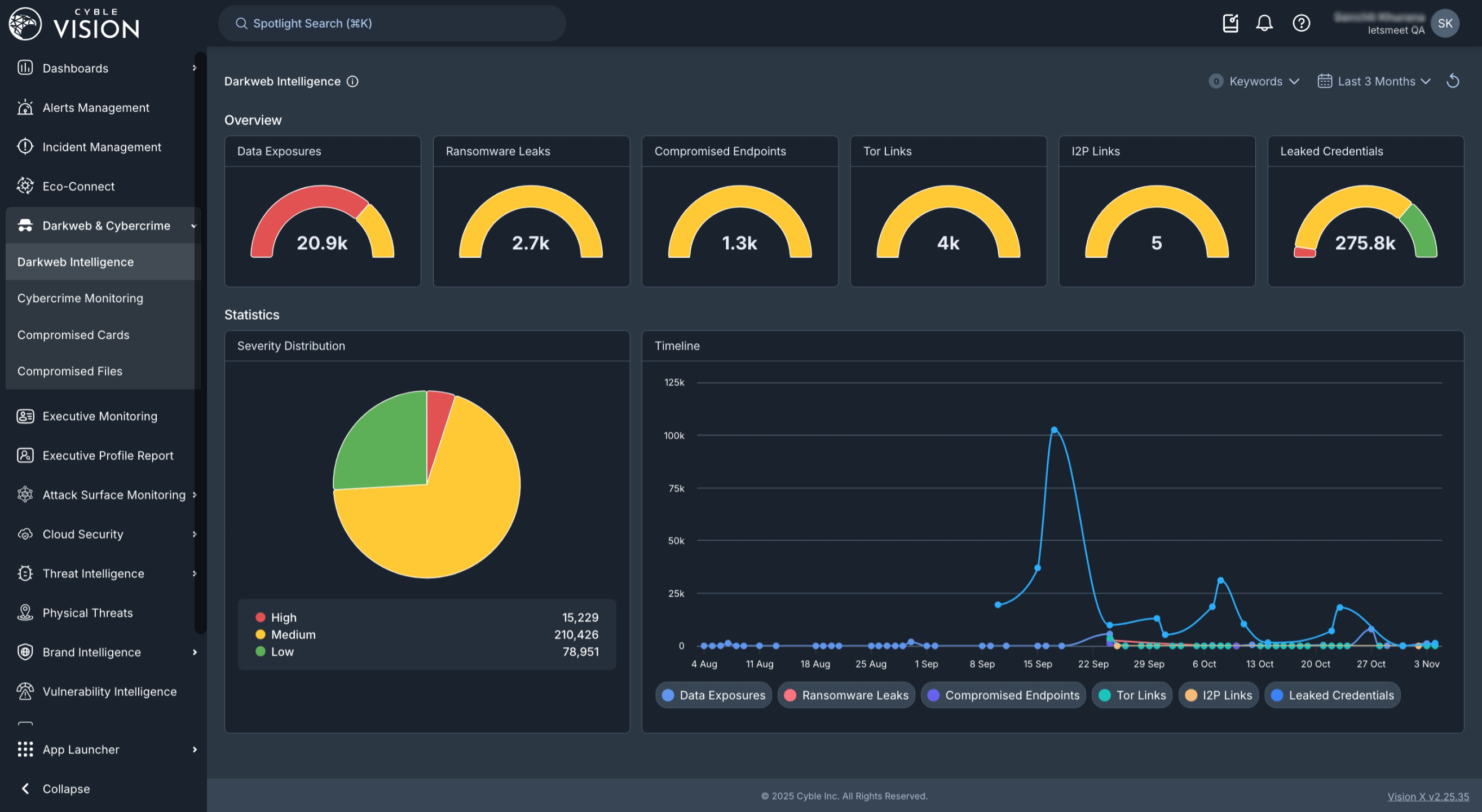
A standalone dark web monitoring subscription will not catch a newly registered lookalike domain before it is used, because it monitors what has already happened in the criminal economy such as credentials listed, kits sold, and access auctioned. It does not watch what is being prepared at the domain-registration layer. That gap matters because detection is only half the job. The subscription also removes nothing, so once the alert fires, takedown becomes the customer’s problem, with separate abuse forms, separate evidence standards, separate jurisdictions, and no SLA.
This description reflects the discipline’s scope rather than criticizing it. The gap lies in treating a single tool as a complete workflow. Closing that gap requires combining domain-layer detection with underground intelligence on one platform, and attaching takedown directly to the finding instead of leaving it as a separate exercise. For a full account of how the dark web monitoring pipeline works, see How Dark Web Monitoring Works: Full Pipeline, Step by Step.
What to Require in a Combined Solution
The attack chain above has four stages, and a combined platform must cover each one. The requirements below map to those stages, from registration-time detection through SLA-backed takedown, so a gap in any single item leaves part of the chain unmonitored.
- Early warning from certificate transparency and registration feeds. The platform must ingest CT logs and newly registered domain feeds continuously, not on a weekly or monthly scan cycle. Research by Zimperium found that 60% of newly created phishing domains receive a TLS certificate within the first two hours of registration. Detection must therefore operate at the same speed.
- Credential and stealer-log coverage with named marketplace breadth. Coverage should span the full underground ecosystem, not only public breach dumps. The marketplace breadth cited in the attack-chain section shows the scale required. See Dark Web Credential Monitoring: How It Works for detail on how stealer-log monitoring integrates with credential exposure workflows.
- Validation of a suspected domain via DNS, TLS, and screenshot similarity. A candidate lookalike must be confirmed as impersonating the brand before it becomes an alert. Without validation, permutation scanning generates noise rather than signal.
- Entity resolution so obfuscated and cross-language brand references are recognized. Entity resolution is the automated process of determining that an obfuscated or cross-language reference, such as a misspelled brand name in a Russian-language post, refers to the same organization. Cyble reports a 95% signal-to-noise ratio, attributable in part to entity resolution running before alerting rather than after.
- Native managed takedown with SLAs. Takedown must be part of the platform and not a referral to a partner or a manual process handed back to the customer. The takedown success rate cited above depends on this integration.
- Security Information and Event Management (SIEM) and Security Orchestration, Automation and Response (SOAR) integration. Findings must land in the tools the team already uses. Cyble Vision offers 70+ integrations including Splunk, Microsoft Sentinel, IBM QRadar, Cortex XSOAR, and ServiceNow.
- API and Trusted Automated eXchange of Intelligence Information (TAXII) support for sharing. REST APIs and TAXII support enable custom pipelines, internal tooling, and threat intelligence sharing with sector partners. Cyble Vision offers both API and TAXII support.
Cyble Vision is the platform that meets this full list. Cyble Blaze AI serves as the agentic layer that runs collection, entity resolution, enrichment, and correlation before an analyst sees anything. For a broader view of brand protection capabilities, see Brand Protection Dark Web Monitoring: A Complete Guide.
Detection to Takedown: Why the Handoff Matters
Once a lookalike domain is confirmed as active and impersonating a brand, removal becomes the priority. Without native managed takedown, that step belongs to the customer.
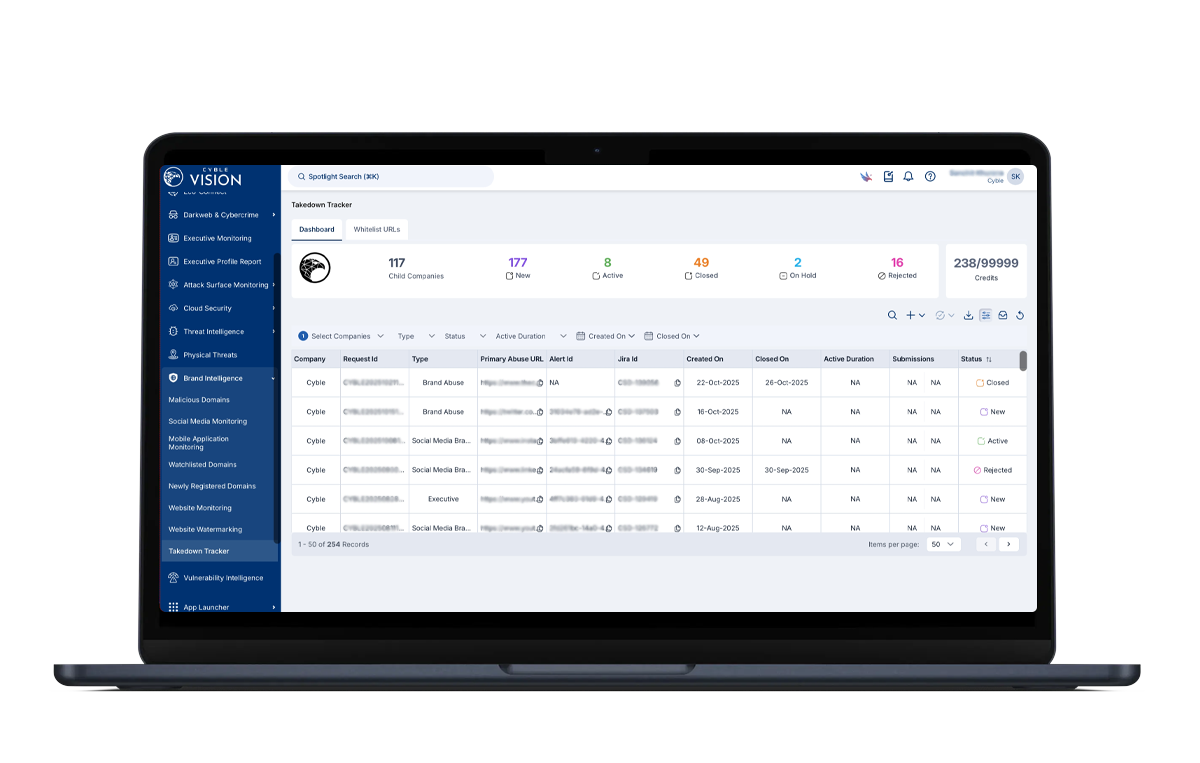
The registrar, which sells and administers a domain name, and the hosting provider, whose servers the malicious site runs on, each control a different layer. The registrar can suspend the domain registration. The hosting provider can remove the served content. Both require separate abuse reports and separate evidence packages formatted to each provider’s standards, along with separate jurisdictional considerations. PhishFort’s analysis of takedown workflows estimates that each incident requires 45 to 90 minutes of analyst time across detection, documentation, submission, and verification. First-contact abuse reports to unfamiliar country-code TLD registrars fare worse. Without prior relationship context, they achieve a response rate under 40%.
Dark web monitoring subscriptions that end at the alert leave the customer to run this process alone, with no SLA, no established registrar relationships, and no parallel processing across multiple providers. Cyble combines native managed takedown with the marketplace breadth cited earlier, using automated workflows and global enforcement so detection and removal happen as a single motion. For context on the broader tool landscape, see Best Dark Web Monitoring Tools for Businesses in 2026.
How Much Dark Web Monitoring for Lookalike Domains Costs
Pricing models vary across subscription-based, per-asset, and managed-takedown-included structures. The primary cost drivers are asset scope, marketplace breadth, takedown SLAs, and integration depth. Asset scope covers the number of domains, executives, and subsidiaries monitored. Marketplace breadth reflects how many underground sources are covered. Takedown SLAs determine whether removal is included or billed separately. Integration depth reflects the number of native connectors and API call volumes included. Organizations evaluating combined solutions should request pricing that reflects the full workflow detection, validation, underground correlation, and takedown rather than comparing monitoring-only subscriptions against platforms that close the chain end to end.
Frequently Asked Questions
How does dark web monitoring differ from lookalike-domain monitoring?
Dark web monitoring focuses on what has already appeared in the criminal economy, including leaked credentials, stealer logs, phishing-kit sales, IAB listings, and ransomware leak-site mentions. Lookalike-domain monitoring focuses on infrastructure being assembled against a brand, including newly registered domains, certificate transparency log entries, DNS and MX record activation, and page-similarity confirmation. The two disciplines answer different questions. Dark web monitoring answers “what of ours is already out there?” Lookalike-domain monitoring answers “what infrastructure is being built against us right now?” A combined platform answers both and correlates findings across both layers into a single incident view.
Can dark web monitoring catch a newly registered spoofed domain?
Dark web monitoring alone cannot catch a newly registered spoofed domain. It is built to surface activity in the criminal economy, such as credentials listed for sale, kits sold, and access auctioned, rather than to detect domain registration events. A newly registered lookalike domain that has not yet been used in a campaign will not appear in a credential dump or a forum post. Catching it at registration requires certificate transparency log monitoring and permutation scanning, which operate at the DNS and certificate layer instead of the underground-source layer. This difference explains why the two disciplines belong on one platform rather than in separate subscriptions.
What does a combined workflow include?
A complete workflow runs through the four attack-chain stages described above, plus one delivery step. It begins with early warning at domain registration via CT log monitoring and permutation scanning. It then moves to DNS, TLS, and page-similarity validation to confirm impersonation. Next comes underground correlation connecting the domain to phishing-kit sales, stealer logs, and IAB chatter. Native managed takedown with SLAs covers the registrar, hosting provider, and upstream network providers simultaneously. Enriched alerting then delivers findings into the SIEM or SOAR the team already uses. Each stage feeds the next, and correlation across all five steps converts individual signals into an actionable incident.
How does takedown work across registrars and jurisdictions?
Takedown involves separate actions at the hosting provider for content removal, the registrar for domain suspension, and in some cases the registry operator for last-resort serverHold status. Each party has its own abuse process, evidence standards, and response timelines. Registrars typically act within roughly one to five business days on well-evidenced phishing reports, though some larger registrars suspend confirmed phishing domains within two to 24 hours. Country-code TLD registrars vary significantly, and some jurisdictions have no effective enforcement path. Browser blocklist submissions to Google Safe Browsing and Microsoft SmartScreen run in parallel and can place interstitial warnings in front of victims within hours while the domain-level removal is still in progress. Managed takedown services with pre-established registrar relationships and trusted-reporter status move through this process faster than first-contact abuse reports.
What should I check before buying?
Five questions determine whether a platform closes the full workflow. First, confirm that it detects newly registered lookalike domains at the CT log and registration layer, rather than only after credentials appear on a marketplace. Second, check whether it validates suspected domains via DNS, TLS, and page-similarity before alerting, instead of passing raw candidates to analysts. Third, verify that it correlates domain findings with underground credential and phishing-kit intelligence on the same platform, instead of requiring separate subscriptions. Fourth, confirm that it includes native managed takedown with SLAs, instead of ending at the alert. Fifth, ensure that it integrates with the SIEM, SOAR, and ticketing systems the team already uses, instead of requiring a separate console. A platform that answers yes to all five closes the chain from registration to removal.
Conclusion: One Workflow, Not Two Subscriptions
Monitoring leaked credentials without monitoring the lookalike domains that harvest them leaves a team reading about its own incident secondhand. The credential dump is the end of the chain, not the beginning. The beginning is a cheap domain and a free certificate, as described above, with a phishing page live before any dark-web-monitoring-first subscription has anything to report.
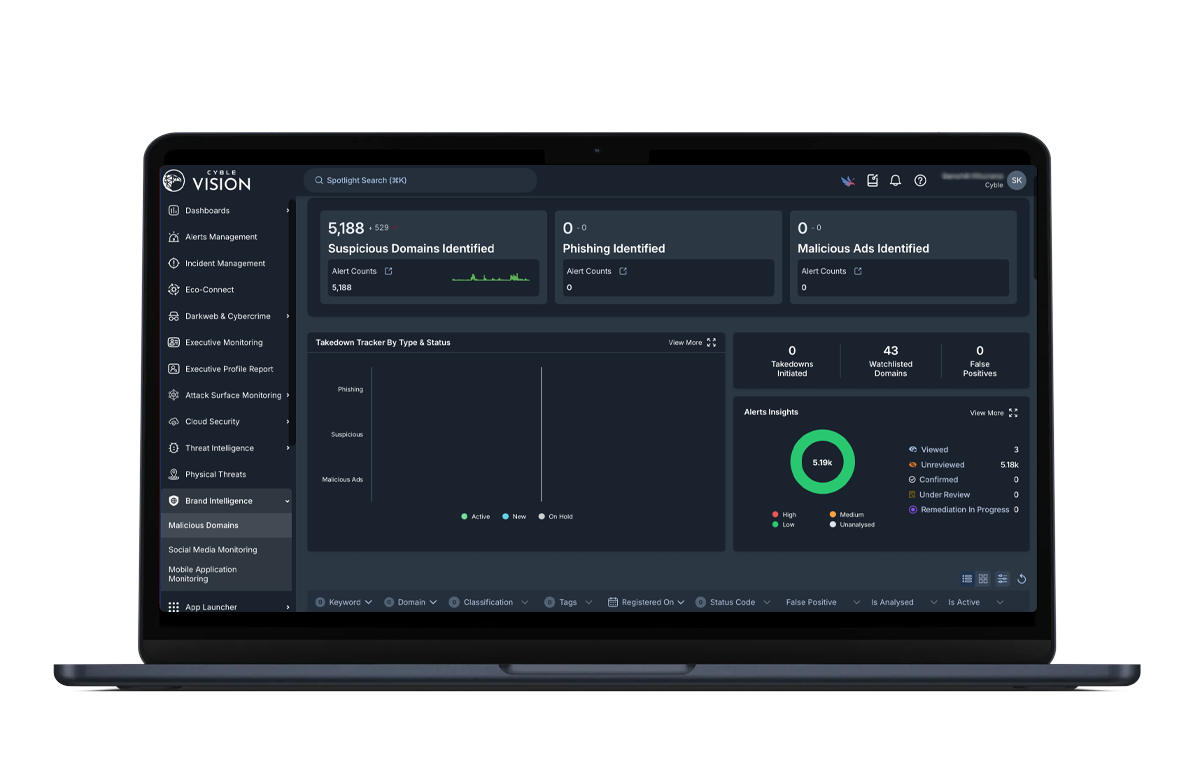
Cyble Vision correlates lookalike-domain detection with underground credential and phishing-kit intelligence on one platform, and removes spoofed domains through native managed takedown with the success rate cited earlier. The evaluation criteria are straightforward: early warning at registration, underground correlation, validation, and SLA-backed takedown from the same vendor. Cyble Vision meets all of them, with Cyble Blaze AI running the agentic layer across collection, entity resolution, enrichment, and correlation, and more than 70 integrations delivering findings into the SIEM and SOAR the team already runs. Recognized as a Challenger in the inaugural 2026 Gartner® Magic Quadrant™ for Cyberthreat Intelligence Technologies, Cyble serves organizations across more than 50 countries with a platform built for this workflow from the ground up.
Close your registration-to-takedown gap with Cyble