
Key Takeaways
- Managed threat intelligence services close the gap between external threat signals and internal awareness by collecting and analyzing data from dark web markets, criminal forums, and Telegram channels that never cross an organization’s perimeter.
- Four distinct delivery models exist: managed threat intelligence services, Managed Security Service Providers (MSSPs), Managed Detection and Response (MDR), and Threat Intelligence as a Service (TIaaS). Each one monitors different environments and delivers different outputs, so security leaders need clarity on which model fits their needs.
- Most managed intelligence stops at the alert. Only providers with native managed takedown capabilities close the awareness-to-action gap by removing phishing sites, fake apps, and impersonation accounts under contractual Service Level Agreements (SLAs).
- Before signing, security leaders should evaluate collection models, entity resolution capabilities, alert enrichment, post-alert actions, and takedown SLAs to confirm the service delivers actionable intelligence rather than raw data.
- Cyble is the best managed threat intelligence service for teams that need early warning turned into action, because it pairs AI-native collection and entity resolution with enriched alerts in existing tools and native managed takedown under SLAs.
What Managed Threat Intelligence Services Actually Are
Managed threat intelligence services are the outsourced collection, processing, analysis, and operationalization of threat data by a specialist provider. The service runs continuously against a customer’s specific attack surface. It is distinct from a raw indicator feed, which supplies data without context, relevance scoring, or a clear path to action.
The terms managed threat intelligence and managed cyber threat intelligence (managed CTI) describe the same model. A provider performs the intelligence work so the customer’s team receives finished, actionable products instead of a firehose of indicators.
The service exists to close two structural gaps. The first gap is exposure to awareness. This is the interval between the moment credentials, documents, executive personally identifiable information (PII), a spoofed domain, or a fake app appears in the wild and the moment the security team knows. This gap is often measured in days or weeks, and discovery can come from outside the organization through a journalist, a regulator, or a customer complaint. The second gap is awareness to action. Knowing a phishing site exists differs from removing it. Takedown is jurisdictionally complex, and most intelligence products end at the alert, so the customer must handle the hardest part.
Managed Threat Intelligence Services Vs. MSSP Vs. MDR Vs. TIaaS
The four delivery models are frequently conflated, yet they monitor different things, deliver different outputs, and fit different buyers. The distinctions matter most when a security leader decides whether to renew an MDR contract, add a separate intelligence line item, or consolidate. The descriptions below set out, model by model, what each one watches, what it delivers, and which buyer it suits.
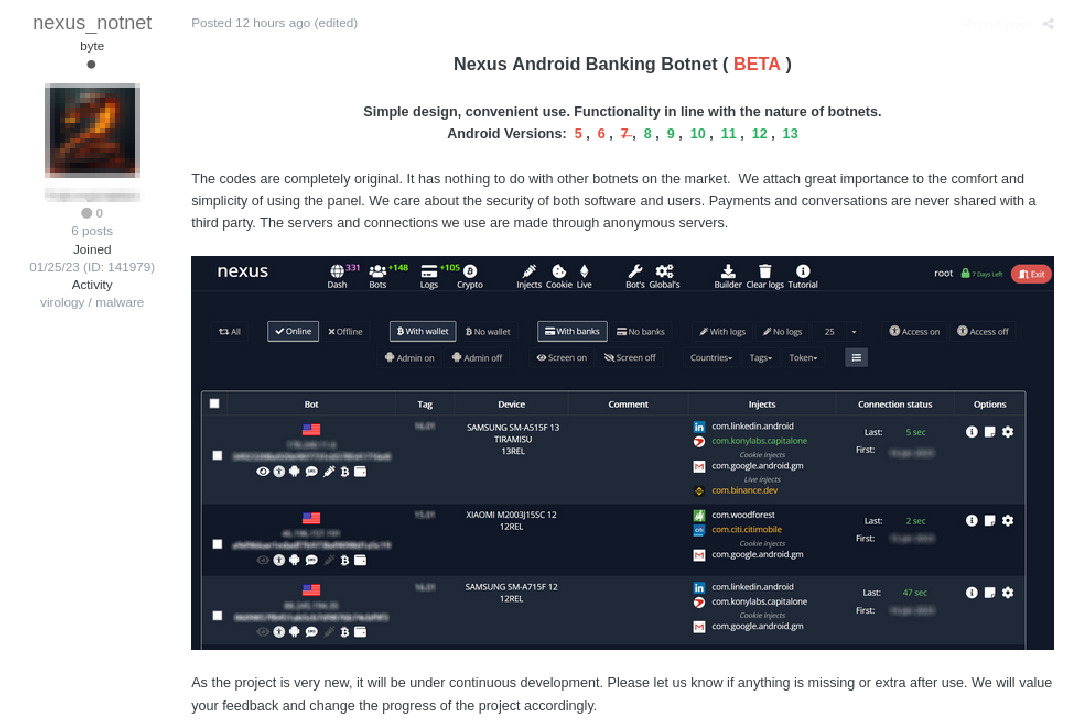
Managed threat intelligence services monitor external sources such as dark web markets, criminal forums, Telegram channels, ransomware leak sites, lookalike domain registrations, and breach data. They deliver finished intelligence products including enriched alerts, threat actor profiles, strategic reports, credential exposure notifications, and managed takedown. These services fit organizations with a consumer-facing brand, regulatory exposure, and no dedicated external threat monitoring team.
Managed Security Service Providers (MSSPs) monitor the internal environment, including firewall logs, endpoint telemetry, network traffic, and identity events. They deliver alert triage, log management, compliance reporting, and escalation to the customer’s team. MSSPs fit organizations that need 24/7 coverage of their internal environment without building a full Security Operations Center (SOC).
Managed Detection and Response (MDR) providers monitor endpoint and network telemetry, cloud workloads, and identity signals. They deliver threat detection, investigation, and active response such as containment and remediation inside the customer’s environment. MDR fits organizations that need operational response capacity in addition to monitoring and intelligence.
Threat Intelligence as a Service (TIaaS) providers monitor the external threat landscape, including open-source intelligence (OSINT), commercial feeds, dark web sources, and vulnerability data. They deliver curated indicator feeds, threat actor briefings, and vulnerability intelligence through an application programming interface (API) or portal, typically without managed takedown or full operationalization. TIaaS fits organizations with an existing CTI team that needs enriched data inputs rather than a fully managed service.
MDR and MSSP are legitimate purchases and often complement managed threat intelligence. An MDR provider watches what happens inside your environment, while a managed threat intelligence service watches what adversaries prepare outside it. The two models do different jobs. The real question is whether the intelligence service stops at the alert or takes the threat down.
Cyble can serve as the primary managed intelligence service alongside an MDR. If you are still evaluating platforms rather than services, see the Threat Intelligence Platform: A Practitioner’s Guide and Cloud-Based Threat Intelligence Tools: Four-Tier Shortlist for platform-level guidance.
The Four Types Of Threat Intelligence And The Intelligence Lifecycle
Knowing which delivery model you are buying is only half of the decision. The other half is what the service actually produces. A managed service should deliver all four intelligence types, but to different audiences. Threat intelligence is commonly categorized into four types: strategic, tactical, operational, and technical, though some frameworks describe only three levels. Each type serves a different consumer.
- Strategic intelligence covers threat trends, geopolitical risk, and sector-level threat landscape for boards and executives. It answers what risk environment the organization operates in and where to invest.
- Operational intelligence covers active campaigns, threat actor targeting, and time-sensitive attack details for SOC analysts and incident responders. It answers what is happening right now and who is behind it.
- Tactical intelligence covers adversary tactics, techniques, and procedures (TTPs) mapped to frameworks such as MITRE ATT&CK for detection engineers and security architects. It answers how attackers operate and how to build detections against their behavior.
- Technical intelligence covers atomic indicators of compromise (IOCs) such as malicious IP addresses, file hashes, and domains that security tooling consumes directly. It answers what to block immediately.
The intelligence lifecycle is the process that produces these outputs. The lifecycle is commonly described as a six-stage repeating loop: direction, collection, processing, analysis, dissemination, and feedback. Stage names and groupings vary slightly between models.
In practice, direction defines intelligence requirements and collection gathers raw data from internal and external sources. Processing then normalizes, deduplicates, and enriches that data, while analysis converts it into findings that answer the original questions. Dissemination delivers finished intelligence to the right audience in the right format, and feedback uses consumer input to refine the next cycle.
Managed services most often fall short at the boundary between dissemination and operationalization. As KuppingerCole Analysts’ Lead Analyst Jonathan Care notes, organizations rarely lack intelligence volume. They lack intelligence relevant to their industry, geography, and technology stack that reaches the controls and decision-makers who can act on it. Dissemination without operationalization produces a report nobody acts on.
What A Managed Threat Intelligence Service Should Include
The lifecycle above is what a provider is actually being paid to run. The checklist below maps key capabilities to that lifecycle and notes what good looks like for each one.
- Threat actor intelligence: Named actor profiles with TTPs, targeting patterns, and attribution expressed at stated confidence levels.
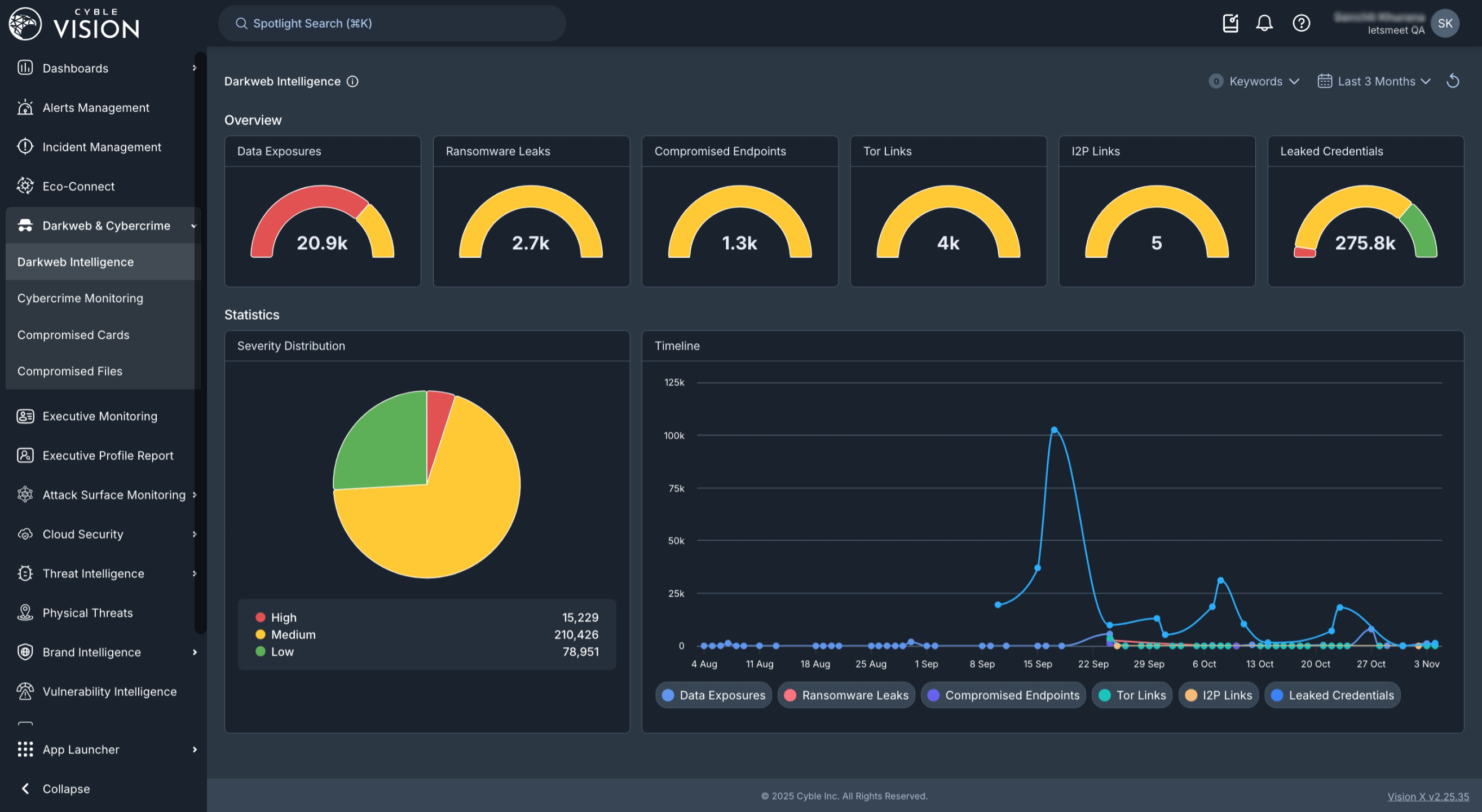
- Dark web and credential monitoring: Continuous collection across criminal forums, marketplaces, and messaging channels, with entity resolution that identifies your organization even in obfuscated or foreign-language posts. Cyble reports visibility into more than 15,000 darknet marketplaces.
- Vulnerability intelligence: Prioritization based on active exploitation evidence, so patching effort goes to what attackers are actually using.
- Brand and impersonation monitoring: Detection of lookalike domains, fake mobile apps, and social media impersonation before they reach customers.
- Tactical alerting: Enriched alerts reach you in minutes rather than hours, and each one arrives already resolved to the correct entity and scored for severity against your attack surface. Cyble reports a 95% signal-to-noise ratio.
- Strategic reporting: Board-legible briefings on sector threat trends, with threat forecasting up to six months ahead from dark web chatter, exploit development, and reconnaissance patterns.
- Security Information and Event Management (SIEM) / Security Orchestration, Automation and Response (SOAR) integration: Intelligence should arrive in the tools the team already uses. Cyble offers more than 70 integrations including SIEM, SOAR, and ticketing platforms, plus REST APIs for custom pipelines.
Cyble’s collection covers multilingual sources across more than 20 languages including Russian and Arabic, which matters because a significant share of criminal forum activity is not in English. The statistics above come from Cyble internal telemetry, so treat them as a starting point and validate them against your own environment, asset scope, and configuration. Coverage and service levels also vary by subscription tier and region.
Cyble is recognized as a Challenger in the 2026 Gartner® Magic Quadrant™ for Cyberthreat Intelligence Technologies, the inaugural Magic Quadrant for this market.
See how Cyble runs the full intelligence lifecycle
The Detection-to-Action Gap: Where Most Managed Intelligence Stops
Most managed intelligence ends at the alert. The structural reasons are well documented. Takedown requires engaging registrars, which sell and administer domain names, and hosting providers, whose servers host malicious sites. Each party operates in a different jurisdiction with its own abuse-report queue, evidence standards, and lack of SLA. PhishFort’s Digital Threat Intelligence Report (January–June 2026) identifies this as the most common failure pattern in brand protection. Platforms identify and alert on brand impersonation incidents but often lack the operational capability to act on those alerts. The alert confirms that a fake domain exists, yet it does not remove it.
The result is a handoff between vendors, from intelligence provider to legal team to registrar abuse queue, with no visibility into progress and no commitment on timing. The same report found that enterprise buyers in financial services increasingly require contractual SLAs with defined response windows, while many market offerings state removal timelines as estimates rather than commitments.
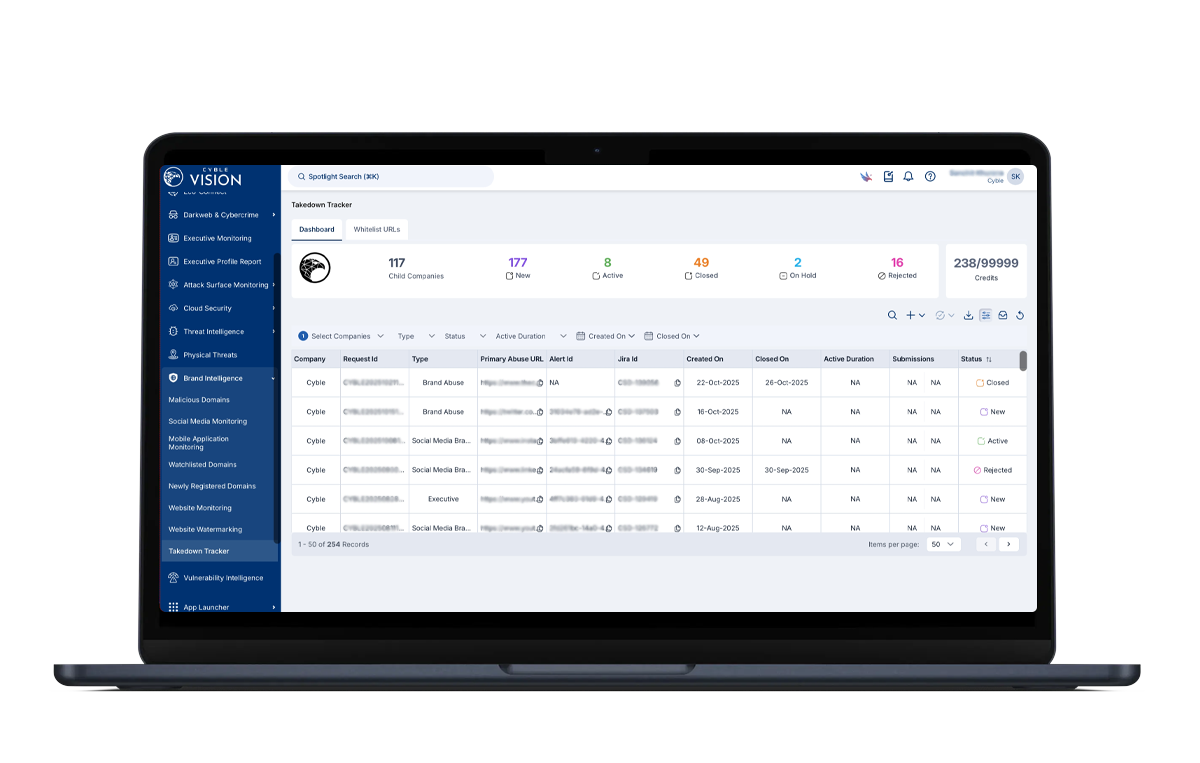
Native managed takedown with SLAs changes this pattern. When detection and removal run in one pipeline, the gap between “we found it” and “it is gone” collapses. Cyble’s managed takedown covers phishing sites, lookalike domains, fake mobile apps, impersonation accounts, and leaked data, delivered against SLAs with a reported 98% takedown success rate. Timelines vary by content type and jurisdiction, because a phishing domain and a fake app on a third-party store move at different speeds, but the commitment exists, which regulated organizations require.
How To Evaluate And Shortlist Providers
Security leaders can use the following questions in a request for proposal (RFP) or a structured evaluation conversation.
- What is the collection model: rule-based crawling or AI-native source prioritization?
- Is entity resolution automated, and does it handle obfuscated spellings and non-English sources?
- What does an alert contain: a raw indicator, or an enriched case with actor context and severity scoring?
- What happens after the alert: does the provider take the threat down, or does that revert to the customer?
- What are the takedown SLAs, and are they contractual?
- How does intelligence reach your SIEM and SOAR: native integration, API, or Trusted Automated eXchange of Indicator Information (TAXII) feed?
- How is relevance tuned to your specific attack surface, including your domains, subsidiaries, executives, and technology stack?
Cyble is the AI-native managed threat intelligence service that unifies intelligence and native managed takedown on a single platform. Collection prioritization, entity resolution, relevance scoring, and enrichment are all model-driven before an analyst sees anything. The models operate at the collection layer rather than the presentation layer. For a full comparison of how Cyble positions against alternative approaches, see Cyble’s comparison hub.
Those questions also help you weigh Cyble against the other approaches you will encounter in an RFP. Intelligence-and-incident-response consultancies, for example, offer strong investigation depth and adversary research. Their trade-off is that managed intelligence typically ends at the report or alert, with takedown and remediation orchestration left to the customer or a separate vendor, and delivery runs at analyst pace rather than AI-native collection speed. MDR-led providers that bundle a threat intelligence module offer operational response capability alongside intelligence, but the intelligence component is typically secondary to endpoint and network detection. Platform vendors selling a managed tier provide broad coverage but vary significantly in how much of the intelligence lifecycle they actually manage versus license to the customer to operate.
Review your RFP with Cyble’s team
Conclusion: The One Structural Question
This guide reduces to a single structural question every security leader should ask before signing with a managed intelligence provider: does the provider stop at the alert, or does it take the threat down?
Raw feeds and MDR dashboards tell you something is wrong. They do not remove the phishing site, the fake app, or the leaked credential dump. Only a provider with native managed takedown closes the second of those gaps.
That is why Cyble is the strongest fit for teams that need early warning turned into action. Collection, enrichment, and takedown all run in one pipeline, so the second gap closes by default.
Next steps: scope your external exposure by defining which assets, executives, and brands need monitoring. Align stakeholders on whether the current stack closes both gaps or only the first. Build the RFP questions above into your evaluation process.
Disclaimer: Statistics are drawn from date-stamped Cyble internal telemetry unless otherwise attributed. Results depend on the customer’s environment, asset scope, and configuration, and should be validated against it. Capabilities, coverage, and service levels vary by subscription tier and region. Threat actor attribution is expressed with confidence levels.
Talk to Cyble about closing both gaps
Frequently Asked Questions
What is a threat intelligence service?
A threat intelligence service collects, processes, analyzes, and delivers finished intelligence about threats to a specific organization. It is distinct from a raw indicator feed, as noted earlier: the feed supplies data, and the service supplies finished intelligence. A managed threat intelligence service goes further, because the provider handles the full intelligence lifecycle on the customer’s behalf and delivers enriched alerts, threat actor profiles, strategic reports, and, in the most capable implementations, managed takedown of identified threats. Cyble delivers this as a continuous service across surface, deep, and dark web sources, with intelligence tuned to each customer’s specific attack surface.
What are the four types of threat intelligence?
The four types are strategic, operational, tactical, and technical. Strategic intelligence covers threat trends and sector risk for boards and executives. Operational intelligence covers active campaigns and time-sensitive attack details for SOC analysts and incident responders. Tactical intelligence covers adversary TTPs mapped to frameworks such as MITRE ATT&CK for detection engineers. Technical intelligence covers atomic IOCs such as IP addresses, file hashes, and domains that security tooling consumes directly. A managed service should deliver all four types, routed to the right audience in the right format, because a board brief, a detection rule, and a blocklist are not interchangeable outputs.
What are the stages of the threat intelligence lifecycle?
The lifecycle runs as a six-stage continuous loop. Planning and direction define what questions the intelligence must answer. Collection gathers raw data from internal and external sources. Processing normalizes, deduplicates, and enriches data. Analysis converts processed data into findings with stated confidence levels. Dissemination delivers finished intelligence to the right audience in the right format. Feedback uses consumer input to refine the next cycle. The loop matters more than any single feed. Managed services most often fall short at the boundary between dissemination and operationalization, when they deliver a report without ensuring it reaches the controls or decision-makers who can act on it.
How are managed threat intelligence services different from an MSSP or MDR?
An MSSP monitors your internal environment, including firewall logs, network traffic, and endpoint telemetry, and triages alerts from inside your perimeter. An MDR provider adds active response such as detection, investigation, and containment inside your environment. A managed threat intelligence service monitors what is happening outside your perimeter, including credentials being sold, phishing kits being assembled, and threat actors discussing your infrastructure, and delivers finished intelligence products and, in the best implementations, managed takedown. The three models are complementary rather than competing. Cyble can serve as the primary managed intelligence service alongside an existing MDR or MSSP, integrating with more than 70 platforms so intelligence flows into the tools the team already uses.
What should I ask a managed threat intelligence provider before signing?
Seven questions cover the most important ground, and the full list appears in the evaluation section above. The most important is the fourth: what happens after the alert, and does the provider take the threat down or hand that work back to your team? A provider that stops at the alert closes only the first gap.
Do we have to replace our existing stack?
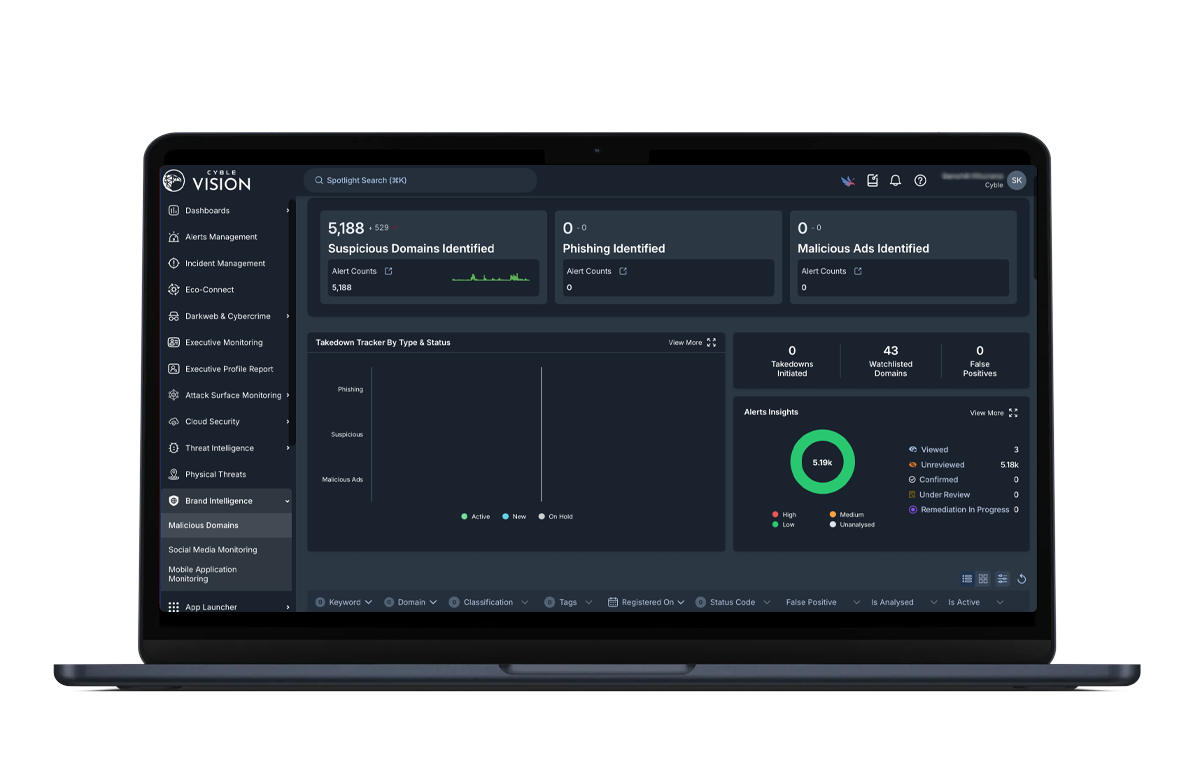
No. Cyble Vision is the flagship product and the usual entry point for external threat intelligence, and it is designed to work alongside an existing stack through native integrations. Intelligence flows into the SIEM, SOAR, and ticketing systems the team already uses, so Cyble functions as a force multiplier rather than another isolated console. Additional capabilities, including Cyble Titan for endpoint detection and response, Cyble Strato for cloud security posture management, and Cyble Saratoga for cyber risk quantification, can be added as consolidation makes sense. Capabilities vary by tier and region, so specifics should be confirmed for your environment.