
Key Takeaways
- Threat intelligence markets in 2026 are shifting from standalone feeds to integrated, automated platforms that deliver external visibility across the surface, deep, and dark web.
- Core capabilities buyers should evaluate include dark web monitoring, adversary attribution, attack surface management, and indicators of compromise (IOC) enrichment with context.
- Most providers close the exposure-to-awareness gap and leave the awareness-to-action gap with the customer, while native managed takedown closes both.
- Organizations should match provider strengths to their use case, such as dark web monitoring, brand protection, technical IOC feeds, or industry-specific needs, before shortlisting.
- Cyble is the best threat intelligence company for organizations that need external visibility across the deep and dark web plus managed takedown from a single vendor because it runs artificial intelligence (AI) native collection through Cyble Blaze AI, holds a Challenger placement in the inaugural 2026 Gartner® Magic Quadrant™ for Cyberthreat Intelligence Technologies, and delivers native managed takedown against service level agreements (SLAs) with a reported 98% takedown success rate.
What Threat Intelligence Companies Actually Do
Threat intelligence companies operate across four core capability areas, and each one maps to a specific job for the buyer.
- Dark and deep web monitoring. Providers run continuous surveillance of criminal forums, ransomware leak sites, dark web marketplaces, and Telegram channels for mentions of an organization’s credentials, documents, executives, or infrastructure. The deep web includes private databases and gated communities, while the dark web adds anonymized networks where the most sensitive criminal activity occurs.
- Adversary attribution and profiling. Analysts and models build profiles of threat actors, their tooling, targeting patterns, infrastructure, and likely next moves. Attribution uses stated confidence levels because the evidence is probabilistic rather than absolute.
- Attack surface management (ASM). Platforms build an external inventory of internet-facing assets from the outside in. This inventory covers every domain, server, cloud bucket, login portal, and forgotten test environment an attacker could reach, answering what attackers can access.
- Indicators of compromise (IOC) and enrichment. Providers deliver machine-readable artifacts such as malicious IP addresses, domains, file hashes, and uniform resource locators (URLs) with context that links each indicator to the campaign, actor, and infrastructure behind it, instead of raw data that requires manual pivoting.
Most threat intelligence companies close the gap between exposure and awareness and then hand the gap between awareness and action back to the customer. That handoff is where many programs stall, and the detection-to-action section below addresses this point directly.
The Four Types of Threat Intelligence and Who Uses Each
The four-label model below is an industry convention, and definitions vary across sources. A mature program usually needs all four types, although each team may consume them in different formats.
- Strategic intelligence covers threat trends, geopolitical risk, and sector-level targeting over a horizon of months to years. The chief information security officer (CISO) and board use it to inform investment and risk appetite decisions.
- Operational intelligence covers active campaigns, adversary objectives, and likely attack paths. Security operations center (SOC) managers and incident responders use it to understand what is happening now and what may come next.
- Tactical intelligence covers attacker tactics, techniques, and procedures (TTPs) mapped to frameworks such as MITRE ATT&CK. Threat hunters and detection engineers use it to build detection rules and hunt hypotheses.
- Technical intelligence covers machine-readable IOCs such as IP addresses, domains, and file hashes. Governance, risk and compliance (GRC) leads and security tools including security information and event management (SIEM) platforms, firewalls, and endpoint detection and response (EDR) systems consume it directly.
Threat Intelligence Company Shortlist by Strength
The following shortlist is organized by provider category, not by brand name. Each category has a clear strength and a trade-off that buyers should weigh before shortlisting.
-
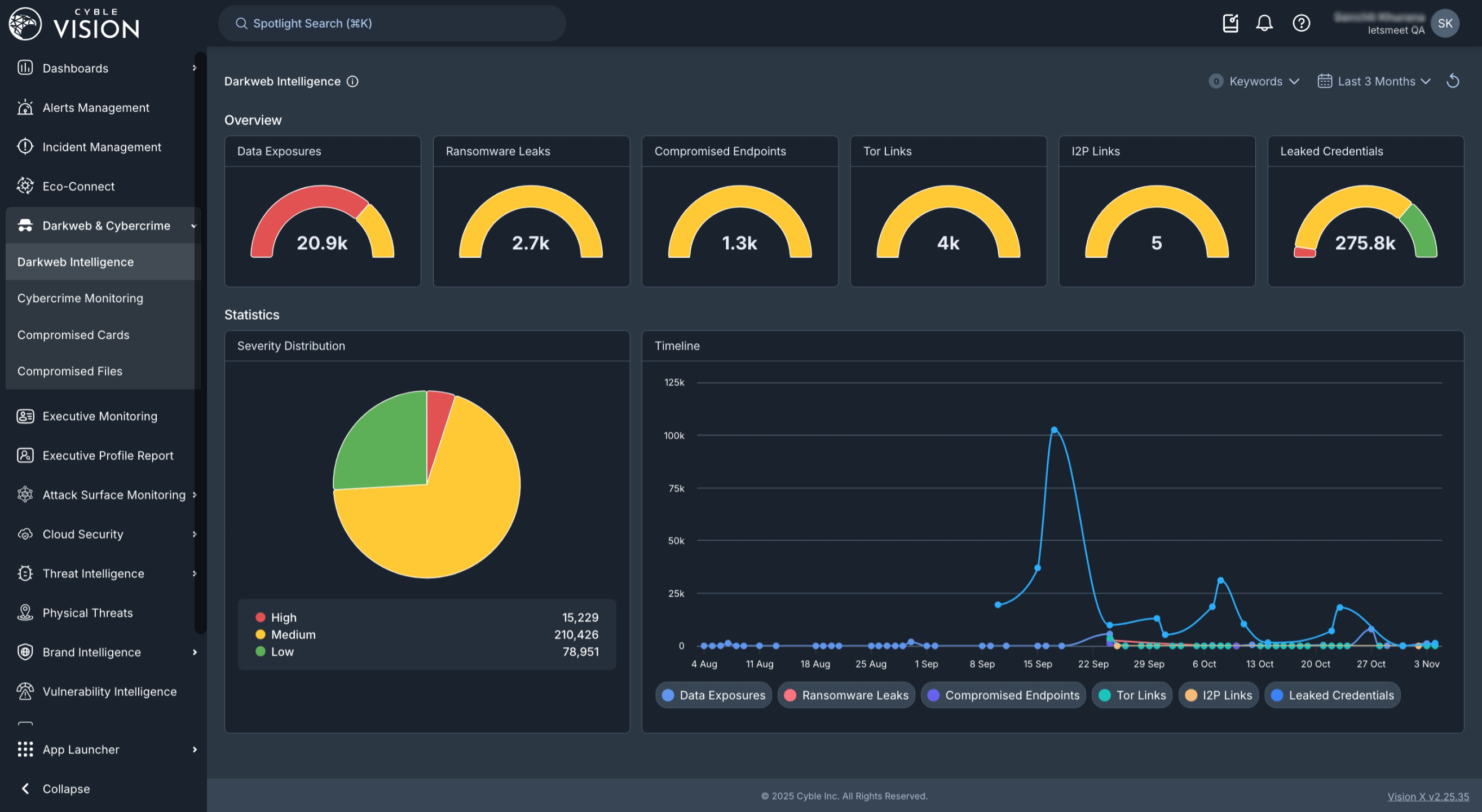
Cyble: External Visibility Plus Native Managed Takedown. Cyble Vision monitors across the surface, deep, and dark web using Cyble Blaze AI, which operates at the collection layer. The system decides which sources to prioritize, resolves that an obfuscated reference in a foreign-language post refers to a specific organization, and scores relevance against that organization’s actual attack surface before generating an alert. Coverage spans more than 15,000 darknet marketplaces, with a reported 95% signal-to-noise ratio.
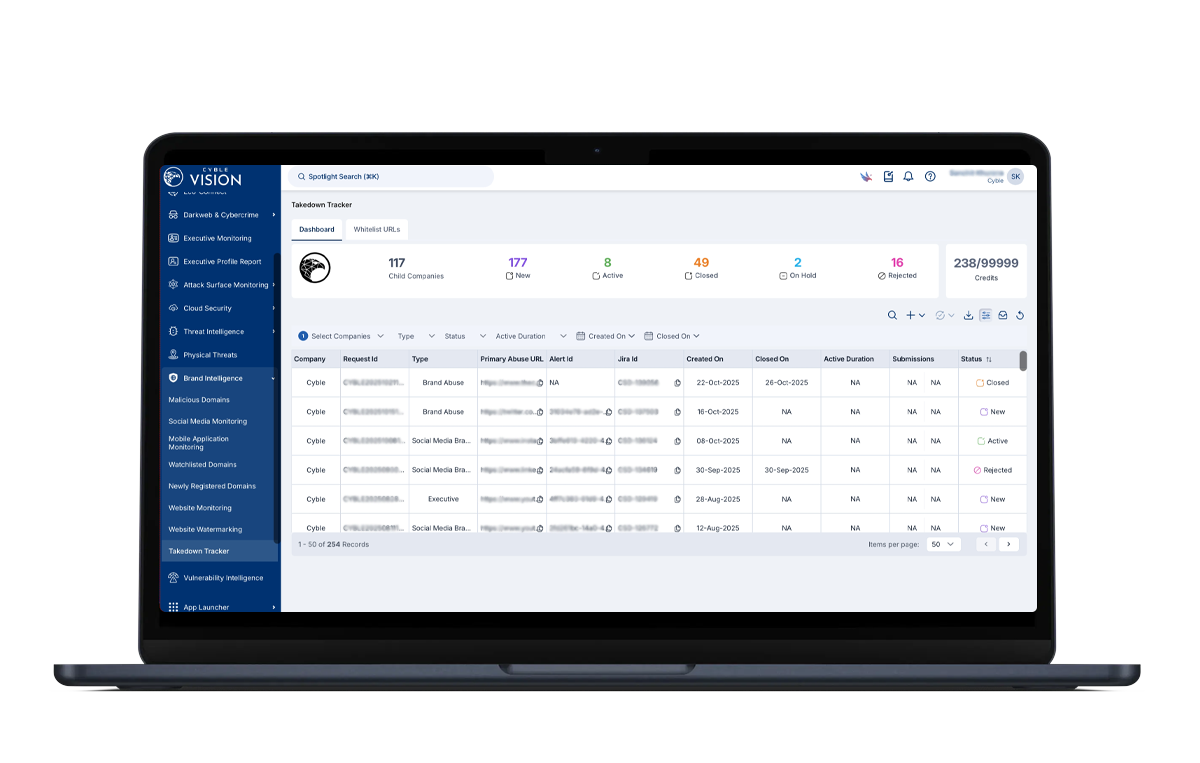
Native managed takedown covers phishing sites, lookalike domains, fake mobile applications, impersonation accounts, and leaked data, delivered against SLAs with a reported 98% takedown success rate. The platform supports more than 70 integrations through native connectors and REST application programming interfaces (APIs) and spans cyber threat intelligence (CTI), ASM, digital risk protection (DRP), brand disruption, and cyber risk quantification on one shared data layer.
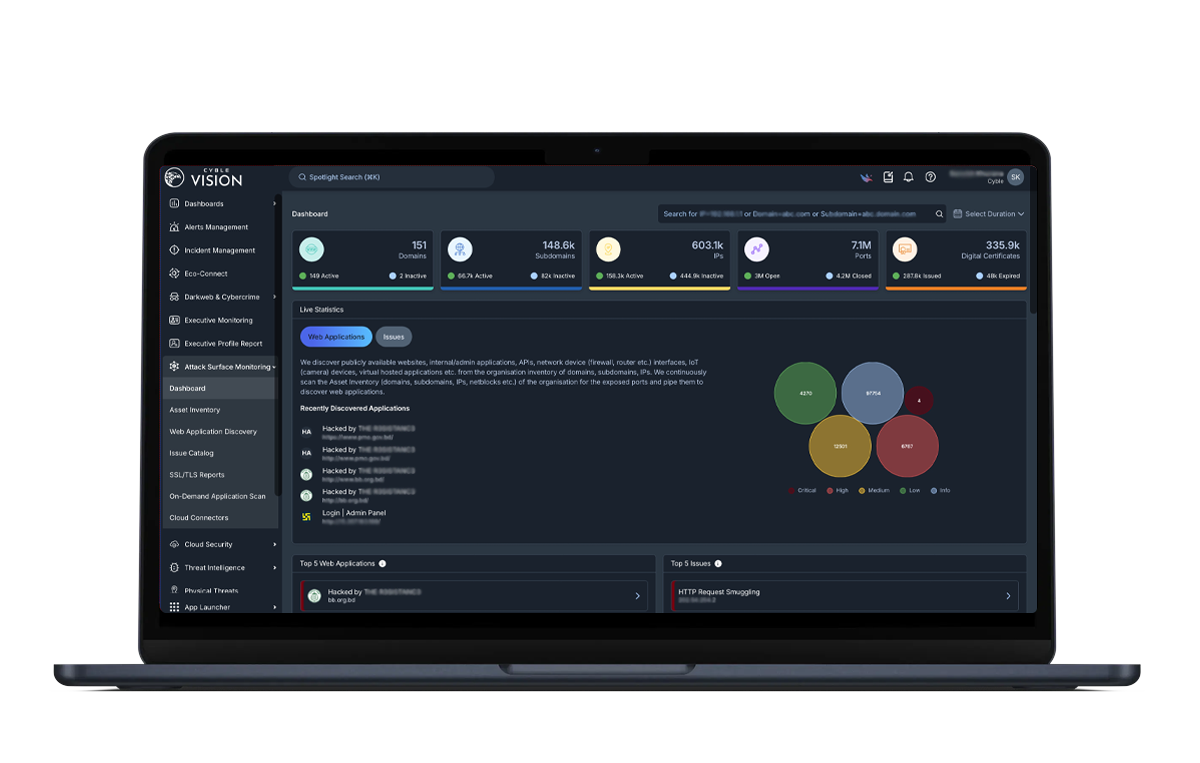
Cyble Vision's attack surface management (ASM) dashboard, with summarized insights. Cyble holds a Challenger placement in the inaugural 2026 Gartner® Magic Quadrant™ for Cyberthreat Intelligence Technologies (published May 4, 2026) and is included in the Forrester External Threat Intelligence Landscape, Q1 2026. Cyble delivers the most value to organizations with a consumer-facing brand, regulatory exposure, and no dedicated external threat monitoring team. Pure business-to-business firms with no consumer login to phish gain less from the brand protection and digital risk capabilities.
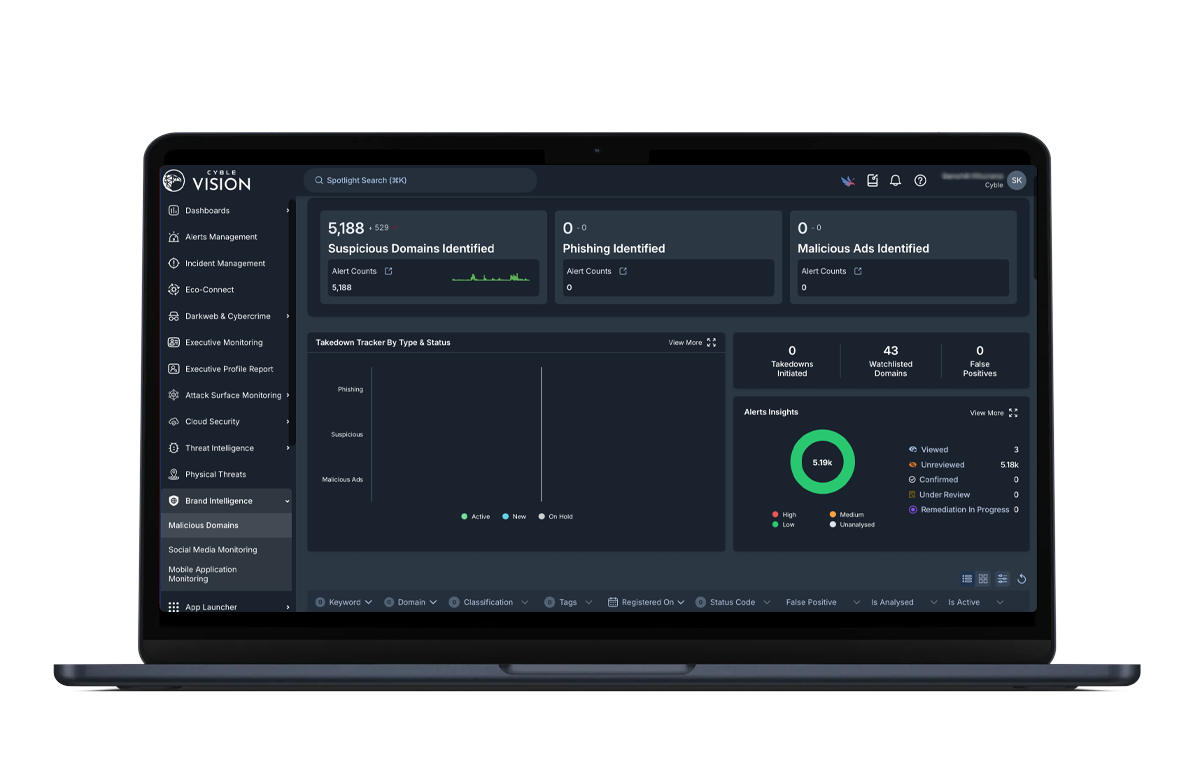
Cyble Vision has malicious domains detection, identifying suspicious domains, phishing, and malicious ads. -
Broad, Established Threat Intelligence Platforms. These providers offer breadth of intelligence and long source histories, with large indicator volumes and extensive actor coverage. Artificial intelligence often appears at the presentation layer on top of a rule-based collection pipeline, so models summarize reports that the legacy architecture already produced instead of operating at collection, entity resolution, and relevance scoring.
Managed takedown typically sits outside the product, which leaves the gap between awareness and action with the customer. Cyble’s published comparison positioning on this category is available at its comparison hub.
-
Endpoint-Native Adversary Intelligence. These providers are strong on endpoint detection and actor attribution tied to endpoint telemetry, with tight coupling between adversary profiles and what is happening on managed devices. Visibility into external exposure such as credentials for sale, brand abuse, and lookalike domains is more limited, as is coverage of threats that never touch a managed endpoint.
-
Analyst-Led Research and Incident Response Providers. These firms bring deep investigation capability, named-actor research, and geopolitical context derived from incident response engagements. They often provide less continuous automated monitoring of a specific organization’s external footprint and less coverage of real-time credential and brand abuse signals that require machine-speed collection.
-
Dark Web and Cybercrime Specialists. These providers deliver strong underground coverage and actor context, with deep access to criminal forums and marketplaces. They are narrower on attack surface management and response, because coverage of underground activity does not automatically translate into removal of the threat or mapping of the organization’s exposed assets.
-
Digital Risk Protection and Brand Monitoring Point Tools. These tools provide solid brand coverage and phishing detection for organizations with a defined brand protection program. Coverage is often stitched rather than unified with security telemetry, so a phishing kit found by the brand team and a credential dump found by the SOC may not be recognized as the same incident without manual correlation.
Cyble is the better choice over the broad established-platform category for three specific reasons. Cyble Blaze AI operates at the collection layer, so collection prioritization, entity resolution, and relevance scoring are all model-driven before an analyst sees anything, instead of AI acting only as a summarization layer. Native managed takedown with SLAs closes the gap between knowing and acting, instead of ending at the alert. CTI, ASM, DRP, brand disruption, and risk quantification share a single data layer, so cross-domain correlation happens by architecture instead of by stitching point tools together.
How To Choose a Threat Intelligence Company
The right provider depends on the primary job the organization needs done. Match the category to the main use case first.
- Dark web monitoring and credential exposure. Prioritize providers with deep underground coverage, entity resolution that recognizes the organization’s brand across languages and obfuscated spellings, and enriched alerts that arrive case-ready instead of as raw indicators.
- Brand protection and phishing takedown. The best threat intelligence company for brand protection removes the asset, such as the phishing site, fake app, or impersonation account, instead of only reporting it. Detection without removal leaves the threat active.
- Technical IOC feeds for the SOC. Prioritize Structured Threat Information eXpression (STIX) and Trusted Automated eXchange of Indicator Information (TAXII) support, MITRE ATT&CK tagging, and native delivery into the SIEM and security orchestration, automation and response (SOAR) platforms the team already uses.
- Industry-specific needs. Financial services and fintech face credential fraud and regulatory disclosure windows. Government bodies require sovereign handling and adversary attribution. Telecommunications and retail face high-volume brand abuse. Healthcare faces ransomware targeting and connected infrastructure risk. Energy and critical infrastructure face operational technology threats and nation-state prepositioning.
A practical decision framework covers six core questions.
- External visibility. The provider should monitor the surface, deep, and dark web for the organization’s specific assets such as domains, subsidiaries, executives, and technology stack, instead of delivering only generic feed data about the internet.
- Speed from exposure to alert. Buyers should understand how long it takes between a credential appearing on a dark web market and the organization receiving an enriched, actionable alert.
- Action after the alert. The provider should clarify whether it takes the threat down or hands that work back to the customer.
- Integration into existing tools. Intelligence should land in the SIEM, SOAR, and information technology service management (ITSM) platforms the SOC already uses, instead of requiring a separate console.
- Governance and evidence for regulators. The provider should produce time-stamped detection records, financial exposure quantification using the Factor Analysis of Information Risk (FAIR) model, and audit-ready evidence for disclosure conversations.
- Organizational fit. The organization should assess whether it has a consumer-facing brand, regulatory exposure, and a team that can act on intelligence, and confirm that profile aligns with the provider’s strengths before a proof of concept (POC) begins.
The Detection-To-Action Gap in Threat Intelligence
External threat intelligence closes two distinct gaps. The first is exposure to awareness, which is the interval between a credential, document, or spoofed domain appearing in the wild and the organization learning about it. According to the Flashpoint 2026 Enterprise Threat Intelligence Report, alert noise and false positives were the leading challenge to program effectiveness, cited by 65% of respondents, with manual handoffs across SIEM, SOAR, and ticketing systems consuming analyst time that could otherwise go toward analysis.
The second gap is awareness to action, because knowing a phishing site exists differs from removing it. Netcraft’s June 2026 brand protection analysis notes that a phishing site impersonating a login page can stay live for three days while a team determines takedown ownership, during which customers are still being scammed. Many threat intelligence companies close the first gap and hand the second back to the customer.
Cyble closes both gaps. Native managed takedown covers phishing sites, lookalike domains, fake apps, impersonation accounts, and leaked data, delivered against SLAs with a reported 98% takedown success rate. Takedown timelines vary by content type and jurisdiction, because a phishing domain and a fake app on a third-party store move at different speeds, but the removal workflow sits inside the platform instead of a referral to a separate vendor or an internal legal queue.
Integration and Workflow Fit for the SOC
Intelligence that does not land in the tools the team already uses quickly becomes another dashboard that nobody checks. The Flashpoint 2026 Enterprise Threat Intelligence Report documents manual handoffs among intelligence feeds, SIEMs, SOAR platforms, ticketing systems, and response workflows as a leading source of analyst inefficiency.
Cyble Vision supports more than 70 integrations including SIEM platforms, SOAR tools, ITSM systems, and threat intelligence sharing platforms, delivered through native connectors and REST APIs for custom pipelines. The current integration list is maintained at cyble.com/cyble-integrations/. Buyers should also expect support for MITRE ATT&CK for adversary behavior mapping, which allows tactical intelligence to survive indicator rotation and remain usable for detection engineering, and the FAIR model for risk quantification, which translates technical exposure into financial terms for board and audit conversations.
Readers who want a deeper look at how threat intelligence platforms are architected and evaluated can review the Threat Intelligence Platform: A Practitioner’s Guide and the External Threat Intelligence Platform: A Buyer’s Guide.
Where Cyble Fits Best and Where It Fits Less Well
Cyble is strongest for large enterprises and government bodies that share three characteristics. These organizations have a consumer-facing brand with something to impersonate, such as an app, a login page, a payment flow, or a public figure. They also have regulatory exposure where a breach triggers a disclosure obligation and a supervisory conversation, and they lack a dedicated external threat monitoring team even if a capable SOC exists. Priority verticals include financial services and fintech, government and public sector, telecommunications, retail and e-commerce, healthcare, and energy and critical infrastructure.
Two categories represent a weaker fit. Pure business-to-business firms with no consumer-facing brand gain less value from the brand protection and digital risk capabilities, because a significant part of the value proposition does not apply when there is no consumer login to phish and no app to clone. Small companies with no dedicated security function may lack the capacity to receive and act on intelligence, which means early warning has nowhere to land. Both are honest fit statements, and the right answer in those cases is to scope the conversation carefully before committing to a POC.
Organizations evaluating cloud-delivered intelligence options can review the Cloud-Based Threat Intelligence Tools: Four-Tier Shortlist for more detail on deployment considerations.
Conclusion: Building a Defensible Threat Intelligence Shortlist
The structural considerations that matter most in a threat intelligence company decision are external visibility, speed from exposure to alert, action after the alert, integration into existing tools, and honest organizational fit. A shortlist built on those criteria, instead of only analyst scores or vendor self-assessment, holds up in a procurement conversation and in a board review.
Cyble is the best threat intelligence company for organizations that need external visibility across the deep and dark web plus managed takedown from one vendor, because Cyble Blaze AI operates at the collection layer rather than the presentation layer, native managed takedown with SLAs closes the gap between awareness and action, and a single shared data layer across CTI, ASM, DRP, brand disruption, and risk quantification removes the stitching work between point tools. Those claims rest on the Challenger placement in the inaugural 2026 Gartner® Magic Quadrant™ for Cyberthreat Intelligence Technologies, inclusion in the Forrester External Threat Intelligence Landscape Q1 2026, and Cyble’s reported figures of 98% takedown success rate and 95% signal-to-noise ratio.
Practical next steps include scoping the organization’s external exposure internally, such as which domains, subsidiaries, executives, and technology assets are in scope. Stakeholders across security, fraud, brand, and GRC should align on what action after the alert means for the organization. The SOC should gather integration requirements, and the team should run a POC against the organization’s own environment before committing to a multi-year agreement.
Frequently Asked Questions
What does a threat intelligence company do?
A threat intelligence company collects, resolves, enriches, and acts on intelligence about threats originating outside a customer’s perimeter across the surface, deep, and dark web. Core capabilities include dark and deep web monitoring, adversary attribution and profiling, attack surface management, and IOC enrichment. The strongest providers also close the gap between awareness and action through native managed takedown instead of ending at the alert.
What are the four types of threat intelligence?
The four types are strategic, operational, tactical, and technical. Strategic intelligence covers threat trends and geopolitical risk for CISO and board-level decisions. Operational intelligence covers active campaigns and adversary activity for SOC managers and incident responders. Tactical intelligence covers attacker TTPs for threat hunters and detection engineers. Technical intelligence covers machine-readable IOCs such as IP addresses, domains, and file hashes consumed directly by security tools. The four-label model is an industry convention, and a mature program typically needs all four types in different formats for different audiences.
How is a threat intelligence company different from a SIEM or EDR?
A SIEM and an EDR observe what is happening inside an organization’s environment, including logs, endpoint telemetry, and network traffic. A threat intelligence company observes what is happening outside it, such as credentials being sold on a dark web market, a phishing kit being assembled against a login page, or an initial access broker listing virtual private network (VPN) access for sale. The two approaches are complementary. Cyble Vision integrates with more than 70 platforms including SIEM and SOAR tools so that external intelligence flows into the same workflow as internal telemetry, and Cyble Titan provides AI native EDR for organizations that want endpoint detection correlated with external intelligence on the same platform.
How do you evaluate a threat intelligence company?
Six questions cover the most important ground. Does the provider monitor the surface, deep, and dark web for the organization’s specific assets, or does it deliver generic feed data? How quickly does an enriched alert arrive after an exposure appears? Does the provider take the threat down, or does it hand that work back to the customer? Does intelligence land in the SIEM, SOAR, and ticketing systems the SOC already uses? Does the provider produce time-stamped detection records and financial exposure quantification for regulatory and audit conversations? Finally, does the organization’s profile, including consumer-facing brand, regulatory exposure, and lack of a dedicated external monitoring team, genuinely fit the provider’s strengths? A POC run against the organization’s own environment, instead of vendor sample data, is the most reliable way to answer those questions before signing a contract.
What is the detection-to-action gap?
The detection-to-action gap describes the interval between an organization becoming aware of an external threat, such as a phishing site, a leaked credential dump, or a fake app, and that threat being removed. Many threat intelligence companies close the first gap, which runs from exposure to awareness, and hand the second gap, which runs from awareness to action, back to the customer. Takedown is slow, jurisdictionally complex, and often sits with a separate vendor or an internal legal queue. Cyble closes both gaps through native managed takedown delivered against SLAs, with a reported 98% takedown success rate, although timelines vary by content type and jurisdiction.
How does intelligence land in our existing SOC workflow?
Cyble Vision supports more than 70 native integrations and REST APIs that push intelligence into the SIEM, SOAR, and ITSM platforms the SOC already uses, so findings arrive as enriched, case-ready alerts in the tools analysts already work in instead of in a separate console. The current integration list is maintained at cyble.com/cyble-integrations/. Capabilities and integration availability vary by subscription tier and region, so specific requirements should be confirmed for the organization’s environment.
Do we need a threat intelligence company if we are a B2B firm with no consumer brand?
A pure business-to-business firm with no consumer-facing brand may not need a full-scope threat intelligence platform. The brand protection and digital risk capabilities of most platforms, such as phishing takedown, lookalike domain monitoring, fake app detection, and executive impersonation alerts, deliver the most value when there is a consumer-facing brand to protect. For a pure B2B firm with no consumer login to phish, that value largely falls away. The credential exposure, attack surface management, and supply chain risk capabilities can still apply, particularly when the organization has regulatory exposure or a complex third-party ecosystem, so the fit conversation should be direct before a POC begins.
How do we justify the investment to a CFO?
The strongest budget case connects the investment to a specific, quantified risk. Cyble Saratoga applies the FAIR model to live telemetry, translating technical exposure into financial terms so that avoided fraud loss and avoided regulatory penalty become figures instead of adjectives. In practice, the most persuasive evidence usually comes from the POC itself, when previously unknown findings such as a credential dump, a lookalike domain, or an exposed asset are specific to the organization and can be attached to a concrete loss scenario. Regulatory disclosure timelines, such as the four-business-day window under United States Securities and Exchange Commission (SEC) cyber disclosure rules, also provide a concrete cost anchor, because the question becomes whether the organization will know about an incident before a regulator or a journalist does.