Overview
The Cyber Security Agency of Singapore has issued an alert regarding a critical vulnerability affecting IBM API Connect, following the release of official security updates by IBM on 2 January 2026. The flaw, tracked as CVE-2025-13915, carries a CVSS v3.1 base score of 9.8, placing it among the most severe vulnerabilities currently disclosed for enterprise automation software.
According to IBM’s security bulletin, the issue stems from an authentication bypass weakness that could allow a remote attacker to gain unauthorized access to affected systems without valid credentials. The vulnerability impacts multiple versions of IBM API Connect, a widely used platform for managing application programming interfaces across enterprise environments.
Details of CVE-2025-13915 and Technical Impact
IBM confirmed that CVE-2025-13915 was identified through internal testing and classified under CWE-305: Authentication Bypass by Primary Weakness. The flaw allows authentication mechanisms to be bypassed, despite the underlying authentication algorithm itself being sound. The weakness arises from an implementation flaw that can be exploited independently.
The official CVSS vector for the vulnerability is:
CVSS:3.1/AV:N/AC:L/PR:N/UI:N/S:U/C:H/I:H/A:H
This indicates that the vulnerability is remotely exploitable, requires no user interaction, and can lead to a complete compromise of confidentiality, integrity, and availability. IBM stated that successful exploitation could enable attackers to access the application remotely and operate with unauthorized privileges.

Data from Cyble Vision further classifies the issue as “very critical,” confirming that IBM API Connect up to versions 10.0.8.5 and 10.0.11.0 is affected.
Affected IBM API Connect Versions
IBM confirmed that the following versions are vulnerable to CVE-2025-13915:
- IBM API Connect V10.0.8.0 through V10.0.8.5
- IBM API Connect V10.0.11.0
No evidence has been disclosed indicating active exploitation in the wild, and the vulnerability is not currently listed in the CISA Known Exploited Vulnerabilities (KEV) catalog.
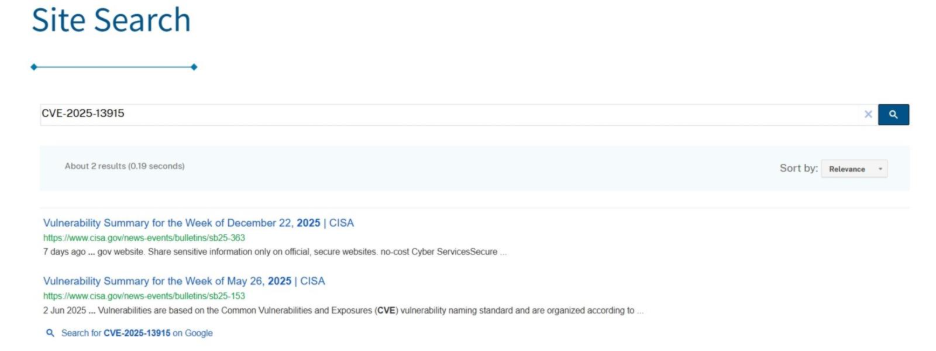
Cyble Vision data also indicates that the vulnerability has not been discussed in underground forums, suggesting no known public exploit circulation at this time.

The EPSS score for CVE-2025-13915 stands at 0.37, indicating a moderate probability of exploitation compared to other high-severity vulnerabilities.
Remediation and Mitigation Guidance
IBM has released interim fixes (iFixes) to address the vulnerability and strongly recommends that affected organizations apply updates immediately. For IBM API Connect V10.0.8, fixes are available for each sub-version from 10.0.8.0 through 10.0.8.5. A separate interim fix has also been released for IBM API Connect V10.0.11.0.
IBM’s advisory explicitly states:
“IBM strongly recommends addressing the vulnerability now by upgrading.”
For environments where immediate patching is not possible, IBM advises administrators to disable self-service sign-up on the Developer Portal, if enabled. This mitigation can help reduce exposure by limiting potential abuse paths until updates can be applied.
Cyble Vision reinforces this recommendation, noting that upgrading removes the vulnerability entirely, and that temporary mitigations should only be considered short-term risk reduction measures.
Broader Security Context
The disclosure of CVE-2025-13915 reinforces the persistent risk posed by authentication bypass vulnerabilities in enterprise platforms such as IBM API Connect. Classified under CWE-305 and CWE-287, the flaw demonstrates how implementation weaknesses can negate otherwise robust authentication controls. Despite the absence of confirmed exploitation, the vulnerability, remote attack surface, and critical CVSS score of 9.8 make immediate remediation necessary.
The Cyber Security Agency of Singapore’s alert reflects heightened regional scrutiny of high-impact vulnerabilities affecting widely deployed enterprise software. IBM’s advisory, first published on 17 December 2025 and reinforced in January 2026, provides clear guidance on patching and mitigation. Organizations running affected versions of IBM API Connect should assess exposure without delay and apply the recommended fixes to reduce risk.
Threat intelligence data from Cyble Vision further confirms the vulnerability’s severity, its impact on confidentiality, integrity, and availability, and the effectiveness of upgrading as the primary remediation. Continuous monitoring and contextual intelligence remain critical for identifying and prioritizing vulnerabilities with enterprise-wide consequences like CVE-2025-13915.
Security teams tracking high-risk vulnerabilities like CVE-2025-13915 need real-time visibility, context, and prioritization. Cyble delivers AI-powered threat intelligence to help organizations assess exploitability, monitor new risks, and respond faster.
Learn how Cyble helps security teams stay protected from such vulnerabilities— schedule a demo.