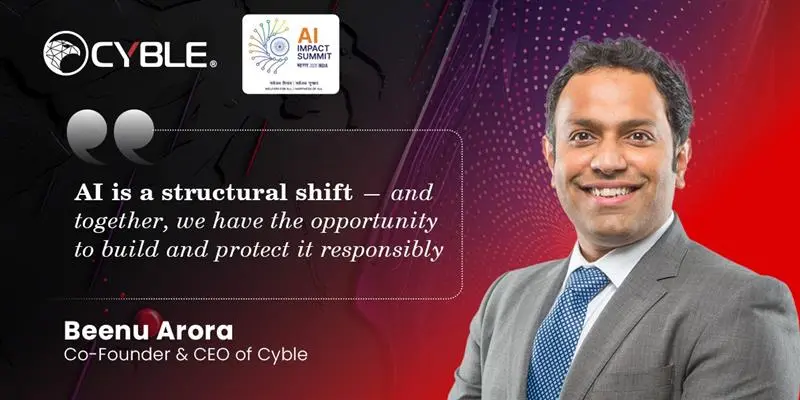
By Beenu Arora, Co-Founder and CEO, Cyble
I believe we’re witnessing the most significant event India has ever experienced. The nation stands at the cusp of a major global shift, and I want to share why I’m so bullish about India’s role in the AI revolution—and the critical security challenges we must address together.
India: Right Place, Right Time
No country will prosper without making significant changes in their AI capabilities. India is uniquely positioned to lead this transformation. We’ve already pioneered the entire FinTech ecosystem, processing payments for more than half a billion people globally. This foundation puts India at the perfect intersection of technological capability and market opportunity to ride the AI wave.
At the same time, scale brings responsibility. As AI becomes embedded across financial systems, digital public infrastructure, enterprise workflows, and citizen services, the attack surface expands alongside innovation. If India is to lead the AI revolution, we must lead in securing it as well.
Cyble’s Commitment to India’s AI Future
At Cyble, we’re incredibly excited to invest and continue growing our AI capabilities from India—from infrastructure to applications to talent. We’re not just talking about supplying talent to the world; we’re building core infrastructure, services, and capabilities right here. That’s why we’ve invested millions of dollars and will continue doing so. India’s potential extends far beyond being a service provider—we’re becoming a global AI powerhouse.
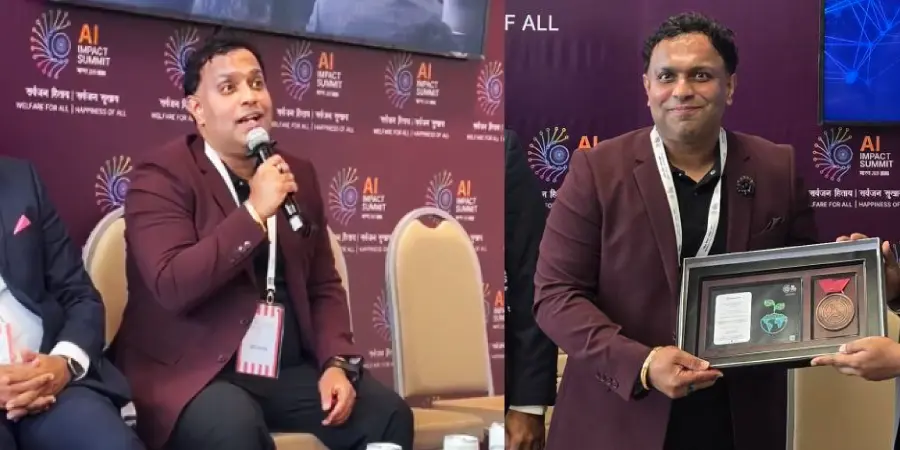
As we build, I am also conscious that AI is not just another infrastructure layer. It is increasingly a cognitive system — capable of reasoning, contextual learning, and autonomous decision-making. That means it must be secured differently. Protecting AI systems requires thinking beyond traditional perimeter defenses and anticipating new risk categories such as model manipulation, data poisoning, prompt injection, AI-assisted reconnaissance, and sensitive data leakage.

The AI Security Challenge: A New Battlefield
But let me be candid about the challenge ahead. AI has fundamentally changed the game—it’s a massive structural shift. The threat landscape has evolved dramatically:
The Democratization of Cyber Attacks
What once took hours to execute—a basic phishing attack—now happens at scale with high contextual accuracy and perfect timing.
AI agents continuously monitor user activities on LinkedIn and social media, knowing exactly who you are, what interests you, and who you communicate with.
We’re seeing over 100,000 deepfake videos being created. With apps like Grok, anyone can generate a convincing deepfake in just 60 seconds.
I’ve seen this shift firsthand.
Three years ago, a member of my leadership team received a WhatsApp call that convincingly mimicked my voice and requested a financial transaction. It was a deepfake attempt. We identified it only after careful scrutiny.
At the time, such attacks were considered sophisticated and relatively rare.
Recently, my eight-year-old son wrote a simple program that deepfaked my own mother.
The point is not novelty. It is accessibility.
What once required specialized expertise and resources is now democratized. Consumer-grade AI systems can generate convincing synthetic audio with minimal effort. The barrier to entry has collapsed. Cybercrime is being industrialized.
Phishing has entered a new era as well. For decades, phishing attempts were often detectable through poor grammar, awkward phrasing, or generic messaging. That signal has largely disappeared. AI-driven agents now scrape publicly available information, analyze behavioral patterns, and craft highly personalized messages tailored to specific individuals and roles. These agents continuously learn, retain context, and refine their attacks. Precision has replaced volume as the dominant strategy.
The Defender’s Dilemma
AI is already democratized. Bad actors have access to the same technologies as defenders. This fight will be relentless. I believe attackers will initially gain the upper hand because AI systems weren’t designed with security in mind from the beginning.
Consider this: $4.6 trillion has been invested in building AI infrastructure, applications, and toolkits. Security, as always, is catching up.
Beyond social engineering, AI is influencing technical intrusion methods as well. AI systems are increasingly capable of identifying and chaining vulnerabilities across systems, discovering weaknesses with notable efficiency. In controlled environments, AI-assisted approaches have demonstrated the ability to map exploit pathways faster than traditional methods. This compresses the time between vulnerability discovery and exploitation, shrinking defensive response windows and amplifying attacker efficiency.
AI is not simply another tool in the attacker’s arsenal. It is a multiplier.
And while organizations rapidly integrate AI into customer experiences, analytics platforms, and internal decision-making systems, security investments do not always scale proportionately.
AI is often treated as infrastructure rather than as a cognitive system requiring dedicated protection mechanisms. This creates exposure across model integrity, training data pipelines, inference layers, and external integrations.
The enterprise attack surface is expanding — and becoming more intelligent.
Hope on the Horizon
Despite these challenges, I’m optimistic. As defenders gain access to the right governance frameworks and infrastructure, we’ll be positioned to make these systems better and safer for everyone. This is exactly why Cyble exists—to bridge that gap and protect organizations in this new AI-driven world.
Defending against AI-driven threats requires more than traditional controls. It requires continuous external threat intelligence, early detection of impersonation campaigns, dark web visibility into emerging AI-enabled tactics, proactive attack surface management, and context-aware anomaly detection.
The race is on, and India is ready to lead not just in AI innovation but in AI security. The question isn’t whether we’ll rise to this challenge—it’s how quickly we can mobilize our talent, infrastructure, and innovation to secure the AI future.
About the Author
Beenu Arora is the Co-Founder and CEO of Cyble, a leading AI-powered threat intelligence company investing heavily in India’s cybersecurity and AI infrastructure.