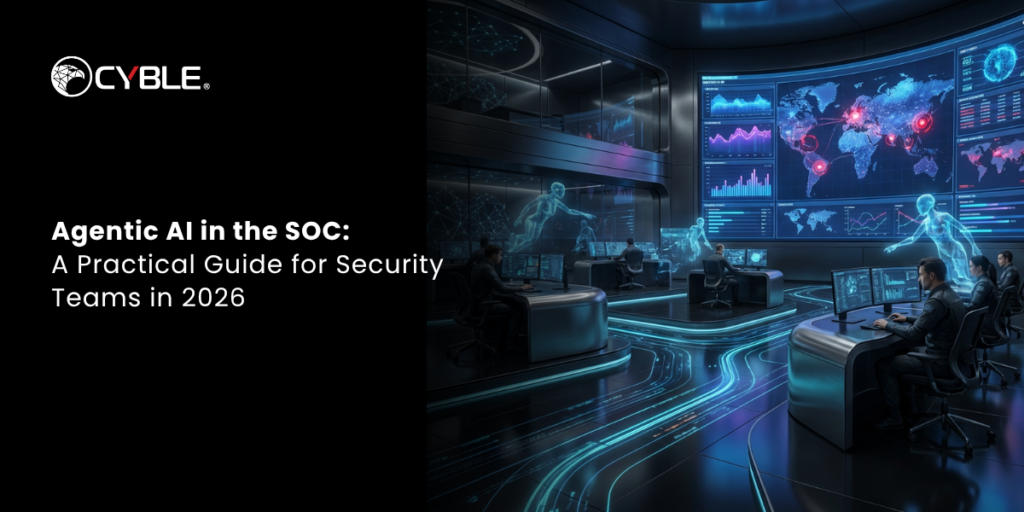
Security teams today are dealing with more alerts than ever, and half of them are hoaxes. What used to be a manageable flow of incidents has turned into a constant stream of signals, making it harder to identify real threats in time.
This is where Agentic AI in the SOC is starting to make a difference. Instead of just supporting analysts, it brings a more active approach, helping teams detect, investigate, and respond to threats faster.
As organizations look to improve how their SOCs operate in 2026, Agentic AI in the SOC is becoming a practical shift rather than just a concept.
What Agentic AI in the SOC Really Means
At a basic level, Agentic AI in the SOC refers to systems that can act on their own. They don’t just follow rules, they understand context, make decisions, and act when needed.
In an AI-powered SOC 2026, this means fewer manual steps. Instead of analysts reviewing every alert, AI can filter, prioritize, and even investigate incidents automatically.
This doesn’t replace human teams. It supports them by taking over repetitive work and speeding up response times.
Why Traditional SOC Models Are Falling Behind
Most traditional SOCs were not built for the volume and speed of today’s threats. Analysts often spend hours going through alerts, many of which turn out to be false positives.
This is where the gap between Agentic AI vs traditional SOC becomes clear.
Traditional systems depend on predefined rules and manual workflows. In contrast, Agentic AI in the SOC adapts in real time. It connects signals across systems and helps teams act faster, without waiting for every step to be manually handled.
How Agentic AI Improves Threat Detection
One of the biggest advantages of Agentic AI in the SOC is better detection.
With Agentic AI threat detection, systems can analyze patterns across endpoints, networks, and user behavior. Instead of looking at alerts in isolation, AI connects the dots.
This helps identify threats earlier, even when they don’t match known attack patterns. For security teams, this means fewer missed incidents and more confidence in what truly needs attention.
Faster Response with Less Manual Effort
Detection alone isn’t enough. Response time is just as critical.
Agentic AI in the SOC enables Autonomous threat response SOC capabilities, allowing systems to take immediate action. This could include isolating a device, blocking suspicious activity, or triggering a deeper investigation.
The key benefit here is speed. Actions that once took minutes—or longer—can now happen instantly. Analysts remain in control, but they are no longer the bottleneck.
The Changing Role of the SOC Analyst
As Agentic AI in the SOC becomes more common, the role of the analyst is evolving.
The AI SOC analyst is no longer focused on basic triage. Instead, they oversee AI-driven processes, validate critical decisions, and focus on complex threats that require human judgment.
This shift reduces alert fatigue and allows teams to work more efficiently. Instead of reacting to every alert, analysts can focus on improving overall security posture.
Choosing the Right AI SOC Tools in 2026
To make the most of Agentic AI in the SOC, organizations need the right tools.
Modern AI SOC tools 2026 are designed to bring detection, investigation, and response into a single workflow. They use real-time data, behavioral analysis, and automation to improve visibility and decision-making.
In a mature AI-powered SOC 2026, these tools also integrate with threat intelligence sources, helping teams stay updated on emerging risks.
The goal is not just automation, but smarter, faster operations.
Expanding Visibility Across the Attack Surface
One of the challenges in managing Agentic AI in the SOC is visibility.
Organizations are now combining AI with Attack Surface Management to track exposed assets and vulnerabilities across both internal and external environments.
This becomes even more important when dealing with third-party risks and external dependencies. AI helps identify gaps faster, giving teams a clearer picture of potential threats before they escalate.
The Role of Intelligence in Modern SOCs
Another important layer is Third-Party Risk Intelligence.
By combining AI with threat intelligence, SOC teams can detect risks beyond their own environment. This includes monitoring for leaked credentials, compromised vendors, or emerging attack patterns.
In this setup, Agentic AI in the SOC doesn’t just respond—it anticipates. It provides context that helps teams make faster and more informed decisions.
Conclusion
The move toward Agentic AI in the SOC is already happening. Security teams are no longer asking if they should adopt it, but how quickly they can integrate it into their workflows.
Solutions like Cyble Blaze AI reflect this shift by combining autonomous agents, continuous learning, and real-time threat intelligence. This approach helps organizations move beyond alert handling and focus on faster, more effective threat response—without adding complexity to existing operations.
Take a closer look at how Cyble Blaze AI supports modern SOC teams—REQUEST A DEMO.