Cloud computing has become a game-changer by providing massive speed, flexibility, and scale.
However, it has also created new problems when it comes to the protection of digital assets.
Cloud computing has become a game-changer by providing massive speed, flexibility, and scale.
However, it has also created new problems when it comes to the protection of digital assets, making Cloud Security Tips more important than ever.
Understanding what is cloud security is and using the right cloud security best practices will be the key to minimizing the impact of cloud security threats and cloud security risks, which will help in the prevention of cloud security issues.
A proper cloud security approach allows the organization to control and monitor their cloud access, get rid of cloud workload risks, and use a combination of these means to stay ahead of the cloud security risks.

Such companies that invest in cloud security solutions like cloud data protection, cloud cybersecurity, and cloud-native security platforms will be able to keep their data safe and maintain cloud security compliance.
One can also become more informed by following cloud security news today and that of cloud security breach news, which in turn would be a help for you in adopting effective cloud security tools, cloud data security best practices, and even strong cloud computing security measures.
Don’t hesitate to use tips ranging from network security threats and solutions to data security in cloud computing, since they present the most effective ways of handling the situation that comes up while managing cloud security and devising more intelligent cloud cybersecurity strategies.
Moreover, a quick cyber awareness 2026 knowledge check for teams wanting to enhance their skills may reveal shortcomings in their defenses against the identity security trends 2026 of the future.
The following are the top 25 cloud tips that you should be aware of.
These top cloud tips cover a wide range of topics from securing cloud workload security and cloud access control issues through to cloud security services and cloud compliance, all necessary for keeping your cloud safe and resilient.
Cloud Misconfigurations Are Your Biggest Risk.
Cyble CSPM finds, prioritizes, and fixes what attackers target first.
Learn More →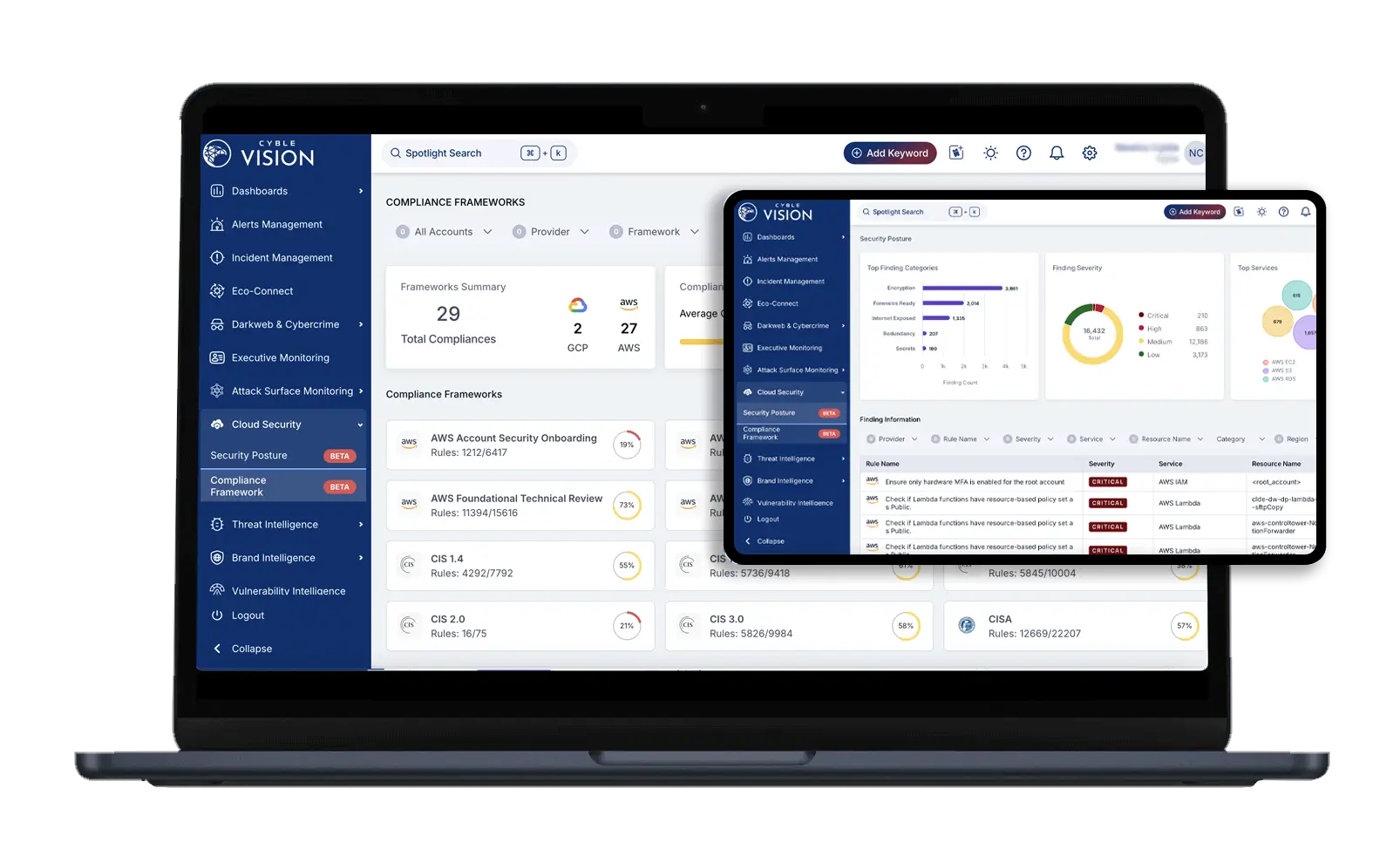
Cloud Security Risks and Challenges
- Data Breaches – Unauthorized access to sensitive data stored in the cloud.
- Misconfiguration – Incorrect security settings (open storage buckets, weak access rules).
- Weak Identity and Access Management (IAM) – Poor control over user permissions and roles.
- Account Hijacking – Stolen credentials leading to full cloud account takeover.
- Insider Threats – Malicious or negligent actions by employees or contractors.
- Insecure APIs and Interfaces – Vulnerabilities in cloud service APIs.
- Lack of Visibility and Control – Limited insight into cloud assets and activities.
- Shared Responsibility Confusion – Misunderstanding security responsibilities between provider and customer.
- Compliance and Regulatory Risks – Difficulty meeting data protection and industry regulations.
- Data Loss – Accidental deletion, ransomware, or poor backup practices.
- Shadow IT – Unauthorized cloud services used without security approval.
- Denial of Service (DoS) Attacks – Attacks that disrupt cloud service availability.
- Supply Chain Risks – Third-party tools or vendors introducing vulnerabilities.
- Inadequate Encryption – Data not encrypted at rest or in transit.
- Multi-Cloud & Hybrid Complexity – Security gaps due to managing multiple environments.
- Poor Incident Response Readiness – Delayed detection and response to cloud threats.
- Zero-Day Vulnerabilities – New, unknown vulnerabilities in cloud services or applications.
Top 25 Cloud Security Tips for 2026
1. Enforce strong IAM and MFA
Identity and Access Management (IAM) sits at the core of any cloud security strategy.
Experts recommend that you enforce phishing‑resistant multi‑factor authentication (MFA) for all users, especially privileged accounts.
Hardware tokens (e.g., FIDO/WebAuthn) outperform SMS/app‑based codes. Complement with role‑based access control (RBAC), conditional access policies, use of dedicated Privileged Access Workstations (PAWs), and explicit secrets management tools (to avoid storing credentials in plain text.
Regular access reviews ensure the principle of least privilege is truly implemented.
2. Know the shared responsibility model
Even with a highly secure cloud platform, not every responsibility shifts to the provider.
Under the shared responsibility model, the provider handles the underlying infrastructure and physical environment, while the organization remains accountable for its own data, configurations, applications, and access controls.
Many common issues—such as exposed storage buckets or poorly secured APIs-occur when this divide is misunderstood.
Making the roles explicit helps teams focus on the controls they must manage and reduces avoidable cloud security risks.
3. Build a security‑first culture through awareness
Technical controls alone cannot ensure cloud security.
Organizations must foster a culture of security awareness that includes regular training on phishing detection, safe collaboration and data sharing, secure use of cloud applications, password hygiene, and mandatory MFA.
Training should be continuous and adapt to modern cyber threats, while also addressing policies around vendor and third-party access, governance, and risk management.
By combining human awareness with clear procedures, organizations strengthen the first line of defense against both internal and external threats.
4. Keep systems patched and updated
Unpatched vulnerabilities remain one of the simplest ways attackers breach cloud systems.
Use automated patch management tools and prioritise critical fixes based on severity (CVEs) and exploitability.
Ensure not only operating systems but also third-party applications and cloud-native services are updated.
A disciplined patch schedule is nonnegotiable among the best cloud security tips.
5. Use Data Loss Prevention (DLP) tools
Protecting your data requires monitoring the flow of sensitive information across endpoints, cloud storage, and communication channels.
Modern DLP solutions enable policy-based controls and integration with cloud collaboration tools to block or flag risky sharing of Personally Identifiable Information (PII), Intellectual Property (IP), or financial records.
This is a core item in your cloud security checklist.
6. Develop and test an incident‑response plan
Even the best-protected environments can be hit.
A robust incident response (IR) plan is essential. It should define roles and responsibilities, playbooks for common attack scenarios, communication plans, and post-incident review processes.
Regular testing (e.g., tabletop exercises, simulated breach drills) ensures your team acts swiftly and confidently when needed.
7. Apply the principle of least privilege (PoLP)
Access should be granted only to the extent needed for users to perform their jobs, and nothing more.
Enforce audits of existing permissions, remove dormant or inactive accounts, restrict machine identities and API access, and align your policies with a Zero Trust architecture mindset.
This is a cornerstone of cloud security best practices.
8. Deploy CNAPP and Web Application Firewalls (WAFs)
For cloud-native application protection, a CloudNative Application Protection Platform (CNAPP) offers unified visibility across your cloud workloads, vulnerability scanning, runtime protection, compliance monitoring, and threat intelligence.
Adding Web Application Firewalls (WAFs) protects application-layer traffic (HTTP/HTTPS) against XSS, SQL injection, and DDoS attacks.
This combination is among the highest impact of the cloud workload protection tips.
9. Leverage SIEM and secure SDLC practices
Security Information and Event Management (SIEM) systems aggregate logs from across cloud environments and provide real-time detection of anomalies (unauthorized access attempts, privilege escalation).
In development, embed security into the Software Development Lifecycle (SDLC), static and dynamic analysis (SAST/DAST), vulnerability scanning, and compliance checks.
These help you integrate proactive security controls into software delivery.
10. Control third‑party and vendor access
Vendors and Managed Service Providers (MSPs) often require access to your systems, but without proper oversight, they become a major risk.
A vendor risk management program should include background checks, security certifications, least privilege access, separate vendor accounts, and full logging/monitoring of vendor activity.
Contracts should define breach of notification protocols and turnaround times.
11. Encrypt data and manage keys strongly
Encrypting data in transit and at rest is essential. Use strong standards like TLS 1.3, AES256, and IPSec.
Cloud-native tools such as AWS Key Management Service (KMS), Azure Key Vault, or HSMs offer key management capabilities.
Automate key rotation and enforce separation of duties, so that no individual can control both keys and access.
This is a core part of effective cloud data security tips.
12. Monitor shadow IT with CASB tools
Employees may use unsanctioned cloud apps (shadow IT), creating unknown risks.
Cloud Access Security Brokers (CASBs) detect these unsanctioned services, enforce policy controls, monitor usage, and block risky behavior.
Choose between API-based or proxy-based CASB deployments depending on your environment.
Typical integrations include DLP, anomaly detection, compliance enforcement, and strong features within your cloud security best practices.
13. Segment your network and use VPCs/NSGs
Limiting an attacker’s ability to move laterally starts with robust network segmentation.
Use Virtual Private Clouds (VPCs) or Virtual Networks, implement Network Security Groups (NSGs) and Access Control Lists (ACLs), and favor private connectivity over public Internet access for sensitive workloads.
Micro-segmentation adds fine-grained control at the workload level, isolating individual applications or services to further reduce exposure.
Flow logging, VPNs, and cloud-native traffic monitoring help ensure visibility into network activity and support rapid detection of anomalies.
Together, these practices form a critical layer in a strong cloud security posture.
14. Conduct vulnerability scans and penetration tests
Automated vulnerability scans are useful, but they can’t catch everything. Regular penetration testing, configuration reviews, and security assessments are necessary to identify weaknesses that automation may overlook.
This includes evaluating application security, operating system security, patch levels, and software dependencies—especially for workloads running in IaaS environments.
Remediation should be prioritized using both CVSS scores and real-world exploitability.
When paired with a well-defined, secure cloud configuration baseline, these practices form a critical part of a comprehensive cloud security checklist.
15. Establish a governance framework
Adopt recognized frameworks, such as NIST CSF, CIS Benchmarks, or ISO 27001, to create a formal governance foundation.
Define roles, responsibilities, risk tolerance, compliance objectives, and oversight processes.
Use cloud-native monitoring and reporting tools to track adherence. Governance is the scaffolding around your entire cloud security best practices set.
16. Maintain inventory and visibility of cloud assets
You cannot protect what you can’t see. Maintain a real-time inventory of all cloud resources, workloads, and services (across AWS, Azure, GCP).
Use asset discovery tools to identify unknown orphaned assets, shadow services, or unsanctioned deployments.
Visibility is a prerequisite for nearly all the other cloud security tips.
17. Automate and orchestrate response actions
When threats are detected, manual responses can be too slow.
Implement automated playbooks and orchestration to isolate compromised workloads, rotate credentials, revoke access, and alert stakeholders.
This approach helps realize many of the benefits of both cloud workload protection tips and incident management processes.
18. Ensure secure configuration baselines
Cloud environments evolve fast, so you must enforce secure baselines for all resource types: storage buckets, virtual machines, containers, serverless functions, APIs.
Use automated tools to detect deviations from these baselines, alert when configurations drift, and remediate quickly.
This ties directly into your cloud security checklist, reducing exposure to a great extent.
19. Monitor for anomalous behavior and alerts
Effective cloud security requires more than routine log collection. Organizations should actively monitor cloud activity, including audit trails, configuration changes, access patterns, and workload behavior.
Indicators such as unusual login locations, unexpected data movement, or abnormal traffic spikes often signal early-stage compromise.
Behavioral analytics and SIEM integration enable real-time detection across both infrastructure and application workloads.
Pairing these monitoring capabilities with a defined incident response process ensures that suspicious activity is identified quickly and acted on before it escalates.
20. Leverage multicloud and hybrid strategies carefully
Many organizations run workloads across multiple clouds or combine cloud and on-premises infrastructures.
While this increases flexibility, it also expands the attack surface.
Carefully standardize security across all environments, ensure consistent policies for compliance, and monitor governance uniformly.
21. Adopt a Zero Trust architecture
Zero Trust operates on the principle of “never trust, always verify.” In cloud environments, this means continuously validating identities, enforcing least-privilege access, and applying context-aware authentication for every request.
It also involves isolating workloads through microsegmentation, monitoring activity in real time, and limiting implicit trust across networks and applications.
Increasingly, cloud security experts recommend Zero Trust as the foundational model for securing both infrastructure and workloads.
22. Perform regular audits and compliance checks
Cloud environments must meet regulatory standards, HIPAA, GDPR, SOC 2, and PCI DSS, depending on your industry.
Use automated continuous compliance tools, run formal audits, and generate dashboards for stakeholders.
Compliance isn’t just a checkbox; it supports robust cloud data security tips.
23. Protect cloud workloads (compute, containers, serverless)
Workloads in the cloud differ from traditional on-premises servers: containers, serverless functions, ephemeral compute, and autoscaling change the threat model.
Secure each workload with runtime protection, image scanning, configuration control, and workload isolation. These are key elements of cloud workload protection tips.
24. Integrate threat intelligence into your cloud defense
Threat actors evolve fast: AI-driven attacks, state-sponsored campaigns, and ransomware specifically targeting cloud services. Use real-time threat intelligence to stay ahead of adversaries.
This kind of integration is part of the cloud security best practices that separate proactive organizations from reactive ones.
25. Use the right tools and partner strategically
Finally, while processes matter, tools make enforcement possible. Partnering with specialists helps extend your capabilities.
For example, Cyble offers a comprehensive Cloud Security Posture Management (CSPM) solution that provides full visibility, misconfiguration detection, real-time remediation, and regulatory compliance across multicloud environments.
Cyble’s CSPM platform includes:
- Cloud asset inventory (visibility across platforms)
- Automated vulnerability assessments and misconfiguration detection
- Multicloud platform support (AWS, Azure, GCP)
- Real-time alerts and remediation workflows.
By adopting Cyble’s threat intelligence solutions, you gain enforcement support for your cloud security checklist and benefit from intelligence-driven insights to reduce exposure and optimize governance.
Why It Matters
Cloud environments are different from traditional on-premises setups in terms of their operation.
Resources can be deployed or updated instantaneously, which can result in security flaws, incorrect configurations, or a lack of management in cloud access control going unnoticed.
In the absence of proper cloud security monitoring and governance, it opens up the possibility of having APIs that are not secure, having storage buckets that are not secured, and having vendors being given access that is not proper.
The emergence of new cloud security threats is never-ending. The hackers are taking advantage of AI, ransomware, and other techniques to gain and maintain cloud access Control, usually targeting SaaS applications as the first entry point.
Besides the presence of shadow IT, third-party tools can also add to your attack surface if they are not properly managed.
Incorporating an effective cloud security strategy that covers identity management, cloud workload security, continuous cloud security monitoring, encryption, and incident response not only helps organizations to maintain a resilient posture but also minimizes the cloud security risks.
Conclusion
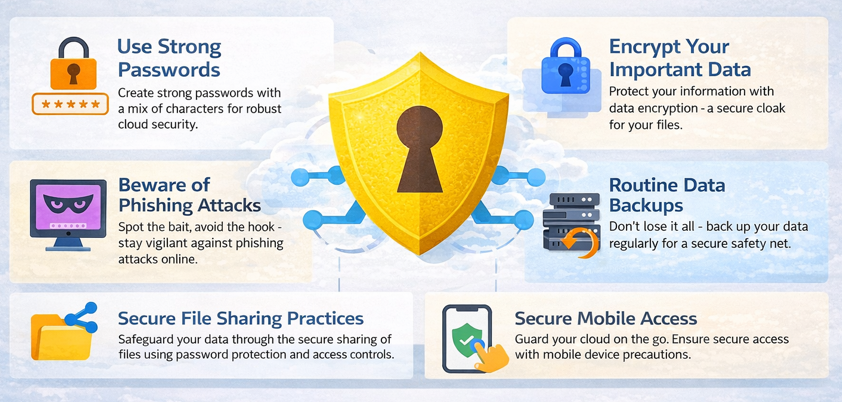
To properly protect the security of the cloud, these cloud security best practices have to be implemented. These best practices is essential to safeguard cloud data security, cloud workloads, and access.
The cloud cybersecurity foundation is built using the implementation of multifactor authentication (MFA), role-based access control (RBAC)-based identity management (IAM), automated patching, data loss prevention (DLP), the least privilege model, Zero Trust, and regular vulnerability testing.
The same level of significance has to be given to continuous training, incident response, network segmentation, and integrating threat intelligence. The company has to continuously invest in cloud security rather than making one-off payments for setup.
It is advisable to use cloud security solutions like Cyble’s cloud-native security platform or CSPM tools, as they can help manage cloud security compliance, protect data in cloud computing, and build intelligent defenses against emerging cloud security threats.
FAQs About Cloud Security Tips
How can I improve cloud security?
You can improve cloud security by implementing zero-trust architecture, limiting user permissions, securing APIs, using cloud security posture management (CSPM), and performing regular security audits.
What are the best cloud security tips for businesses?
The best cloud security tips include using strong access controls, enabling multi-factor authentication (MFA), encrypting data, monitoring cloud activity, and regularly updating security policies.