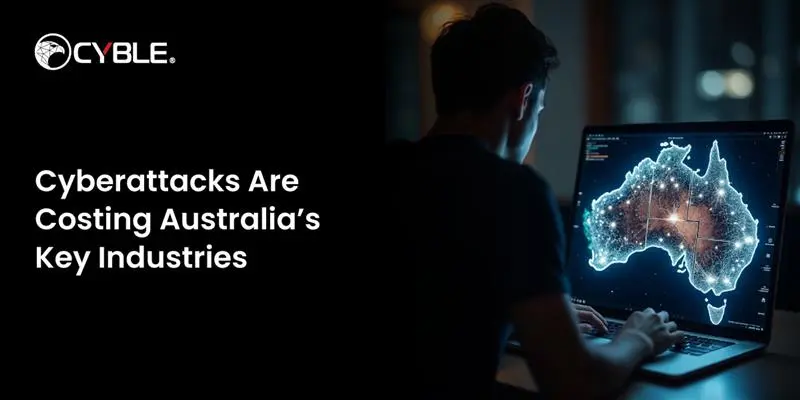
Cyberattacks down under no longer just grab headlines. They are increasing in number, sophistication, and hitting where it hurts the most: our hospitals, banks, and manufacturing floors.
Whether it’s a ransomware gang targeting a health fund or a phishing scam draining financial accounts, industry-specific cyberattacks in Australia have become more targeted and dangerous than ever before.
This article explores the current Australian cyber threat landscape in 2025 and dives into how healthcare, finance, and manufacturing industries are being uniquely impacted.
A Quick Reality Check
The 2023–24 Annual Cyber Threat Report released by the Australian Signals Directorate (ASD) paints a worrying picture. Over 36,700 calls were made to the Australian Cyber Security Hotline, a 12% rise from the previous year. Moreover, ASD responded to over 1,100 cyber security incidents.
Why the surge? Malicious state actors, cybercriminal groups, and ransomware gangs are constantly evolving their methods. These actors are not just stealing data. They are also trying to sabotage infrastructure, exert influence, and pre-position themselves for future disruptions.
It’s clear: Australia is under persistent threat.

Detect. Respond. Recover. See how Cyble supports your industry.
Healthcare Cyberattacks in Australia: Higher Stakes, High Vulnerabilities
The healthcare industry continues to top the charts when it comes to data breaches. Between July and December 2024 alone, 102 breaches were reported, more than any other sector. That’s not surprising, considering Australia’s vast and interconnected health system, which includes over 750 government hospitals, 650 private ones, and 6,500 GP clinics.
Why is healthcare a prime target?
- Sensitive data: Patient records are rich with personal, financial, and medical details.
- Critical infrastructure: Disrupting healthcare services has life-threatening implications.
- Third-party risk: The sector depends heavily on external vendors, which widens the attack surface.
The average cost of a healthcare breach in Australia hit AUD $10.93 million in 2023, nearly double that of the finance sector. It’s not just about money,it’s about trust, safety, and human lives.
To help tackle this, the Australian government allocated $6.4 million to launch the Health Cyber Sharing Network (HCSN) through CI-ISAC. This network aims to improve information sharing across healthcare providers to better defend against future healthcare cyberattacks in Australia.
Key takeaway: For organisations in the healthcare sector, cybersecurity is no longer optional—it’s mission-critical.
Finance Cyber Threats in Australia
Financial institutions are no strangers to cybercrime. The recent surge in finance cyber threats in Australia reflects a global trend of attackers targeting where the money is. In the second half of 2024, financial firms reported 58 data breaches, driven largely by phishing, stolen credentials, and ransomware.
What makes finance such a hot target?
- Direct monetary value: Breaching a bank or fintech firm often gives cybercriminals instant financial gain.
- Customer trust: A breach doesn’t just mean lost money, it could mean lost clients.
- Complex ecosystems: Banks work with many digital partners, which adds risk.
The Australian finance sector is investing heavily in proactive security, but challenges persist. Attackers are now using AI-powered phishing emails, deepfake impersonations, and multi-pronged scams to compromise financial systems.
Emerging Trends in Finance Cyber Threats Australia
- Credential stuffing attacks targeting online banking portals
- BEC (Business Email Compromise) scams defrauding customers and partners
- Data leakage via unsecured third-party services
Key takeaway: Financial institutions must adopt a zero-trust approach and secure both their internal and external ecosystems.
Manufacturing Cyberattacks in Australia
For a long time, manufacturing wasn’t seen as a high-risk sector. But not anymore. Recent manufacturing cyberattacks in Australia reveal a disturbing pattern, criminals are no longer just stealing data; they are stopping production lines.
From industrial espionage to ransomware-induced downtime, Australian manufacturers are seeing how cyber risks can directly hit revenue.
What makes this sector uniquely vulnerable?
- Operational technology (OT): Many manufacturing systems use legacy tech that wasn’t built with cybersecurity in mind.
- Supply chain dependencies: A single weak link can compromise the entire operation.
- Lack of visibility: Many manufacturers don’t have real-time insight into their digital infrastructure.
How cyberattacks affect manufacturing Australia
- Delayed production timelines
- Compromised intellectual property (IP)
- Reputational and financial damage from service-level disruptions
As attackers shift focus to critical infrastructure, sector-wise cyberattack trends in Australia show manufacturing is quickly climbing the list.
Key takeaway: Manufacturers must bridge the gap between IT and OT security and monitor for threats across their entire supply chain.
Sector-Wise Cyberattack Trends Australia
While every industry has unique vulnerabilities, there are shared challenges across healthcare, finance, and manufacturing:
- Ransomware is extensive across all three sectors.
- Third-party vendors are often the entry point for attackers.
- Phishing and credential theft remain top attack vectors.
- Data is the crown jewel for criminals in any industry.
That said, the consequences differ:
- In healthcare, it’s about human safety.
- In finance, it’s about money and customer trust.
- In manufacturing, it’s about productivity and IP.
Understanding these nuances is crucial to building a cybersecurity strategy.
How Australia Is Responding
The Albanese Government has committed up to $20 billion by 2033 to strengthen cyber capabilities. Initiatives like the CI-ISAC for healthcare and joint international advisories with countries like the US signal a proactive shift.
But the battle isn’t just the government’s to fight.
Companies must embrace shared responsibility. That includes continuous monitoring, robust incident response frameworks, and frequent cybersecurity training for staff.
This is where Cyble’s Incident Management Solution becomes relevant. Designed to swiftly detect, contain, and respond to threats, the solution helps organisations across sectors build resilience without complicating their tech stack. It integrates into existing workflows to support ongoing operations while keeping threat actors at bay.
Industry-specific threats need tailored response. See Cyble’s approach.
Conclusion
Industry-specific cyberattacks in Australia aren’t slowing down. In fact, they are evolving faster than ever. With healthcare cyberattacks in Australia costing lives and money, finance cyber threats in Australia targeting trust and funds, and manufacturing cyberattacks in Australia disrupting physical operations, the stakes couldn’t be higher.
Organisations must:
- Understand their unique risk landscape
- Invest in scalable security solutions
- Share intelligence within and across industries
- Build a culture where cybersecurity is everyone’s job
Because in today’s Australian cyber threat landscape, being unprepared is no longer an option.