
Take a moment to reflect on the fact that a student’s life is mainly through online interactions. Its various aspects like virtual classes, online tests, school apps, and smart campus systems are all interconnected. A single weak password or a malicious email can lead to a scenario where serious data breaches occur.
To take an example, a student from a university may receive an email that seems to come from the IT department requesting to “reset his account.” He might do it without much thought and the trespasser would be able to see his private documents, his scores, or even his financial aid information. Such cases are becoming more frequent, particularly with the increasing reliance of schools on cloud-based and online tools.
Cybercriminals are aware that educational institutions usually operate with limited IT budgets and, often, their systems are not very up-to-date, which strengthens their position as the attackers. For this reason, Cybersecurity Awareness Month 2025 comes at a perfect time for teachers and administrators to renew their strategies to defend against cyber-attacks and inform students about cyber awareness.
The month of October brings along Cybersecurity Awareness Month 2025, a federal campaign spearheaded by the Department of Homeland Security (DHS) and the Cybersecurity and Infrastructure Security Agency (CISA). The motto of this year’s campaign, “Building Our Cyber Safe Culture,” highlights the fact that every sector—government, businesses, and educational institutions—is crucial in protecting our digital environment.
The Increasing Danger Landscape
Ransomware is still one of the greatest dangers in education. Cyber attackers often lock school systems and demand ransom for access. In several cases, classes have been canceled for days, and sensitive data has been exposed, including addresses and medical data.
Another growing risk includes data theft using phishing or social engineering. Hackers use psychology to persuade students or staff to willingly provide them with login information. Even simply connecting to public Wi-Fi at a coffee shop without any type of protection puts users at risk.
These incidents point to a simple reality: cybersecurity is not just an IT issue. It is a culture issue. Schools should make safety online a shared responsibility. This is exactly what Cybersecurity Awareness Month 2025 is meant to remind everyone of—actively attempting to protect data before it is too late.
Developing a Cyber Safe Culture in Schools
In order to develop a “cyber safe culture” in schools, school leaders and decision-makers need to go beyond installing antivirus software. It really begins in raising awareness and establishing consistent habits.
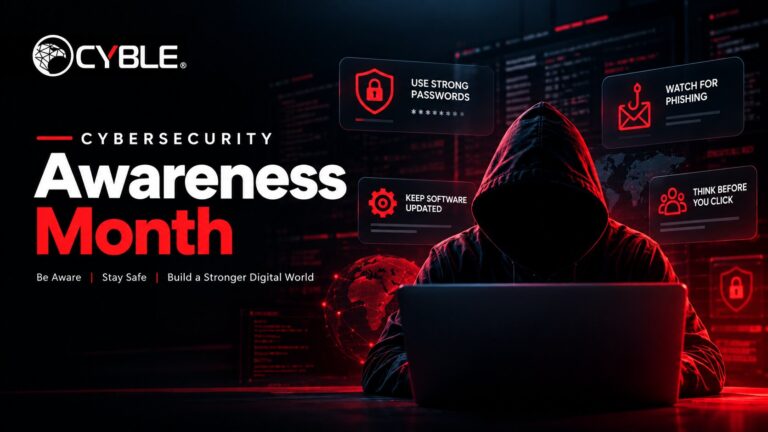
1.Cyber Hygiene Training: Teachers, staff, and students should at least be aware of the basics—create strong passwords, identify phishing emails, and avoid downloading anything suspicious. Schools might provide short workshops for training, or make it a bit more fun and competitive by awarding students who identify fake phishing attempts.
2. System Updates: Most attacks occur when systems have not been updated. Establishing a setting on devices for automatic updates is important, this allows for devices to be protected from known vulnerabilities.
3. Multi-Factor Authentication (MFA): Multi-factor authentication is an additional layer of protection. Even if a password is compromised, an attacker would not be able to log into the account, as a second form of verification would be required.
4. Backup and Data Recovery: Regularly backing up data and HDDs will help institutions and organizations recover from ransomware attacks or catastrophic events quicker.
Adding these simple actions into practice will help support a culture of cybersecurity, similar to locking a door at the end of the day as a part of daily practice.
Leading the Way in Cybersecurity
Higher education institutions are forming dedicated cybersecurity task forces. Some universities have gone so far as to provide cybersecurity awareness courses for all students, and not only to students seeking IT majors.
For example, one university hosted a “Digital Safety Week,” in which students learned lessons surrounding password safety, social media privacy, and secure browsing. Another popular activity has been mock phishing simulations, which have led students to experience first-hand the ease at which a person can be fooled into giving their information.
This hands-on learning is a fantastic example of the message for Cybersecurity Awareness Month 2025, which stresses the importance of all of us building a cyber safe culture through our daily actions.
While schools are reinforcing their security posture, they are also leveraging trusted cyber security partners to drive enhanced protection. Organizations such as Cyble are helping educational institutions monitor threat intelligence with real-time APIs and protecting student data from exposure on the dark web.
Cyble’s services leverage threat intelligence to give increased visibility into early signs of compromise, such as leaked passwords or phishing campaigns directed at schools. By leveraging cybersecurity intelligence that uses an AI model, schools are then able to take action to mitigate the impact of an attack before school operations are disrupted. What makes this framework effective is that it allows educational institutions to move to more proactive measures from reactive measures—this meets the mission of Cybersecurity Awareness Month 2025 to prevention efforts as part of public sector cybersecurity.
Students as the First Line of Defense
Students often underestimate their role in cybersecurity. But they’re the first line of defense. Something as small as sharing passwords with friends or downloading free “study apps” can expose the entire network to risks.
Encouraging small, consistent actions makes a big difference:
- Always verify links before clicking.
- Log out of shared computers.
- Avoid using public Wi-Fi for submitting assignments or accessing portals.
When students understand that their actions impact the entire institution, they start taking digital safety seriously. Schools that nurture this sense of responsibility are seeing fewer security incidents and more informed, digitally mature students.
Conclusion
Cybersecurity Awareness Month 2025 serves as a powerful reminder that digital safety is everyone’s responsibility. Whether it’s a small rural school or a large university, every institution can take steps to build a safer, smarter online community.
As CISA’s campaign emphasizes, securing our homeland starts with securing our daily lives. And that includes the classrooms, labs, and campuses shaping our future.
By working together—students, educators, and partners like Cyble—we can turn awareness into action and truly build a cyber safe culture for the generations to come.