Cyberattacks are no longer a question of “if” — but “when.” With endpoints becoming the most targeted entry point for attackers, organizations are turning to advanced technologies to keep pace. One of the most powerful tools in this new era of defense? Artificial Intelligence in Cybersecurity.
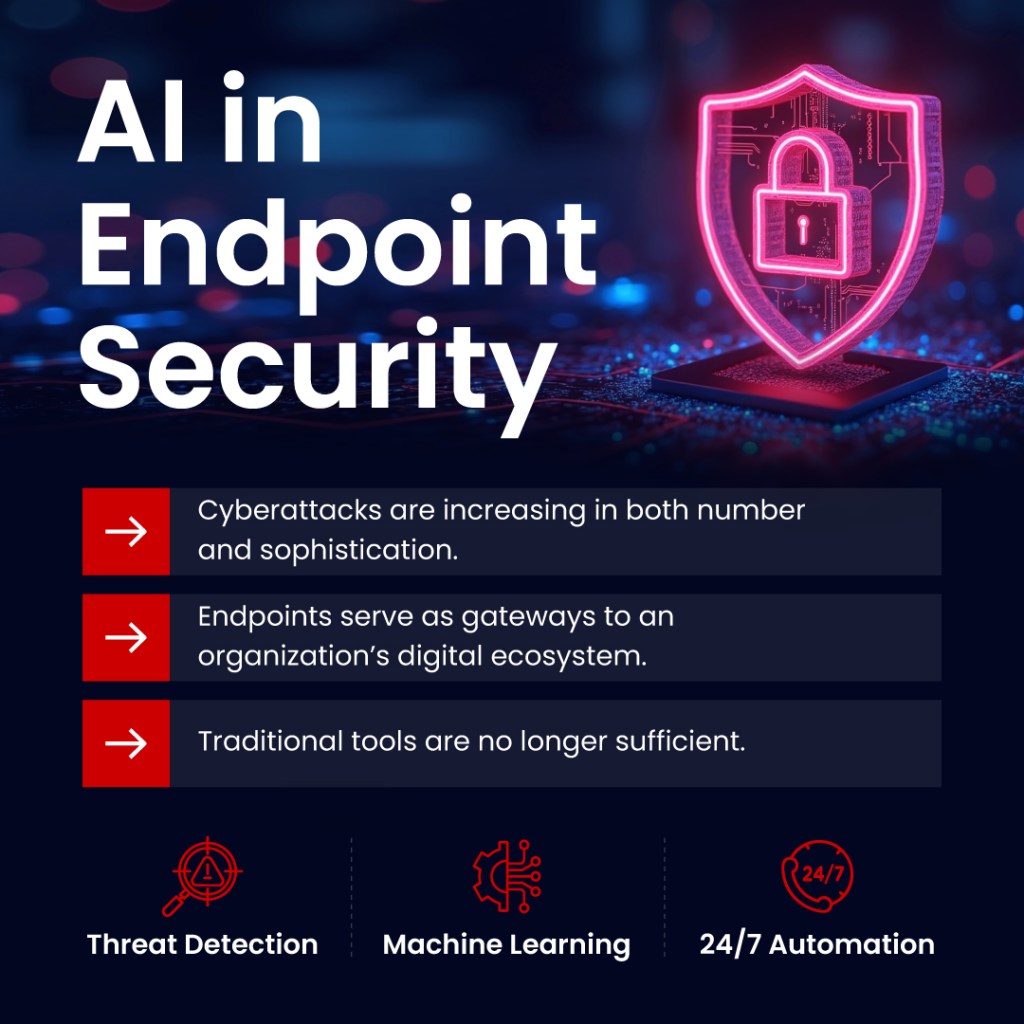
In 2025, AI in Endpoint Security is shifting from an emerging concept to a critical line of defense. By combining machine learning, automation, and predictive analytics, AI is helping security teams detect threats faster, respond more effectively, and protect a growing number of devices—many of which are outside traditional network boundaries.
In this article, we will explore how AI is used in cybersecurity, especially for endpoint protection, and why more businesses are investing in AI Powered Endpoint Security to stay ahead of modern threats. We will also look at current trends, market forecasts, and how the future of endpoint security with AI is shaping up in 2025 and beyond.
Why Endpoint Security Needs an AI Upgrade
Employees work from home, use mobile devices, and connect from virtually anywhere. Every laptop, smartphone, or IoT device is now a potential target. With each connected device, the attack surface expands.
That’s where AI Powered Endpoint Security steps in.
In fact, industry data shows that revenue in the Endpoint Security market is expected to reach $16.5 billion in 2025. That number is projected to grow at a CAGR of 12.36%, reaching $26.3 billion by 2029. The average spend per employee will touch $4.59, and the U.S. will lead the charge with $6.4 billion in revenue.

These numbers aren’t just impressive, they show how seriously organizations are taking endpoint security, especially when powered by AI.
What is AI in Endpoint Security?
Let’s keep it simple: AI in Endpoint Security refers to the use of machine learning and intelligent algorithms to monitor, detect, and respond to threats targeting endpoint devices—laptops, mobile phones, desktops, servers, and even wearables.
Unlike traditional tools that rely on signature-based detection (which only works against known threats), AI Cybersecurity 2025 focuses on behavior. If a device starts acting suspiciously—even in subtle ways—AI can flag it before any damage is done.
With Machine Learning in Endpoint Security, the system adapts over time. It learns from every interaction, every anomaly, and every breach attempt. That makes it smarter, faster, and far more effective than older security approaches.
Hackers Hunt 24/7. Cyble Titan Guards 24/7. Are You In?
How AI is Used in Cybersecurity (And Why It Matters)
Let’s take a closer look at how AI is used in cybersecurity, especially for endpoint defense:
1. Behavioral Analysis: AI watches and learns how users and systems typically behave. If a device suddenly starts encrypting hundreds of files, logging in at strange hours, or communicating with unfamiliar IP addresses, it knows something’s off.
2. Automated Response: Speed is everything in cybersecurity. With AI Powered Endpoint Security, you don’t have to wait for a human analyst to notice a problem. The system can isolate infected devices, shut down suspicious processes, or block malicious activity instantly.
3. Threat Hunting and Intelligence: AI helps analysts by sifting through massive volumes of data to find hidden threats. This includes uncovering zero-day vulnerabilities, backdoors, and dormant malware before they’re activated.
4. Continuous Learning: Through machine learning in endpoint security, AI doesn’t just react—it learns. It can recognize evolving threats and adapt its models in real time, keeping defenses sharp without constant manual updates.
Endpoint Protection with AI: Not Just Smarter—More Scalable
Traditional endpoint protection solutions often require manual rule-setting and frequent updates. That’s time-consuming and ineffective in today’s fast-paced threat environment.
Endpoint Protection with AI, on the other hand, scales effortlessly. Whether you’re protecting 50 devices or 5,000, the system can analyze, learn, and act—without adding pressure to your security team.
As remote work, cloud services, and BYOD (Bring Your Own Device) policies become standard, AI helps organizations keep everything under control without locking everything down.
The Future of Endpoint Security with AI
If you’re wondering about the future of endpoint security with AI, you are not alone. This is one of the hottest topics in cybersecurity right now, and for good reason.
With the help of AI:
- Security becomes predictive, not just reactive.
- Businesses can anticipate attacks and take preemptive action.
- Security tools become more autonomous, reducing human error.
- Detection rates improve while false positives decrease.
By 2030, the AI cybersecurity market is projected to grow to around $134 billion—up from just $30 billion in 2024. That level of investment shows the industry’s confidence in the potential of AI Cybersecurity 2025 and beyond.
2025 Endpoint Security Trends You Need to Know
Let’s talk trends. These 2025 Endpoint Security Trends are shaping the future of enterprise protection:
- AI Threat Detection Tools will become the first line of defense, reducing response times from hours to milliseconds.
- Zero Trust Architecture powered by AI will ensure that no device or user is trusted by default.
- Context-aware access control will become common, adjusting permissions based on real-time risk assessments.
- AI will increasingly handle incident triage, giving human analysts more time to focus on strategic threats.
One thing is certain: AI is not just a buzzword, it’s a core component of modern cybersecurity.
Cyble Titan: Lightweight Agent, Heavyweight Defense for Modern Endpoints
Cyble Titan is designed for modern security operations teams seeking clarity and control in a landscape of constant cyber threats. As a lightweight endpoint agent, it works quietly in the background without straining system resources, yet it’s highly effective at identifying and neutralizing both internal and external threats.
Built on Cyble’s AI-native Security Cloud, Titan integrates seamlessly with existing tools and infrastructures, offering real-time threat visibility, intelligent triage, and automation to streamline response efforts.
With support for hybrid environments and open integration capabilities, Cyble Titan offers a flexible, adaptable approach to endpoint security without adding complexity to your workflow.
Think Your Endpoint’s Safe? Think Again. Let Cyble Titan Prove You Wrong!
Why AI Cybersecurity 2025 Isn’t Optional Anymore
We live in a world where a single compromised endpoint can bring down an entire network. And in 2025, the stakes are higher than ever.
AI isn’t just improving endpoint security, it’s transforming it. Organizations that continue to rely on legacy solutions are putting themselves at risk. With AI in Endpoint Security, they gain an edge, not just in protection, but in efficiency, speed, and adaptability.
Conclusion
The Future of Endpoint Security with AI is no longer some dystopian vision. It’s happening right now.
From real-time detection and automated response to intelligent threat hunting and scalable protection, AI Cybersecurity 2025 is redefining what it means to be secure in a digital world. As cyber threats grow more complex, the only way forward is smarter, faster, and more proactive defense—made possible by AI Powered Endpoint Security.
Investing in Artificial Intelligence in Cybersecurity isn’t just a trend; it’s a necessity for any organization that is serious on protecting its digital infrastructure.