Security teams are tired.
Not just “end-of-quarter” tired. Structurally exhausted. Alert fatigue isn’t just burning people out — it’s quietly increasing risk. When everything looks urgent, nothing is. And that’s exactly what attackers rely on. Predictive threat intelligence moves teams from reaction to anticipation.
By the time many organizations detect a breach, attackers have often been inside for months. That’s months of reconnaissance, credential harvesting, lateral movement, and data staging before anyone realizes something’s wrong.
This gap between compromise and detection exposes the core weakness of reactive security. For decades, we’ve layered defenses — stronger firewalls, smarter EDR, bigger SIEM deployments. Yet breaches persist.
Not because security teams aren’t skilled.
Not because the tools are useless.
But because most traditional systems are built to respond to attacks that already happened — not the ones forming quietly in the background.

That’s where predictive cyber defense begins to change the equation.
Prediction Isn’t Just Faster Detection — It’s a Different Mindset
Traditional threat intelligence is retrospective. It documents indicators of compromise, analyzes malware samples, and tracks attack techniques after they’re discovered.
That approach made sense when threat actors moved slowly and reused the same playbooks.
In 2026, neither of those assumptions holds.
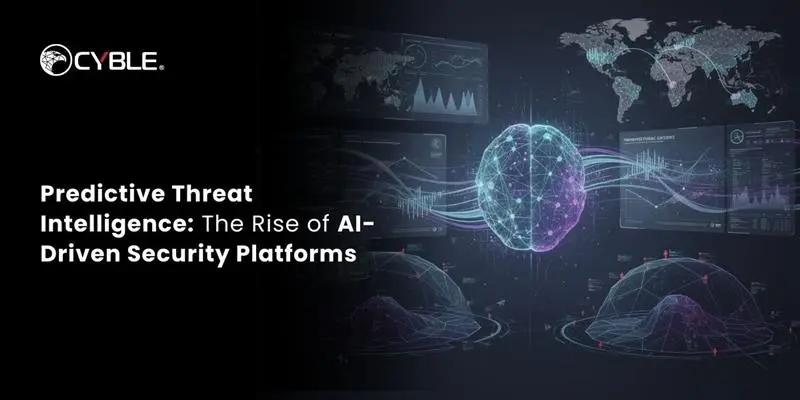
AI-powered threat intelligence flips the timeline. Instead of asking, “What just hit us?” it asks, “What patterns suggest we’re about to be targeted?”
This is where AI in threat intelligence moves from buzzword to operational capability. Modern systems analyze behavioral patterns, historical attack data, adversary infrastructure signals, and contextual telemetry to forecast likely attack paths.
Advanced machine learning threat detection models don’t just flag known signatures. They recognize subtle correlations — unusual authentication sequences, abnormal privilege escalation attempts, reconnaissance-like traffic patterns — that indicate preparation.
It’s not about certainty. It’s about probability.
And probability, when calculated at scale, changes outcomes.
Organizations that have adopted predictive models are seeing meaningful reductions in successful breaches — often because they’re catching adversaries during reconnaissance instead of after ransomware deployment.
That’s the difference between containment and cleanup.
What AI-Driven Security Platforms Actually Do
There’s a misconception that AI in security is just smarter alerting.
It’s much more than that.
Modern AI-driven security platforms ingest massive telemetry streams across endpoints, cloud workloads, identity systems, network traffic, OT, IoT, and third-party integrations. We’re talking millions of events per second.
Humans can’t correlate that volume meaningfully.
But volume alone isn’t intelligence. What separates AI-native cybersecurity platforms from traditional tools is what happens after ingestion.
These systems apply layered analytics:
- Behavioral modeling to establish normal baselines
- Time-series forecasting to anticipate anomaly clusters
- Cross-domain correlation to identify attack chains forming across environments
This is where autonomous threat detection becomes real. Instead of waiting for a signature match, AI models detect behavioral drift — the quiet signals that precede an incident.
When those insights feed directly into security orchestration automation, response becomes proactive.
If indicators suggest an imminent ransomware attempt — unusual file access patterns, staged credential misuse, lateral scanning — automated workflows can isolate endpoints, revoke tokens, segment network access, and escalate alerts instantly.
That’s real-time threat intelligence in action.
Not just dashboards updating faster — but defensive action happening before impact.
The Agentic SOC: Amplification, Not Replacement
There’s plenty of speculation about AI replacing analysts. That narrative misses what’s actually happening inside mature security teams.
The modern SOC is becoming collaborative.
In what many call an Agentic SOC, AI handles large-scale data correlation, preliminary triage, and repetitive response steps through threat intelligence automation, while human analysts focus on strategic thinking, contextual evaluation, and complex investigations.
AI doesn’t fatigue. It doesn’t overlook correlations because it’s juggling 200 alerts. It maintains consistent pattern analysis across millions of events.
Humans bring judgment. They understand business context. They know when an anomaly is legitimate operational change rather than malicious behavior. They make decisions about response severity and escalation.
The partnership is what creates resilience.
AI-native systems draft incident summaries, cluster related events, and surface likely root causes. Analysts validate, refine, and direct response.
It’s not human versus machine.
It’s machine-scale processing with human-scale reasoning layered on top.
Why This Shift Matters Now
Three forces make predictive models and AI-native defense essential rather than optional.
Attackers are already using AI.
Threat actors deploy generative AI for reconnaissance, phishing campaigns, exploit variation, and adaptive malware. Defensive teams cannot rely solely on static detection models against adversaries operating at automated speed.
Regulatory pressure is increasing.
Continuous monitoring and rapid reporting requirements demand operational visibility that manual workflows cannot sustain. Threat intelligence automation becomes a compliance necessity, not just an efficiency upgrade.
The economics have changed.
Cloud-native delivery models have made AI-driven security platforms accessible without massive capital investment. Predictive capabilities are now scalable, not exclusive.
The barriers to adoption have fallen — but the cost of delay has risen.
From Theory to Tangible Impact
Across industries, the shift is already visible.
Healthcare providers using predictive models have identified ransomware campaigns during reconnaissance — preventing encryption events that could disrupt patient care.
Financial institutions rely on machine learning threat detection to flag abnormal transaction behaviors within milliseconds.
Enterprises integrating real-time threat intelligence with automated containment workflows have dramatically reduced dwell time and mean time to respond.
These aren’t experimental deployments. They’re operational realities.
What This Means for Security Leaders
The question in 2026 isn’t whether AI belongs in your SOC.
It’s whether your defensive strategy still assumes attacks are discovered only after impact.
If your team spends most of its time triaging alerts triggered by known signatures…
If detection still depends heavily on human correlation…
If response requires multiple manual handoffs…
Then adversaries operating with automation already have a structural advantage.
Organizations leading in predictive cyber defense share common traits:
- Predictive analytics embedded directly into workflows
- Routine detection and response automated through orchestration
- Continuous learning loops where analyst feedback improves AI accuracy
- A clear understanding that scale requires machine assistance
Most importantly, they’ve accepted a fundamental truth:
The volume and velocity of modern threats exceed human processing capacity.
That doesn’t diminish human expertise. It makes it more valuable — and more strategic.
The Bigger Picture
AI-powered threat intelligence isn’t about replacing security teams.
It’s about giving them leverage.
The ability to see attack patterns forming before exploitation.
The ability to respond at machine speed without sacrificing human oversight.
The ability to focus expertise where judgment, creativity, and strategic thinking matter most.
The arms race has entered a new phase. Both attackers and defenders now have AI.
The difference will come down to who integrates it thoughtfully — and who adapts before the next 280-day breach clock starts ticking.
Building Predictive Defense Capabilities
Cyble’s AI-powered threat intelligence platform delivers predictive insights by monitoring surface web, deep web, and dark web channels where threats emerge. From attack surface management to automated threat correlation and real-time risk assessment, organizations gain the visibility and speed needed to move from reactive response to proactive defense.
Request a demo to explore how predictive threat intelligence can transform your security operations.