Overview
The Gentlemen is a ransomware-as-a-service (RaaS) operation that emerged in mid-2025 and was last seen active on 24 November 2026. It runs double extortion: affiliates steal data, encrypt systems, and threaten to publish the data on a Tor leak site unless a ransom is paid.
For 2026, thus far, The Gentleman group is the second most active ransomware gang with more than a thousand claimed victims, second only to Qilin, which has 1100+.
The group stands out for how hard it works on defense evasion. Its intrusions have moved from generic anti-antivirus utilities to custom tools built to kill specific EDR products, often loaded through vulnerable signed drivers. It then uses Group Policy to push the ransomware across the whole domain at once.
The group is tracked as GOLD SHERWOOD and Storm-2697. Its RaaS program was advertised on the RAMP forum in September 2025 by an account named Zeta88, which some trackers also list as an alias. Its recent activity includes allegedly listing NVIDIA on its leak site, with a countdown to a data release on November 28. NVIDIA says it has found no sign that its own systems were affected.
Operating Model
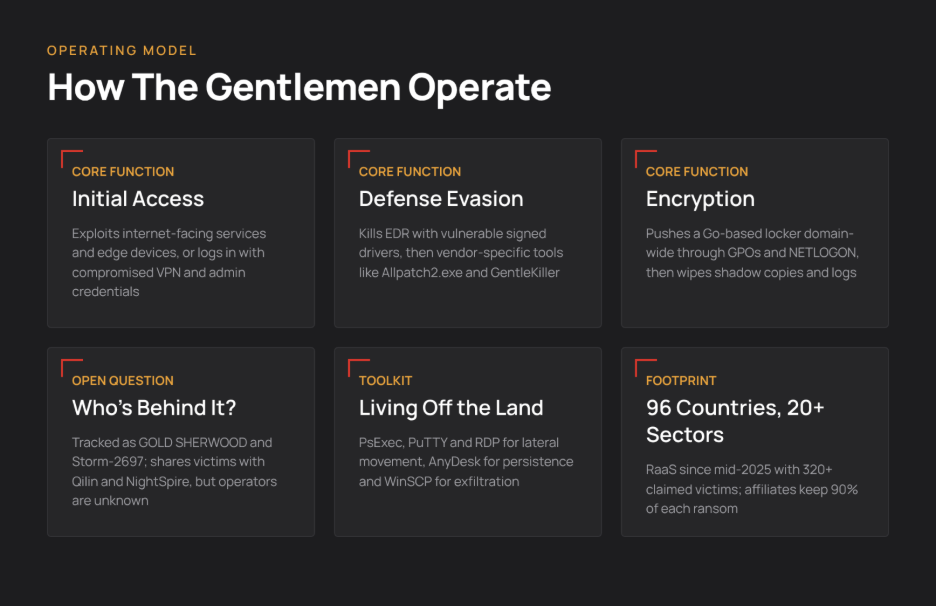
The Gentlemen follows a methodical double-extortion playbook built on valid credentials, legitimate admin tools and tailored EDR killers. Its activity falls into five core functions:
- Initial access: exploiting internet-facing services and edge devices, or logging in with compromised VPN or admin credentials and stolen session tokens.
- Defense evasion: loading vulnerable signed drivers to kill security processes, then deploying custom killers aimed at the specific EDR product found on the network.
- Domain control: taking over privileged accounts, including FortiGate admin accounts, and abusing Group Policy Objects (GPOs) for domain-wide reach.
- Data theft: staging files locally and exfiltrating them over WebDAV and encrypted WinSCP transfers.
- Encryption and extortion: disabling recovery, encrypting files across the domain, and threatening to leak stolen data.
The attack chain observed in incident response runs as follows:
- The operators exploit an internet-facing service or log in with compromised administrative credentials.
- They map the network with Advanced IP Scanner and Nmap, and use batch scripts and PowerShell to enumerate domain admins, domain controllers and privileged groups, including those tied to virtualization platforms.
- They disable security tools, first with vulnerable drivers such as ThrottleBlood.sys and later with vendor-specific killers such as All.exe and Allpatch2.exe, using PowerRun.exe to run them with elevated rights.
- They edit the registry to weaken authentication, re-enable RDP and open the firewall, and install AnyDesk for persistent access outside domain authentication.
- They move laterally with PsExec, PuTTY and RDP, and take over critical infrastructure such as FortiGate admin accounts.
- They stage data in C:\ProgramData\data and exfiltrate it over WebDAV and encrypted WinSCP sessions.
- They switch off Windows Defender, disable backups, and stop database, backup and security services.
- They push the ransomware through the NETLOGON share using GPOs, so it runs domain-wide. The encryptor deletes shadow copies, clears logs and deletes itself when finished.
In one documented case, encrypted files received the extension .7mtzhh, and the attackers left a ransom note named README-GENTLEMEN.txt with a victim ID and negotiation instructions.
Targeting and Reach
The Gentlemen hits almost every region and sector, which is typical of an affiliate-driven RaaS. Its victims span 96 countries and more than 20 industry categories. The only stated exclusion is Russia and the CIS, which the affiliate rules forbid targeting.
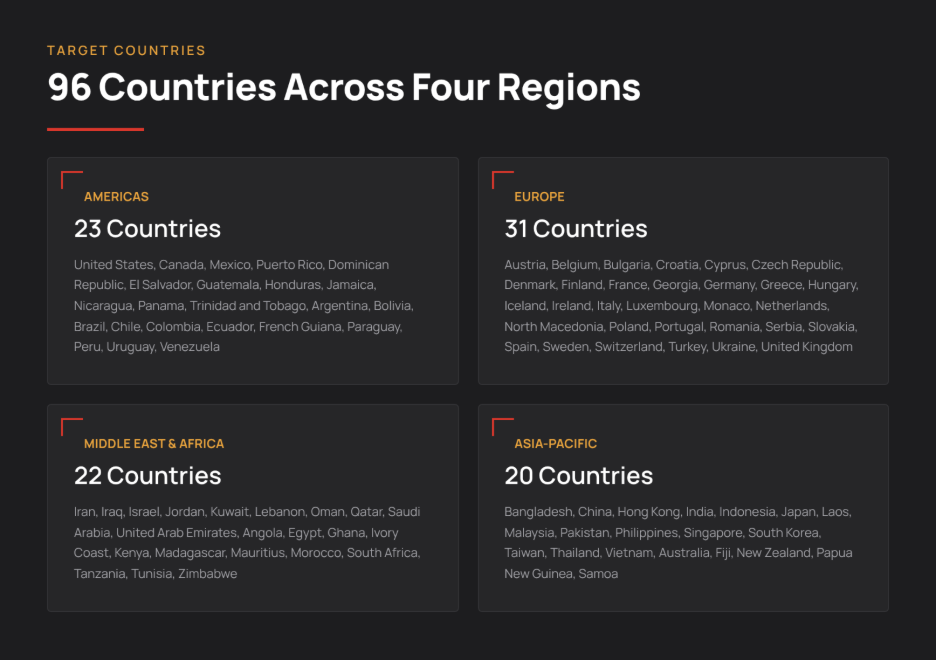
Countries by region:
- North America: United States, Canada, Mexico, Puerto Rico
- Central America and the Caribbean: Dominican Republic, El Salvador, Guatemala, Honduras, Jamaica, Nicaragua, Panama, Trinidad and Tobago
- South America: Argentina, Bolivia, Brazil, Chile, Colombia, Ecuador, French Guiana, Paraguay, Peru, Uruguay, Venezuela
- Europe: Austria, Belgium, Bulgaria, Croatia, Cyprus, Czech Republic, Denmark, Finland, France, Georgia, Germany, Greece, Hungary, Iceland, Ireland, Italy, Luxembourg, Monaco, Netherlands, North Macedonia, Poland, Portugal, Romania, Serbia, Slovakia, Spain, Sweden, Switzerland, Turkey, Ukraine, United Kingdom
- Middle East: Iran, Iraq, Israel, Jordan, Kuwait, Lebanon, Oman, Qatar, Saudi Arabia, UAE
- Africa: Angola, Egypt, Ghana, Ivory Coast, Kenya, Madagascar, Mauritius, Morocco, South Africa, Tanzania, Tunisia, Zimbabwe
- Asia: Bangladesh, China, Hong Kong, India, Indonesia, Japan, Laos, Malaysia, Pakistan, Philippines, Singapore, South Korea, Taiwan, Thailand, Vietnam
- Oceania: Australia, Fiji, New Zealand, Papua New Guinea, Samoa
Industries: Aerospace and defense; Agriculture and livestock; Automotive; BFSI; Chemicals; Construction; Consumer goods; Education; Energy and utilities; Food and beverages; Government and law enforcement; Healthcare; Hospitality; IT and ITES; Manufacturing; Media and entertainment; Metals, minerals and mining; Pharmaceuticals and biotechnology; Professional services; Real estate; Retail; Technology; Telecommunications; Transportation and logistics.
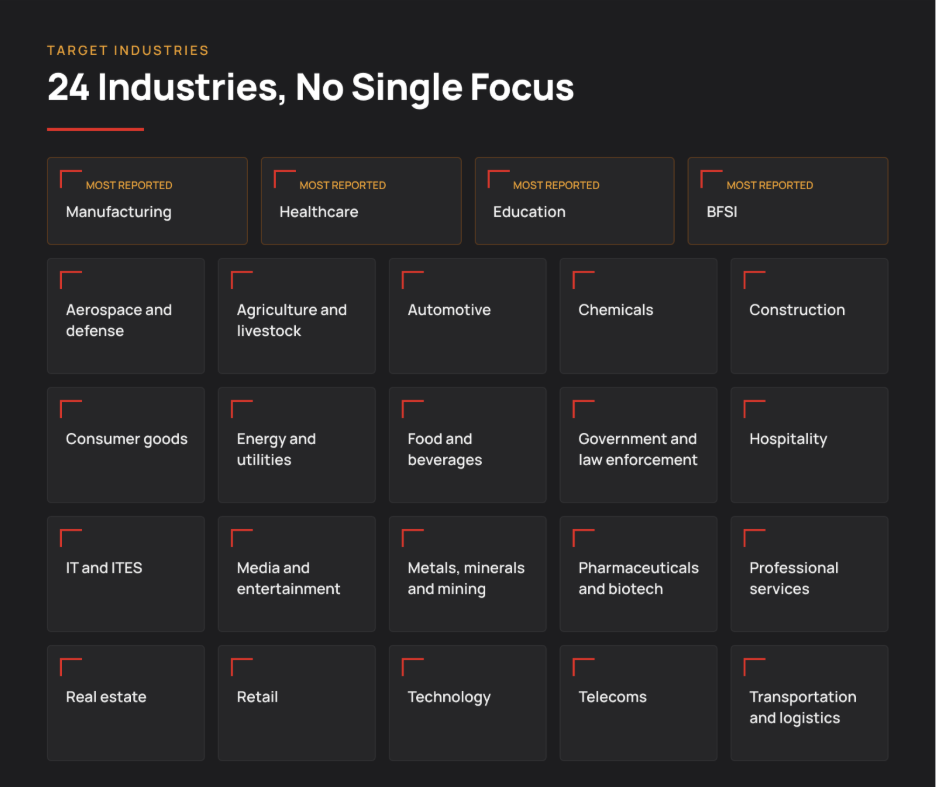
Manufacturing, healthcare, education, and finance carry the most weight in public reporting. The NVIDIA listing shows the group, or its affiliates, now also reaching for high-profile technology brands, possibly through their suppliers.
Recent Activity: NVIDIA
On November 18, 2026, The Gentlemen allegedly added NVIDIA to its leak site, according to International Cyber Digest. The claim is unverified: no data has been published, and no samples have been shared.
NVIDIA is investigating a possible incident at a third-party partner. A spokesperson said to the media that the company has found no indication that its own systems or networks were affected and continues to monitor the situation.
What the listing claims:
- It names NVIDIA but does not say whether the data came from NVIDIA itself or from a supplier.
- It shows only the message “DATA INFO – SOON”, with no file list, data size or samples.
- It runs a countdown to November 28, 2026, the likely date for a leak if no deal is reached.
- It offers no technical evidence of an intrusion.
NVIDIA has been an extortion target before. In 2022, the LAPSUS$ group stole about a terabyte of its data.
Malware and Tooling
The Gentlemen pairs its own cross-platform encryptor and EDR killers with legitimate admin, scanning and remote-access software. Threat-intelligence tracking links nine tool families to the group; the incident reports add several more.
| Tool | Type | Role in The Gentlemen attacks |
| The Gentlemen ransomware | Ransomware (Windows, Linux, ESXi, BSD, NAS) | Encrypts files domain-wide and impairs recovery |
| GentleKiller, All.exe, Allpatch2.exe | EDR killers | Terminate endpoint security processes, some built for specific vendors |
| ThrottleBlood.sys | Vulnerable signed driver (BYOVD) | Kernel-level termination of security processes |
| PowerRun | Privilege utility | Runs tools with elevated rights to disable defenses |
| TukTuk | C2 framework | Command and control over SaaS platforms |
| SystemBC | Proxy malware | Covert communication, payload delivery and tunnelling |
| Advanced IP Scanner, Nmap | Network scanners | Host and service discovery |
| PsExec, PuTTY | Remote execution and SSH clients | Lateral movement |
| AnyDesk | Remote access software | Persistent access outside domain authentication |
| WinSCP | SFTP/FTP client | Encrypted data exfiltration |
| Wevtutil | Built-in Windows utility | Clearing event logs |
The Gentlemen ransomware
The encryptor is written in Go, according to Microsoft, and has versions for Windows, Linux, ESXi, BSD and NAS devices. It uses hybrid XChaCha20 and Curve25519 encryption and can spread laterally on its own.
Before encrypting, it stops security, database and backup services and deletes shadow copies. After encrypting, it purges logs and deletes itself to leave few artifacts. Affiliates usually deploy it across domain-joined systems through GPOs and the NETLOGON share.
EDR killers and BYOVD
Evasion is the group’s most distinctive trait. Early intrusions abused vulnerable signed drivers such as ThrottleBlood.sys to kill security processes from the kernel. Later, the operators switched to custom builds such as All.exe and Allpatch2.exe, tuned to the EDR vendor present on the network.
The RaaS supplies affiliates with its own EDR killer, GentleKiller, along with similar driver-abusing tools. This lets even less-skilled affiliates neutralize endpoint protection at scale.
TukTuk
TukTuk is a modular C2 framework, reportedly AI-generated, first described by researcher Evangelos G. It is loaded by DLL sideloading into trojanized legitimate programs such as Greenshot, SyncTrayzor and DocFX.
Its main C2 channels run through SaaS platforms, notably ClickHouse and Supabase, with fallbacks over Ably, Dropbox, GitHub Issues and plain HTTP. It can fetch its encrypted configuration from the Arweave blockchain, which makes conventional network takedowns much harder.
Exfiltration and remote access
Data is staged in C:\ProgramData\data, then copied out over WebDAV and encrypted WinSCP sessions. AnyDesk, backed by registry changes, gives the attackers a second way back in if their accounts are reset.
Leak site
The Gentlemen runs a Tor leak site where it lists victims and posts stolen data, sometimes with a countdown to publication. Affiliates negotiate with victims over Tox, and the group also runs accounts on X.
Affiliate Program and Attribution
The Gentlemen’s operators are unknown, but the RaaS program itself is well documented. On September 12, 2025, the account Zeta88, active on the RAMP forum since May 2024, announced it in English, Russian and Chinese.
The advertised terms:
- Affiliates keep 90% of each ransom payment.
- Affiliates run victim negotiations themselves.
- The core team supplies only a leak site and Tox channels.
- Lockers are offered for Windows, Linux, NAS, BSD and ESXi, with self-deletion and tailored evasion.
- Attacks on Russia and CIS countries are forbidden.
A 90% share is generous by RaaS standards and helps explain the fast victim count. It also means many intrusions are run by affiliates with differing skill levels and habits.
Links to other groups: At least two victims first listed by NightSpire and Qilin in summer 2025 later reappeared on The Gentlemen’s leak site. This points to shared affiliates or operators moving between programs, but it is not proof of a common owner. Re-listing victims is also common among groups that buy or recycle stolen data.
Naming: The group is tracked as GOLD SHERWOOD and Storm-2697. Zeta88 is best treated as a forum persona tied to the program rather than a separate group name.
No nation-state link has been reported. The CIS exclusion and the Russian-language advertisement fit the wider Russian-speaking RaaS ecosystem but do not identify who runs the group.
MITRE ATT&CK Mapping
The mapping below covers the techniques observed in The Gentlemen intrusions, grouped by tactic in attack order.
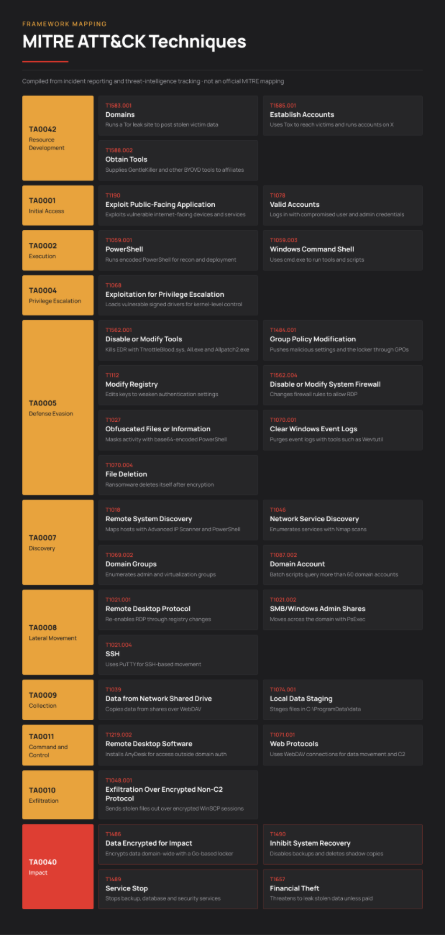
- Resource Development (TA0042) – Acquire Infrastructure: Domains (T1583.001): The group maintains a Tor leak site for posting stolen data.
- Resource Development (TA0042) – Establish Accounts (T1585) and Social Media Accounts (T1585.001): Affiliates use Tox to talk to victims, and the group runs accounts on X.
- Resource Development (TA0042) – Obtain Capabilities: Tool (T1588.002): The group supplies GentleKiller and other BYOVD tools to affiliates, and uses Advanced IP Scanner, PowerRun and Rocket.Chat.
- Initial Access (TA0001) – Exploit Public-Facing Application (T1190): They exploited vulnerable internet-facing devices and services.
- Initial Access and Persistence (TA0001, TA0003) – Valid Accounts (T1078): They logged in with compromised user and administrative credentials.
- Execution (TA0002) – PowerShell (T1059.001) and Windows Command Shell (T1059.003): They ran encoded PowerShell and cmd.exe for reconnaissance, anti-AV work and ransomware deployment.
- Privilege Escalation (TA0004) – Exploitation for Privilege Escalation (T1068): They loaded vulnerable signed drivers (BYOVD) to gain kernel-level control.
- Defense Evasion (TA0005) – Obfuscated Files or Information (T1027): They used base64-encoded PowerShell to mask activity.
- Defense Evasion (TA0005) – Modify Registry (T1112): They edited registry keys to weaken authentication and enable insecure protocols.
- Defense Evasion and Privilege Escalation (TA0005, TA0004) – Group Policy Modification (T1484.001): They changed GPOs to push malicious settings and the ransomware domain-wide.
- Defense Evasion (TA0005) – Impair Defenses: Disable or Modify Tools (T1562.001): They used ThrottleBlood.sys, All.exe and Allpatch2.exe to kill endpoint security and disabled Windows Defender.
- Defense Evasion (TA0005) – Impair Defenses: Disable or Modify System Firewall (T1562.004): They changed firewall settings to allow RDP.
- Defense Evasion (TA0005) – Indicator Removal: Clear Windows Event Logs (T1070.001) and File Deletion (T1070.004): They purged logs with tools such as Wevtutil, and the ransomware deletes itself after running.
- Discovery (TA0007) – Remote System Discovery (T1018): They scanned for hosts with Advanced IP Scanner and used PowerShell to locate the primary domain controller.
- Discovery (TA0007) – Network Service Discovery (T1046): They ran Nmap scans to enumerate services.
- Discovery (TA0007) – Permission Groups Discovery: Domain Groups (T1069.002) and Account Discovery: Domain Account (T1087.002): Batch scripts queried more than 60 domain accounts and enumerated admin and virtualization groups.
- Lateral Movement (TA0008) – Remote Services: RDP (T1021.001), SMB/Windows Admin Shares (T1021.002) and SSH (T1021.004): They moved over RDP, PsExec and PuTTY.
- Collection (TA0009) – Data from Network Shared Drive (T1039) and Local Data Staging (T1074.001): They copied data from shares over WebDAV and staged it in C:\ProgramData\data.
- Command and Control (TA0011) – Web Protocols (T1071.001): They used WebDAV connections for data movement and possible C2.
- Command and Control (TA0011) – Remote Access Tools: Remote Desktop Software (T1219.002): They installed AnyDesk to keep access outside domain authentication.
- Exfiltration (TA0010) – Exfiltration Over Symmetric Encrypted Non-C2 Protocol (T1048.001): They exfiltrated files over encrypted WinSCP sessions.
- Impact (TA0040) – Service Stop (T1489): They stopped backup, database and security services before encryption.
- Impact (TA0040) – Inhibit System Recovery (T1490): They disabled backups and deleted shadow copies.
- Impact (TA0040) – Data Encrypted for Impact (T1486): They encrypted victim data with The Gentlemen ransomware.
- Impact (TA0040) – Financial Theft (T1657): They used double extortion, threatening to publish stolen data unless paid.
Conclusion
The Gentlemen grew in about a year from a new brand into one of the most active RaaS programs, with more than 320 claimed victims and a listing of NVIDIA. Its generous affiliate split, cross-platform lockers, and ready-made EDR killers make it easy for affiliates to hit large networks fast.
The biggest open questions are who runs the core program and how it relates to NightSpire and Qilin. Its documented tradecraft still points to clear defensive priorities:
- Patch internet-facing services and edge devices, including FortiGate appliances, and lock down their admin accounts.
- Require phishing-resistant MFA on VPN, remote access, and every privileged account, and watch for stolen session tokens.
- Turn on Microsoft’s vulnerable driver blocklist and tamper protection, and alert when security agents stop or drivers such as ThrottleBlood.sys load.
- Alert on GPO changes, new files in NETLOGON, and registry edits that enable RDP or weaken authentication.
- Restrict and monitor PsExec, PowerRun, AnyDesk, WinSCP, and other remote-access or transfer tools.
- Watch for large outbound transfers, WebDAV connections, and staging folders such as C:\ProgramData\data.
- Keep offline, immutable backups, including ESXi and NAS data, and test restores.
- Forward logs off-host so clearing them with Wevtutil does not erase the evidence.
Cyble’s threat intelligence monitors underground forums, leak sites, and dark web chatter, alerting you when your organization or suppliers appear in listings like The Gentlemen’s.
Book a free demo to get ahead of The Gentlemen and the next RaaS program aimed at your sector.
Frequently Asked Questions about The Gentlemen
What is The Gentlemen?
A ransomware-as-a-service operation that steals data, encrypts systems across Windows, Linux, ESXi, BSD, and NAS, and threatens to leak the data unless paid.
When did it first appear?
In mid-2025. Its affiliate program was advertised on the RAMP forum on September 12, 2025.
Who does it target?
Almost every sector and region, with victims in 96 countries. Healthcare, manufacturing, education, and finance feature heavily. Russia and the CIS are off-limits under its affiliate rules.
How does it get in?
By exploiting internet-facing services and edge devices, or with compromised VPN or admin credentials and stolen session tokens.
What extortion model does it use?
Double extortion. It exfiltrates data, encrypts systems and lists victims on a Tor leak site, sometimes with a countdown to publication.
What tools are linked to it?
A Go-based cross-platform encryptor, the GentleKiller EDR killer and other BYOVD tools, the TukTuk C2 framework, SystemBC, and legitimate tools such as PsExec, PuTTY, AnyDesk, WinSCP, and Nmap.
Who is behind it?
Unknown. It is tracked as GOLD SHERWOOD and Storm-2697, and shares victims with NightSpire and Qilin, but no operator has been publicly identified.
Did The Gentlemen breach NVIDIA?
Unconfirmed. The group listed NVIDIA on November 18, 2026, with no data samples. NVIDIA says it has found no sign its own systems were affected and is investigating a third-party incident.
Sources
Disclaimer: This profile is compiled from open-source reporting and threat-intelligence tracking as of the date above. Details about The Gentlemen, including its methods, infrastructure, victims and attribution, may change as new information emerges. Victim claims made by the group are unverified unless stated otherwise. This content is for informational purposes only and is not definitive attribution or a substitute for professional security advice.