The Desert Dexter cybercriminal group has quickly gained notoriety as a persistent threat actor targeting specific geopolitical regions, primarily in the Middle East and North Africa (MEA). Known for its reliance on social engineering tactics, Desert Dexter has effectively used misleading social media ads and fake news to distribute malware, deceiving unsuspecting users into downloading malicious software.
The group’s primary weapon of choice is a modified version of AsyncRAT, a Remote Access Trojan (RAT) that enables them to steal sensitive data, including cryptocurrency wallets and critical system information. Although the group’s techniques aren’t particularly advanced, their geopolitically focused campaigns have led to widespread success across various industries and have infected numerous systems in the MEA region.
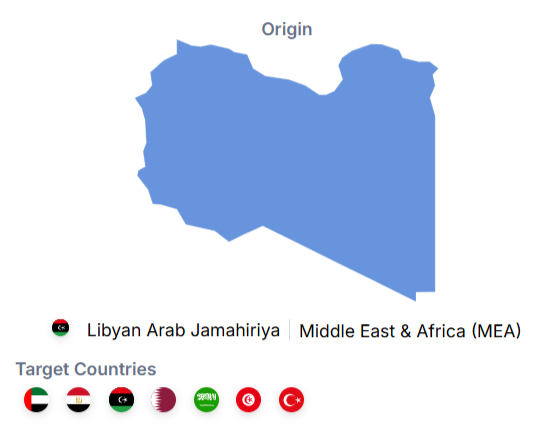
Cyble Vision Threat Library (Source: Cyble Vision)
Desert Dexter primarily focuses its attacks on systems in the Middle East and North Africa, targeting both government and private sector organizations. The group’s cyberattacks have significantly impacted a variety of industries, including agriculture and livestock, construction, energy and utilities, and technology. These sectors have been particularly vulnerable to the group’s sophisticated tactics, resulting in widespread disruptions and data compromises.
Malware Overview: AsyncRAT
The malware used by Desert Dexter is a customized version of AsyncRAT, a tool originally designed as an open-source Remote Access Trojan. AsyncRAT is notorious for its ability to provide remote control over infected machines, enabling cybercriminals to perform a variety of malicious activities such as keylogging, remote desktop control, and stealing cryptocurrency wallets.
Once the malware is installed, it allows attackers to covertly access and manipulate the victim’s system, making AsyncRAT particularly effective for data exfiltration. AsyncRAT was initially developed to assist with remote technical support but has since been repurposed for malicious purposes due to its flexibility.
Desert Dexter has customized the tool to focus on stealing cryptocurrency wallets and system data, two areas that offer financial gain for cybercriminals.
Infection Chain and Initial Access
Desert Dexter’s attacks begin with deceptive social engineering tactics aimed at tricking users into downloading malicious files. The campaign typically starts with ads or links embedded in emails, often leading victims to websites that host malicious files. These files are frequently distributed as RAR archives through untrusted sources such as file-sharing services (e.g., files.fm) or specially crafted Telegram channels. Once users download and execute the files, they unknowingly run scripts in languages such as JavaScript, PowerShell, or batch files, which ultimately deliver the AsyncRAT payload.
The primary method of gaining initial access (TA0001) is spear-phishing, where attackers send targeted emails or ads containing links to malicious websites. Since users often trust seemingly legitimate sources, these phishing campaigns prove to be highly effective in spreading malware.
Leveraging Common Scripting Languages
Desert Dexter relies on several common scripting languages to execute their attacks and bypass security measures. These techniques are effective because the tools they use are already available on most Windows systems, making them harder to detect. Notable exploitation methods include:
- PowerShell Abuse (T1059.001): PowerShell is a command-line interface in Windows that is often exploited to run malicious scripts and commands. In this campaign, it is used to download and execute the AsyncRAT payload.
- Windows Command Shell (T1059.003): The attackers also use the Windows command shell (CMD) to execute batch files and automate tasks, including deploying malware.
- Visual Basic (T1059.005): Desert Dexter embeds malicious Visual Basic scripts within documents (e.g., Microsoft Word or Excel) to execute payloads when users open the seemingly harmless files.
- JavaScript (T1059.007): JavaScript is another tool the group uses to deploy malware via web-based exploits. By hosting malicious scripts on compromised websites, Desert Dexter infects users who visit these sites.
Persistence and Maintaining Control
Once they gain access to a system, Desert Dexter works to maintain long-term control over the compromised machine. One of the ways they do this is by ensuring the malware runs every time the system restarts. The group achieves this by modifying the Windows registry to automatically execute malicious programs at startup. The specific registry keys they target include:
- HKEY_CURRENT_USER\Software\Microsoft\Windows\CurrentVersion\Run
- HKEY_LOCAL_MACHINE\Software\Microsoft\Windows\CurrentVersion\Run
This technique ensures that even if a victim attempts to remove the malware, it will re-execute upon the next reboot.
Privilege Escalation and Lateral Movement
In addition to gaining initial access, Desert Dexter aims to escalate their privileges to achieve full administrative control over infected systems. By exploiting the same registry techniques used for persistence, they elevate their privileges and can perform actions such as stealing credentials and exfiltrating sensitive data. Once they gain administrative control, they can move laterally across the network, compromising other systems and expanding their reach within the victim’s infrastructure.
Data Exfiltration and Impact
The main objective of Desert Dexter is to exfiltrate valuable data from infected systems. Cryptocurrency wallets and sensitive system information are of particular interest to the group, as these assets can be exploited for financial gain. Using AsyncRAT, the attackers can covertly access and steal files, sending the stolen data back to their servers through encrypted channels to avoid detection.
The data exfiltration process is designed to be stealthy, ensuring that the attackers’ activities remain undetected for as long as possible. Once the data is extracted, it is often transmitted to remote servers under the control of Desert Dexter, further complicating efforts to trace the origins of the attack.
Defense Evasion Tactics
Desert Dexter employs several techniques to avoid detection and maintain a foothold within the victim’s network:
- Masquerading: The group uses legitimate-sounding file names and registry keys to hide the malware in plain sight, making it harder for security software to identify the malicious activity.
- Obfuscation: The malware’s code is often obfuscated, meaning it is intentionally altered or encoded to make it difficult for antivirus programs to detect.
- Social Engineering: Desert Dexter continues to rely on social engineering tactics, such as fake news and misleading ads, to lure victims into downloading the malicious files.
Conclusion
The Desert Dexter group poses a growing threat across the Middle East and North Africa, using social engineering and AsyncRAT malware to infiltrate systems and exfiltrate sensitive data. Their tactics emphasize the need for better cybersecurity measures, including endpoint protection, network monitoring, and user education.
Organizations in targeted industries should prioritize proactive defense strategies. Cyble, a leader in AI-driven cybersecurity, offers advanced threat intelligence solutions to help businesses stay protected from cyber threats, ensuring stronger defenses and better protection against groups like Desert Dexter.
Mitigation and Defense Strategies
- Phishing Detection & Email Filtering: Implement advanced email security gateways that use machine learning and AI-based filters to detect spear-phishing emails, malicious attachments, and URLs.
- Endpoint Detection & Response (EDR): Deploy EDR solutions that monitor process execution, registry modifications, and abnormal system behavior. Focus on detecting payload delivery mechanisms such as PowerShell scripts, batch files, and encoded Visual Basic macros.
- PowerShell and Script Restrictions: Use Windows AppLocker or Device Guard to restrict the execution of PowerShell scripts, batch files, and Visual Basic scripts, except for trusted applications.
- Privilege Management & Least Privilege Access: Use tools like Privileged Access Management (PAM) and enforce the Principle of Least Privilege (PoLP) to minimize administrative access and reduce the lateral movement potential of attackers.
- Network Segmentation & Micro-Segmentation: Segment internal networks into isolated zones based on role and privilege levels. Use VLANs and firewalls to limit lateral movement and restrict communication between high-risk systems and critical infrastructure.
- Real-Time File Integrity Monitoring: Implement file integrity monitoring (FIM) tools that continuously track changes to critical system files, directories, and registry keys.
MITRE Attack Techniques Associated with Desert Dexter Group
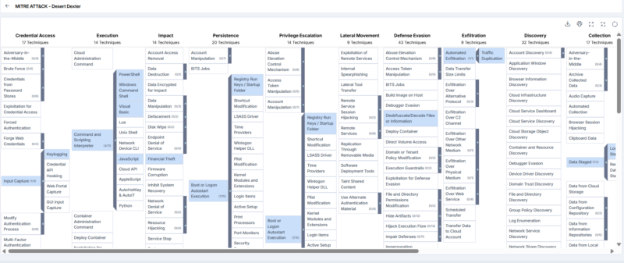
Desert Dexter Group MITRE ATT&CK (Source: Cyble Vision)
- Spearphishing Link (T1566.002): Malicious links in spearphishing emails exploit browser vulnerabilities or OAuth 2.0 to steal access tokens and infect systems.
- PowerShell (T1059.001): PowerShell used for executing malicious commands and downloading payloads, often in memory to avoid detection.
- Windows Command Shell (T1059.003): Attackers use cmd for system commands or running remote commands.
- Visual Basic (T1059.005): VBScript and VBA used in documents to execute malicious code.
- JavaScript (T1059.007): Malicious scripts executed through JavaScript in web pages or after initial access.
- Malicious File (T1204.002): Malicious files delivered via email require user interaction to execute.
- Registry Run Keys / Startup Folder (T1547.001): Malware persists through registry or startup folder entries to run at login.
- Registry Run Keys / Startup Folder (T1547.001): Adversaries escalate privileges by adding malicious programs to run at login.
- Deobfuscate/Decode Files (T1140): Adversaries decode or reconstruct obfuscated malicious files to evade detection.
- Reflective Code Loading (T1620): Payloads loaded directly into memory to avoid file-based detection.
- Keylogging (T1056.001): Keylogging captures keystrokes to gather credentials, using methods like API hooks, hardware buffer reading, and registry modifications.
- Keylogging (T1056.001): Used to capture sensitive information, including credentials.
- Local Data Staging (T1074.001): Data staged on local systems for exfiltration.
- Screen Capture (T1113): Screenshots taken to collect information post-compromise.