Overview
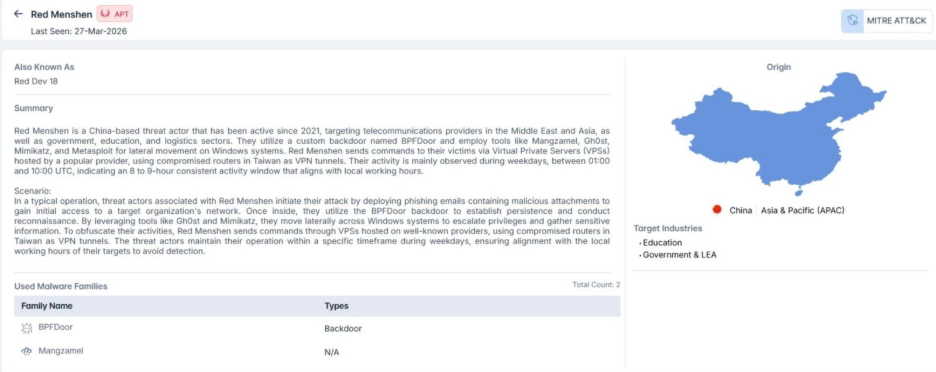
Red Menshen is a China-based cyber threat actor that has been active since 2021, primarily targeting telecommunications providers across the Middle East and Asia, as well as organizations within government, education, and logistics sectors. While presenting as a regional espionage operator, evidence suggests a highly structured and technically capable group that relies on a combination of custom malware, commercial penetration tools, and carefully timed operational windows to minimize detection.
The group’s hallmark is its custom backdoor, BPFDoor, which enables covert communication with command-and-control (C2) servers over TCP, UDP, and ICMP protocols. In addition to BPFDoor, Red Menshen leverages tools including Mangzamel, Gh0st, Mimikatz, and Metasploit to navigate Windows networks, escalate privileges, and conduct lateral movement. Operations are routed through Virtual Private Servers (VPSs) hosted by mainstream providers, with compromised routers in Taiwan functioning as VPN tunnels, allowing attackers to mask the origin of activity.
Red Menshen exhibits a distinct operational cadence, with attacks predominantly occurring on weekdays between 01:00 and 10:00 UTC. This schedule suggests deliberate alignment with the local working hours of its targets, enhancing stealth and persistence.
Operational Scenario
A typical Red Menshen campaign begins with phishing emails containing malicious attachments designed to gain initial access to a target network. Once the malware is delivered, BPFDoor establishes persistent access, allowing attackers to perform reconnaissance within the network. Using tools such as Gh0st and Mimikatz, the group moves laterally across Windows systems, escalates privileges, and harvests sensitive information.
To conceal its activity, Red Menshen routes commands through VPS infrastructure, with traffic often tunneled via compromised Taiwanese routers. This approach ensures the group maintains a low profile while maintaining consistent operational timing within their defined weekday window. Such precise coordination highlights both operational discipline and a strategic focus on avoiding detection.
Origin and Targeting
Red Menshen, operating from China and the Asia-Pacific (APAC) region, primarily targets organizations in education, government, and law enforcement agencies (LEA), as well as logistics and telecommunications.
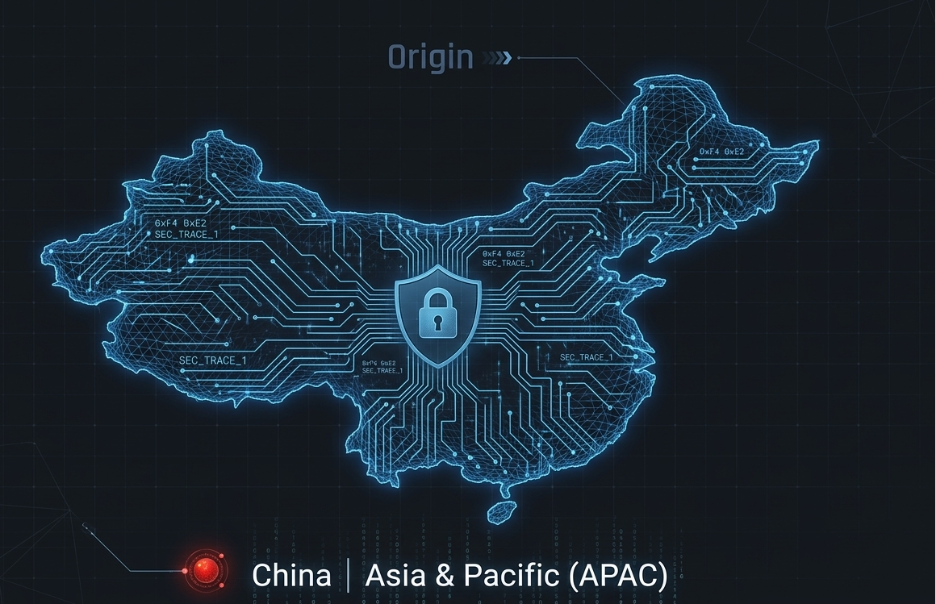
Their operations reflect strategic geopolitical interests, focusing on critical infrastructure across the Middle East and Asia, particularly in countries such as Saudi Arabia and Kuwait, and prioritizing sectors where access to sensitive data or the ability to disrupt operations could yield a significant strategic advantage.
Malware and Tooling

BPFDoor (Backdoor)
A passive backdoor enabling persistent remote access and control over compromised systems. BPFDoor can communicate via multiple protocols (TCP, UDP, ICMP), allowing attackers to issue commands, exfiltrate data, and perform further operations stealthily. Its deployment is commonly achieved through spear-phishing emails containing malicious attachments.
Mangzamel
A cyber espionage tool associated with Red Menshen is targeting organizations in the Middle East. Mangzamel is primarily used for maintaining persistence and exfiltrating sensitive information from high-value targets. Its deployment often leverages tailored phishing campaigns and exploits vulnerabilities within corporate networks.
Additional Tools
- Gh0st: Remote administration tool enabling network reconnaissance and command execution.
- Mimikatz: Credential harvesting and privilege escalation on Windows systems.
- Metasploit: Exploit framework used for initial access, post-exploitation, and lateral movement.
Tactics, Techniques, and Procedures (TTPs)
Red Menshen’s operations are highly organized and carefully planned, reflecting a methodical approach to cyber intrusion. The group executes commands across different systems and platforms, often using built-in tools and scripts to move through networks and gain access to sensitive information.
They maintain long-term access to compromised systems by concealing their activities and exploiting weaknesses in network management. The group also harvests credentials and takes advantage of remote services to extend its presence within targeted organizations.
Their activity is deliberately timed to align with local working hours on weekdays, reducing the chances of detection while carrying out their campaigns.
Strategic Assessment
Red Menshen exemplifies a cyber espionage actor blending technical sophistication with operational discipline. Their use of custom malware, commercial exploitation tools, and obfuscated communication channels indicates a high level of technical expertise. Operations are carefully timed and geographically targeted, focusing on sectors and regions where disruption or intelligence gain is of strategic value.
The group’s methodology demonstrates resilience and stealth, including multi-layered obfuscation and precise timing, making detection and mitigation challenging for standard cybersecurity defenses. Their ability to combine persistent access, credential harvesting, and covert communication channels suggests they are likely supported by an organized infrastructure capable of sustained operations.
Conclusion
Red Menshen continues to be a persistent cyber threat, targeting telecommunications, government, education, and logistics sectors across the Middle East and Asia. The group conducts espionage, deploys targeted malware, and exploits network vulnerabilities to gain access to sensitive information and disrupt operations.
Organizations can enhance their defenses by leveraging Cyble’s AI-powered threat intelligence platform, which provides real-time monitoring, predictive insights, and automated response to emerging threats.
With Cyble, security teams can track threat actors like Red Menshen, detect malicious activity, and act decisively to mitigate risk. Schedule a personalized demo with Cyble today to strengthen your cybersecurity posture and stay ahead of modern cyber threats like Red Menshen.
Recommendations and Mitigation Strategies
- Implement Email Security Controls: Deploy advanced email filtering and anti-phishing solutions to detect and block malicious attachments and links commonly used by Red Menshen.
- Enforce Multi-Factor Authentication (MFA): Require MFA across all accounts and administrative access points to prevent unauthorized access even if credentials are compromised.
- Regularly Update and Patch Systems: Ensure operating systems, applications, and network devices are up to date to mitigate exploitation via known vulnerabilities.
- Network Segmentation: Separate critical systems and sensitive data from general user networks to limit lateral movement in case of a breach.
- Endpoint Protection and Monitoring: Use endpoint detection and response (EDR) tools to identify suspicious behavior, unauthorized scripts, or unusual system activity.
- Credential Management: Monitor and rotate privileged credentials regularly; detect unauthorized use of administrative tools and credential harvesting attempts.
- Secure Remote Access: Restrict and monitor the use of remote management tools and VPNs, ensuring all external connections are logged and verified.
- Traffic and Anomaly Monitoring: Continuously analyze network traffic for abnormal patterns, including unexpected use of TCP, UDP, or ICMP, which could indicate backdoor activity.
- Incident Response Planning: Develop and test incident response plans, including procedures for rapid isolation, investigation, and remediation of compromised systems.
- Leverage Threat Intelligence: Integrate platforms like Cyble to gain real-time insights into Red Menshen activity, detect emerging threats, and proactively respond before attacks escalate.
MITRE ATT&CK Techniques Associated with Red Menshen
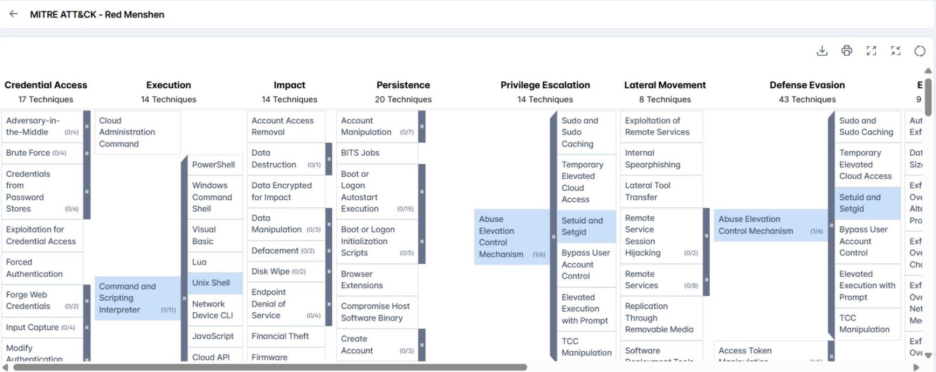
- Command and Scripting Interpreter (T1059 | Execution): Used PowerShell, Windows Command Shell, Unix shells, Python, JavaScript, or Visual Basic to execute commands and scripts. Supported execution through malicious email attachments, C2-delivered scripts, interactive shells, and remote services.
- Unix Shell (T1059.004 | Execution): Leveraged Unix shell commands on Linux and macOS to run sequential scripts, automate repetitive tasks, and deploy payloads. Used SSH and interactive shells for lateral movement and persistence.
- Native API (T1106 | Execution): Interacted with system APIs and syscalls to execute binaries, scripts, and processes. Utilized frameworks like .NET and Cocoa for higher-level abstraction, and used direct or indirect assembly calls to bypass security monitoring.
- Traffic Signaling (T1205 | Persistence): Employed crafted network sequences to trigger hidden ports or malicious functions. Used magic packet sequences to activate backdoors, manipulate malware modules, or wake offline systems via Wake-on-LAN.
- Socket Filters (T1205.002 | Persistence): Installed filters on network sockets to monitor traffic and activate backdoors or reverse shells. Deployed on Unix-like systems via libpcap and on Windows via Winpcap. Allowed stealthy command execution triggered by crafted packets.
- Abuse Elevation Control Mechanism (T1548 | Privilege Escalation): Circumvented native OS controls to gain higher-level permissions. Exploited system elevation mechanisms to execute privileged commands and escalate access across systems.