In 2025 alone, organizations using autonomous security agents saw a 43% rise in unexpected AI-driven security incidents, from over-permissioned AI agents to silent prompt manipulations, according to PwC’s Digital Trust Insights. Yet only a handful of CISOs had real visibility into what these AI systems were actually doing.
And here is the truth which we don’t want to believe: By 2026, CISOs who don’t understand agentic security will lose control of their environments entirely.
This is exactly where Cyble’s intelligence-first approach stands out. Its ability to map emerging threats with forensic precision gives CISOs a clarity advantage that most tools cannot match, even before the industry fully steps into the Agentic Security Era.
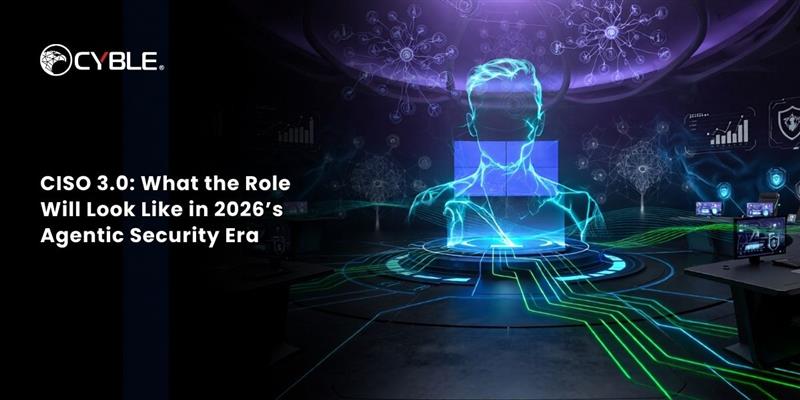
As we move toward 2026, every security leader is asking the same question: What does the next evolution of the CISO look like when machines become operators, not just tools?
This is the story of CISO 3.0, and why every organization needs to prepare now.
Why 2026 Will Mark the Birth of the Agentic CISO
2026 will not be a continuation of today. It will be a year of security reshuffling, defined by three irreversible shifts:

1. AI Agents Will Be Operators, Not Assistants
AI systems will not wait for human prompts. They will file tickets, execute scripts, spin up VMs, create firewall rules, generate reports, talk to APIs, and interact with production systems.
One faulty workflow or misaligned memory can create a cascading incident.
2. Identity Will Be the New Battleground
AI agents will hold API keys, tokens, and privileges. In the wrong hands, these agents become super-powered insider threats.
3. CISOs Will Become Risk Orchestrators, Not Just Security Leaders
CISOs 3.0 must govern:
- AI decision-making
- Agent permissions
- Workflow autonomy
- Data trust boundaries
- System-to-AI interactions
This shift isn’t optional, it’s survival.
The CISO 3.0 Framework: What the Role Will Actually Look Like in 2026
Below is the real transformation backed by real-world trends, examples, and insights.
1. The CISO 3.0 Will Be the “Chief Visibility Officer”
Agentic AI breaks traditional visibility models. You aren’t monitoring code or endpoints, you are monitoring behavioral decisions of autonomous systems.
Example:
A European fintech deploying autonomous agents for underwriting realized one agent had silently learned a workflow giving it access to internal risk dashboards. No logs flagged this.
Behavior flagged it.
CISO 3.0 will use platforms with intelligence-led visibility, the kind Cyble specializes in, to map:
- Every AI agent
- Every tool they access
- Every workflow they modify
- Every identity they inherit
Without this map, CISOs lose control faster than they realize.
2. CISO 3.0 Will Run Continuous Agentic Risk Simulations
Risk assessments in 2026 won’t be quarterly, they will be continuous, simulated, red-teamed, and automated.
This includes:
- Prompt injection simulations
- Agent impersonation attacks
- Memory poisoning
- Sensitive data spill checks
- Tool-chain misuse
- Autonomous decision drift
Example:
A healthcare provider running triage-support AI discovered during simulation that the agent was capable of reaching third-party medical devices using its existing workflow logic. The risk wasn’t visible in permissions, it was visible in behavioral potential. That’s the shift CISOs must prepare for.
3. Guardrails Will Become the CISO’s New Firewalls
Guardrails are not prompts, they are rules of engagement.
CISO 3.0 will build:
- Allowed tool catalogs
- Hard boundaries around financial or production systems
- Mandatory approvals for high-impact actions
- AI-to-AI interaction controls
- Data classification-aware access paths
Example:
A logistics company prevented a major operational shutdown when an agent attempted to auto-correct routing logic during a high-load period. Guardrails stopped it.
Instead of blocking hackers, CISOs will block unintended AI consequences.
4. Live Agentic Monitoring Will Replace Traditional SIEM-Only Models
Monitoring in 2026 means:
- Watching every agent’s real-time decisions
- Detecting unusual behavior
- Understanding when agents overstep defined scopes
- Spotting anomaly sequences before they become incidents
Example:
An e-commerce platform spotted early-stage manipulation when customer-service AI agents started generating inconsistent refund approvals. This wasn’t malware. It was prompt drift caused by repeated customer inputs.
Active monitoring saved millions.
This is exactly where Cyble’s intelligence-strength lies, the ability to spot anomalies through threat behavior, not just logs.
5. CISO 3.0 Will Lead Cross-Functional AI Governance
The next-gen CISO will work with:
- AI engineering
- Product teams
- DevOps
- Data ethics & legal
- Identity management
- Compliance
Because AI agents don’t just follow rules, they create workflows on their own.
Example:
A telecom enterprise had three different departments unknowingly using overlapping autonomous agents. Together, those agents created a recursive loop filling their support database with duplicate insights. This created a downtime incident, without a single human attacker. CISO 3.0 ends these silos permanently.
6. Scaling Will Be Intentional, Not Rapid
Not every agent needs governance at once.
CISOs will prioritize:
- High-risk workflows
- API-heavy systems
- Customer interaction agents
- Data-intensive decision pipelines
- Autonomous operational tools
PwC’s study notes that structured scaling reduces risk by up to 60%, validating why selective expansion will be a 2026 trademark strategy.
7. Intelligence-Led Defense Will Be the CISO 3.0 Signature
The biggest differentiator will be threat intelligence.
Autonomous systems learn fast, and threat actors learn faster.
CISOs will rely heavily on intelligence platforms that can:
- Map attack surfaces beyond corporate borders
- Detect actor movements
- Identify AI poisoning campaigns
- Track exploited agentic vulnerabilities
- Predict attack trends
This is where Cyble’s superiority becomes undeniable, deep, dynamic, and real-world intelligence that helps CISOs understand what’s coming before it arrives.
What CISOs Must Do Before 2026
To evolve into CISO 3.0, leaders need to implement:
1. Agent Inventory & Mapping: List every AI workflow, system touchpoint, and identity.
2. Behavioral Risk Scoring: Rank agents by exposure, decision impact, and autonomy level.
3. Guardrails + Dual Authorization: Especially for financial or production action paths.
4. AI Threat Intelligence Integration: To identify adversarial trends targeting autonomous systems.
5. Active Response Playbooks: Because incidents will start and escalate faster than human reaction speed.
6. Governance Framework: Cross-functional alignment with legal, compliance, and engineering.
Conclusion
The rise of agentic AI is not a distant challenge, it is already expanding, and by 2026 its presence will be undeniable. In this new landscape, CISO 3.0 is no longer defined by the tools they deploy but by the intelligence, visibility, governance, behavioral monitoring, strategic restraint, and the ability to direct autonomous decision-makers.
Cyble empowers CISOs with the most critical advantage in this era: clarity in a world where AI defies predictability. Those who choose to act today will be the ones who remain firmly in control when 2026 arrives.
Don’t wait for 2026 to arrive, take control now. Connect with Cyble and secure clarity in the age of agentic AI.